
Life, 1883-03-29 · page 6 of 16
Life — March 29, 1883 — page 6: what you’re looking at
What you’re looking at
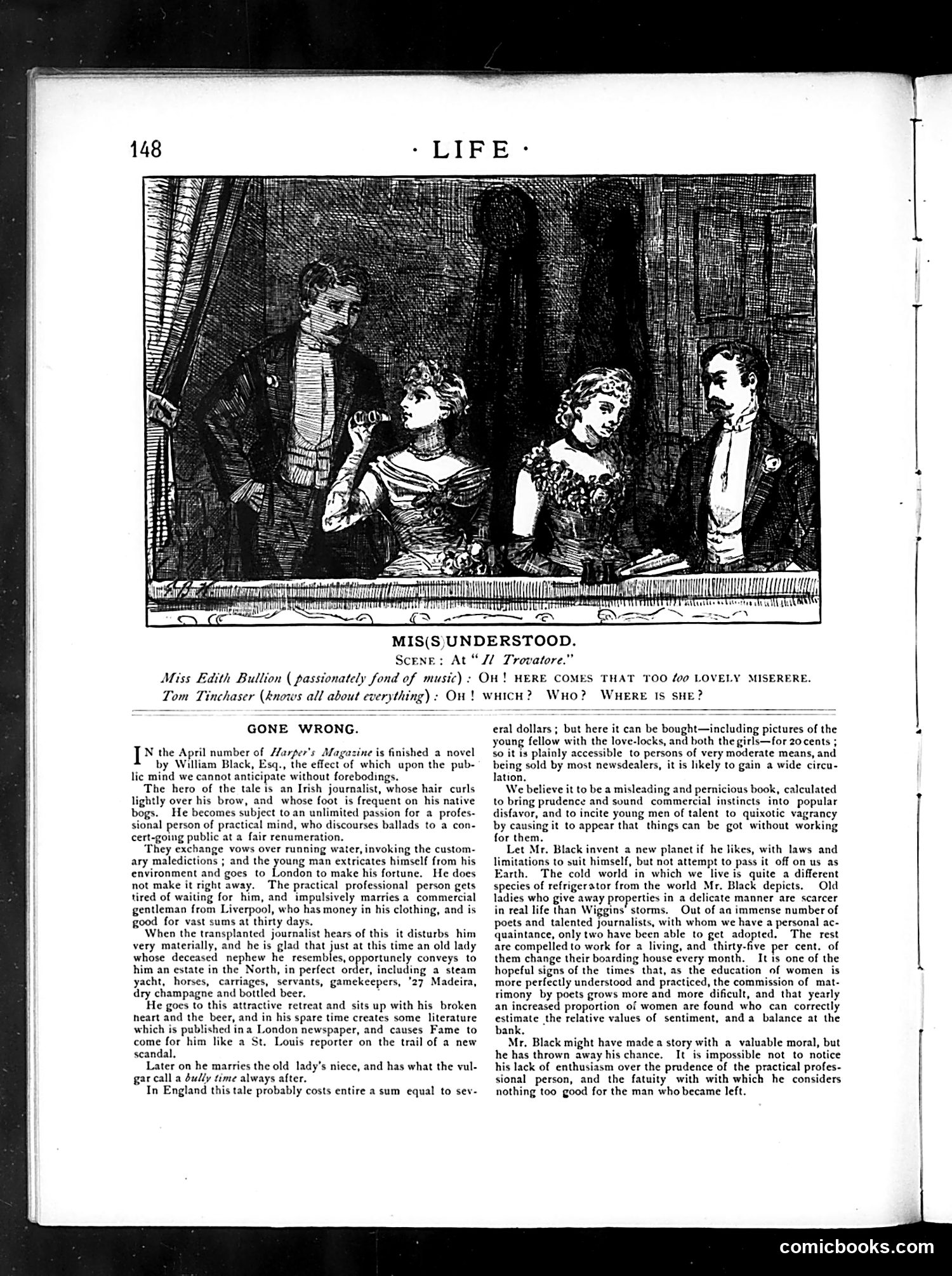
This page satirizes William Black's novel *Madcap*, critiquing what the reviewer calls a "misleading and pernicious book." The cartoon illustrates a scene from the plot: an Irish journalist protagonist becomes infatuated with a wealthy woman and impulsively marries a commercial gentleman from Liverpool instead—creating romantic chaos. The satire mocks Black's implausible storyline and his portrayal of female characters as incomprehensibly fickle. The reviewer argues the novel promotes "prudence" while actually glorifying "vagrant" behavior and poor decision-making. The title "Miss Understood" plays on the female characters' supposed inscrutability, suggesting the author fails to credibly depict women's motivations or psychology.
📄 Transcribed text from this page (OCR, searchable)
Machine-transcribed from the original scan — historical spelling and the odd misread are preserved.
Scene: At“ J! Trovator MIS(S)UNDERSTOOD. Miss Edith Bullion ( passionately fond of music): OW! HERE COMES THAT TOO 00 LOVELY MISERERE. Tom Tinchaser (knows all about everything): OH! wHicH? WHO? WHERE IS SHE? GONE WRONG. JN the April number of Harper's Magazine is finished a novel by William Black, Esq., the effect of which upon the pub- lic mind we cannot anticipate without forebodings. The hero of the tale is an Irish journalist, whose hair curls lightly over his brow, and whose foot is frequent on his native bogs. He becomes subject to an unlimited passion for a profes- sional person of practical mind, who discourses ballads to a con- cert-going public at a fair renumeration. They exchange vows over running water, invoking the custom- ary maledictions ; and the young man extricates himself from his environment and goes to London to make his fortune. He does not make it right away. The practical professional person gets tired of waiting for him, and impulsively marries a commercial gentleman from Liverpool, who has money in his clothing, and is good for vast sums at thirty days. When the transplanted journalist hears of this it disturbs him very materially, and he is glad that just at this time an old lady whose deceased nephew he resembles, 0 portunely conveys to him an estate in the North, in perfect order, including a steam yacht, horses, carriages, servants, gamekeepers, '27 Madeira, dry champagne and bottled beer, He goes to this attractive retreat and sits up with his broken heart and the beer, and in his spare time creates some literature which is published ina London newspaper, and causes Fame to come for him like a St, Louis reporter on the trail of a new scandal, Later on he marries the old lady’s niece, and has what the vul- garcall a dudly time always after. In England this tale probably costs entire a sum equal to sev- eral dollars ; but here it can be bought—including pictures of the young fellow with the love-locks, and both the girls—for 20 cents ; So it is plainly accessible to persons of very moderate means, and being sold by most newsdealers, it is likely to gain a wide circu- lation. We believe it to be a misleading and pernicious book, calculated to bring prudence and sound commercial instincts into popular disfavor, and to incite young men of talent to quixotic vagrancy by causing it to appear that things can be got without working for them. Let Mr. Black invent a new planet if he likes, with laws and limitations to suit himself, but not attempt to pass it off on us as Earth. The cold world in which we live is quite a different species of refrigerator from the world Mr. Black depicts. Old ladies who give away properties in a delicate manner are scarcer in real life than Wiggins’ storms. Out of an immense number of poets and talented journalists, with whom we have a personal ac- quaintance, only two have been able to get adopted. The rest are compelled to work for a living, and thirty-five per cent. of them change their boarding house every month. It is one of the hopeful signs of the times that, as the education of women is more perfectly understood and practiced, the commission of mat- rimony by poets grows more and more dificult, and that yearly an increased proportion of women are found who can correctly estimate the relative values of sentiment, anda balance at the bank, Mr, Black might have made a story with a valuable moral, but he has thrown away his chance. It is impossible not to notice his lack of enthusiasm over the prudence of the practical profes- sional person, and the fatuity with with which he considers nothing too good for the man who became left. + comicbooks.com