
A complete issue · 16 pages · 1883
Life — February 8, 1883
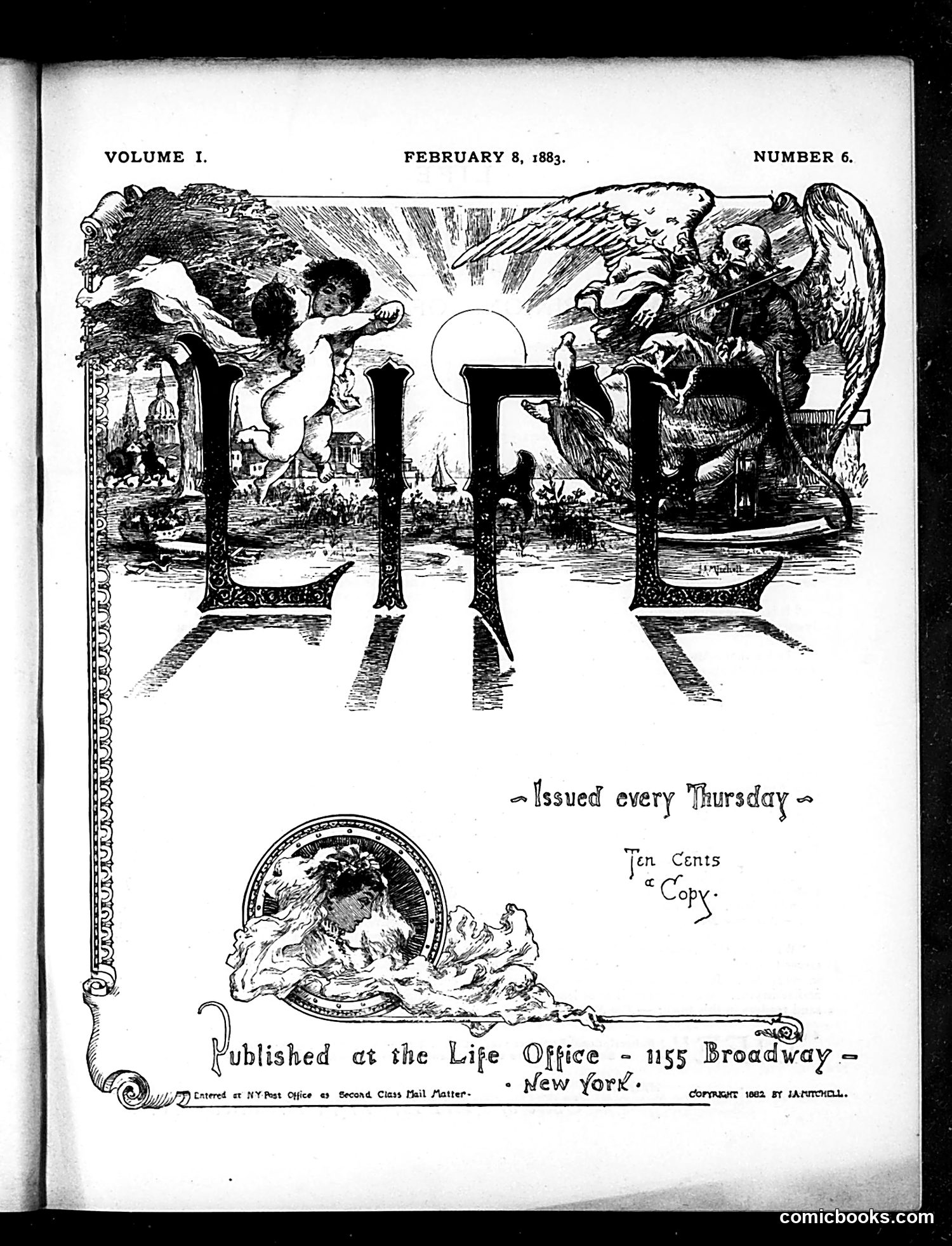
This is the cover of *Life* magazine's first volume, issue 6. The central image features the magazine's title "LIFE" in large ornamental letters, flanked by elaborate allegorical engravings. On the left appears a classical scene with cherubs and a cityscape; on the right, a winged figure (likely representing fate or fortune) presides over a landscape. The artwork is decorative rather than explicitly political. Below, the publication details indicate *Life* was issued weekly at ten cents per copy and published at 1155 Broadway in New York. The ornate Victorian-style illustrations and design reflect the aesthetic conventions of 1880s American periodicals, emphasizing the magazine's literary and artistic aspirations.
This page is **advertising copy, not a cartoon**. It's a promotional article for *Life* magazine itself, presenting press reviews praising the publication. The quotes from various newspapers highlight *Life's* appeal: it's described as wholesome, charming, artistic, and literary. Critics praise its illustrations, typography, humor ("gentle and refined"), and satirical content aimed at educated readers. Several reviews note it's a new weekly publication that could become a leading humor magazine—potentially rivaling *Punch*. The page emphasizes *Life's* quality production values and refined comedic tone, distinguishing it from cruder competitors. The subscription information (10 cents per copy, $5 yearly) and New York office address appear at bottom. This is essentially promotional material, not political satire.
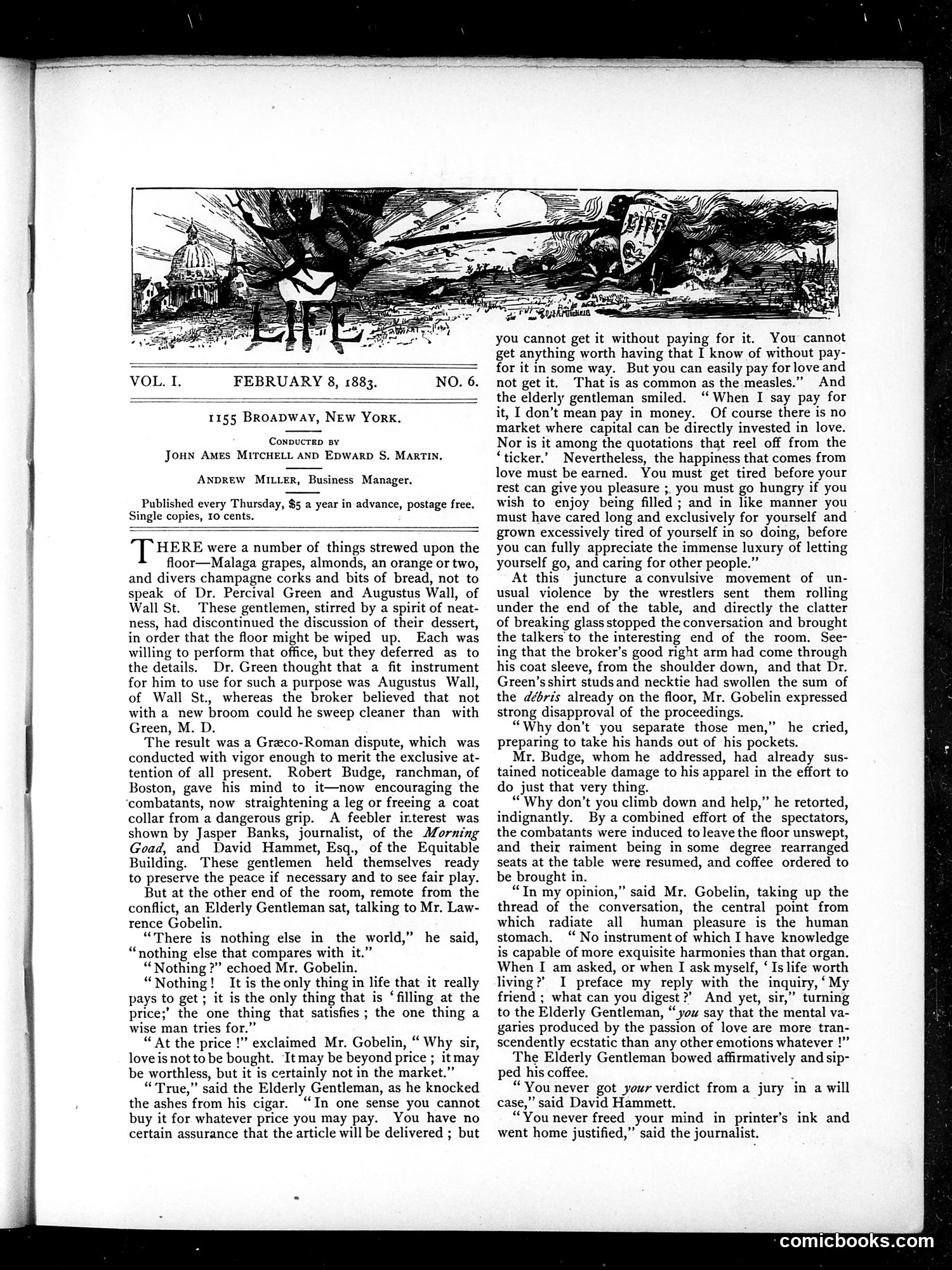
The masthead illustration depicts a chaotic scene with figures in conflict beneath a classical dome (likely the Capitol), with what appears to be a violent struggle occurring. The exact identities of the figures are unclear from the image alone. The page's main text is a dialogue-based satirical piece discussing love, pleasure, and human nature—specifically debating whether happiness can be "bought" or must be earned. The speakers include gentlemen identified as Mr. Gobelin, Mr. Budget, David Hammet, and a journalist, discussing philosophy over a meal where breaking glass has interrupted their conversation. Without additional context about 1883 political events, the specific satirical targets of the masthead illustration remain unclear, though the violent imagery suggests commentary on political or social conflict of that era.
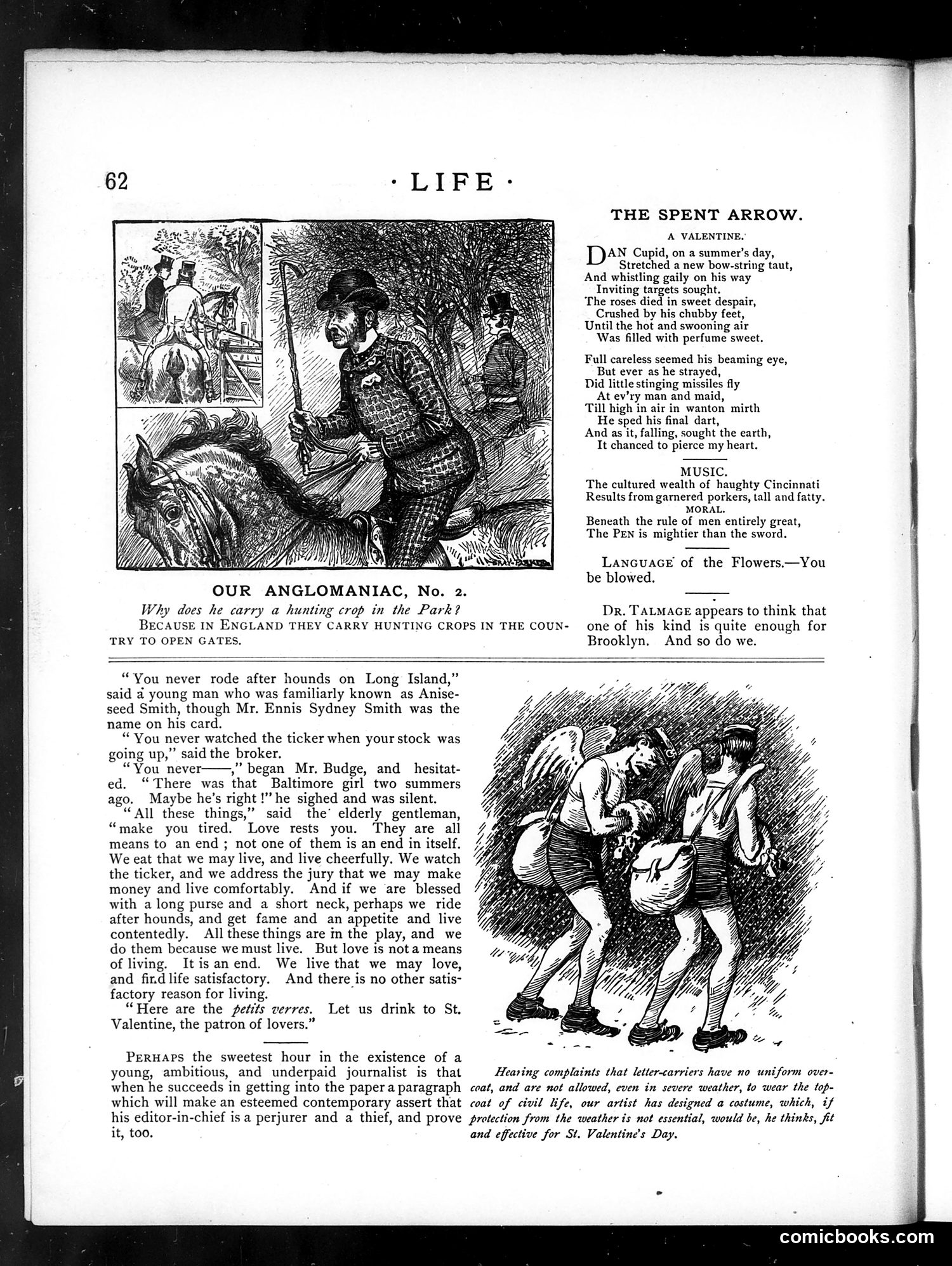
This cartoon satirizes an American who imitates English hunting traditions. The caption explains the joke: he carries a hunting crop in the park "because in England they carry hunting crops in the country to open gates." The figure is dressed in English hunting attire and appears pompous—the satire targets wealthy Americans who affectedly adopt British customs and mannerisms, a phenomenon the magazine calls "Anglomaniac" behavior. The humor lies in the absurdity of transplanting country hunting gear to urban park settings, suggesting pretension disconnected from practical purpose. This reflects late 19th-century American anxiety about wealthy elites' anglophilia and their perceived loss of distinct American identity through blind imitation of British upper-class conventions.
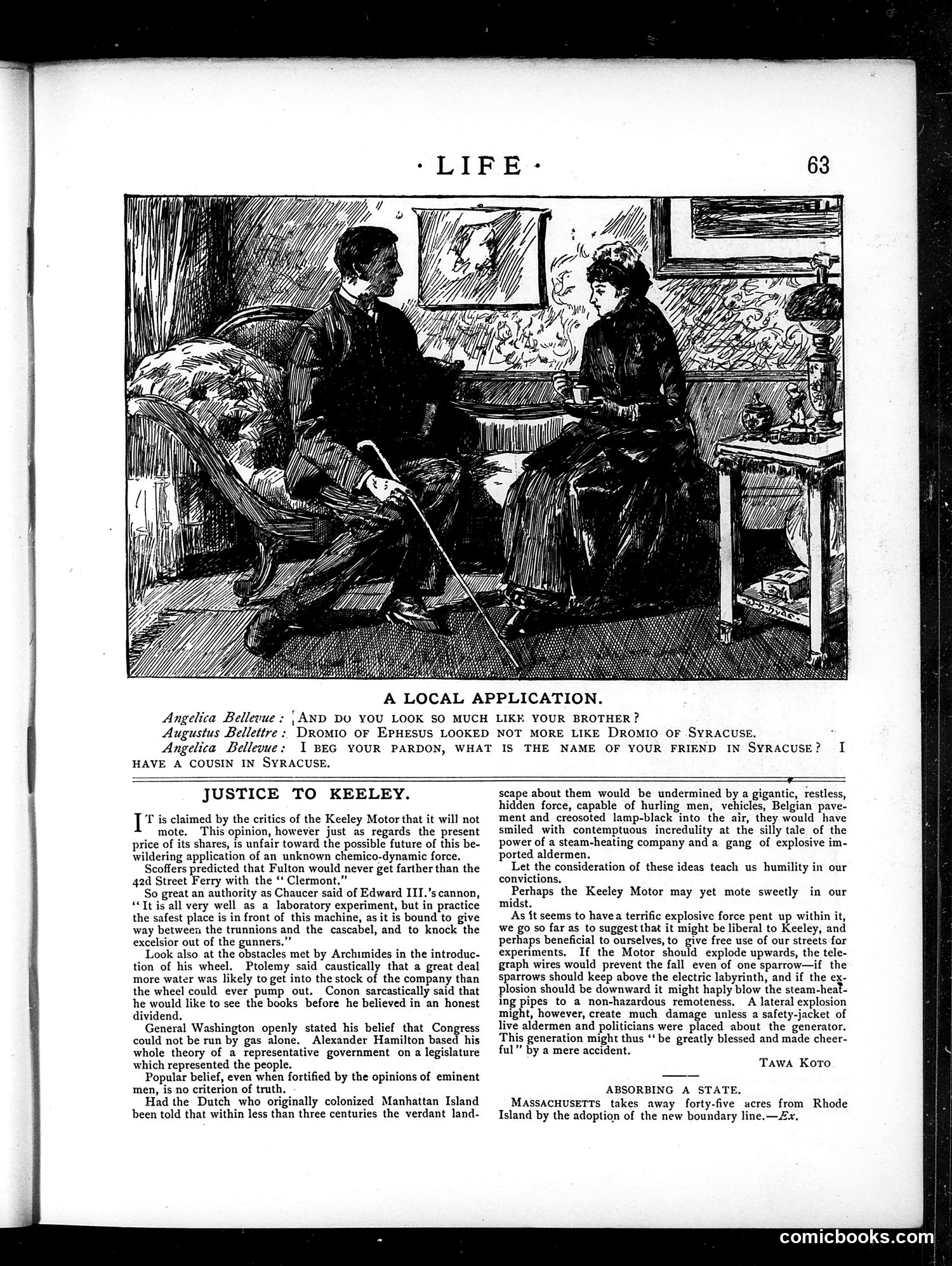
**The Cartoon "A Local Application":** This satirical sketch depicts two men in conversation. The dialogue references Syracuse and a person named Dromio, with one character claiming to have "a cousin in Syracuse." The humor appears to be a literary reference—likely to Shakespeare's "The Comedy of Errors," which features characters named Dromio in Syracuse. The joke seems to mock how people invoke obscure family connections or make literary allusions inappropriately in casual conversation. **The "Justice to Keeley" Article:** This lengthy editorial defends the Keeley Motor against critics' claims that it's impractical. The text discusses how the motor might theoretically work and debates whether it could safely power vehicles or require safety precautions. It references General Washington and Alexander Hamilton regarding representative government. The page combines humor with technical/political debate typical of Life's satirical approach.
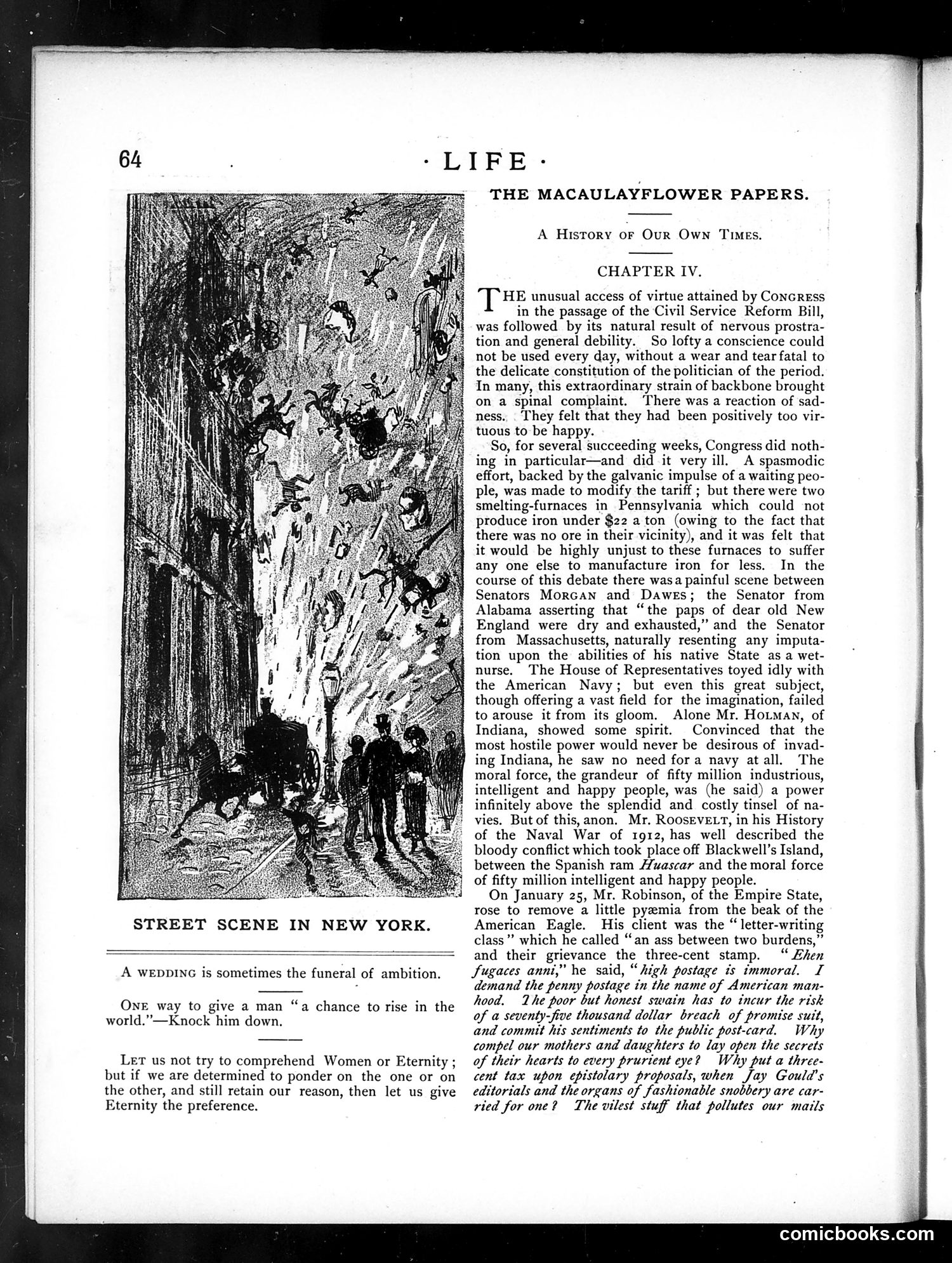
The page features "Street Scene in New York," an engraving depicting crowded urban chaos—figures packed densely on a street, some appearing distressed or struggling. The accompanying text discusses Congress's passage of the Civil Service Reform Bill, describing the political and physical toll on members. The satire suggests that virtue and reform efforts exhausted legislators so thoroughly they became ill. References to specific senators (Morgan, Dawes) debating tariffs and Pennsylvania iron production indicate this addresses 1880s-era protectionist trade debates. The cartoon likely illustrates urban overcrowding or social disorder contemporaneous with these political controversies, satirizing both congressional dysfunction and city life's chaotic conditions. The overall message appears critical of how reform efforts paradoxically weakened rather than strengthened the government.
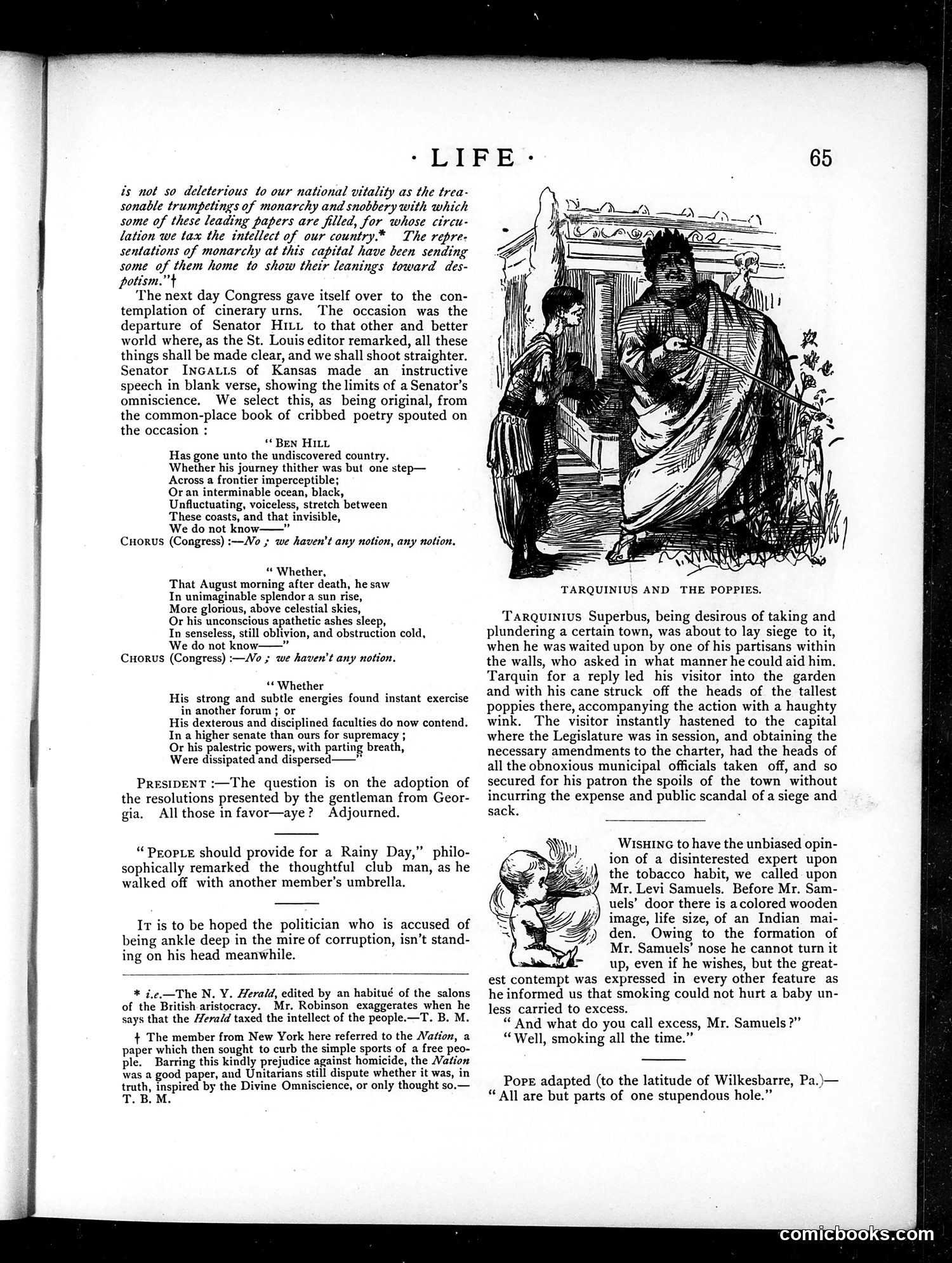
The main illustration, titled "Tarquinius and the Poppies," depicts a political allegory. A figure (likely representing a political leader) strikes off poppy heads with his cane while a visitor watches. The accompanying text explains this refers to Tarquin the Proud, a Roman tyrant who allegedly destroyed tall poppies—a metaphor for eliminating prominent citizens who threatened his power. The satire criticizes a contemporary politician (identity unclear from this page alone) for suppressing municipal officials and eliminating political opposition. The classical allusion suggests the cartoonist views these actions as tyrannical. Secondary content includes commentary on tobacco smoking habits and a quote from Pope mocking corruption ("all are but parts of one stupendous hole"). The page critiques abuse of political power through historical comparison.
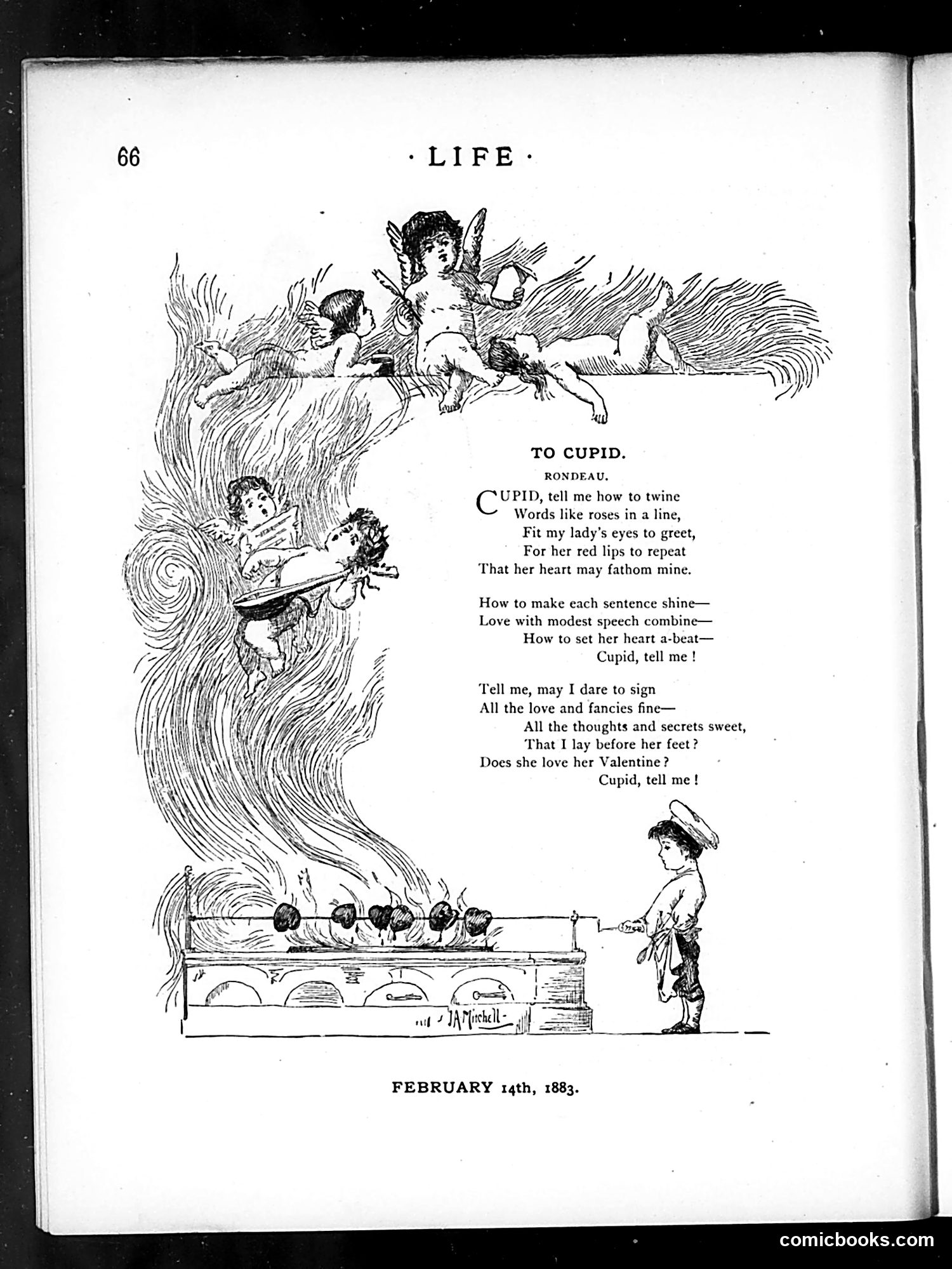
This Valentine's Day satirical poem mocks the conventions of romantic love letters and courtship. A young man (shown at bottom right) appeals to Cupid for help composing flowery declarations to win his lady's heart—requesting instruction on how to "make each sentence shine" and craft modest yet persuasive language. The joke lies in the contradiction: he's asking Cupid (the god of love, depicted above with cherubs) to teach him how to write *sincere* love poetry, when his request itself reveals his verses will be calculated artifice rather than genuine emotion. The elaborate illustration of Cupid among swirling clouds emphasizes the absurdity of expecting divine intervention for romantic authenticity.
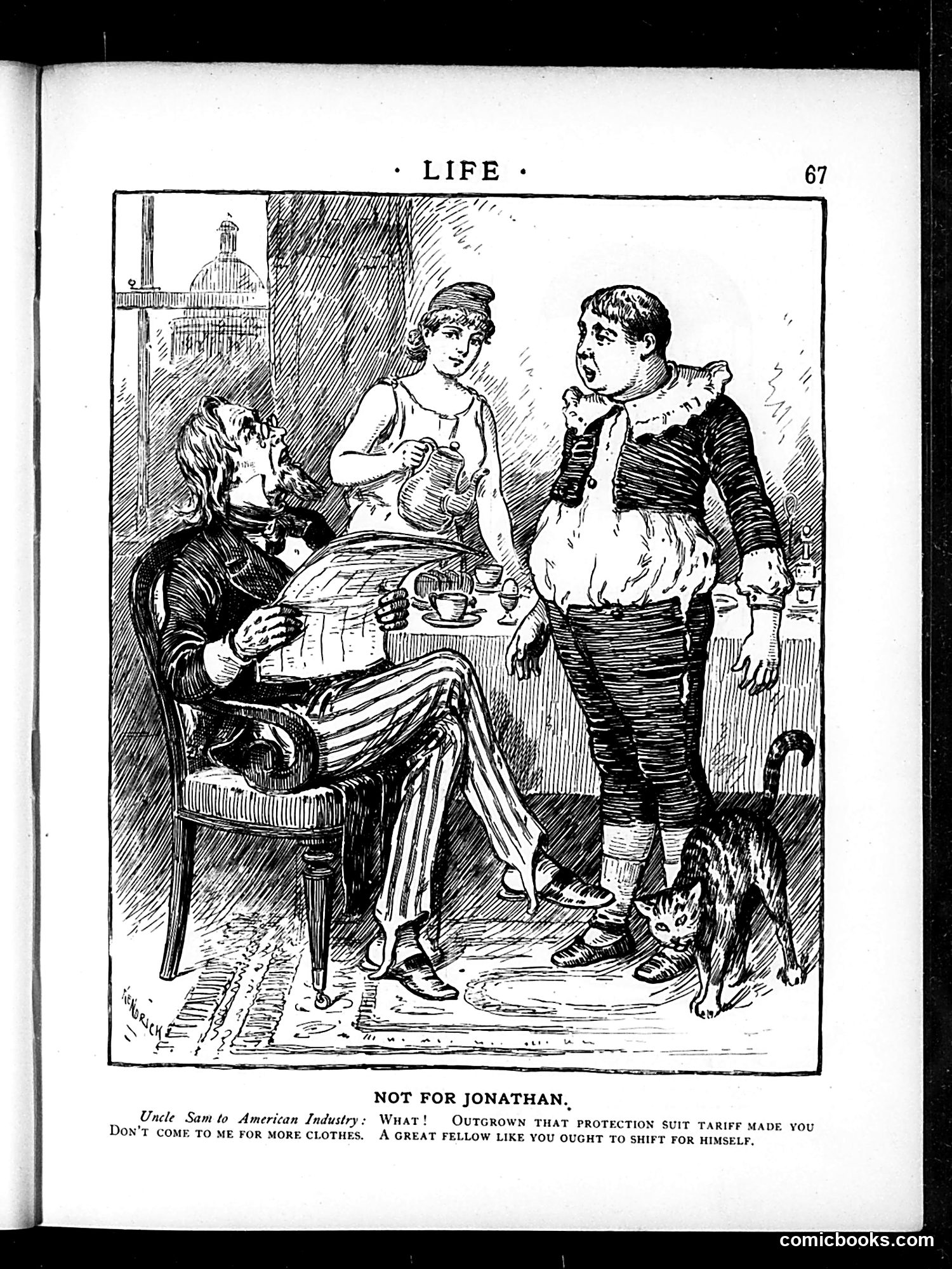
This cartoon satirizes American protectionist trade policy through a dialogue between "Uncle Sam" (representing American government/industry) and a portly industrialist. The industrialist complains that an "outgrown" protective tariff made him wealthy, yet now he refuses to "shift for himself"—meaning he won't compete without continued government protection. The satire suggests that American industrialists, having grown fat and complacent under tariff protection, have become dependent on government subsidies rather than competing fairly. "Jonathan" (likely referring to Jonathan Bull, a personification of Britain) would represent free trade principles or foreign competition. The cartoon criticizes American business leaders for demanding continued artificial protection instead of proving their competitiveness in open markets—a common Progressive Era critique of monopolistic corporate practices.
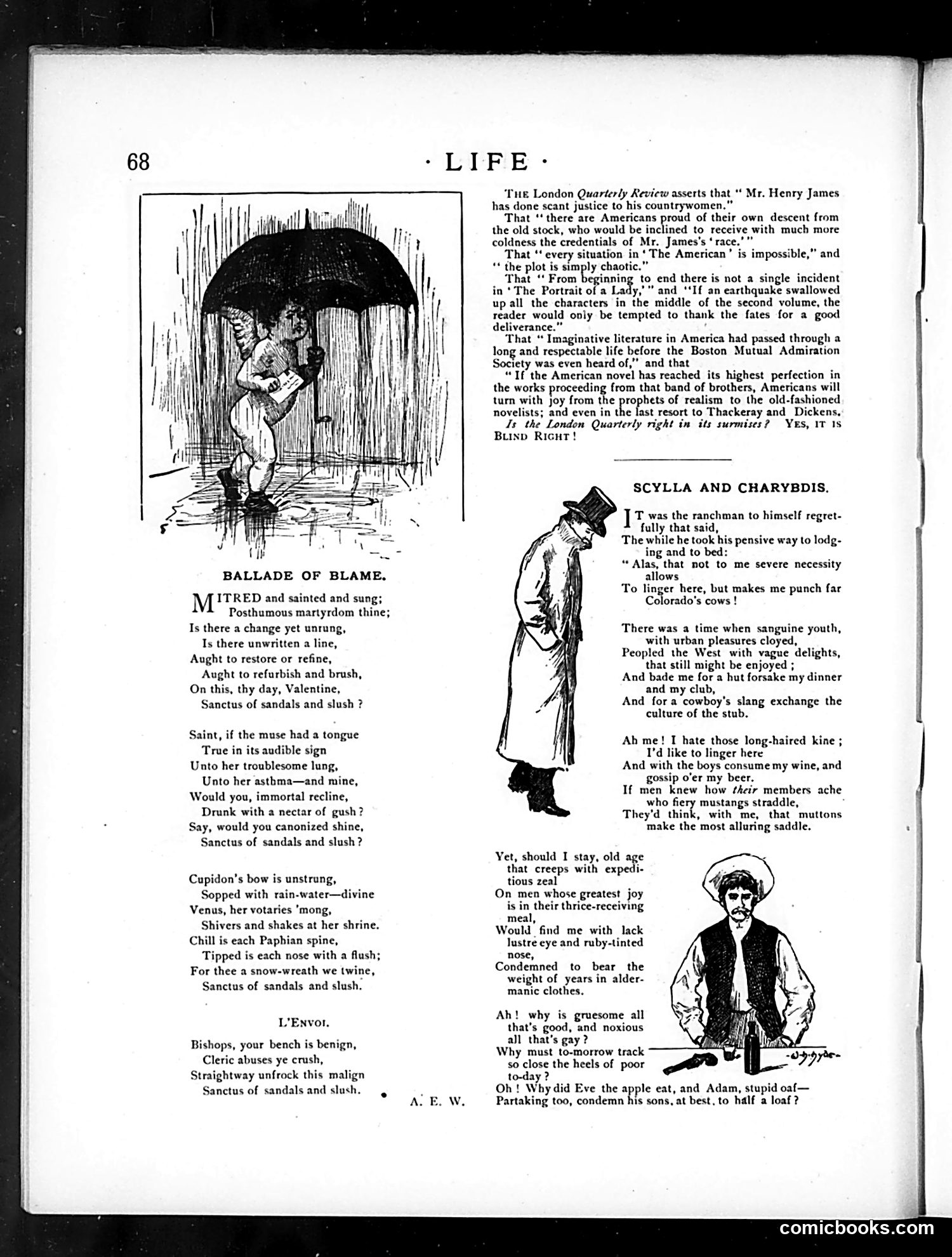
This page contains literary satire and poetry from *Life* magazine's commentary on American letters. **Top Section:** *Life* ridicules the *London Quarterly Review* for dismissing Henry James's novels about Americans. The magazine sarcastically agrees that James's works are "impossible" and "chaotic," then argues this proves American literature has reached "highest perfection"—the sarcasm implying James's critics are wrong and jealous of American literary achievement. **"Ballade of Blame":** A satirical poem attacking someone (likely a religious or political figure) called a "Saint" with "sandals and slush"—suggesting false piety masking incompetence or hypocrisy. The refrain mocks this sanctimonious pose. **"Scylla and Charybdis":** Humorous verse about a rancher torn between frontier life (which physically exhausts him) and urban leisure (which leads to aging and disgrace). The classical allusion to being trapped between two dangers reflects his impossible choice—a common satirical theme about American restlessness and social contradiction.
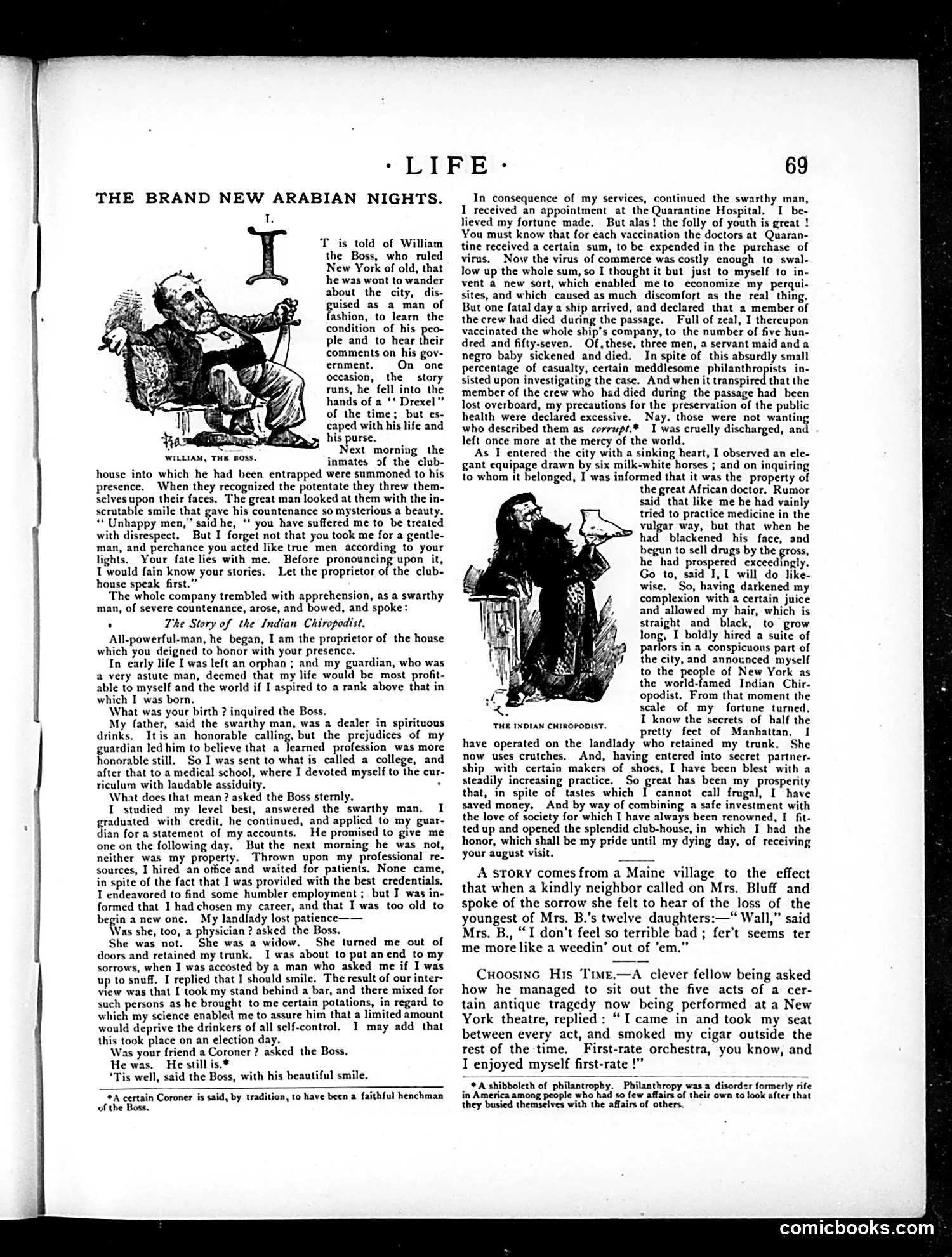
This satirical story mimics the *Arabian Nights* format to mock New York City's Tammany Hall political machine, likely under "Boss" William O'Brien or a similar corrupt Democratic boss of the Gilded Age. The tale ridicules how political patronage worked: a failed medical school graduate becomes successful only through connections to a Coroner (a political operative). The "Drexel" reference suggests a wealthy financier. The humor lies in the protagonist's "success"—he abandons medicine to tend bar for the Coroner, gets a cushy Quarantine Hospital job as political reward, and prospers through graft rather than merit. The satirical point: New York's political system rewarded loyalty and connections over education or ability. The "swarthy man's" transformation from respectable medical graduate to political operative exemplifies how Tammany Hall corrupted civic institutions and subverted honest advancement.
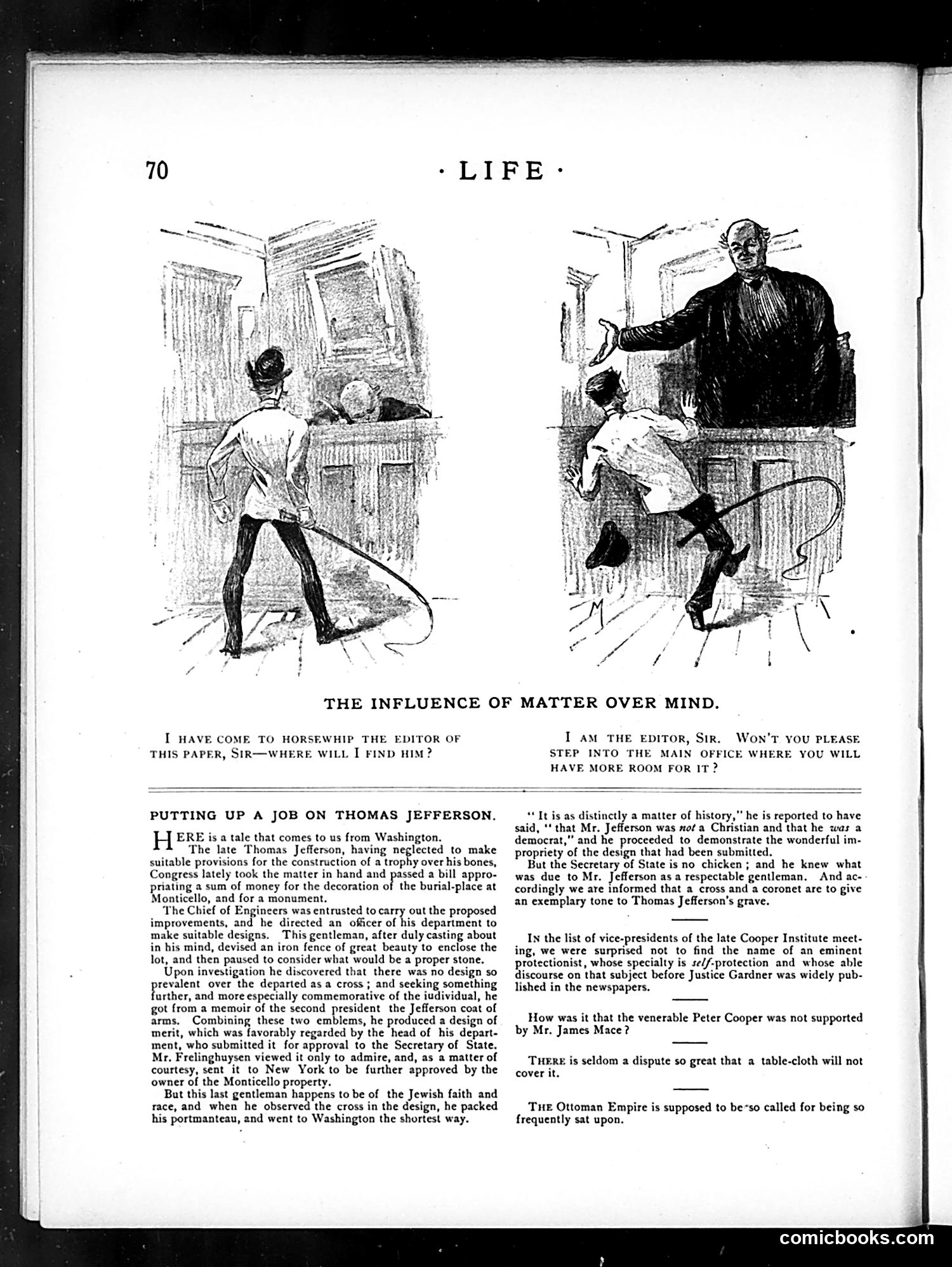
This two-panel cartoon satirizes how physical circumstances override rational discourse. The left panel shows someone arriving with a horsewhip to attack a newspaper editor. The right panel depicts the editor calmly redirecting the aggressor to a larger office—suggesting violence requires more space than the editor's current room. The accompanying text mocks a controversy over Thomas Jefferson's monument design. A government engineer proposed combining Jefferson's coat of arms with a Christian cross. The current owner of Monticello—described as a Jewish gentleman—objected that Jefferson was Christian and Democratic, making the design inappropriate. The satirical point: despite his logical argument about historical accuracy, the Jewish owner's protest was ignored, and the cross-and-coronet design proceeded anyway. The cartoon's title suggests that physical/material considerations (needing a bigger room for violence; a Christian cross on Jefferson's grave) overpower reasoned objection.
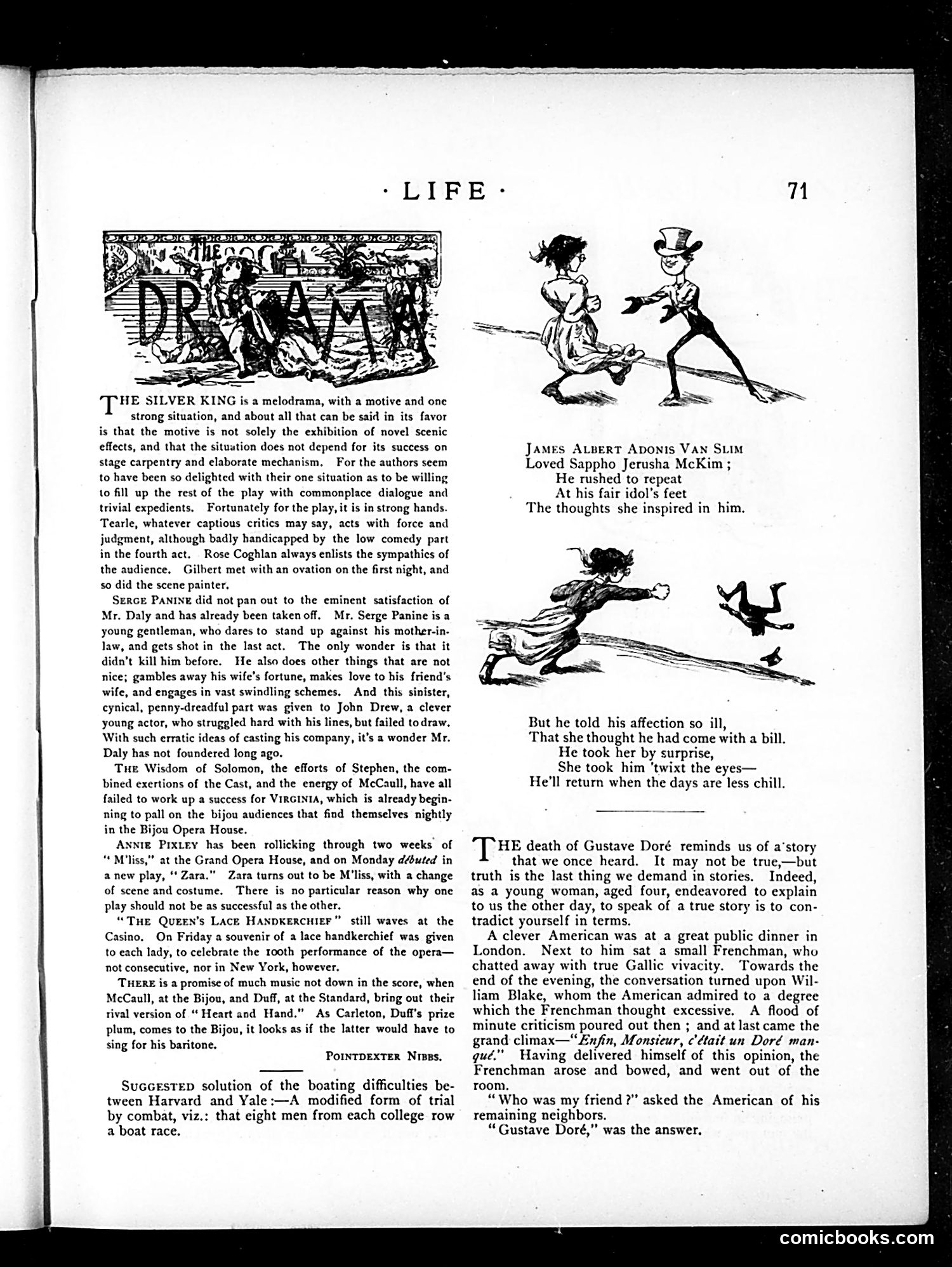
This page contains theater criticism and humorous verse from what appears to be a late 19th-century issue of Life magazine. The **main content** reviews several theatrical productions: "The Silver King" (praised for strong acting despite weak plotting), "Serge Panine" (criticized and already closed), "Virginia" (failing to attract audiences), and other operatic works. The critics praise certain performers like Rose Coghlan while questioning casting decisions. The **illustrations** are small comedic verses with accompanying drawings. One depicts a romantic mishap involving "James Albert Adonis Van Slim," a suitor whose passionate declaration of love is misinterpreted by his lady as a bill collector's visit—she punches him in the face. The humor lies in the contrast between his flowery romantic intentions and her violent practical response. At the bottom, there's a brief anecdote about the death of artist Gustave Doré, setting up a humorous story about an American and Frenchman at a London dinner (text cuts off).
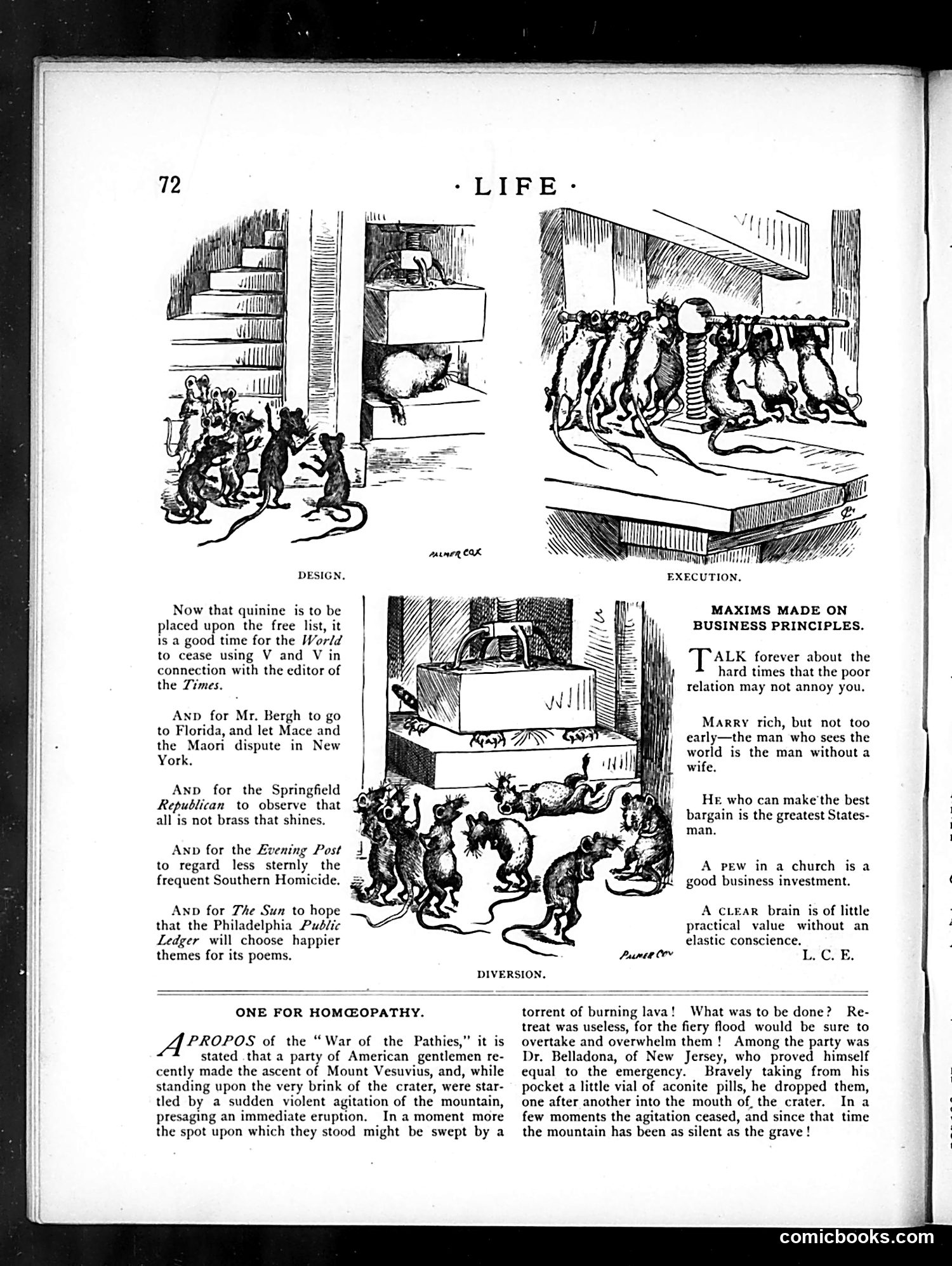
This page contains three satirical sections mocking contemporary issues and practices: **"Design" and "Execution"**: These cartoon vignettes (likely depicting monkeys or caricatured figures) comment on newspaper editorial hypocrisy. The text mockingly suggests various newspapers should change their stances—such as ceasing to use certain initials regarding the Times editor, or the Evening Post being less stern about Southern violence. The satire suggests editorial inconsistency. **"Maxims Made on Business Principles"**: Cynical aphorisms satirizing American commercial culture, suggesting materialism trumps ethics (marrying for money, viewing church attendance as investment, valuing profit over conscience). **"One for Homeopathy"**: A joke mocking homeopathic medicine. An American doctor supposedly stops Mount Vesuvius's eruption by dropping homeopathic aconite pills into the crater—absurdly suggesting homeopathy's tiny doses could affect a volcano, thereby ridiculing the medical practice's effectiveness. The page targets journalistic inconsistency, mercenary values, and pseudoscience through satirical humor typical of 19th-century Life magazine.
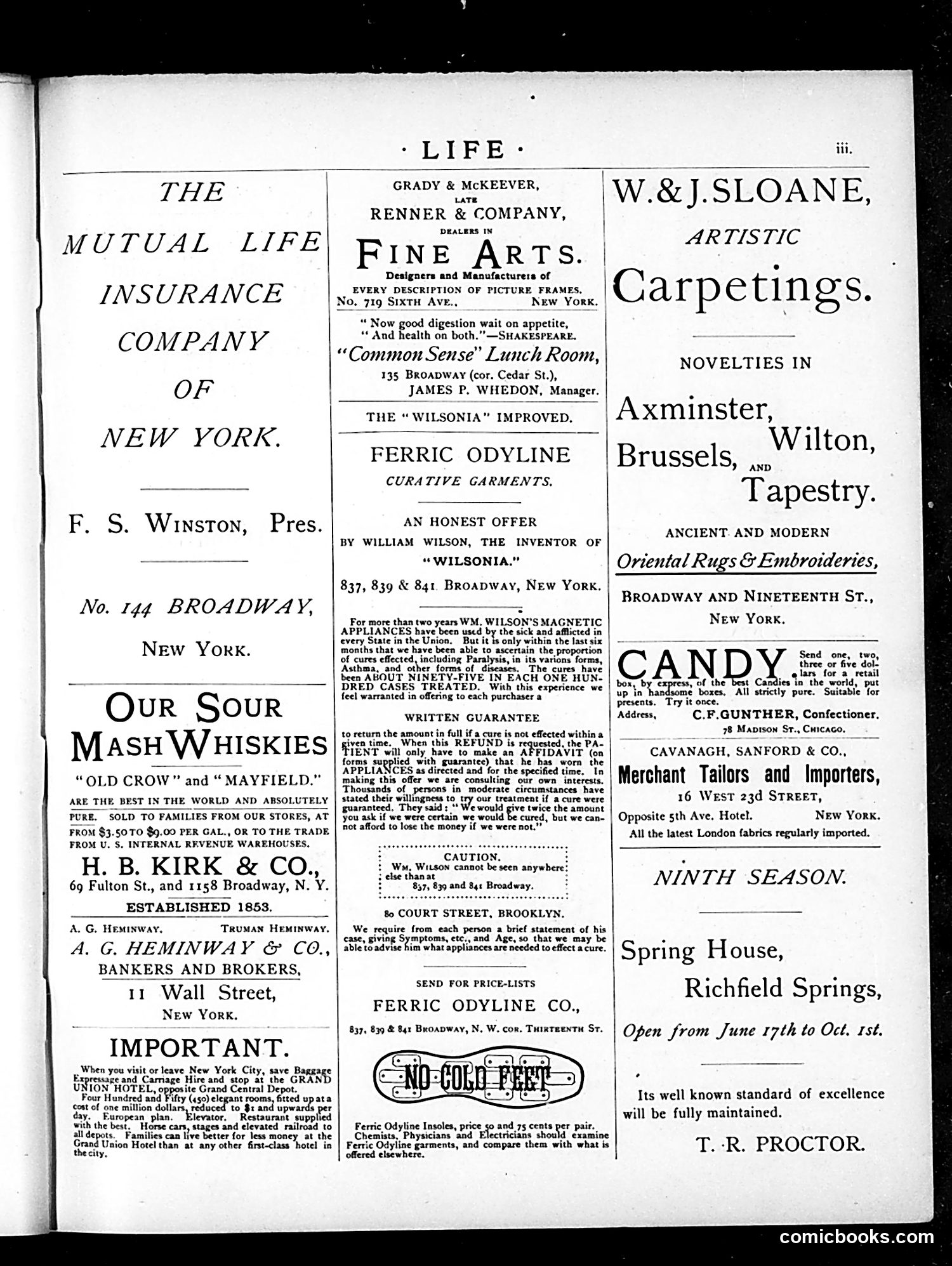
This page is primarily **advertising**, not political satire or cartooning. It's a typical page 3 from *Life* magazine featuring various commercial advertisements: insurance companies, whiskey, banks, hotels, picture frames, lunch rooms, and magnetic health devices. The only potentially satirical content is implicit in the "Ferric Odyline" magnetic garments ad. These devices claimed to cure nearly everything (paralysis, asthma, etc.) with a "95 out of 100" cure rate—an absurd medical claim typical of late 19th-century quack medicines. The elaborate guarantee ("wear these magnetic appliances or get your money back") mocks desperate patients while the actual product was almost certainly fraudulent. This represents *Life* magazine satirizing contemporary medical scams through placement rather than explicit ridicule.
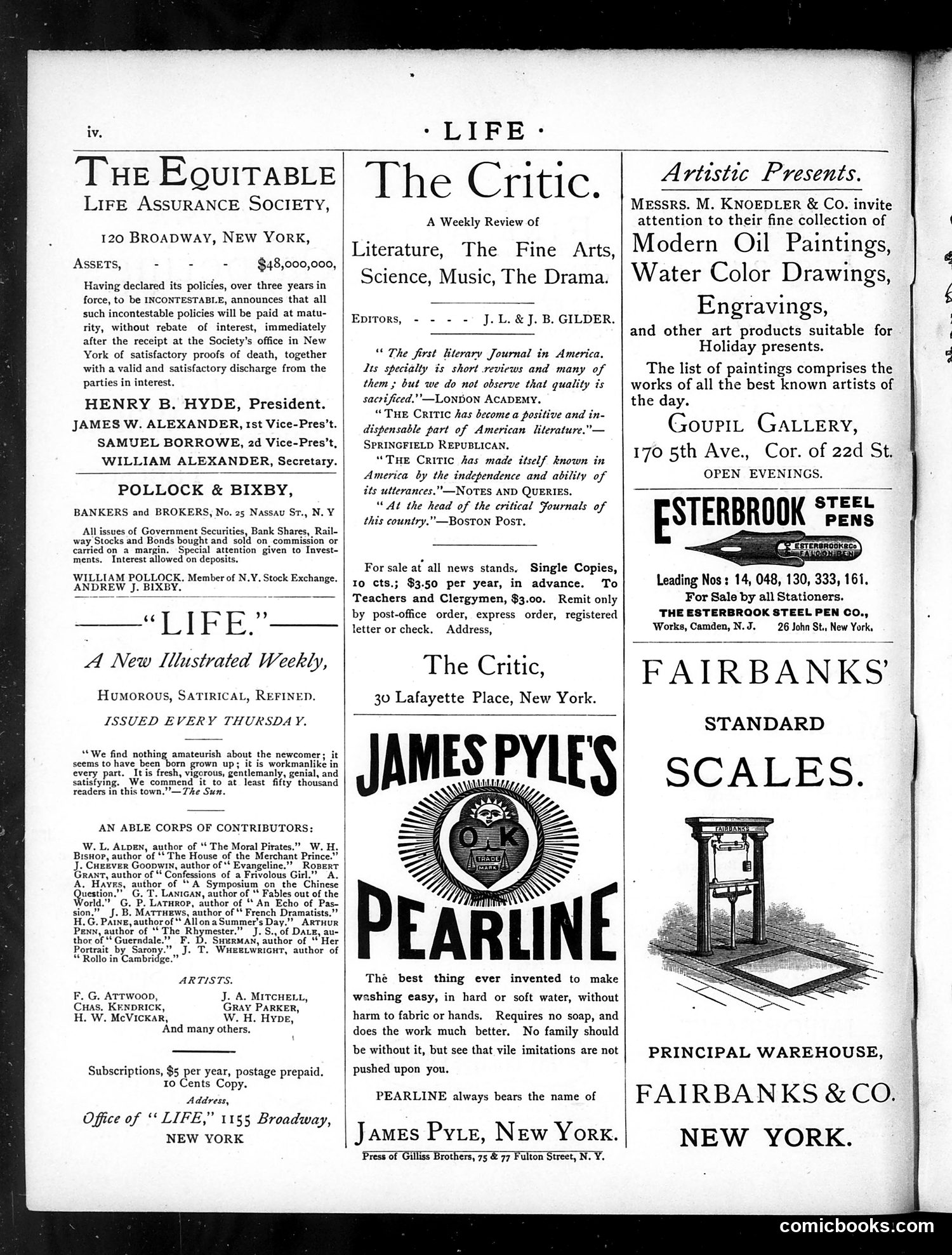
This is primarily an **advertising and masthead page** from Life magazine, not a political cartoon page. The page showcases Life itself—a new illustrated weekly described as "humorous, satirical, refined"—alongside advertisements and the magazine's masthead information. It lists Life's editors, contributors (including authors like Robert Grant and J.B. Matthews), and artists. The advertisements include financial services (Equitable Life Assurance, Pollock & Bixby bankers), consumer products (Pearline soap, Esterbrook pens, Fairbanks scales), and art galleries (Knoedler & Co., Goupil Gallery). The Critic, a competing literary review journal, also advertises here. Together, these ads and mastheads reflect the late 19th-century New York media and commercial landscape—showing what publications and products genteel readers were expected to patronize. No specific political satire or cartoon commentary is evident on this particular page.