
Life, 1883-02-08 · page 3 of 16
Life — February 8, 1883 — page 3: what you’re looking at
What you’re looking at
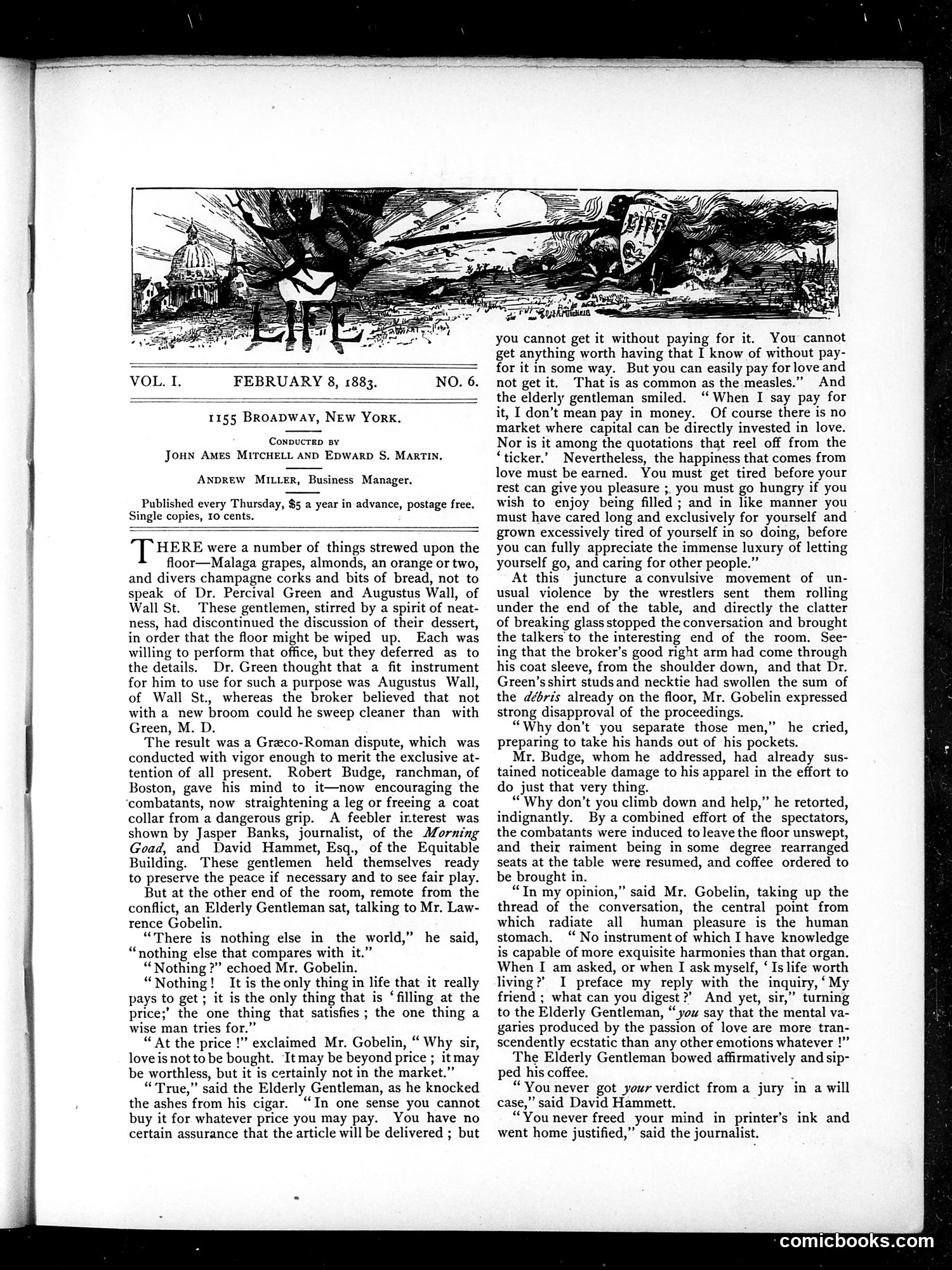
The masthead illustration depicts a chaotic scene with figures in conflict beneath a classical dome (likely the Capitol), with what appears to be a violent struggle occurring. The exact identities of the figures are unclear from the image alone. The page's main text is a dialogue-based satirical piece discussing love, pleasure, and human nature—specifically debating whether happiness can be "bought" or must be earned. The speakers include gentlemen identified as Mr. Gobelin, Mr. Budget, David Hammet, and a journalist, discussing philosophy over a meal where breaking glass has interrupted their conversation. Without additional context about 1883 political events, the specific satirical targets of the masthead illustration remain unclear, though the violent imagery suggests commentary on political or social conflict of that era.
📄 Transcribed text from this page (OCR, searchable)
Machine-transcribed from the original scan — historical spelling and the odd misread are preserved.
FEBRUARY 8, 1883. 1155 BROADWAY, New York. ConpucTED BY Joun AMEs MITCHELL AND Epwarp S. MARTIN. ANDREW MILLER, Business Manager. Published every Thursday, $5 a year in advance, postage free. Single copies, 10 cents. HERE were a number of things strewed upon the floor—Malaga grapes, almonds, an orange or two, and divers champagne corks and bits of bread, not to speak of Dr. Percival Green and Augustus Wall, of Wall St. These gentlemen, stirred by a spirit of neat- ness, had discontinued the discussion of their dessert, in order that the floor might be wiped up. Each was willing to perform that office, but they deferred as to the details. Dr. Green thought that a fit instrument for him to use for such a purpose was Augustus Wall, of Wall St., whereas the broker believed that not with a new broom could he sweep cleaner than with Green, M. D. The result was a Greco-Roman dispute, which was conducted with vigor enough to merit the exclusive at- tention of all present. Robert Budge, ranchman, of Boston, gave his mind to it—now encouraging the ‘combatants, now straightening a leg or freeing a coat collar from a dangerous grip. A feebler irterest was shown by Jasper Banks, journalist, of the Morning Goad, and David Hammet, Esq., of the Equitable Building. These gentlemen held themselves ready to preserve the peace if necessary and to see fair play. But at the other end of the room, remote from the conflict, an Elderly Gentleman sat, talking to Mr. Law- rence Gobelin. “There is nothing else in the world,” he said, “nothing else that compares with it.” “Nothing ?” echoed Mr. Gobelin. “Nothing! It is the only thing in life that it really pays to get; it is the only thing that is ‘filling at the price;’ the one thing that satisfies ; the one thing a wise man tries for.” “At the price !” exclaimed Mr. Gobelin, “ Why sir, love is not to be bought. It may be beyond price ; it may be worthless, but it is certainly not in the market.” “True,” said the Elderly Gentleman, as he knocked the ashes from his cigar. “In one sense you cannot buy it for whatever price you may pay. You have no certain assurance that the article will be delivered ; but you cannot get it without paying for it. You cannot get anything worth having that I know of without pay- for it in some way. But you can easily pay for love and not get it. That is as common as the measles.” And the elderly gentleman smiled. ‘When I say pay for it, I don’t mean pay in money. Of course there is no market where capital can be directly invested in love. Nor is it among the quotations that reel off from the ‘ticker.’ Nevertheless, the happiness that comes from love must be earned. You must get tired before your rest can give you pleasure ;. you must go hungry if you wish to enjoy being filled ; and in like manner you must have cared long and exclusively for yourself and grown excessively tired of yourself in so doing, before you can fully appreciate the immense luxury of letting yourself go, and caring for other people.” At this juncture a convulsive movement of un- usual violence by the wrestlers sent them rolling under the end of the table, and directly the clatter of breaking glass stopped the conversation and brought the talkers to the interesting end of the room. See- ing that the broker’s good right arm had come through his coat sleeve, from the shoulder down, and that Dr. Green’s shirt studs and necktie had swollen the sum of the débris already on the floor, Mr. Gobelin expressed strong disapproval of the proceedings. “Why don’t you separate those men,” he cried, preparing to take his hands out of his pockets. Mr. Budge, whom he addressed, had already sus- tained noticeable damage to his apparel in the effort to do just that very thing. “Why don’t you climb down and help,” he retorted, indignantly. By a combined effort of the spectators, the combatants were induced to leave the floor unswept, and their raiment being in some degree rearranged seats at the table were resumed, and coffee ordered to be brought in. “Tn my opinion,” said Mr. Gobelin, taking up the thread of the conversation, the central point from which radiate all human pleasure is the human stomach. “No instrument of which I have knowledge is capable of more exquisite harmonies than that organ. When I am asked, or when I ask myself, ‘ Is life worth living?’ I preface my reply with the inquiry, ‘My friend ; what can you digest ?’ And yet, sir,” turning to the Elderly Gentleman, “you say that the mental va- garies produced by the passion of love are more tran- scendently ecstatic than any other emotions whatever !” The Elderly Gentleman bowed affirmatively and sip- ped his coffee. : “You never got your verdict froma jury in a will case,” said David Hammett. “You never freed your mind in printer’s ink and went home justified,” said the journalist. comicbooks.com