
Life, 1883-02-08 · page 6 of 16
Life — February 8, 1883 — page 6: what you’re looking at
What you’re looking at
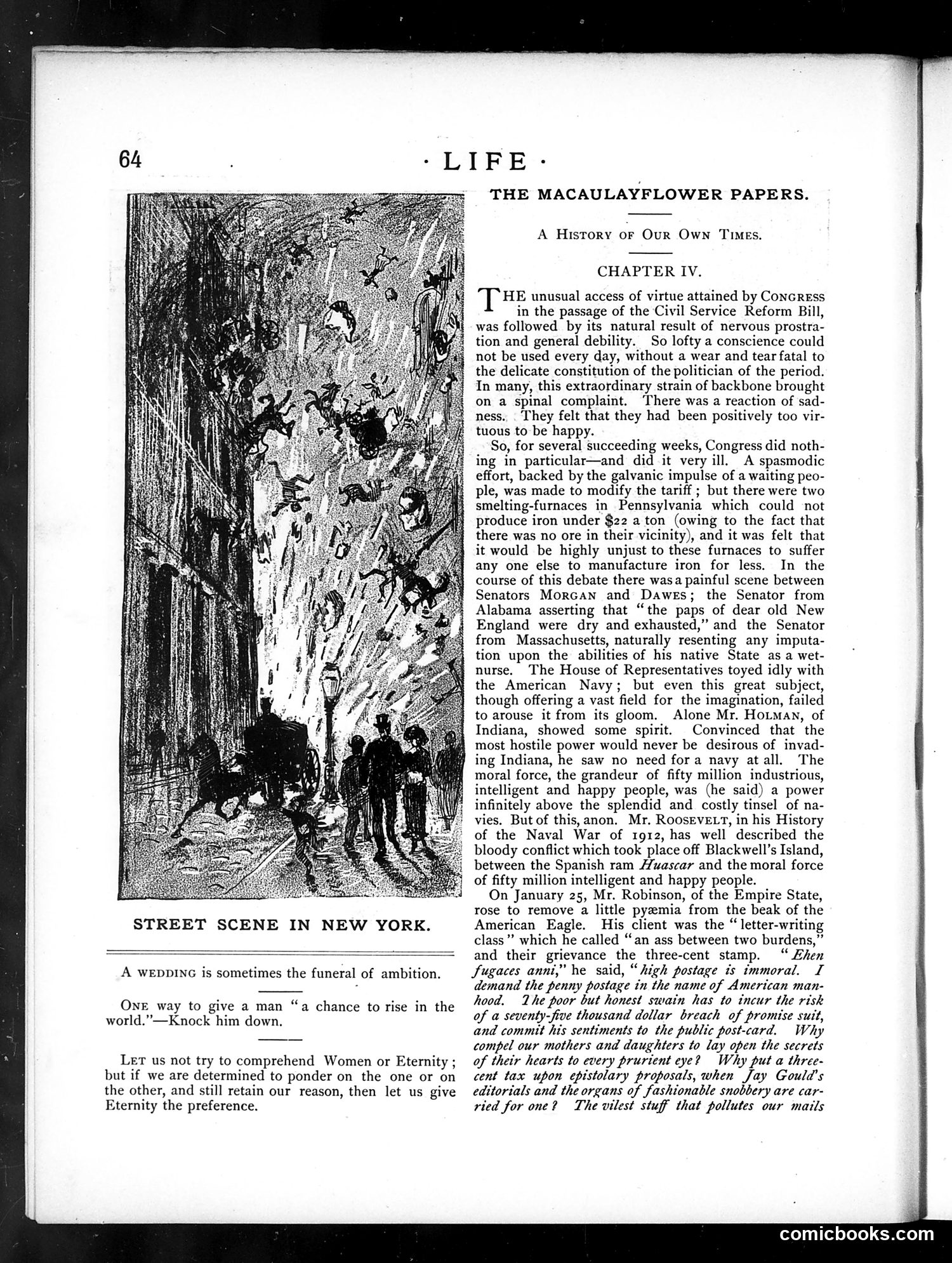
The page features "Street Scene in New York," an engraving depicting crowded urban chaos—figures packed densely on a street, some appearing distressed or struggling. The accompanying text discusses Congress's passage of the Civil Service Reform Bill, describing the political and physical toll on members. The satire suggests that virtue and reform efforts exhausted legislators so thoroughly they became ill. References to specific senators (Morgan, Dawes) debating tariffs and Pennsylvania iron production indicate this addresses 1880s-era protectionist trade debates. The cartoon likely illustrates urban overcrowding or social disorder contemporaneous with these political controversies, satirizing both congressional dysfunction and city life's chaotic conditions. The overall message appears critical of how reform efforts paradoxically weakened rather than strengthened the government.
📄 Transcribed text from this page (OCR, searchable)
Machine-transcribed from the original scan — historical spelling and the odd misread are preserved.
> LIFE: THE MACAULAYFLOWER PAPERS. STREET SCENE IN NEW YORK. A WEDDING is sometimes the funeral of ambition. « One way to give a man “a chance to rise in the world.”—Knock him down. Let us not try to comprehend Women or Eternity ; but if we are determined to ponder on the one or on the other, and still retain our reason, then let us give Eternity the preference. A History or Our Own Times. CHAPTER IV. THE unusual access of virtue attained by ConGREss in the passage of the Civil Service Reform Bill, was followed by its natural result of nervous prostra- tion and general debility. So lofty a conscience could not be used every day, without a wear and tear fatal to the delicate constitution of the politician of the period. In many, this extraordinary strain of backbone brought on a spinal complaint. There was a reaction of sad- ness. . They felt that they had been positively too vir- tuous to be happy. So, for several succeeding weeks, Congress did noth- ing in particular—and did it very ill. A spasmodic effort, backed by the galvanic impulse of a waiting peo- ple, was made to modify the tariff ; but there were two smelting-furnaces in Pennsylvania which could not produce iron under $22 a ton (owing to the fact that there was no ore in their vicinity), and it was felt that it would be highly unjust to these furnaces to suffer any one else to manufacture iron for less. In the course of this debate there wasa painful scene between Senators Morcan and Dawes; the Senator from Alabama asserting that “the paps of dear old New England were dry and exhausted,” and the Senator from Massachusetts, naturally resenting any imputa- tion upon the abilities of his native State as a wet- nurse. The House of Representatives toyed idly with the American Navy; but even this great subject, though offering a vast field for the imagination, failed to arouse it from its gloom. Alone Mr. Hoiman, of Indiana, showed some spirit. Convinced that the most hostile power would never be desirous of invad- ing Indiana, he saw no need fora navy atall. The moral force, the grandeur of fifty million industrious, intelligent and happy people, was (he said) a power infinitely above the splendid and costly tinsel of na- vies. But of this,anon. Mr. RoosEvELt, in his History of the Naval War of 1912, has well described the bloody conflict which took place off Blackwell’s Island, between the Spanish ram Huascar and the moral force of fifty million intelligent and happy people. On January 25, Mr. Robinson, of the Empire State, rose to remove a little pyemia from the beak of the American Eagle. His client was the “ letter-writing class” which he called “an ass between two burdens,” and their grievance the three-cent stamp. “ Zhen Sugaces anni,” he said, “high postage is immoral. I demand the penny postage in the name of American man- hood. The poor but honest swain has to incur the risk of a seventy-five thousand dollar breach of promise suit, and commit his sentiments to the public post-card. Why compel our mothers and daughters to lay open the secrets of their hearts to every prurient eye? Why put a three- cent tax upon epistolary proposals, when Jay Gould's editorials and the organs of fashionable snobbery are car- ried for one? The vilest stuff that pollutes our mails comicbooks.com