A complete issue · 36 pages · 1935
Judge — May 1935
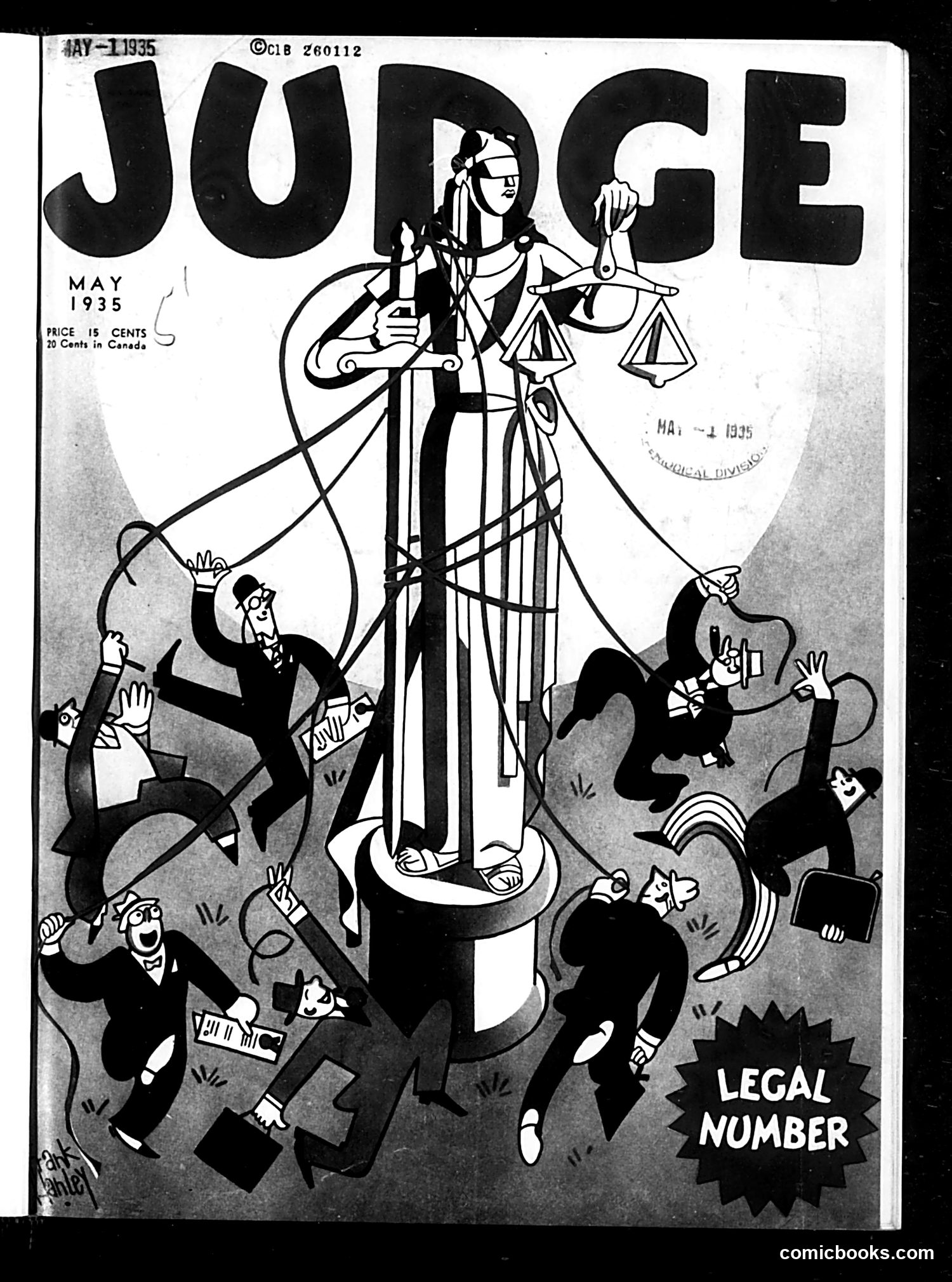
# Analysis of Judge Magazine Cover, May 1935 This cover depicts Lady Justice (blindfolded, holding scales and sword) towering over a chaotic crowd of smaller figures below—apparently lawyers, judges, or legal professionals engaged in frantic activity. They're depicted as cartoon characters in exaggerated poses, some appearing to manipulate strings connected to Lady Justice herself. The satire critiques the legal system's vulnerability to manipulation and corruption. The central figure represents idealized justice, but the swarming figures below suggest that lawyers and court officials are actually pulling strings behind the scenes, contradicting justice's supposed impartiality. The "LEGAL NUMBER" label in the corner appears to reference a specific legal case or controversy, though the exact reference is unclear without additional context about 1935 legal events.
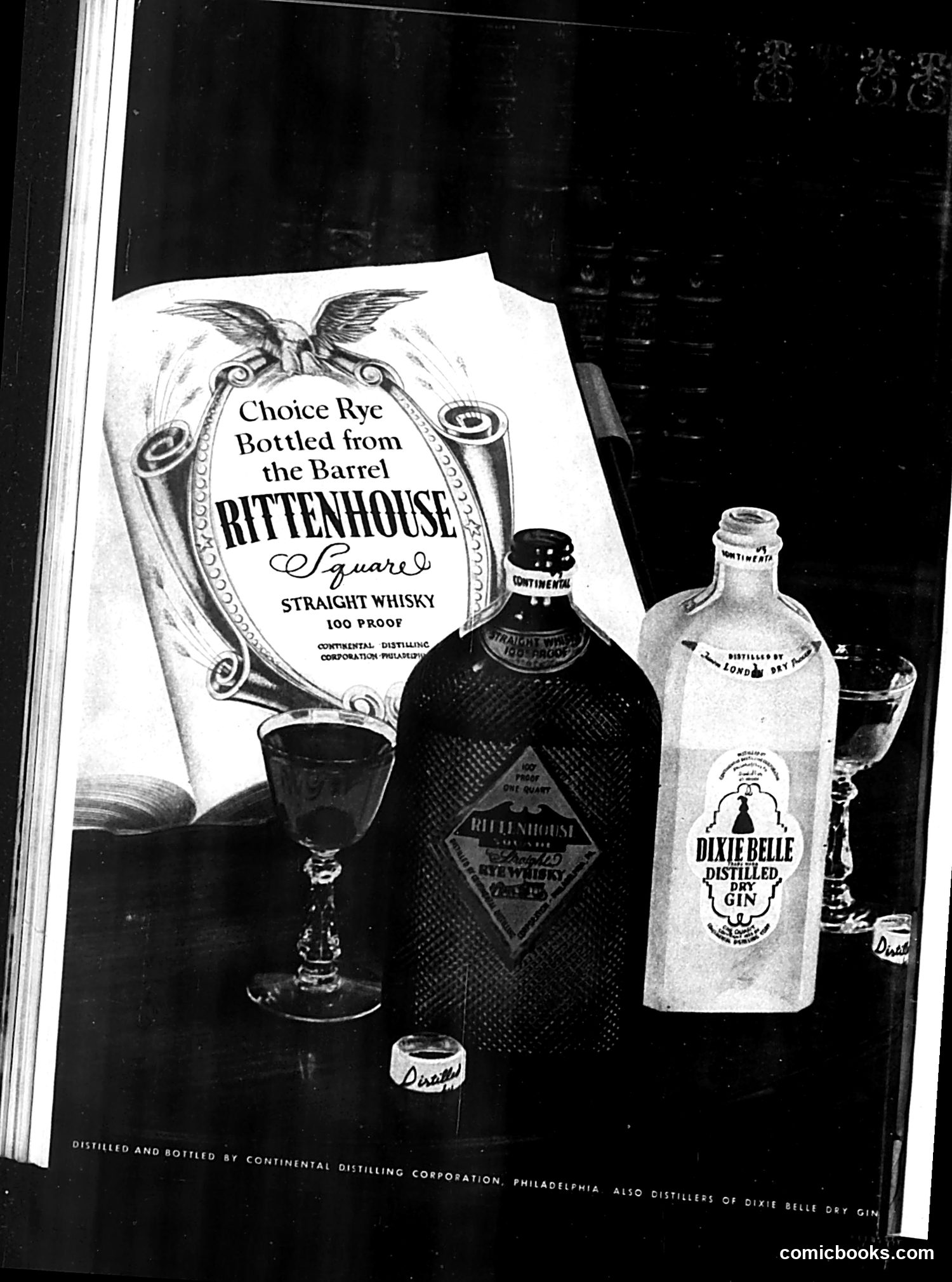
# Analysis This page is primarily **advertising**, not satire or political commentary. It displays liquor advertisements from the Prohibition era (the image quality and style suggest early 1930s). The main ad features **Rittenhouse Square Straight Whisky** (100 proof), bottled by Continental Distilling Corporation in Philadelphia. Accompanying it are bottles of **Dixie Belle Distilled Dry Gin**. The significance: This advertisement's appearance in Judge magazine during Prohibition (1920-1933) is itself notable—it suggests either the magazine was published just before Prohibition's implementation or this is from the repeal period (post-1933). The prominent display of whisky and gin would have been illegal or controversial during actual Prohibition enforcement, making this a historical artifact of American alcohol regulation.
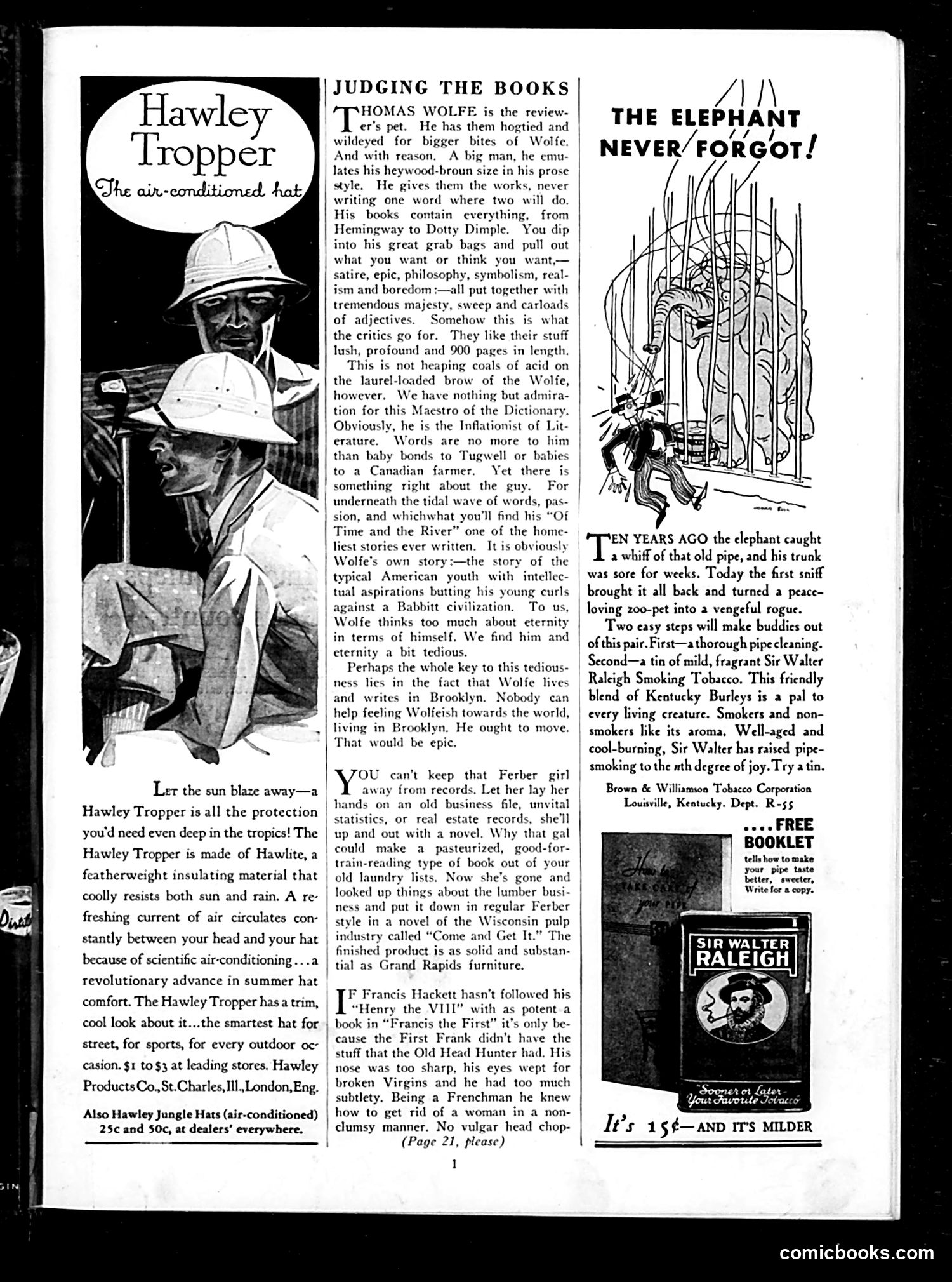
# Analysis of Judge Magazine Page 1 This page is primarily **advertising and book reviews** rather than political satire. The left side advertises **Hawley Tropper hats**, describing their air-conditioning properties as protection from sun and rain—a commercial pitch emphasizing comfort and innovation. The center section reviews **Thomas Wolfe**, the novelist, with praise for his ambitious, lengthy works containing philosophy and symbolism. The reviewer admires Wolfe's literary ambition despite finding him occasionally tedious. The right side features **"The Elephant Never Forgot!"**—an advertisement for **Sir Walter Raleigh Smoking Tobacco**. The cartoon depicts an elephant remembering a past injury, using humor to suggest the product creates lasting positive memories in smokers. Below is an advertisement for a **free booklet** about the tobacco, priced at 15 cents. The page reflects 1920s-30s magazine advertising combining literary criticism with commercial promotion.
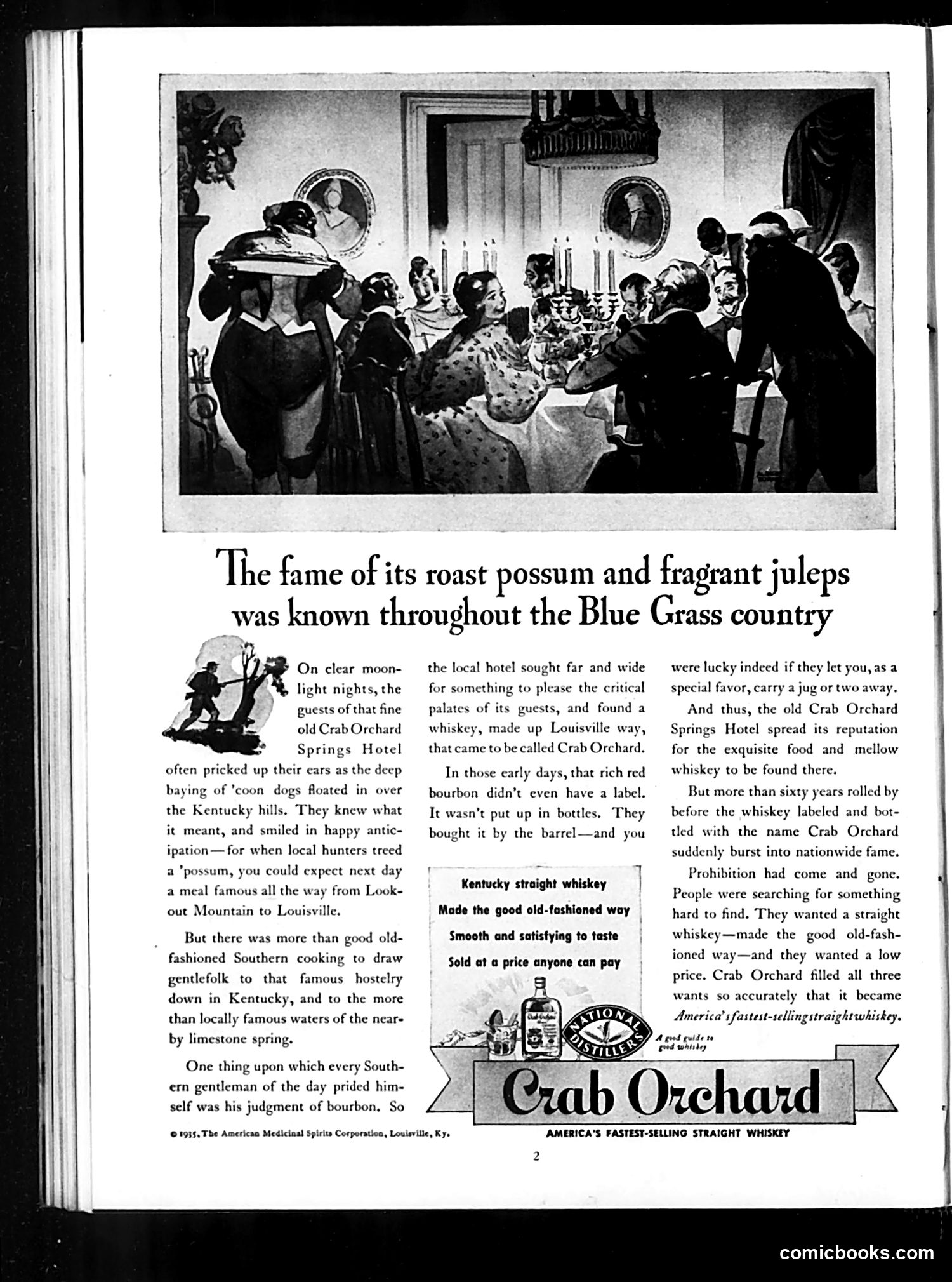
# Crab Orchard Whiskey Advertisement This page is primarily a **whiskey advertisement** rather than political satire. It advertises Crab Orchard bourbon, claiming to be "America's fastest-selling straight whiskey." The narrative describes a Kentucky hotel famous for roasted possum and juleps, establishing Southern frontier authenticity. The illustration shows an elegant dinner party, contrasting the rustic origin story with refined hospitality. The ad emphasizes that Crab Orchard whiskey became notably popular *after* Prohibition ended, positioning it as the answer to consumers seeking "good old-fashioned" straight bourbon "made the good old-fashioned way." The text suggests the brand capitalized on post-Prohibition demand for quality whiskey when "people were searching for something hard to find." This is commercial content, not satirical commentary.
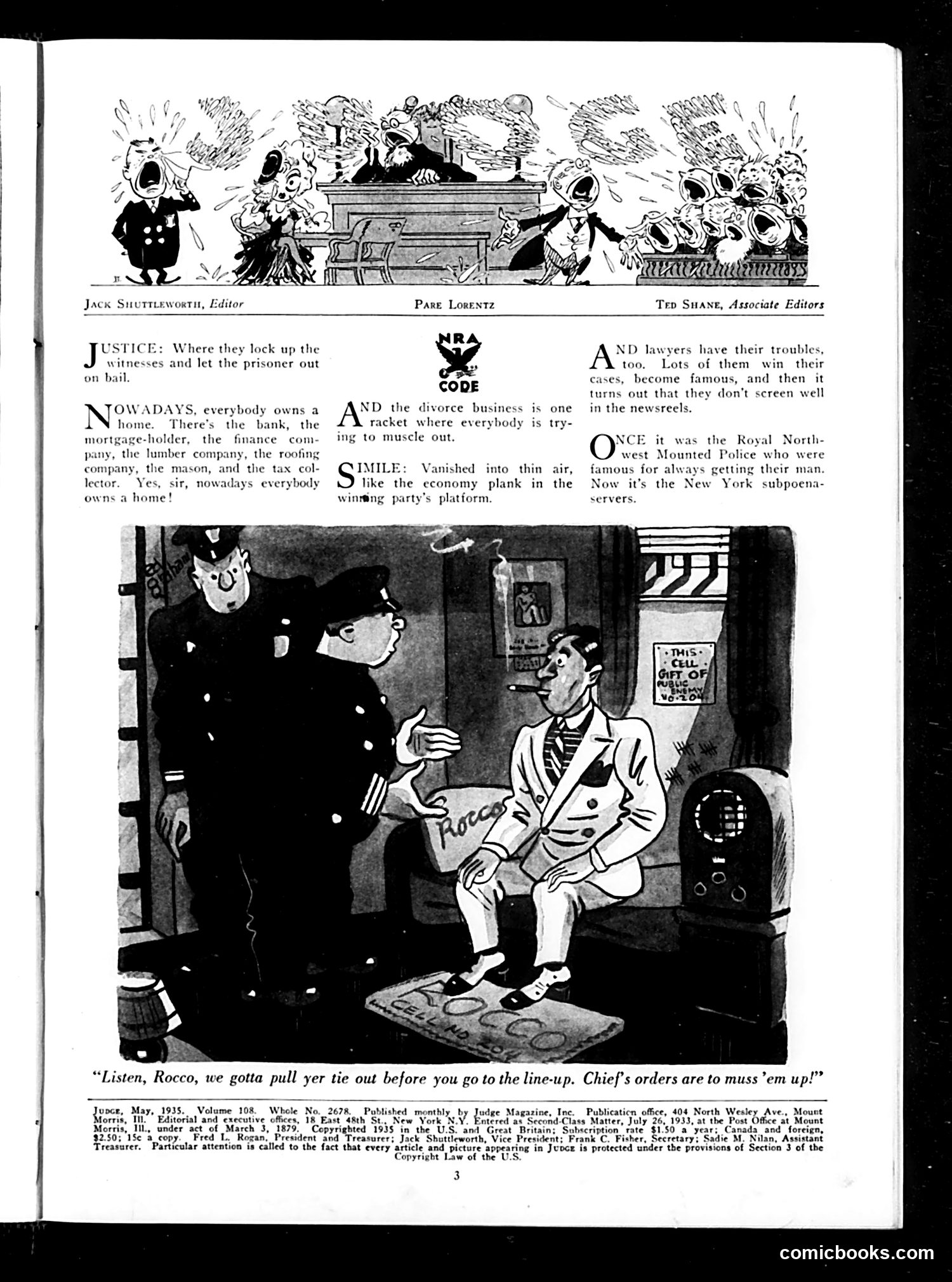
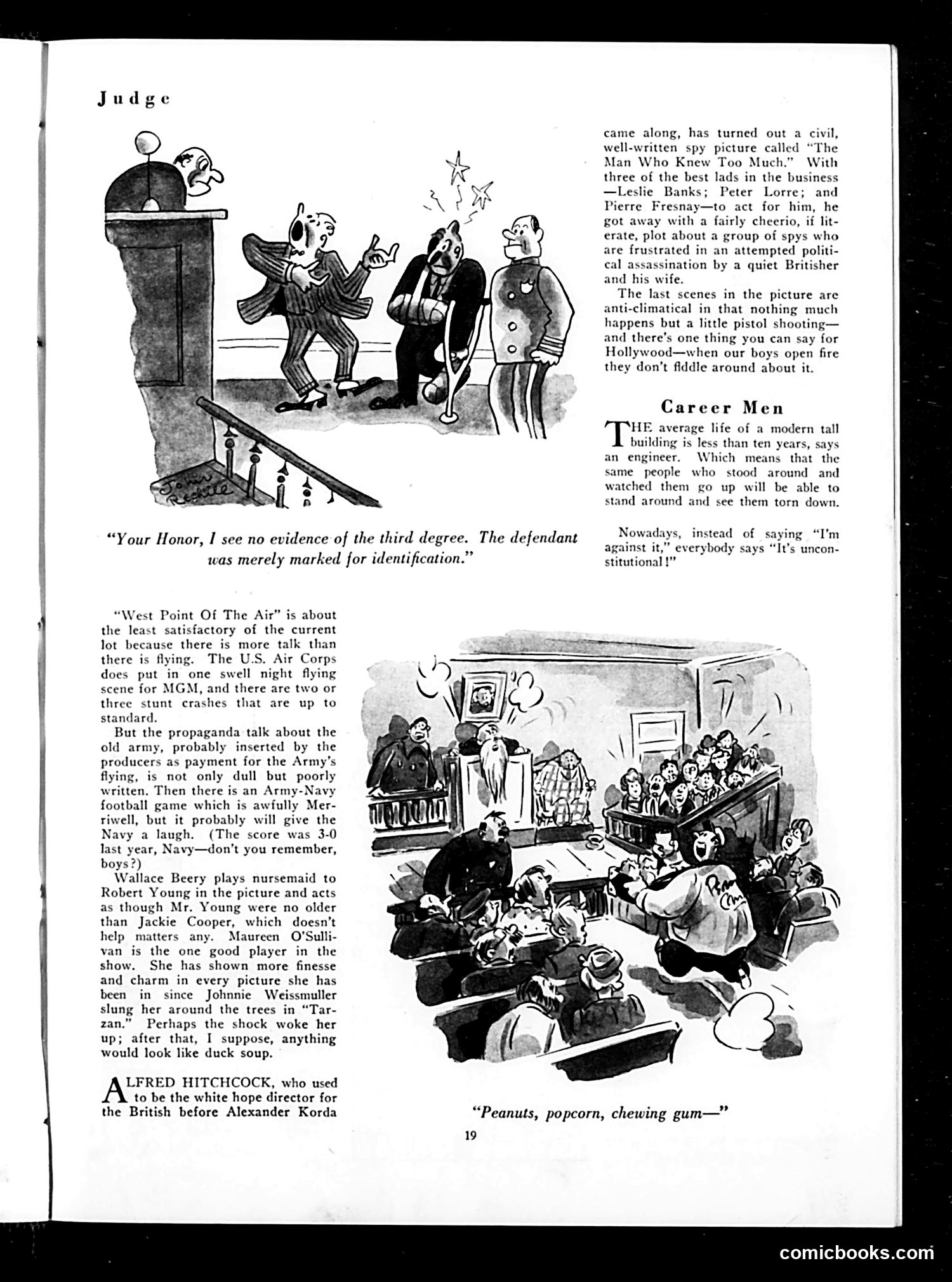
# Judge Magazine Satire Analysis (May 1935) This page satirizes several contemporary issues: **Top section** mocks: - **Justice system absurdities**: judges releasing prisoners on bail while locking up witnesses - **Home ownership**: the irony that "everybody" owns homes despite mortgages, banks, and insurance companies holding actual control - **Divorce industry**: portrayed as a profitable "racket" - **Lawyers' troubles**: winning cases that damage their reputations - **Police**: transition from famous Royal Canadian Mounted Police to New York subpoena-servers **Main cartoon** shows a police officer ("Chief's orders") instructing a suspect named "Rocco" to fabricate testimony ("pull yer tie out") before a police lineup—satirizing police corruption and witness intimidation tactics. The satire criticizes institutional dishonesty across law enforcement, courts, and legal professions.
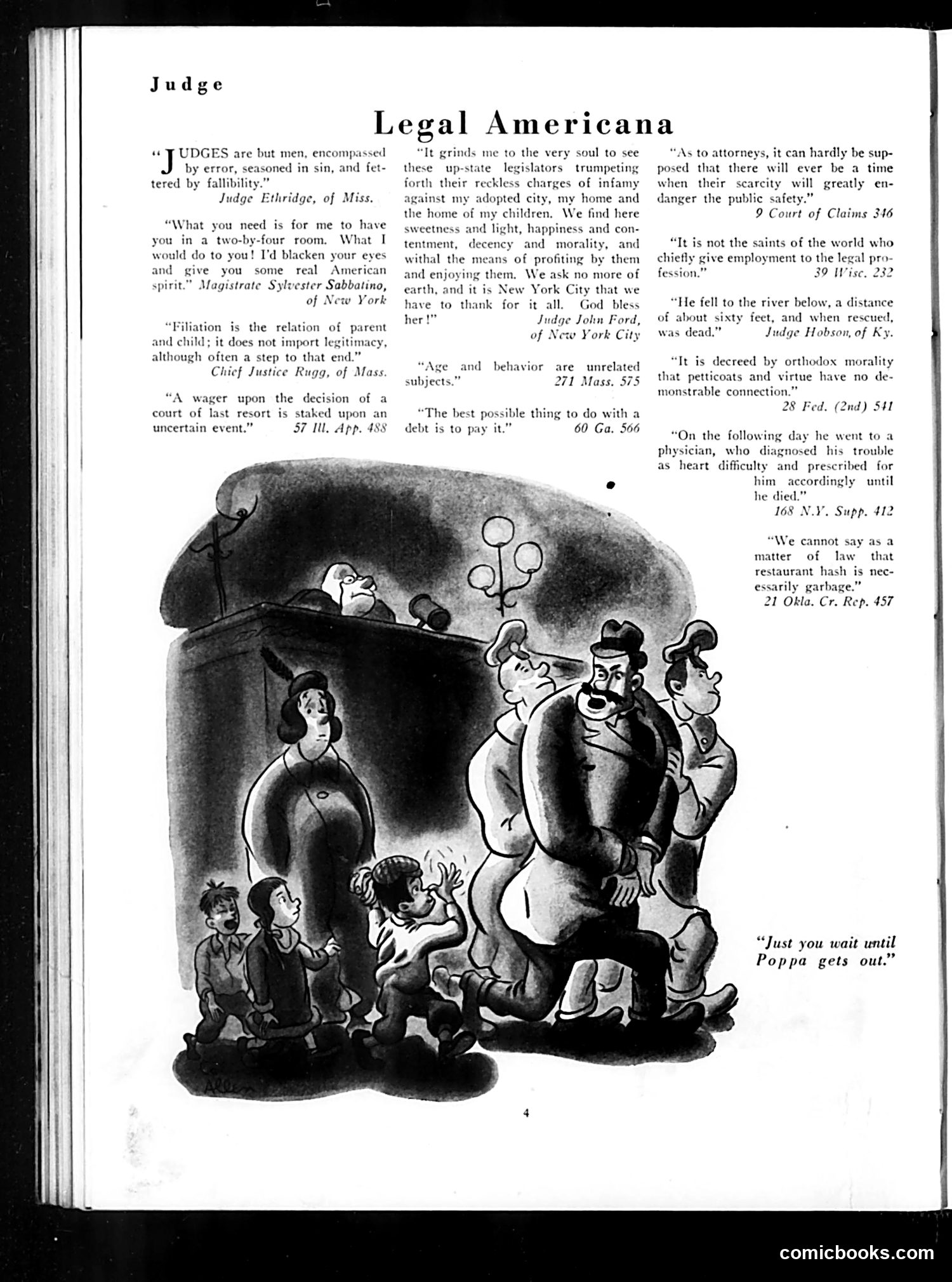
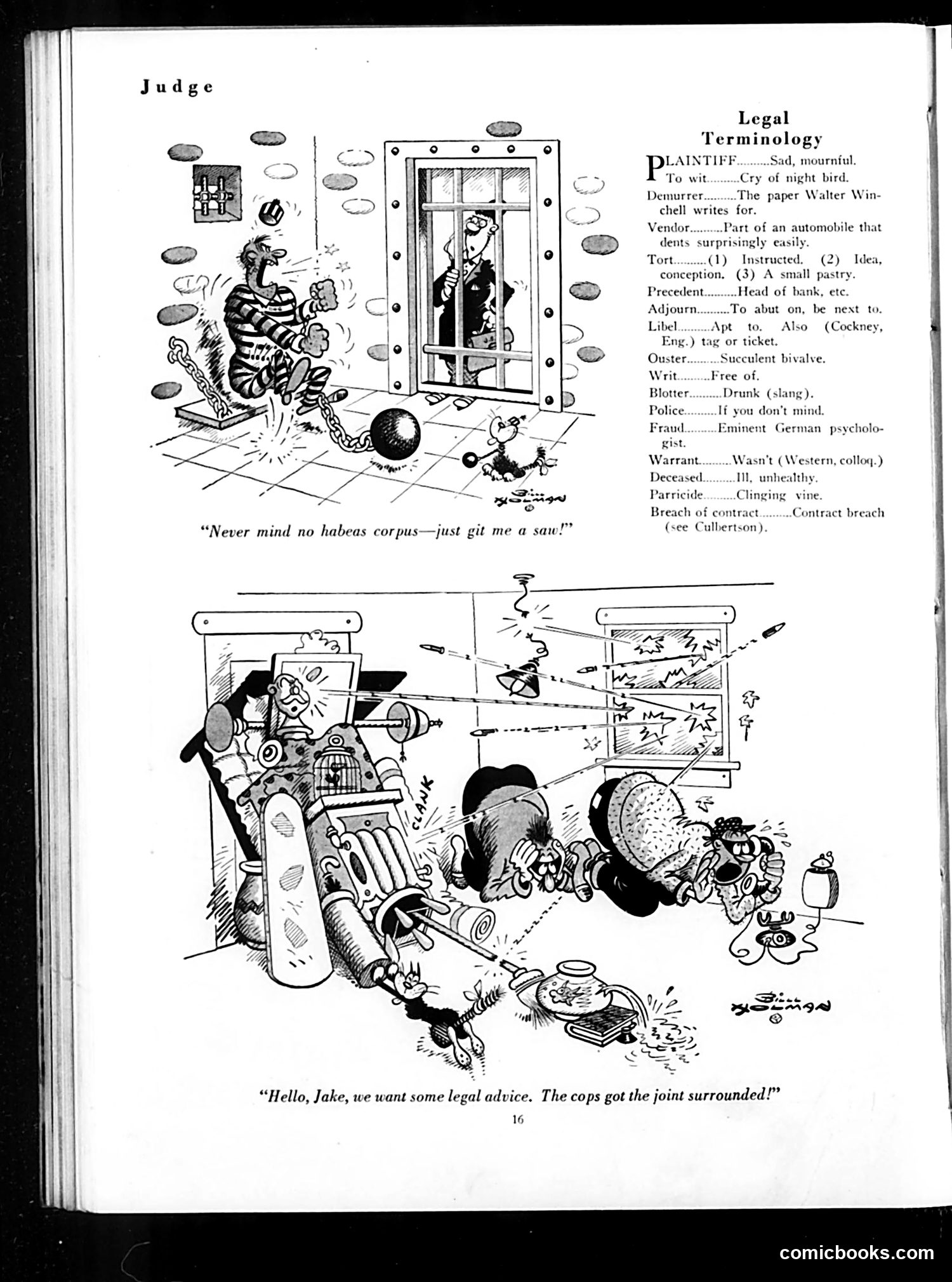
# Legal Americana - Judge Magazine Cartoon Analysis This cartoon satirizes organized crime and police corruption, likely from the Prohibition era (1920s-1930s). The large figure at top appears to be a crime boss or gang leader presiding over a criminal operation depicted as an underground den or speakeasy. Smaller figures below—including what look like ordinary citizens and children—are trapped or threatened by the criminal enterprise. The caption "Just you wait until Poppa gets out" suggests a gangster's threat of retaliation. The satire critiques how organized crime infiltrates communities, endangers families, and operates with apparent impunity. The contrasting "Legal Americana" quotes on ethics and law above underscore the irony: judges and officials discuss legal principles while criminals openly threaten violence in the streets.
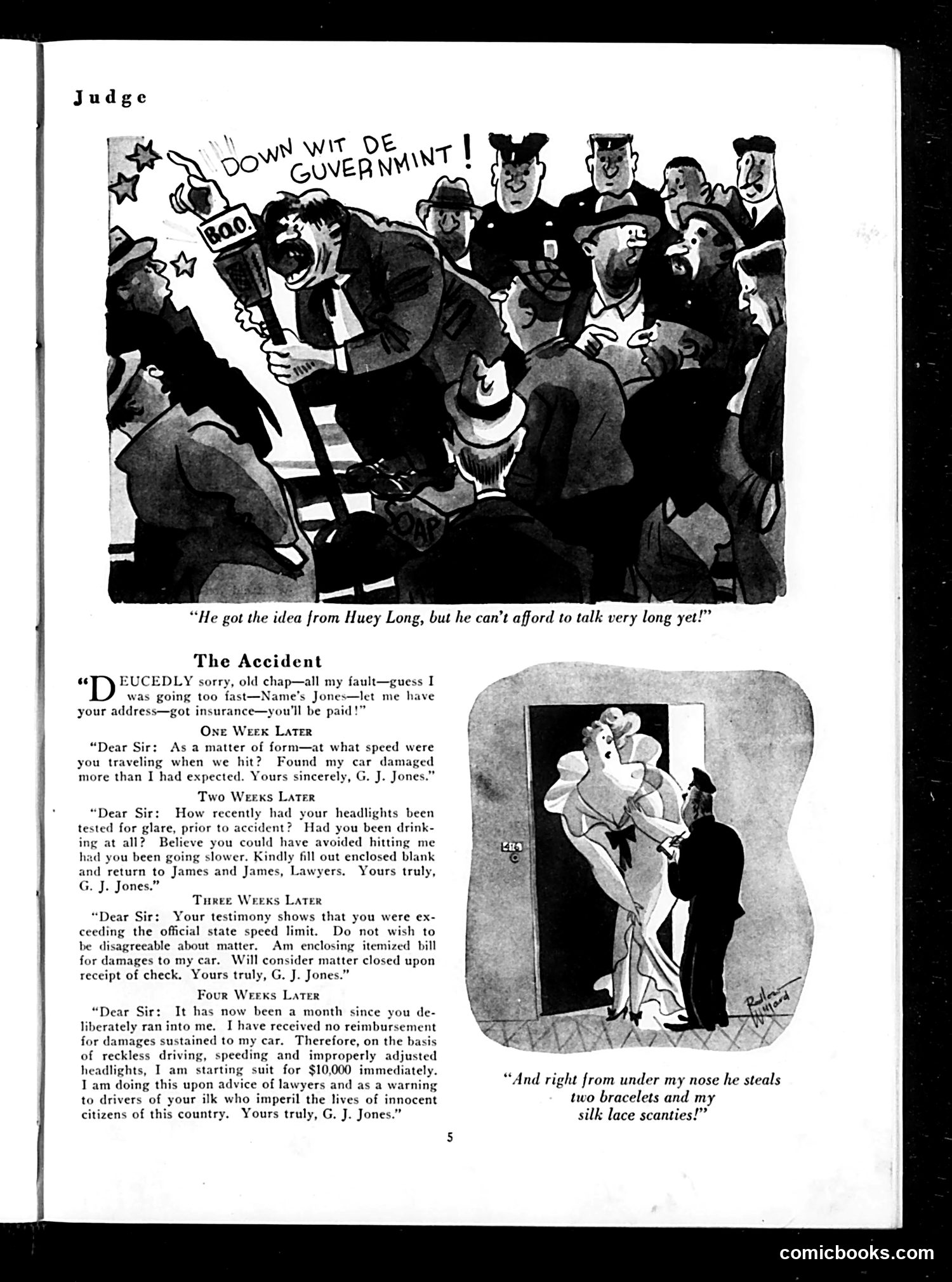
# Analysis The top cartoon satirizes political protesters demanding "DOWN WIT DE GUVERNMINT!" One figure holds a torch labeled "ANARCHY," while officials and police surround the agitator. The caption notes he got the idea from "Huey Long," suggesting this mocks populist or radical political movements of the 1930s. The joke implies such protesters are dangerous firebrands whose rhetoric spreads recklessly. The bottom section, "The Accident," presents an escalating dispute between two drivers over a car collision. A series of letters shows how a minor fender-bender transforms into legal threats and a $10,000 lawsuit threat. The accompanying cartoon illustrates a woman catching a man stealing her jewelry, captioning his hypocrisy. Together, this satirizes how litigation and mutual accusation spiral from simple disputes into absurdity.
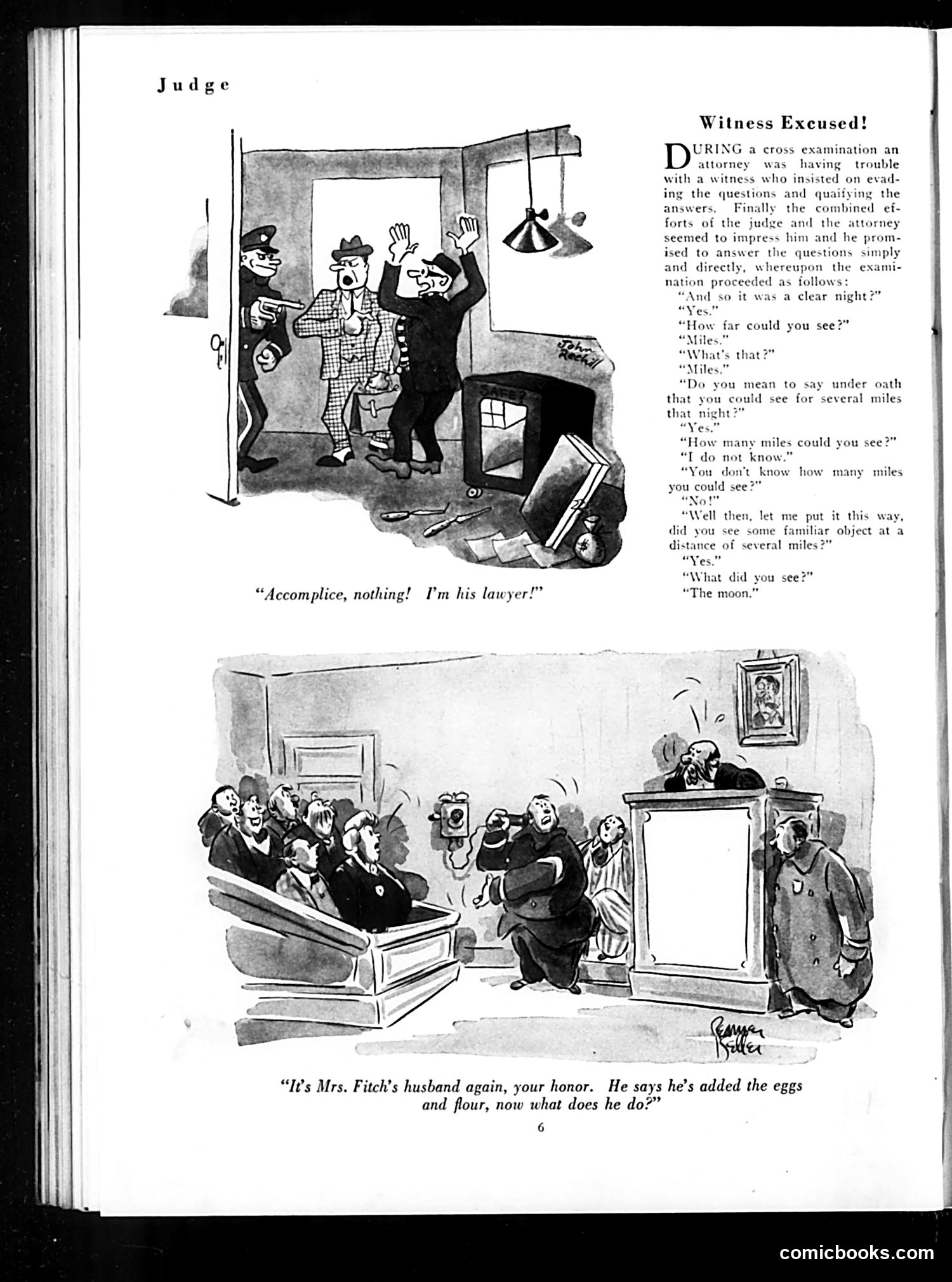
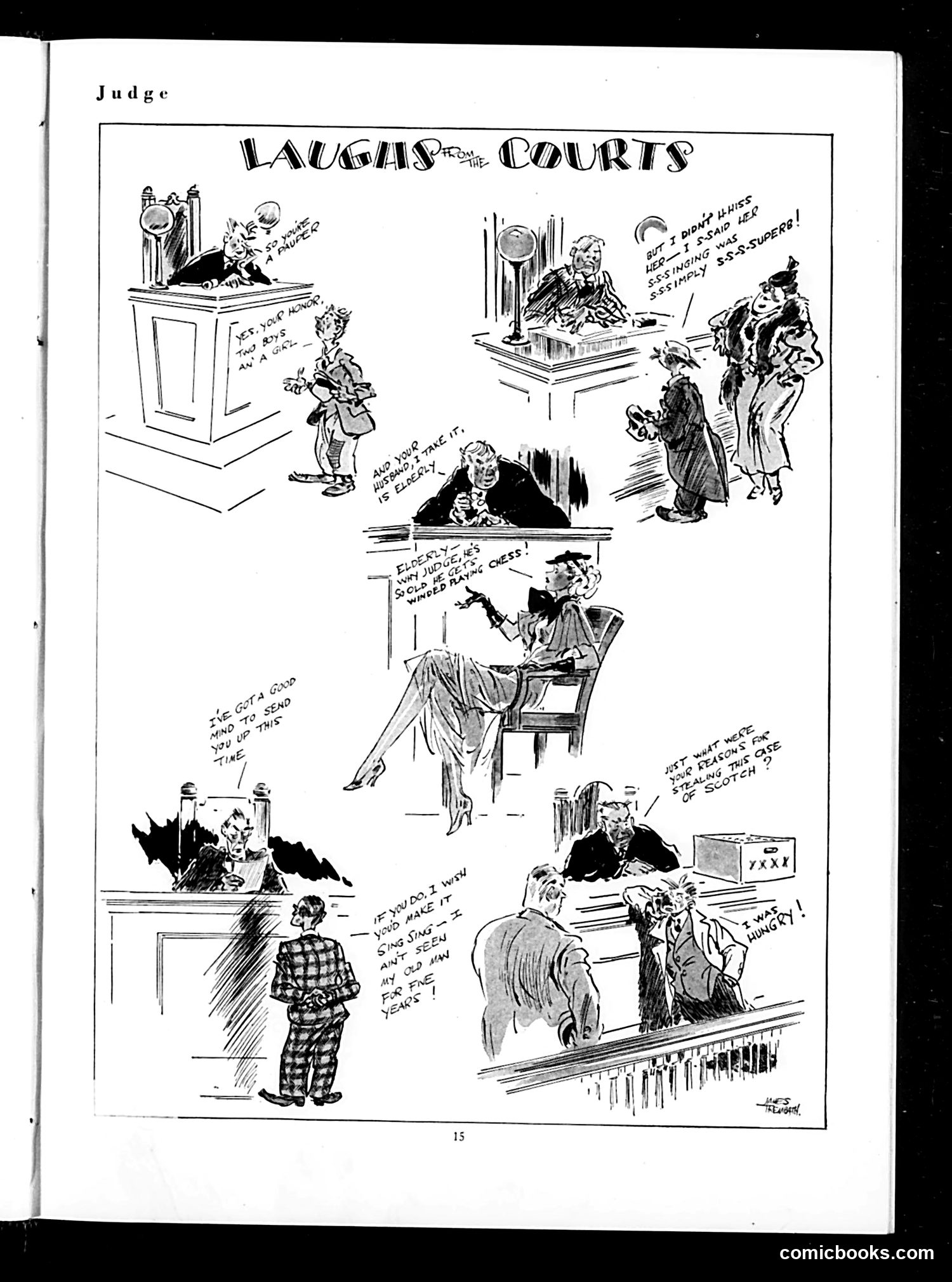
# Explanation for Modern Readers This page from *Judge* magazine contains two legal satires: **Top cartoon ("Witness Excused!")**: An attorney frustrates a witness through repetitive questioning about visibility at night. When pressed to name what he could see "several miles" away, the witness answers "The moon"—exposing the absurdity of the attorney's gotcha-style cross-examination. The judge and lawyer's reaction suggests the witness has outwitted them through literal truth-telling. **Bottom cartoon**: A judge questions a witness about Mrs. Fitch's husband's cooking, asking what he does after adding eggs and flour. The humor relies on the innuendo that he's asking about baking, but the witness (or reader) might imagine something inappropriate, playing on double meanings common to this era's courtroom humor. Both cartoons mock lawyer tactics and courtroom absurdities.
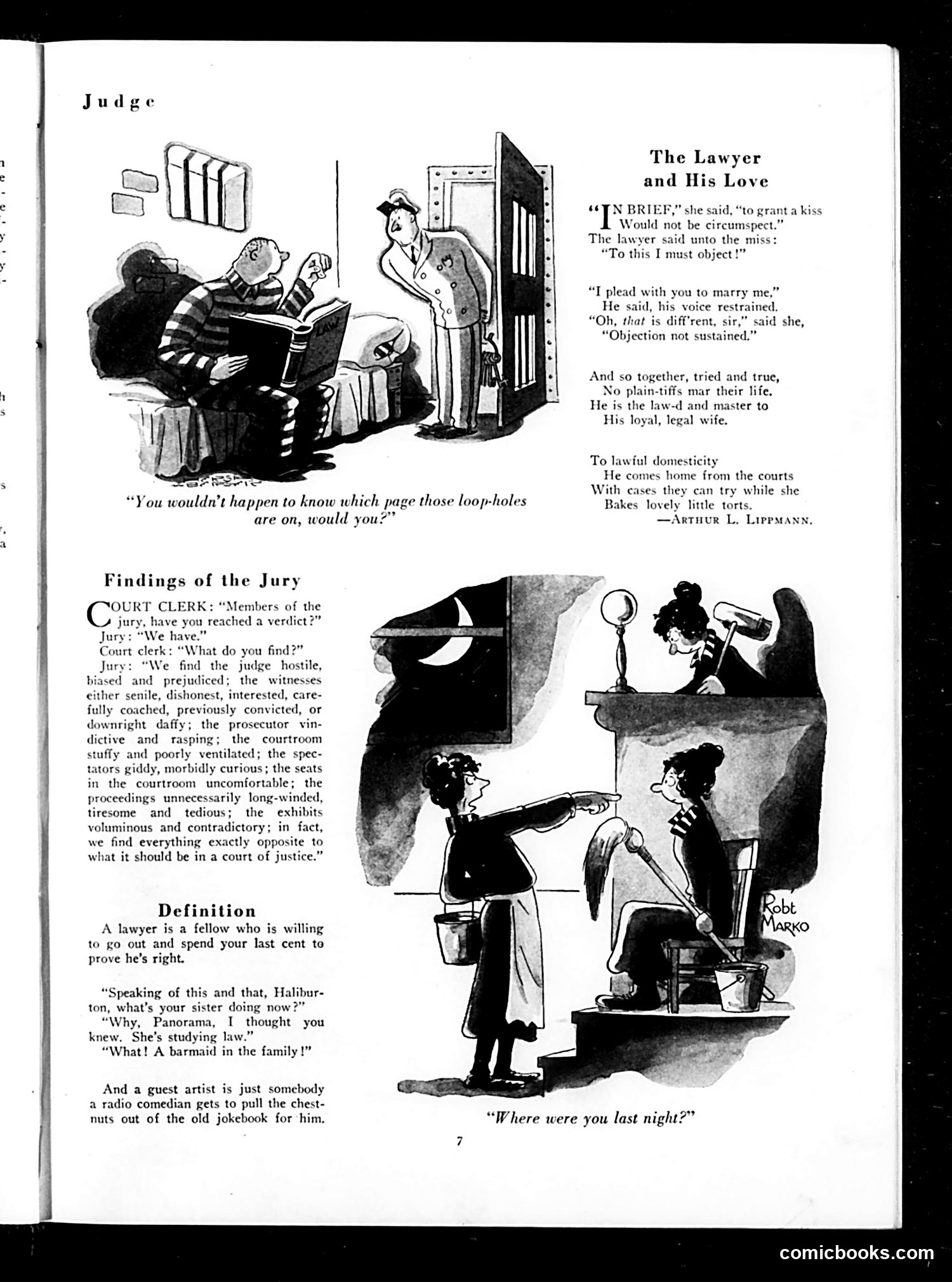
# Analysis of Judge Magazine Page This page presents legal humor typical of Judge's satirical style. **"The Lawyer and His Love"** (top) mocks courtroom procedure: a lawyer objects to his romantic rival's kiss as "circumspect," then objects again when told the rival's kiss is "different." The poem celebrates the lawyer finally winning his case and marrying the woman, finding domestic happiness ("lovely little tarts") preferable to courtroom battles. **"Findings of the Jury"** satirizes the legal system's failures—biased judges, dishonest witnesses, poor ventilation, and contradictory evidence—concluding courts produce "everything exactly opposite to what it should be." **"Definition"** provides cynical humor: a lawyer is someone willing to spend money proving he's right. The bottom cartoon shows an interrogation scene, likely depicting typical legal cross-examination tactics.
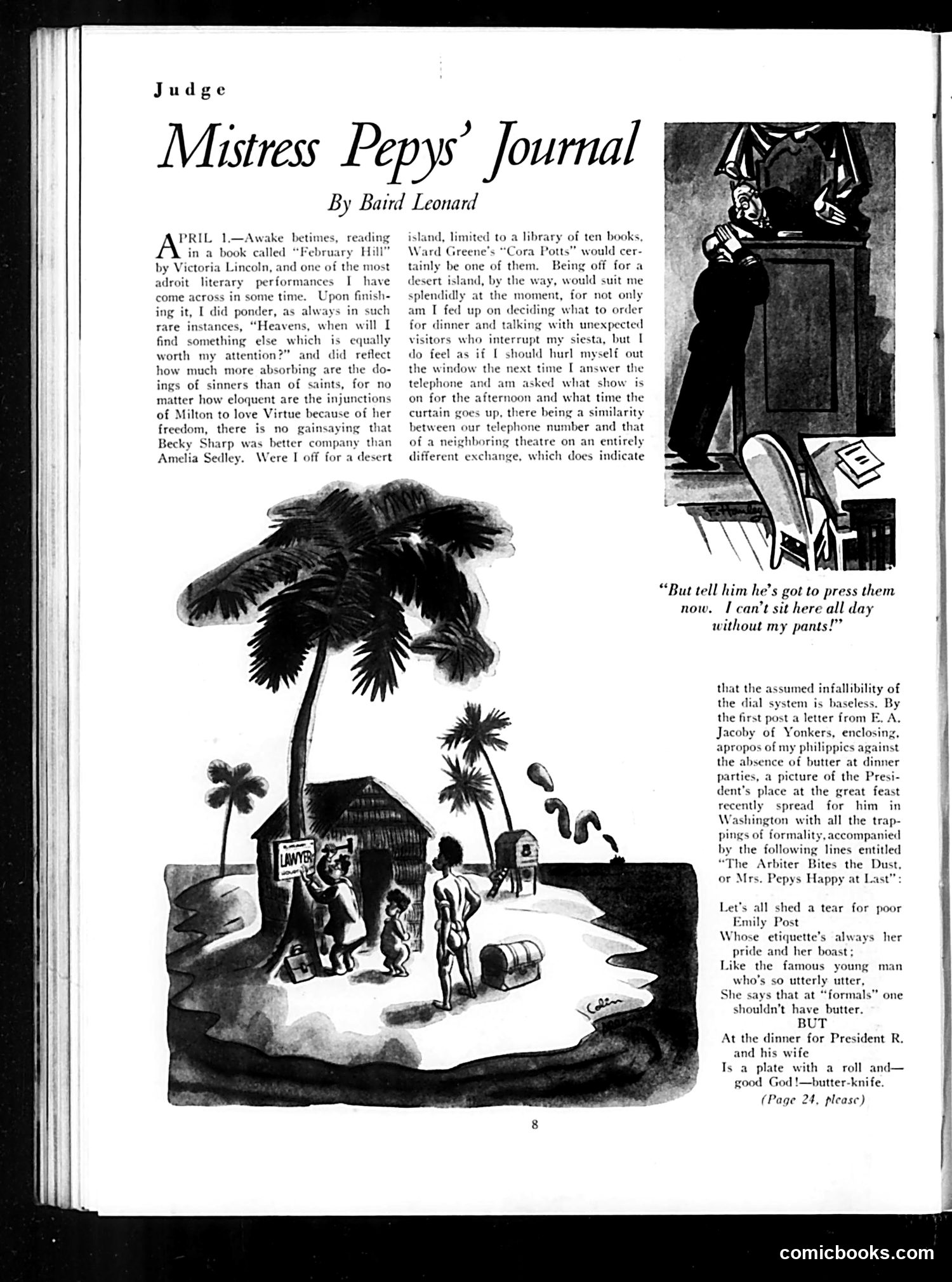
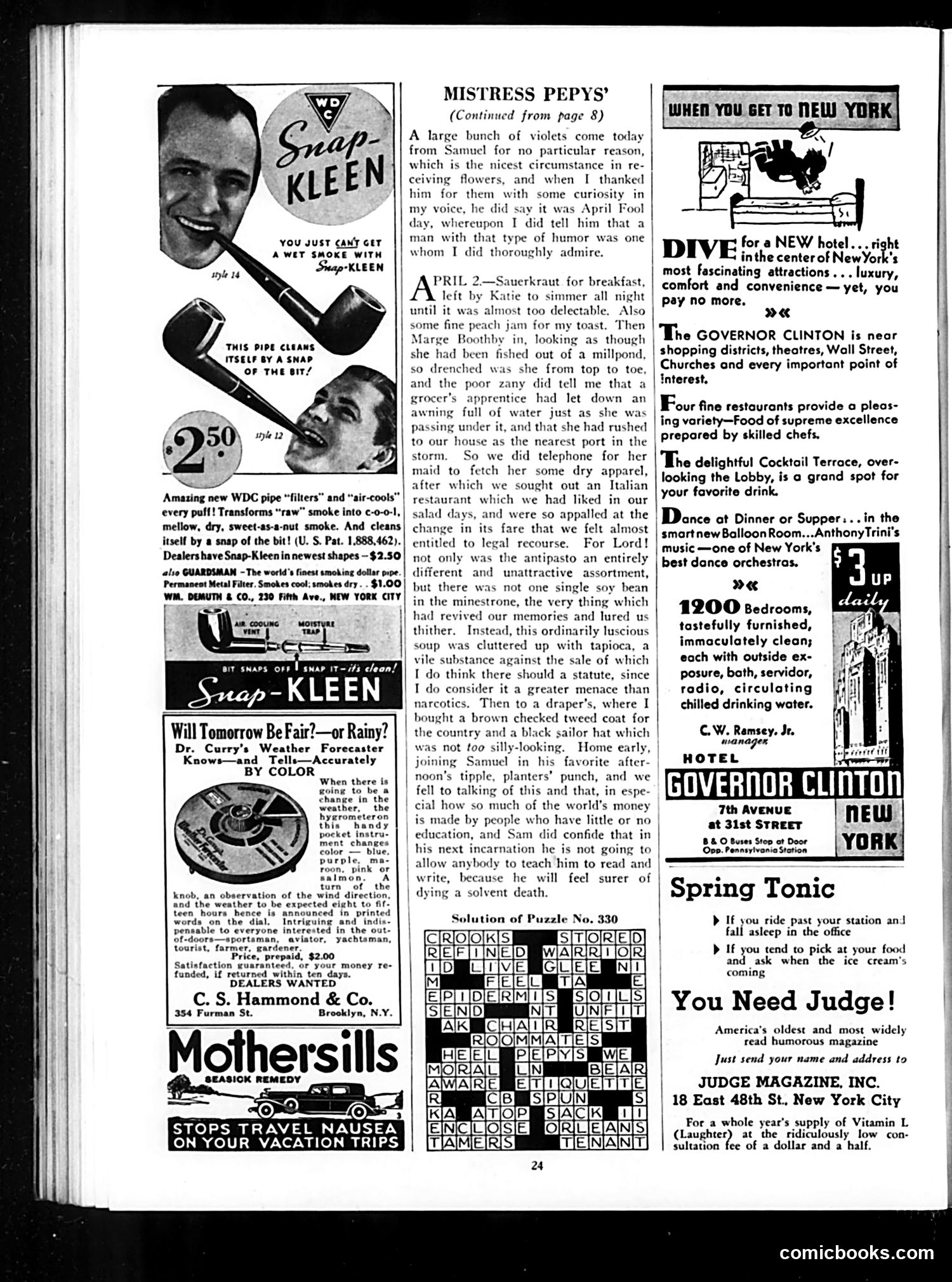
# "Mistress Pepys' Journal" — Judge Magazine Satire This is a literary humor column by Baird Leonard mimicking Samuel Pepys's famous diary. The author, writing as "Mistress Pepys," complains about domestic frustrations: deciding dinner menus, unexpected visitors interrupting her siesta, and a telephone number confused with a neighboring theater's. The main satire targets **Emily Post**, the famous etiquette arbiter. A reader sends verses mocking Post's rigid formality rules—particularly her insistence that butter should be absent from formal dinners. The joke: at a dinner for President R. (likely Roosevelt) and his wife, there's actual butter and a butter-knife present, contradicting Post's strict protocols. The cartoon illustrates desert-island escapism—the author daydreaming of escape from these quotidian annoyances. This satirizes both rigid social conventions and the tedium of upper-middle-class domestic life circa the 1930s.
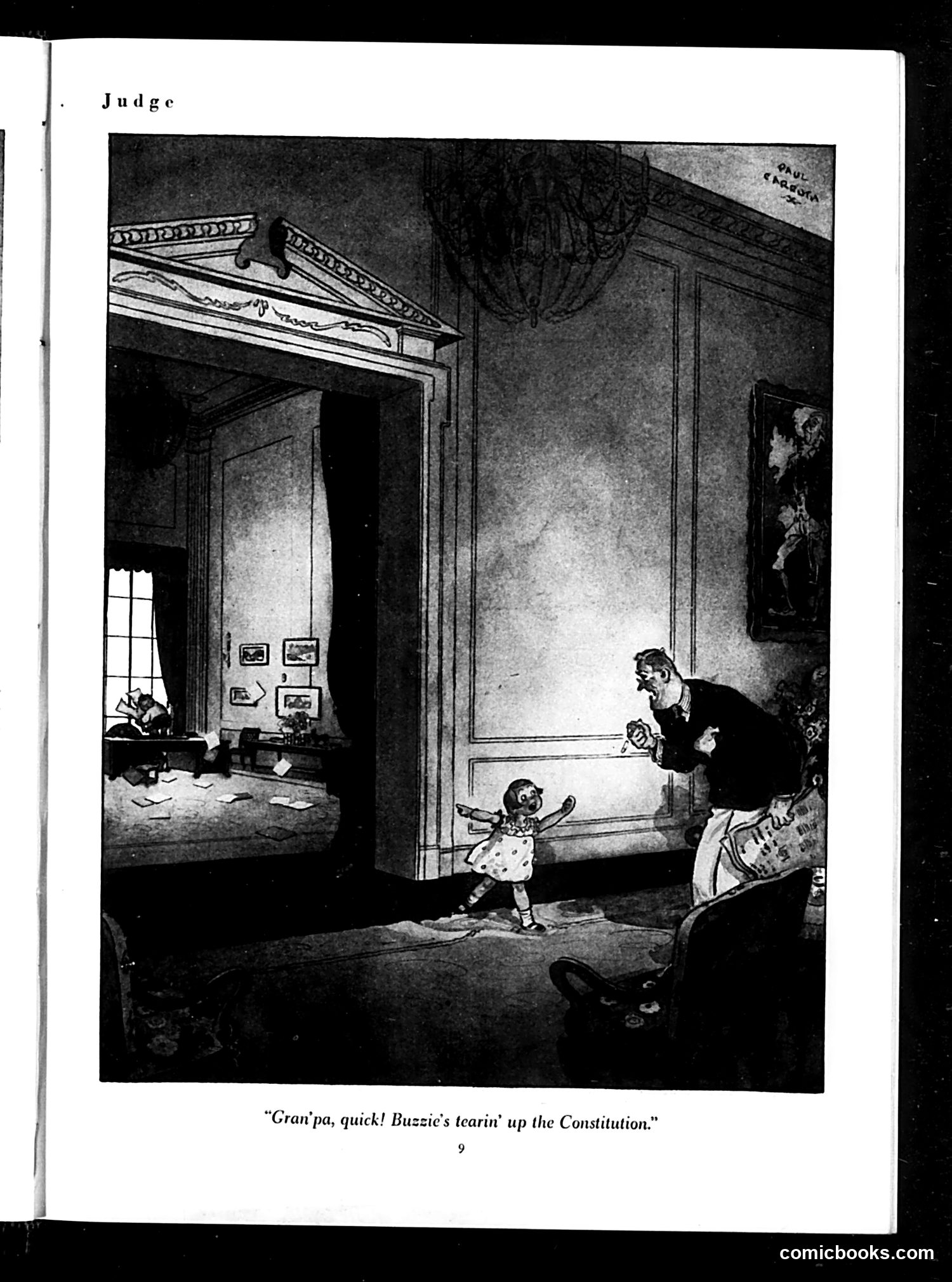
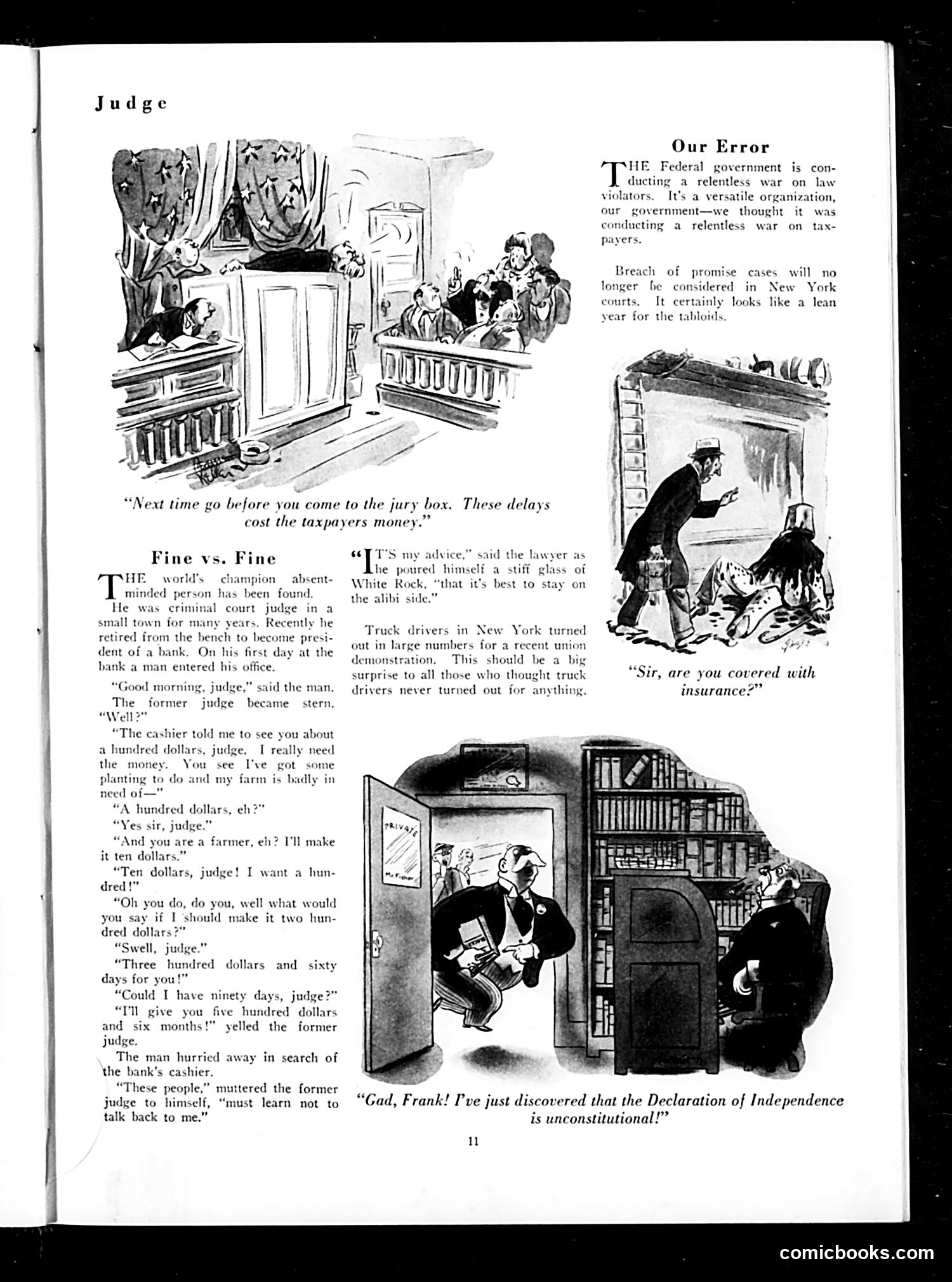
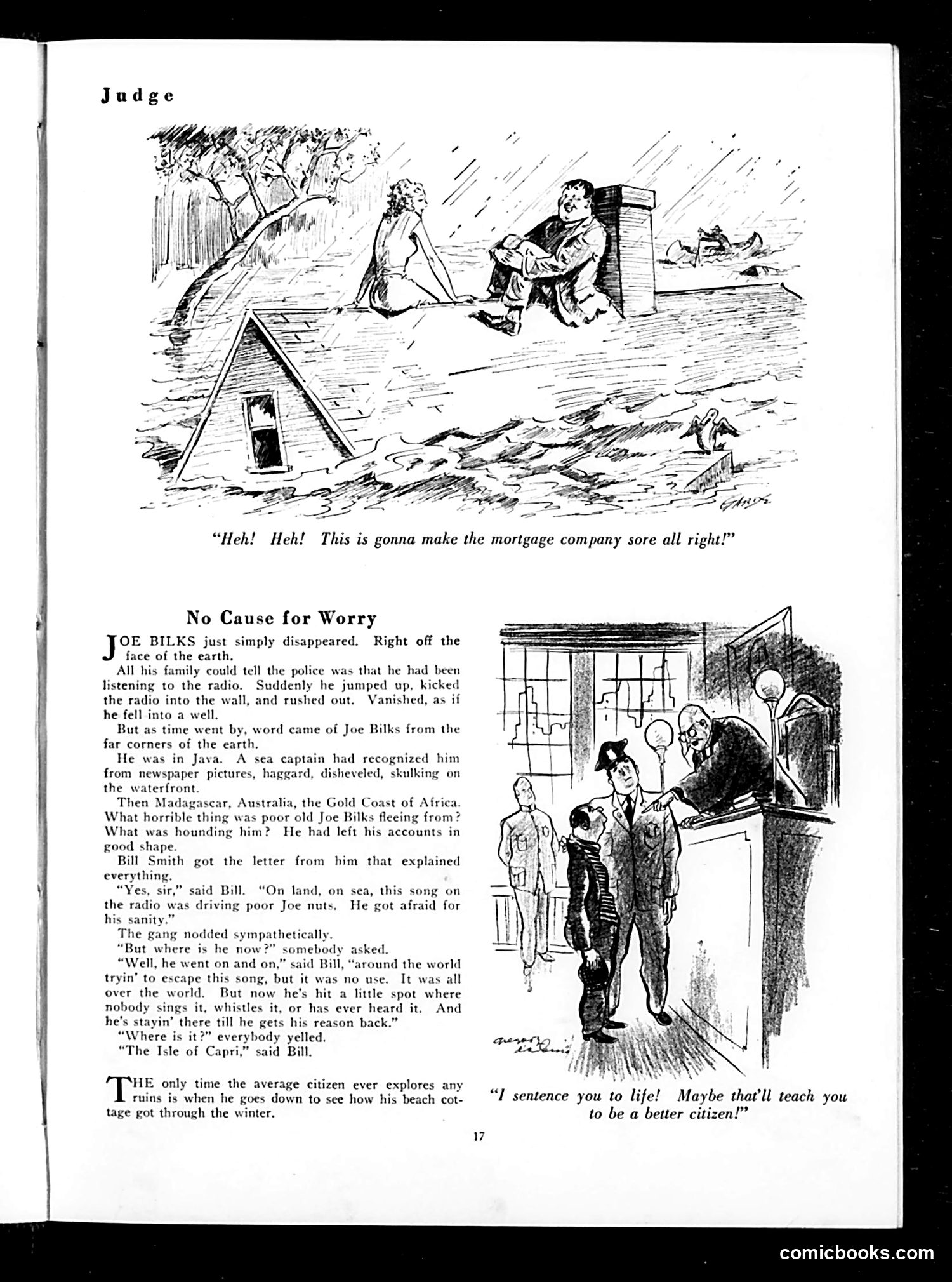
# Analysis This is a single-panel satirical cartoon titled "Judge" depicting a domestic scene. An elderly man (labeled "Gran'pa") sits in a chair while a small child runs toward him in apparent alarm. The child reports that "Buzzie's tearin' up the Constitution." The satire appears to reference a political figure or public personality nicknamed "Buzzie" who was perceived as undermining constitutional principles. Without additional context about the publication date, I cannot identify the specific historical figure intended. The humor derives from treating constitutional destruction as casually as a child's misbehavior—something requiring grandpa's immediate intervention. The cartoon satirizes both the perceived threat to constitutional governance and the domestic triviality with which serious political concerns are sometimes treated.
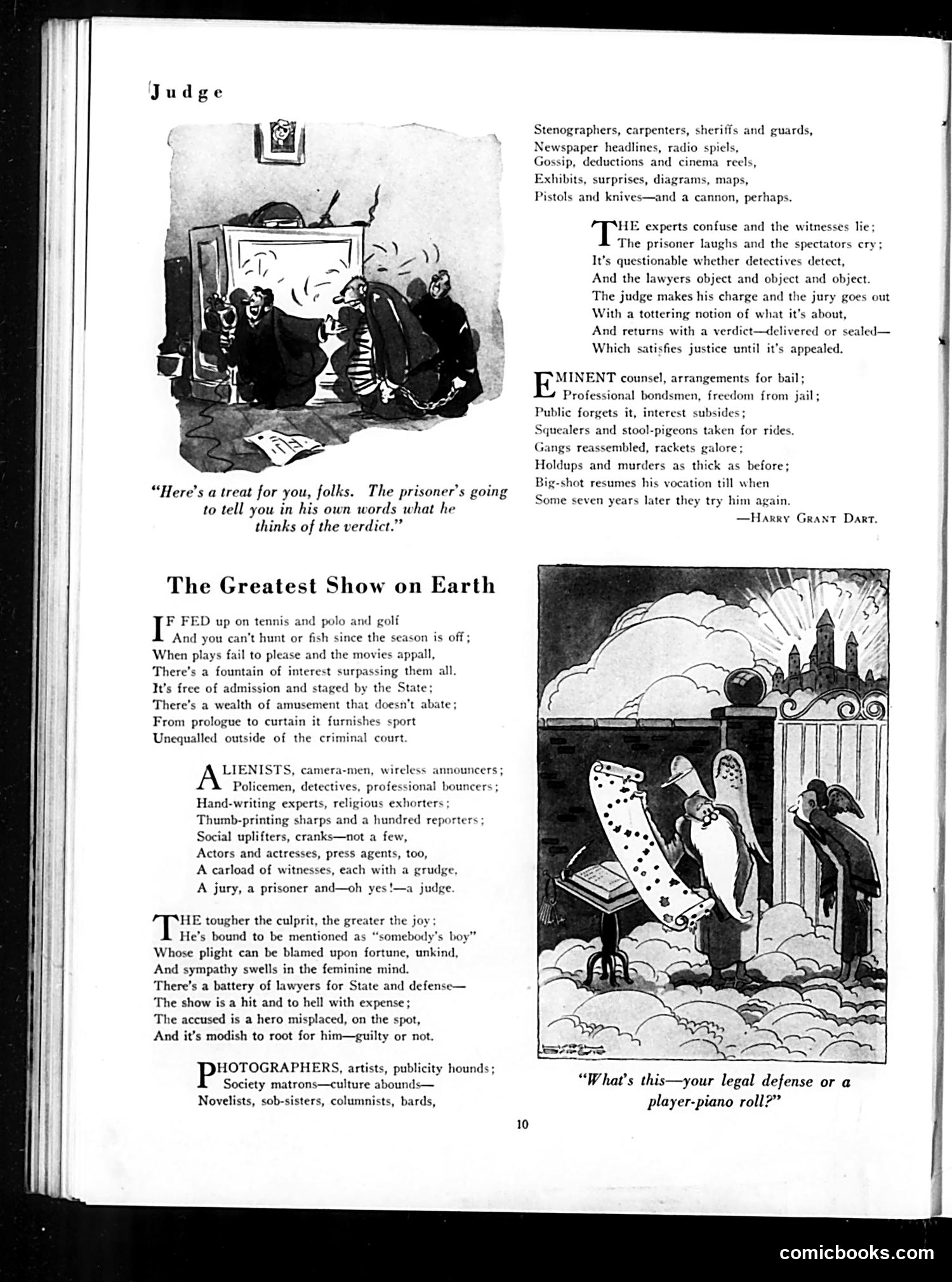
# Judge Magazine Satire: "The Greatest Show on Earth" This poem by Harry Grant Dart satirizes criminal trials as public spectacle and entertainment rather than serious justice. The piece mocks how trials attract crowds of photographers, society figures, reporters, and sensation-seekers who treat courtrooms like theater. The satire targets multiple failures: witnesses who lie, detectives of questionable competence, lawyers who endlessly object, and juries confused about their purpose. More pointedly, Dart ridicules public sympathy for criminals—wealthy or famous defendants become "heroes misplaced," while justice becomes fashionable theater rather than legitimate process. The final stanza reveals the system's futility: criminals are freed on bail, gangs reorganize, crime continues unabated, and years later the same criminals face trial again. The accompanying cartoons reinforce this cynicism about courtroom performance masquerading as justice. The work reflects 1920s-30s disillusionment with the legal system's ability to actually prevent crime or deliver meaningful consequences.