
Judge, 1935-05 · page 16 of 36
Judge — May 1935 — page 16: what you’re looking at
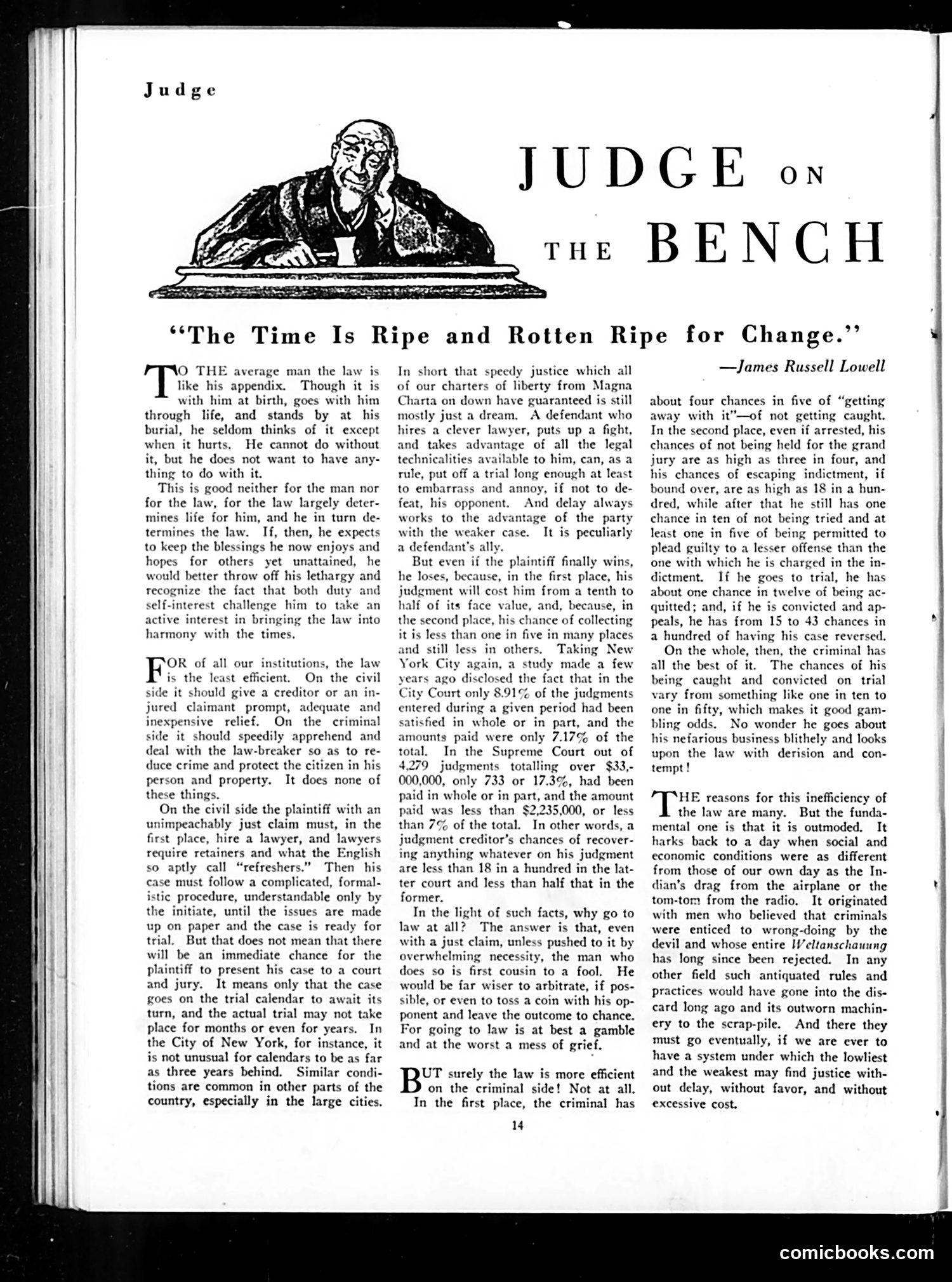
A restored page from Judge, 1935-05. Page through the whole issue in the reader above.
📄 Transcribed text from this page (OCR, searchable)
Machine-transcribed from the original scan — historical spelling and the odd misread are preserved.
O THE average man the law is like his appendix. Though it is with him at birth, goes with him through life, and stands by at his burial, he seldom thinks of it except when it hurts. He cannot do without it, but he does not want to have any- thing to do with it. This is good neither for the man nor for the law, for the law largely deter- mines life for him, and he in turn de- termines the law. If, then, he expects to keep the blessings he now enjoys and hopes for others yet unattained, he would better throw off his lethargy and recognize the fact that both duty and self-interest challenge him to take an active interest in bringing the law into harmony with the times. OR of all our institutions, the law s the least efficient. On the civil side it should give a creditor or an in- jured claimant prompt, adequate and inexpensive relief. On the criminal side it should speedily apprehend and deal with the law-breaker so as to re- duce crime and protect the citizen in his person and property. It does none of these things. On the civil side the plaintiff with an unimpeachably just claim must, in the first place, hire a lawyer, and lawyers require retainers and what the English so aptly call “refreshers.” Then his case must follow a complicated, formal- istic procedure, understandable only by the initiate, until the issues are made up on paper and the case is ready for trial. But that does not mean that there will be an immediate chance for the plaintiff to present his case to a court and jury. It means only that the case goes on the trial calendar to await its turn, and the actual trial may not take place for months or even for years. In the City of New York, for instance, it is not unusual for calendars to be as far as three years behind. Similar condi- tions are common in other parts of the country, especially in the large cities. In short that speedy justice which all of our charters of liberty from Magna Charta on down have guaranteed is still mostly just a dream. A defendant who hires a clever lawyer, puts up a fight, and takes advantage of all the legal technicalities available to him, can, as a rule, put off a trial long enough at least to embarrass and annoy, if not to de- feat, his opponent. And delay always works to the advantage of the party with the weaker case. It is peculiarly a defendant's ally. But even if the plaintiff finally wins, he loses, because, in the first place, his judgment will cost him from a tenth to half of its face value, and, because, in the second place, his chance of collecting it is less than one in five in many places and still less in others. Taking New York City again, a study made a few years ago disclosed the fact that in the City Court only 8.91% of the judgments entered during a given period had been satisfied in whole or in part, and the amounts paid were only 7.17% of the total. In the Supreme Court out of 4.279 judgments totalling over $33,- 000,000, only 733 or 17.3%, had been paid in whole or in part, and the amount paid was less than $2,235,000, or less than 7% of the total. In other words, a judgment creditor’s chances of recover- ing anything whatever on his judgment are less than 18 in a hundred in the lat- ter court and less than half that in the former. In the light of such facts, why go to law at all? The answer is that, even with a just claim, unless pushed to it by overwhelming necessity, the man who does so is first cousin to a fool. He would be far wiser to arbitrate, if pos- sible, or even to toss a coin with his op- ponent and leave the outcome to chance. For going to law is at best a gamble and at the worst a mess of grief. UT surely the law is more efficient on the criminal side! Not at all. In the first place, the criminal has 14 UDGE on “The Time Is Ripe and Rotten Ripe for Change.’’ —James Russell Lowell about four chances in five of “getting away with it’—of not getting caught. In the second place, even if arrested, his chances of not being held for the grand jury are as high as three in four, and his chances of escaping indictment, if bound over, are as high as 18 in a hun- dred, while after that he still has one chance in ten of not being tried and at least one in five of being permitted to plead guilty to a lesser offense than the one with which he is charged in the in- dictment. If he goes to trial, he has about one chance in twelve of being ac- quitted; and, if he is convicted and ap- peals, he has from 15 to 43 chances in a hundred of having his case reversed. On the whole, then, the criminal all the best of it. The chances of his being caught and convicted on trial vary from something like one in ten to one in fifty, which makes it good gam- bling odds. No wonder he goes about his nefarious business blithely and looks upon the law with derision and con- tempt! HE reasons for this inefficiency of the law are many. But the funda- mental one is that it is outmoded. It harks back to a day when social and economic conditions were as different from those of our own day as the In- dian’s drag from the airplane or the tom-tom from the radio. It originated with men who believed that criminals were enticed to wrong-doing by the devil and whose entire Weltanschauung has long since been rejected. In any other field such antiquated rules and practices would have gone into the dis- card long ago and its outworn machin- ery to the scrap-pile. And there they must go eventually, if we are ever to have a system under which the lowliest and the weakest may find justice with- out delay, without favor, and without excessive cost. comicbooks.com