
Judge, 1935-05 · page 12 of 36
Judge — May 1935 — page 12: what you’re looking at
What you’re looking at
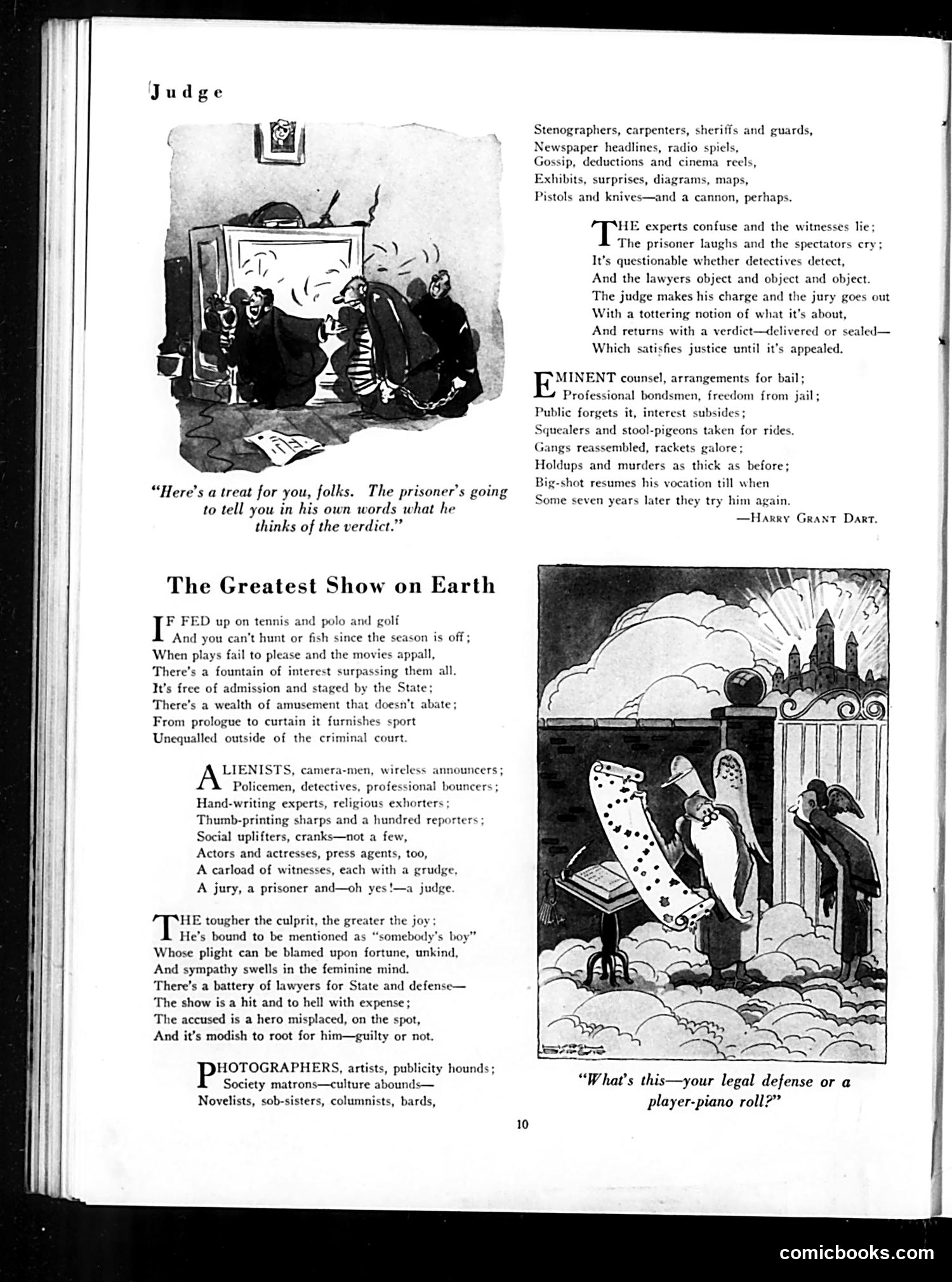
# Judge Magazine Satire: "The Greatest Show on Earth" This poem by Harry Grant Dart satirizes criminal trials as public spectacle and entertainment rather than serious justice. The piece mocks how trials attract crowds of photographers, society figures, reporters, and sensation-seekers who treat courtrooms like theater. The satire targets multiple failures: witnesses who lie, detectives of questionable competence, lawyers who endlessly object, and juries confused about their purpose. More pointedly, Dart ridicules public sympathy for criminals—wealthy or famous defendants become "heroes misplaced," while justice becomes fashionable theater rather than legitimate process. The final stanza reveals the system's futility: criminals are freed on bail, gangs reorganize, crime continues unabated, and years later the same criminals face trial again. The accompanying cartoons reinforce this cynicism about courtroom performance masquerading as justice. The work reflects 1920s-30s disillusionment with the legal system's ability to actually prevent crime or deliver meaningful consequences.
📄 Transcribed text from this page (OCR, searchable)
Machine-transcribed from the original scan — historical spelling and the odd misread are preserved.
“Here’s a treat for you, folks. The prisoner's going to tell you in his own words what he thinks of the verdict.” The Greatest Show on Earth F FED up on tennis and polo and golf And you can't hunt or fish since the season is off; When plays fail to please and the movies appall, There’s a fountain of interest surpassing them all. It’s free of admission and staged by the State; There's a wealth of amusement that doesn’t abate; From prologue to curtain it furnishes sport Unequalled outside of the criminal court. LIENISTS, camera-men, wireless announcers; Policemen, detectives, professional bouncers ; Hand-writing experts, religious exhorters ; Thumb-printing sharps and a hundred reporters ; Social uplifters, cranks—not a few, Actors and actresses, press agents, too, A carload of witnesses, each with a grudge, A jury, a prisoner and—oh yes!—a judge. HE tougher the culprit, the greater the He’s bound to be mentioned as “somebody's boy” Whose plight can be blamed upon fortune, unkind, And sympathy swells in the feminine mind. There’s a battery of lawyers for State and defense— The show is a hit and to hell with expense; The accused is a hero misplaced, on the spot, And it’s modish to root for him—guilty or not. HOTOGRAPHERS, artists, publicity hounds; Society matrons—culture abounds— Novelists, sob-sisters, columnists, bards, Stenographers, carpenters, sheriffs and guards, Newspaper headlines, radio spiels, Gossip, deductions and cinema reels, Exhibits, surprises, diagrams, maps, Pistols and knives—and a cannon, perhaps. T experts confuse and the witnesses lie; The prisoner laughs and the spectators cry; It’s questionable whether detectives detect, And the lawyers object and object and object. The judge makes his charge and the jury goes out With a tottering notion of what it’s about, And returns with a verdict—delivered or sealed— Which satisfies justice until it’s appealed. MINENT counsel, arrangements for bail; Professional bondsmen, freedom from jail; Public forgets interest subsides ; Squealers and stool-pigeons taken for rides, Gangs reassembled, rackets galore; Holdups and murders as thick as before; Big-shot resumes his vocation till when Some seven years later they try him again. —Harry Grant Dart. “What's this—your legal defense or a player-piano roll?” comicbooks.com