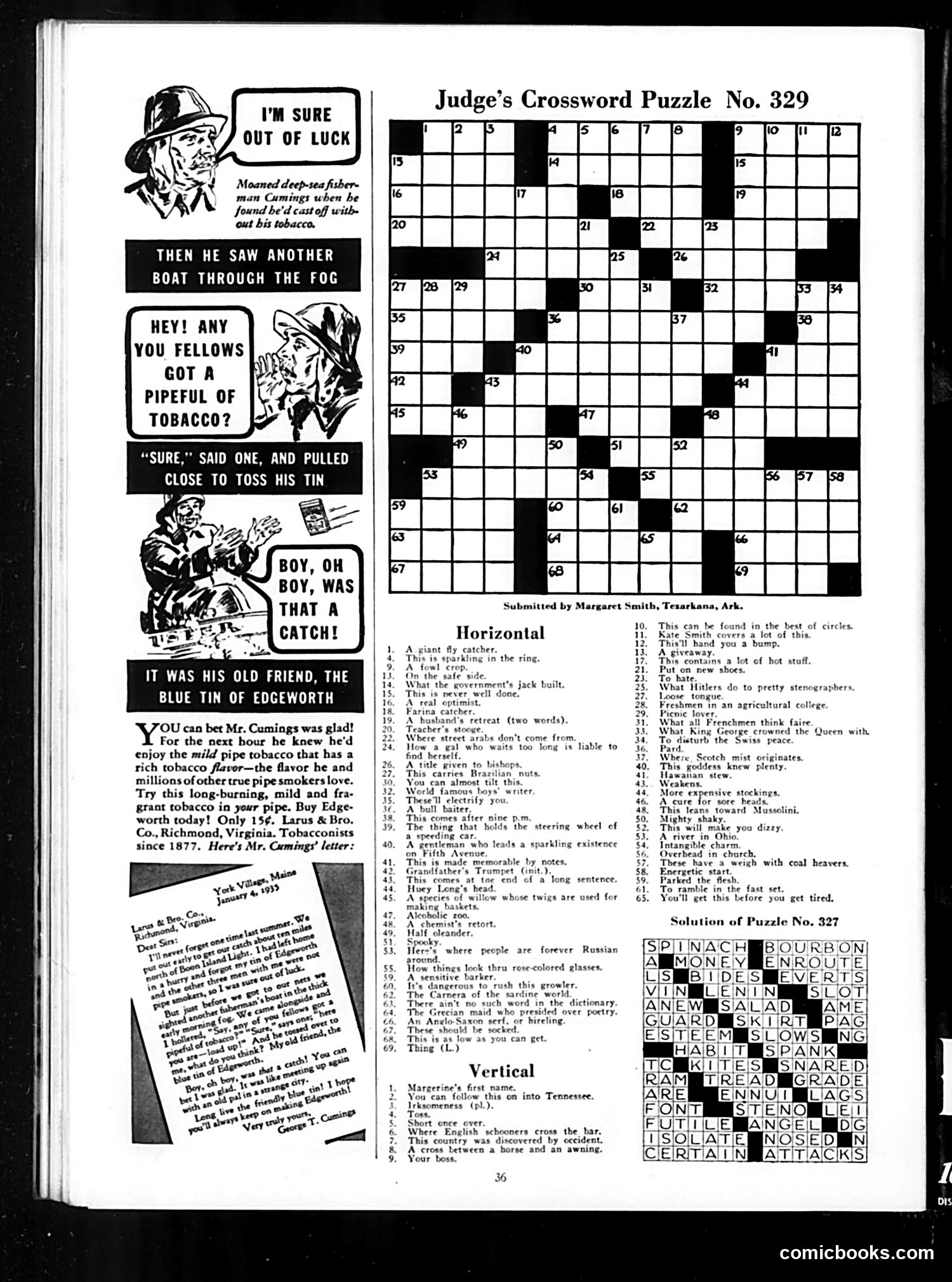
A complete issue · 40 pages · 1935
Judge — March 1935
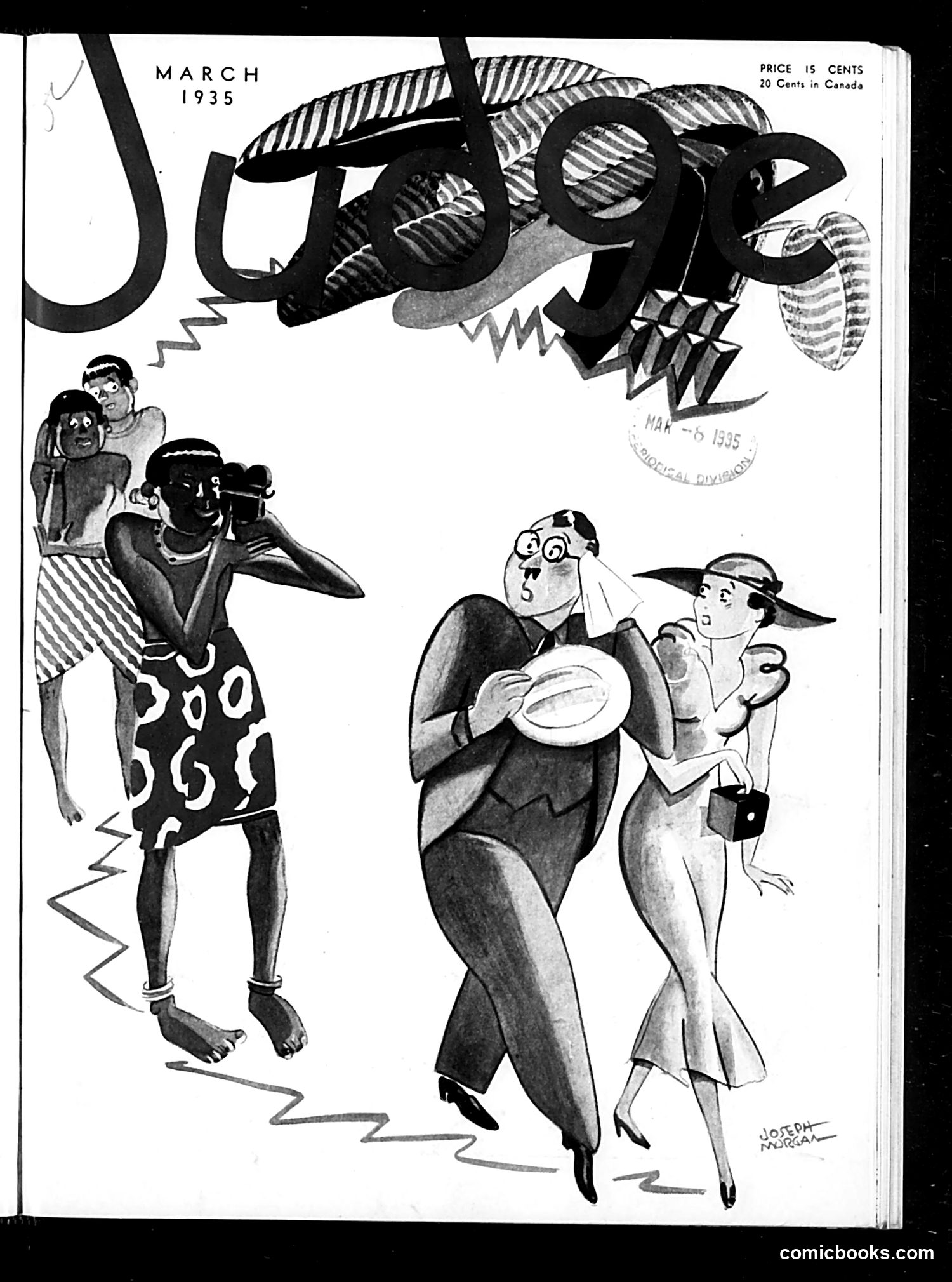
# March 1935 Judge Magazine Analysis This satirical cover depicts fear of economic consequences during the Great Depression era. The large threatening figure at top—labeled "1939"—represents anxieties about the future, specifically what might happen four years ahead. The lightning bolts and aggressive pose suggest impending disaster or conflict. Below, three figures react with alarm: people of different social classes and ethnicities appear panicked, fleeing or cowering from the looming "1939." One figure wears tropical/colonial dress, another fashionable 1930s attire. The satire critiques contemporary anxieties about economic recession, potential war, or social upheaval. By personifying a future year as a menacing monster, Judge mocks both the apocalyptic predictions circulating during the Depression and the public's susceptibility to such fears. The diverse figures suggest these anxieties crossed all social boundaries.
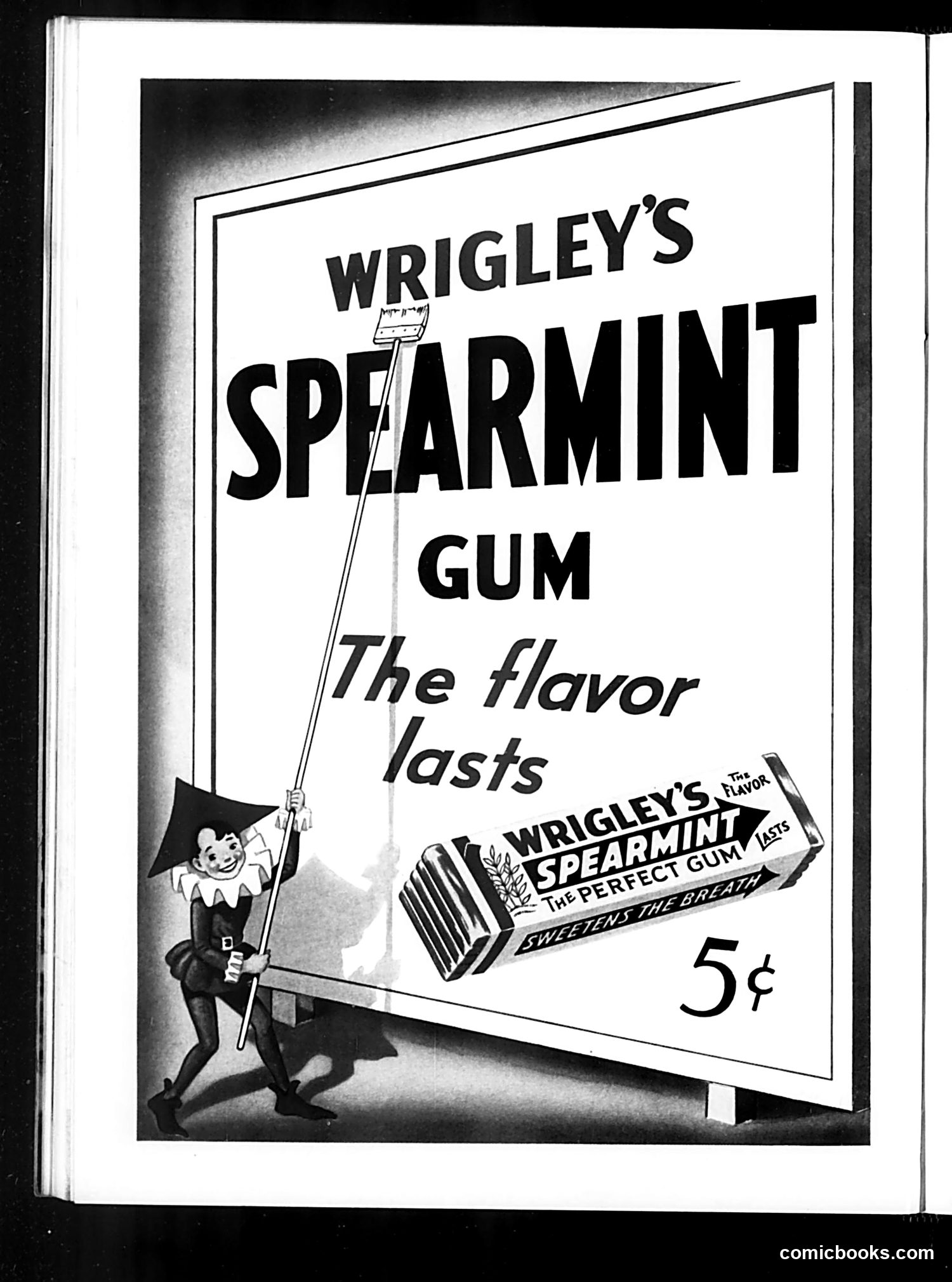
# Wrigley's Spearmint Gum Advertisement This is a straightforward **product advertisement**, not political satire. It promotes Wrigley's Spearmint gum with the marketing slogan "The flavor lasts" and highlights the tagline "The Perfect Gum" and "Sweetens the Breath." The ad features a whimsical elf or jester-like mascot character pulling down a large billboard displaying the product. This playful imagery was typical advertising design of the early-to-mid 20th century, using cartoon characters to make products memorable and appealing. The price point of **5¢** reflects the product's affordability during that era. There is **no political commentary or satire** evident on this page—it's purely commercial advertising designed to drive consumer purchases through humor and brand recognition.
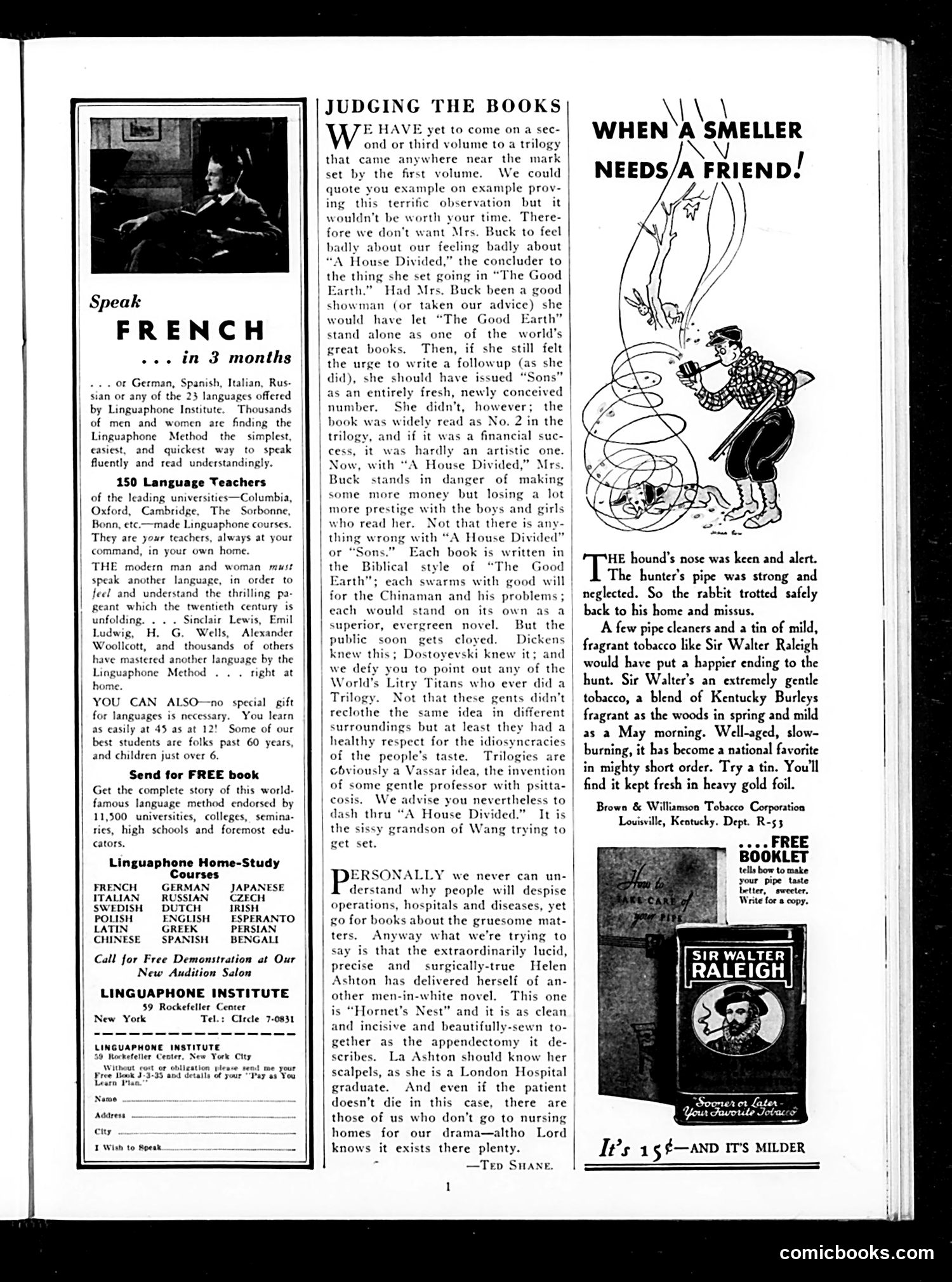
# "When a Smeller Needs a Friend" Cartoon This cartoon depicts a hunter with a hound dog that has apparently picked up a scent. The joke plays on the double meaning of "smeller" — both the dog's nose and a person with bad body odor. The setup shows the hunter helping his dog follow a trail, but the accompanying text suggests the real humor concerns a person with poor hygiene or unpleasant odor needing companionship despite this flaw. The cartoon is paired with a Sir Walter Raleigh tobacco advertisement below, emphasizing the product as a genteel, pleasant-smelling alternative — implicitly contrasting refined tobacco aroma with the "smeller" problem referenced above. The humor relies on 1920s-era sensibilities about cleanliness and social acceptability.
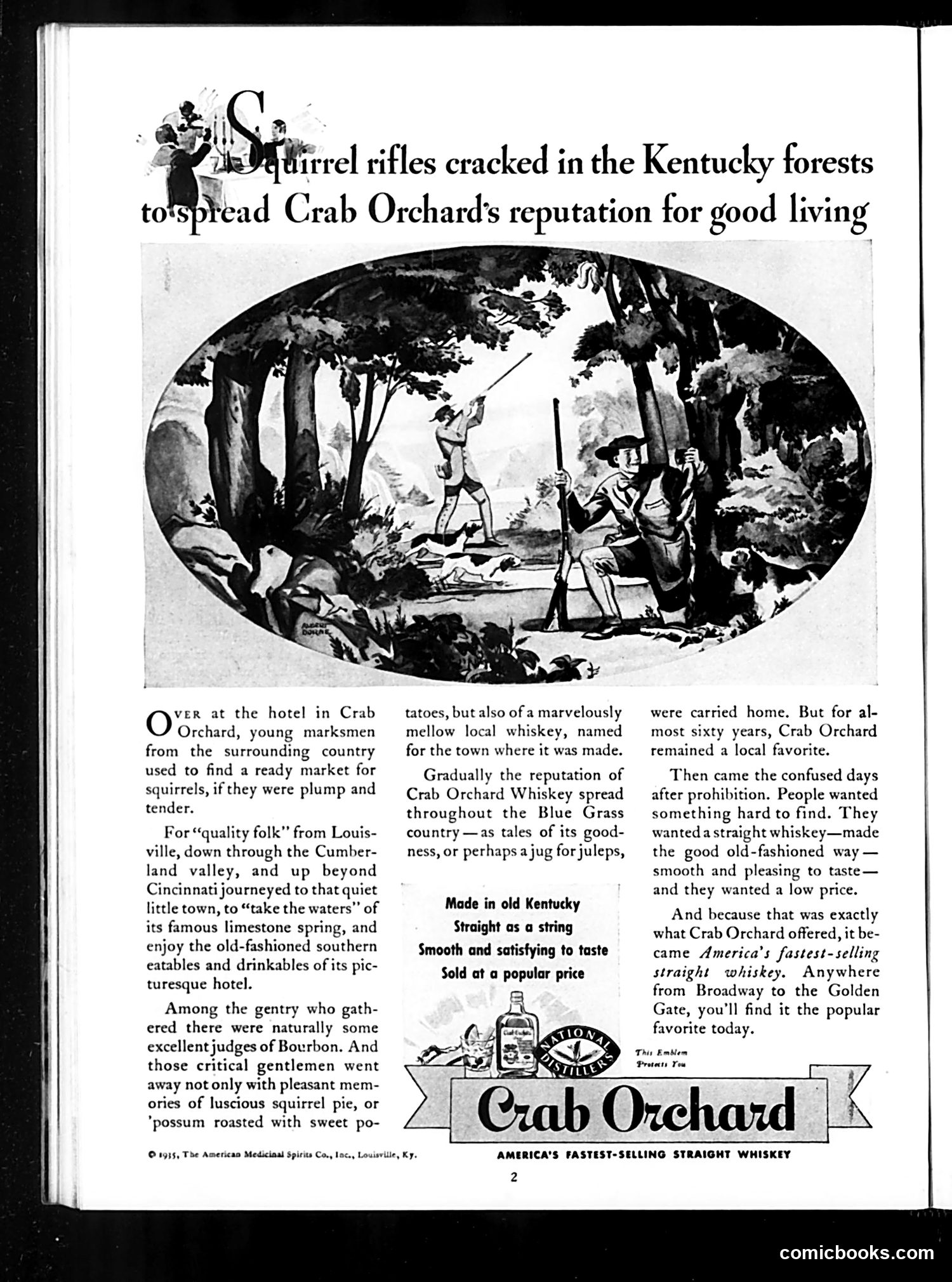
# Analysis This page is **primarily an advertisement**, not political satire. It promotes Crab Orchard Whiskey by framing the product within American frontier mythology. The illustrated oval scene depicts **colonial-era or frontier hunters** in a Kentucky forest—likely meant to evoke authenticity and tradition rather than satirize specific figures. The text constructs a narrative: Crab Orchard hotel became famous for whiskey; Prohibition made spirits scarce; consumers then sought Crab Orchard's "old-fashioned" smooth whiskey as a legal alternative. The "fastest-selling straight whiskey" claim positions the product as satisfying post-Prohibition demand. The reference to "quality folk" from Louisville to Cincinnati journeying to the spring establishes prestige through association with gentry and connoisseurs. **This is vintage advertising exploiting nostalgia and Prohibition-era scarcity**, not political commentary.
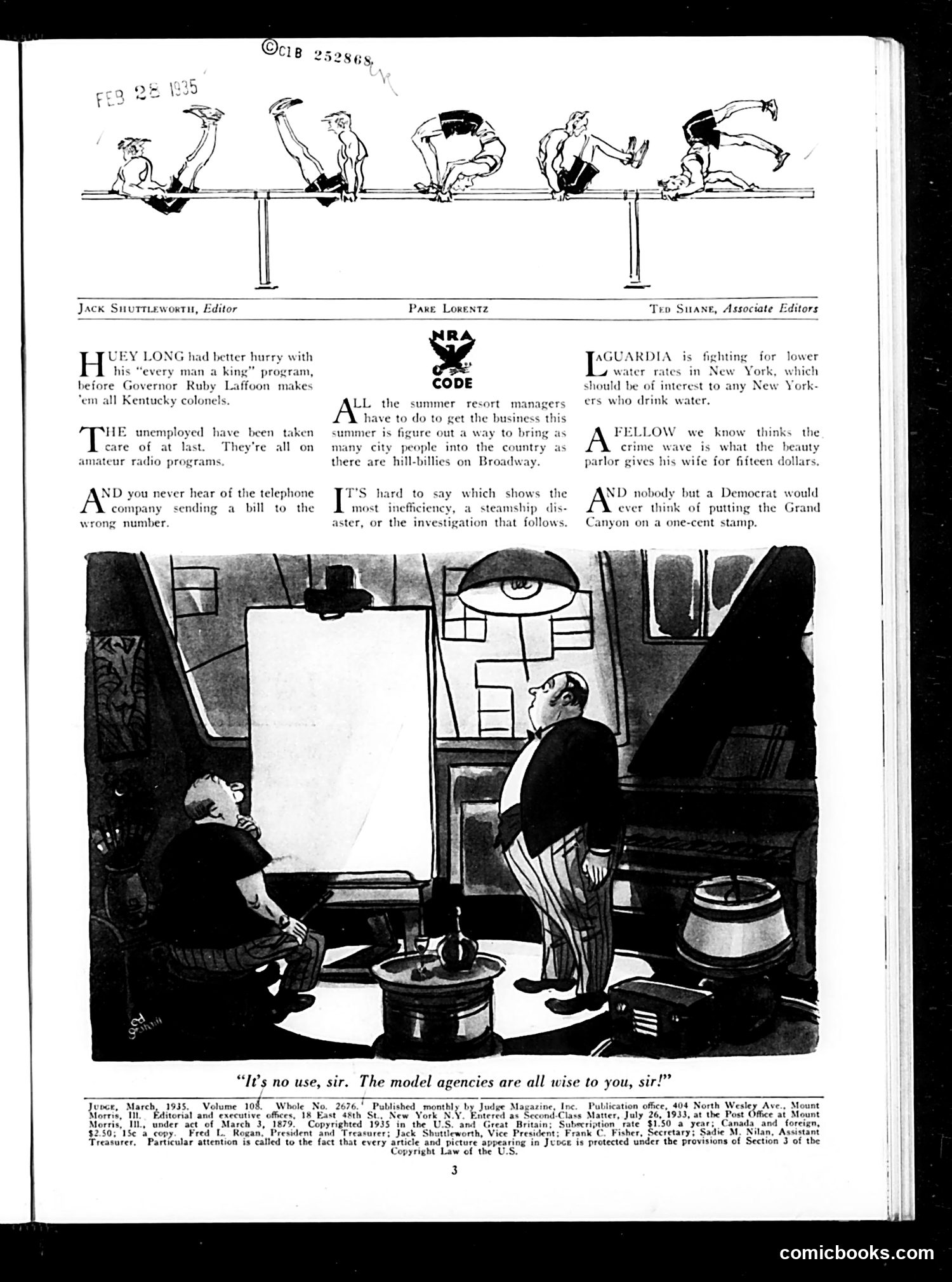
# Analysis of Judge Magazine Page (March 1935) **Main Cartoon:** A man approaches a modeling agency office, where the receptionist tells him: "It's no use, sir. The model agencies are all wise to you, sir!" The joke appears to satirize unsuccessful or persistently rejected job-seekers during the Great Depression era. The man's repeated attempts to find work through modeling agencies are futile because agencies have learned to recognize and reject him. **Sidebar Editorial Items:** Brief commentary on various 1935 topics including Huey Long's "every man a king" program, unemployment relief programs, summer resort business revival, and Grand Canyon preservation efforts. The overall page reflects Depression-era anxieties about employment and social welfare issues contemporary to March 1935.
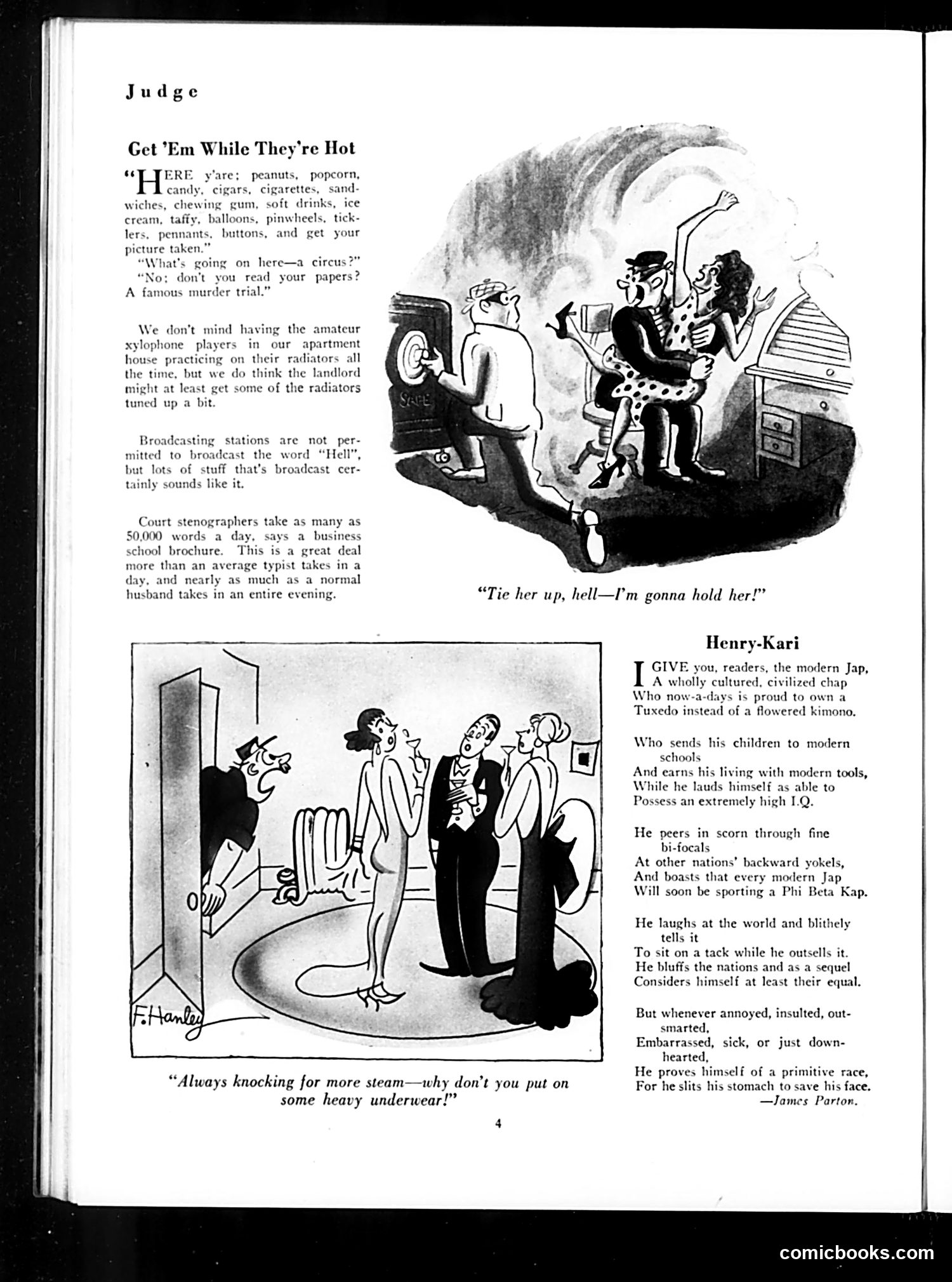
# Page Analysis: Judge Magazine **Top Cartoon ("Get 'Em While They're Hot"):** Depicts a circus-like scene with a barker selling concessions (peanuts, popcorn, candy). The joke satirizes urban apartment living—neighbors complaining about amateur xylophone practice and radiators, while advertising/broadcasting stations avoiding saying "Hell" but broadcasting other crude content. The satire critiques selective moral standards and urban noise pollution. **Bottom Cartoon ("Always knocking for more steam"):** Shows a man in a bathtub surrounded by fully-clothed guests. The caption jokes about someone constantly demanding more steam/hot water while underdressed. This appears to be domestic humor about household complaints and comfort expectations. **"Henry-Kari" Poem:** A satirical character portrait of a modern Japanese man adopting Western customs (tuxedo instead of kimono, attending modern schools) while remaining superficially arrogant about Japanese superiority. The satire mocks pretentious cultural hypocrisy.
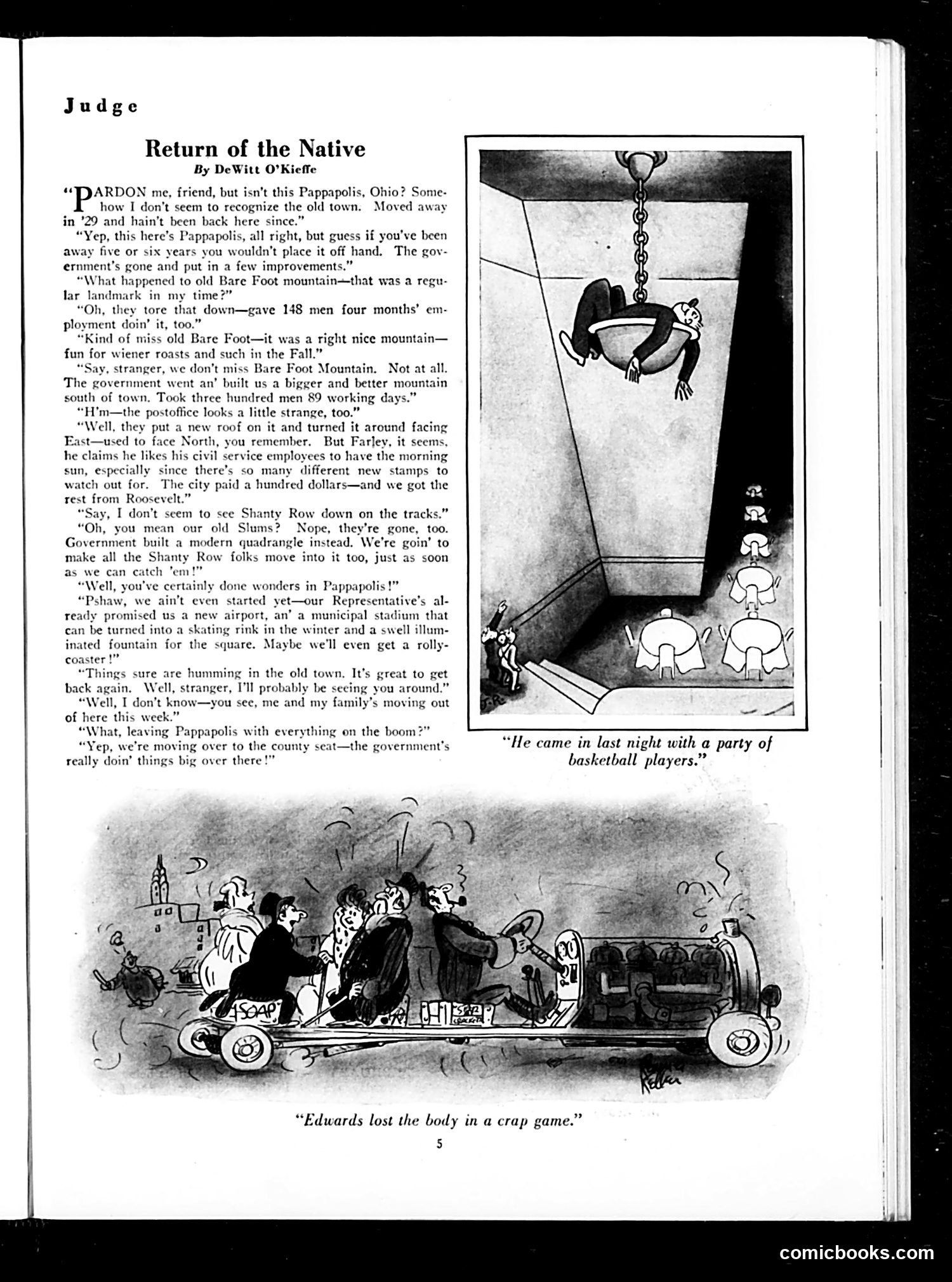
# "Return of the Native" by DeWitt O'Kieffe This satirical piece mocks the changes in Pappapolis, Ohio after someone left and returned five or six years later. The dialogue humorously contrasts what was lost (old landmarks like Bare Foot Mountain, demolished for government projects) with what was gained (new government buildings, a reoriented post office, promised but unbuilt airport and stadium). The cartoon critiques government inefficiency and over-development—tearing down natural/historic landmarks to build bureaucratic infrastructure that yields minimal practical benefit. The final cartoon captioning "Edwards lost the body in a crap game" suggests the absurdity and moral decay accompanying these "improvements." The satire targets early 20th-century American municipal development and government waste disguised as progress.
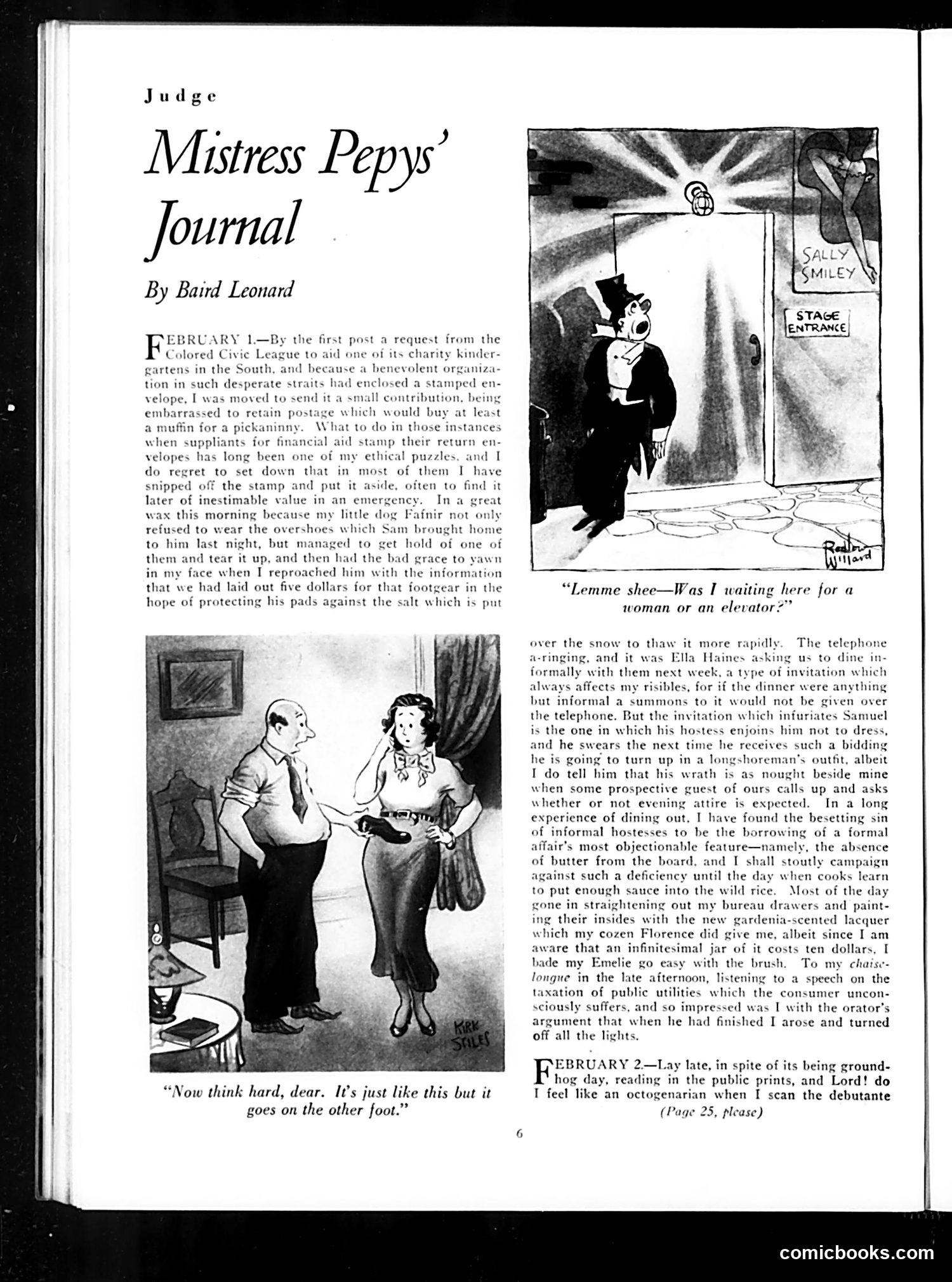
# Judge Magazine: "Mistress Pepys' Journal" This is a satirical column by Baird Leonard mimicking Samuel Pepys' famous diary, but written from a female perspective observing high society. The two cartoons illustrate humorous domestic situations: **Top cartoon**: A man in formal attire appears confused entering what seems to be a theater or building, with the caption suggesting he's uncertain whether he's waiting for a woman or an elevator—poking fun at gender roles and modern confusion. **Bottom cartoon**: Shows a woman instructing a man on proper etiquette, captioned "Now think hard, dear. It's just like this but it goes on the other foot"—likely depicting instruction on proper formal dress or dance steps, mocking husbands' incompetence at social graces. The column satirizes upper-class social expectations, gender dynamics, and domestic life in the early 20th century.
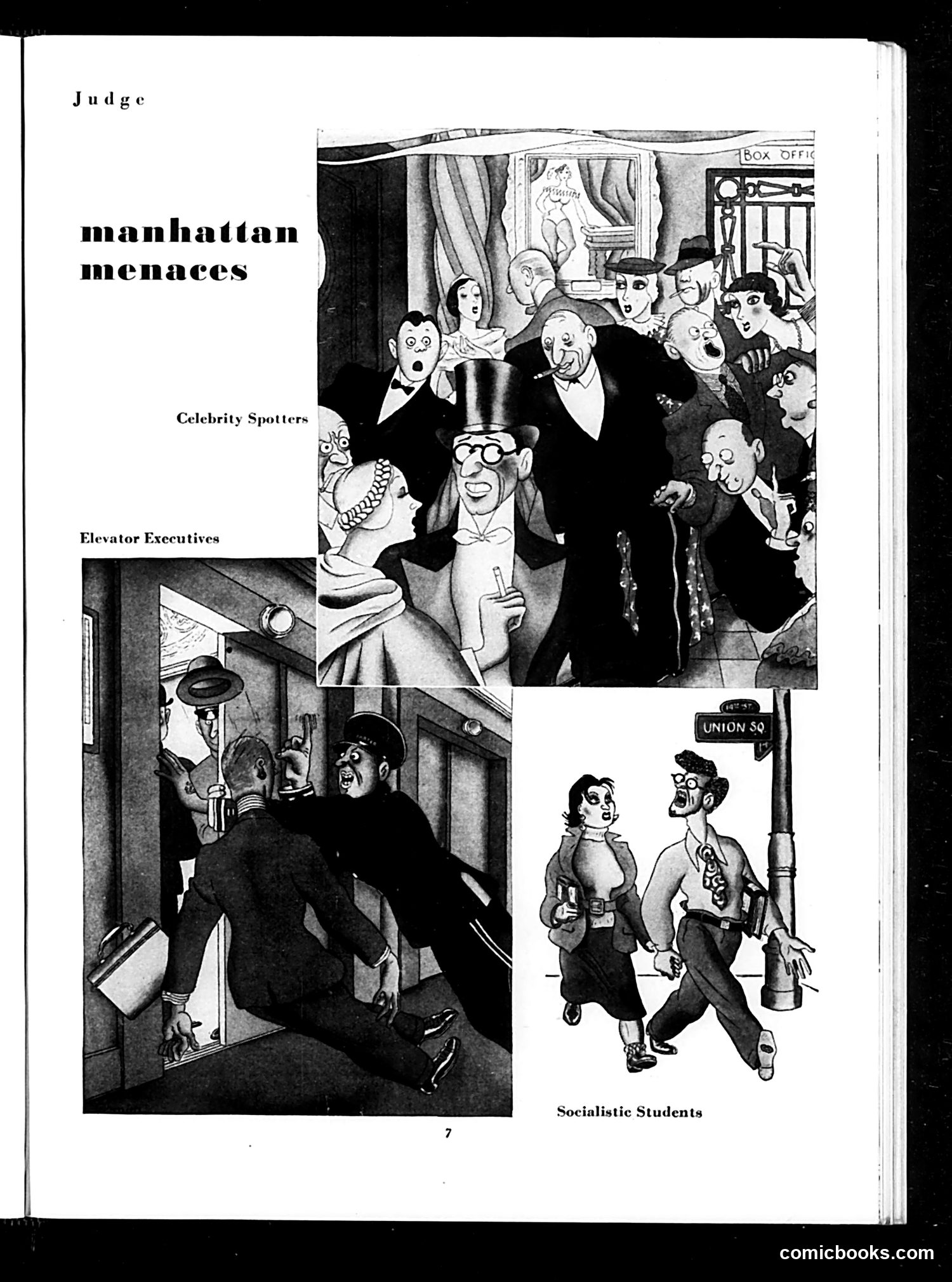
# Analysis of Judge Magazine Page 7 This page contains three satirical cartoon sections titled "manhattan menaces": **"Celebrity Spotters"** (top): Depicts exaggerated caricatures of well-dressed theatergoers with shocked expressions, suggesting mockery of society people who frequent theaters and public venues while being overly dramatic or pretentious. **"Elevator Executives"** (left): Shows businessmen in an elevator, apparently portraying urban office workers in cramped or awkward situations—likely satirizing the absurdities of daily commuter life in Manhattan's growing business culture. **"Socialistic Students"** (bottom right): Features young people at Union Square, a known gathering place for political radicals and leftist activists in 1920s-30s New York, caricatured with exaggerated features in a derisive manner typical of anti-communist satire of the era. The overall theme mocks various Manhattan social types and perceived threats to traditional society.
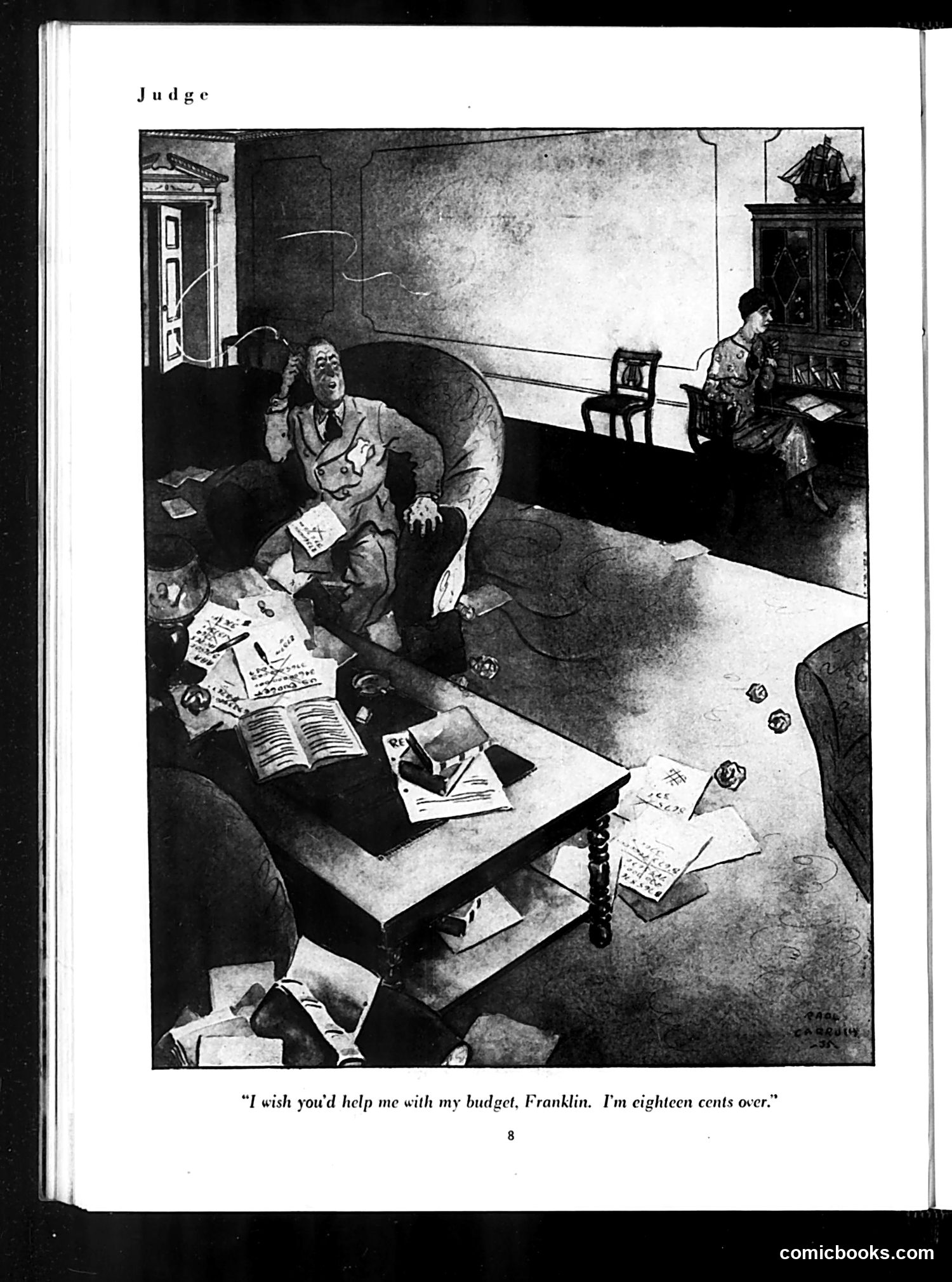
# "Judge" Cartoon Analysis This single-panel cartoon satirizes household financial struggles, likely from the early-to-mid 20th century. A woman sits surrounded by scattered bills, ledgers, and accounting papers, appearing overwhelmed by her budgeting efforts. She asks "Franklin" (presumably her husband, shown standing on the right) to help her with her household budget—she's overspent by just eighteen cents. The satire targets the tension between meticulous household management and marital dynamics. The woman's desperate plea over a trivial overage suggests the impossible standards women faced in managing domestic finances precisely, while husbands often remained uninvolved or dismissive of such work. The modest amount (eighteen cents) amplifies the absurdity of her distress, highlighting how women bore responsibility for financial propriety in matters both significant and trivial.
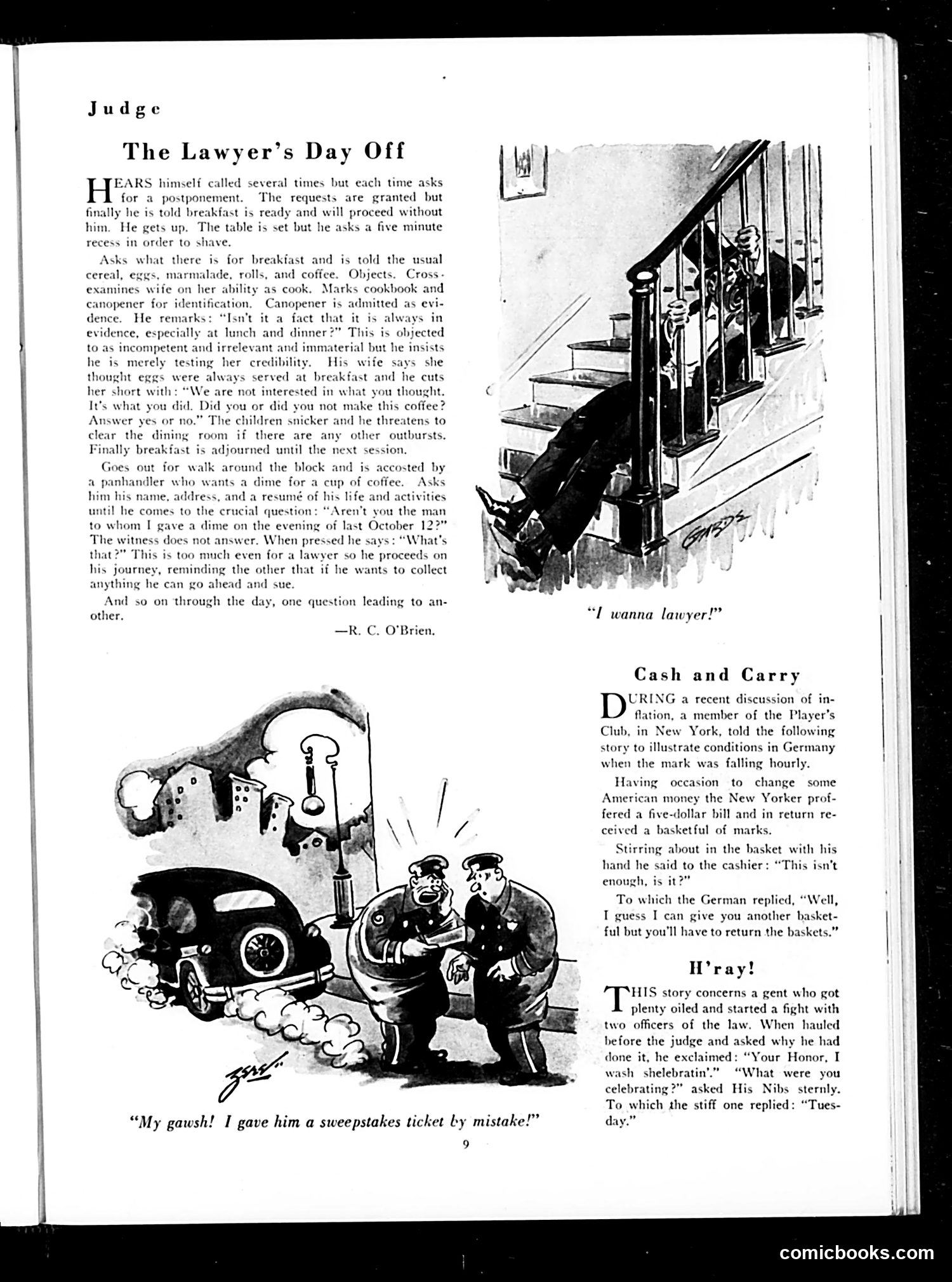
# Judge Magazine Page Analysis This page contains three humorous pieces satirizing American life circa the 1920s: **"The Lawyer's Day Off"** mocks obsessive legal minds. A lawyer treats his entire day—breakfast, casual encounters—as courtroom cross-examinations, objecting to his wife's cooking, interrogating a panhandler about a past dime, and treating simple conversations as evidentiary proceedings. The satire targets how certain professionals cannot separate their work mentality from domestic life. **"Cash and Carry"** references hyperinflation in post-WWI Germany, where currency became so worthless that exchanging five American dollars yields a full basket of marks. The joke's dark humor lies in the cashier's quip that the customer must return the baskets—the container is worth more than the money inside. **"H'ray!"** presents a drunk man who assaults police officers, then tells the judge he was "celebrating Tuesday"—absurd justification suggesting he gets drunk every day for no particular reason. All three pieces exemplify Judge's satirical approach to professional pretension, economic chaos, and human folly.
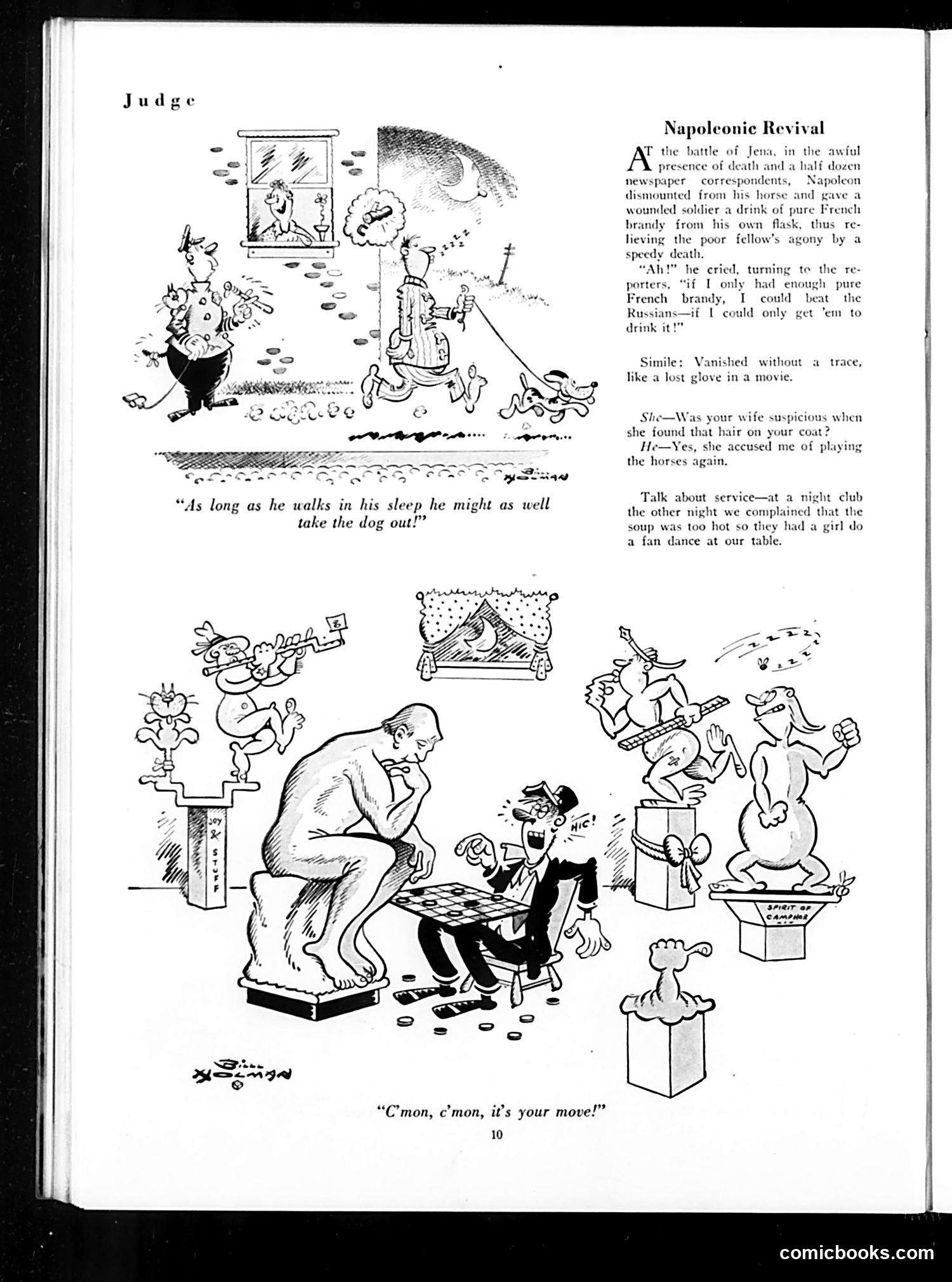
# Explanation for Modern Readers This *Judge* magazine page contains three separate humor pieces: 1. **Top cartoon**: A sleepwalker inadvertently walks the dog while asleep—the joke being he's useful even unconscious. 2. **"Napoleonic Revival"** article: A satirical anecdote mocking Napoleon's military failures. It claims he gave brandy to a wounded soldier at the Battle of Jena, then suggests his defeat of the Russians would require getting them drunk on French brandy—absurdist humor suggesting Napoleon's legendary abilities were exaggerated or that alcohol could explain military outcomes. 3. **Bottom cartoon**: A man caught with another woman's hair on his coat tries to blame it on horses; his wife predictably doesn't believe him. The page represents typical early-20th-century *Judge* content: light domestic comedy, military/historical satire, and sophisticated wordplay aimed at educated readers. The "Napoleonic Revival" reference appears to allude to contemporary discussions of Napoleon's legacy, though the specific historical moment remains unclear without publication date context.
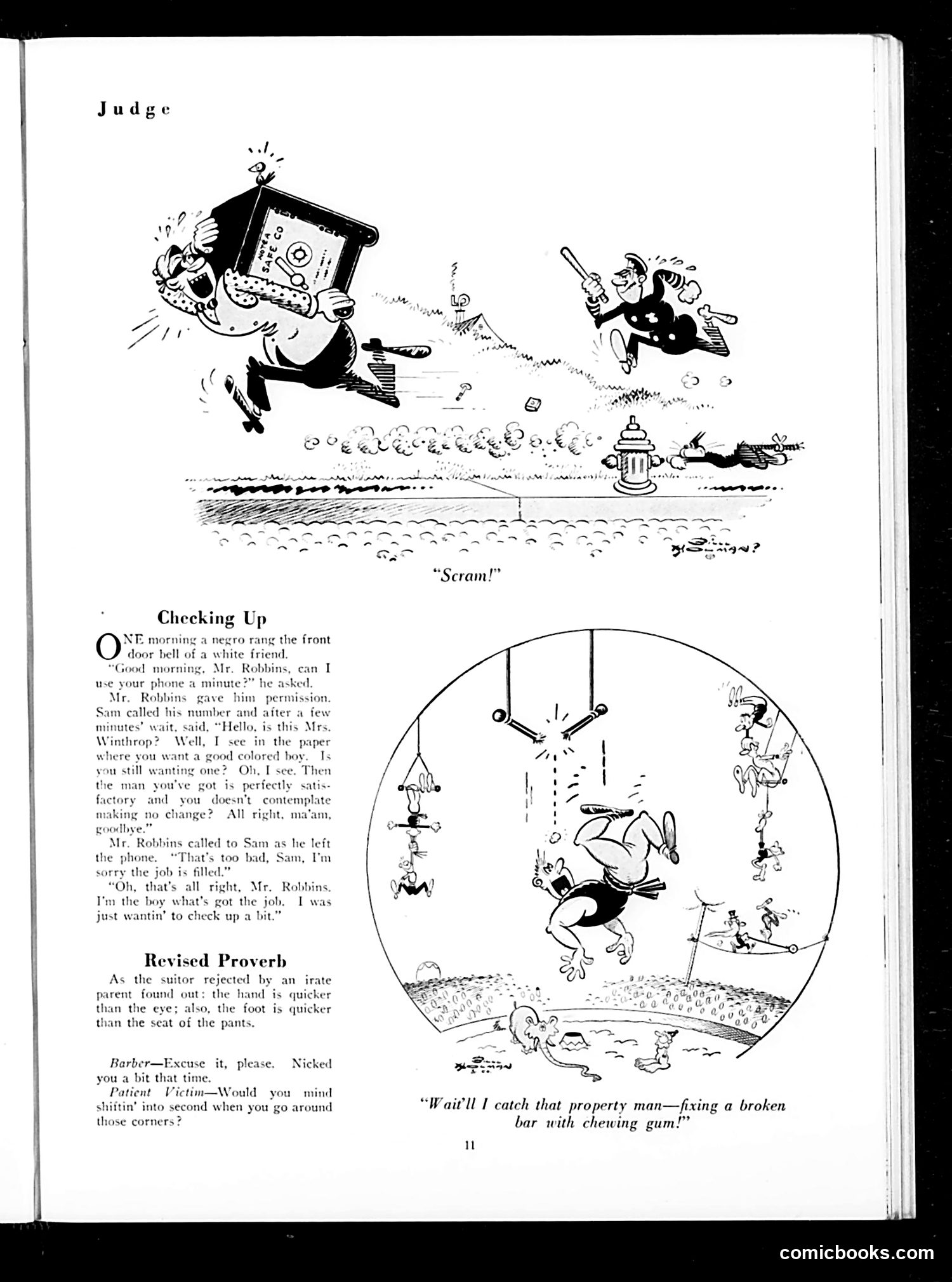
# "Checking Up" - Judge Magazine Satire The top cartoon depicts a judge being chased by a man with a club, labeled "Scram!" — satirizing judicial authority being undermined or fleeing from consequence. The main text story, "Checking Up," uses racist dialect humor typical of early-20th-century American comedy. A Black man named Sam borrows a white man's phone to call about a job opening for "a good colored boy." When told the position is filled, Sam reveals he was actually *checking* — he already has that job and was verifying the employer's satisfaction. The "joke" plays on the era's stereotype of Black workers as dishonest or duplicitous. "Revised Proverb" offers crude humor about a suitor being physically ejected by an angry father — the hand (hitting) and foot (kicking) being faster than the eye. The circular cartoon shows chaos around a clock with various figures, captioned about "catching that property man—fixing a broken bar with chewing gum!" — likely backstage theater satire about cheap repairs. All content reflects early-20th-century vaudeville-influenced humor standards.