
Judge, 1935-03 · page 11 of 40
Judge — March 1935 — page 11: what you’re looking at
What you’re looking at
# Judge Magazine Page Analysis This page contains three humorous pieces satirizing American life circa the 1920s: **"The Lawyer's Day Off"** mocks obsessive legal minds. A lawyer treats his entire day—breakfast, casual encounters—as courtroom cross-examinations, objecting to his wife's cooking, interrogating a panhandler about a past dime, and treating simple conversations as evidentiary proceedings. The satire targets how certain professionals cannot separate their work mentality from domestic life. **"Cash and Carry"** references hyperinflation in post-WWI Germany, where currency became so worthless that exchanging five American dollars yields a full basket of marks. The joke's dark humor lies in the cashier's quip that the customer must return the baskets—the container is worth more than the money inside. **"H'ray!"** presents a drunk man who assaults police officers, then tells the judge he was "celebrating Tuesday"—absurd justification suggesting he gets drunk every day for no particular reason. All three pieces exemplify Judge's satirical approach to professional pretension, economic chaos, and human folly.
📄 Transcribed text from this page (OCR, searchable)
Machine-transcribed from the original scan — historical spelling and the odd misread are preserved.
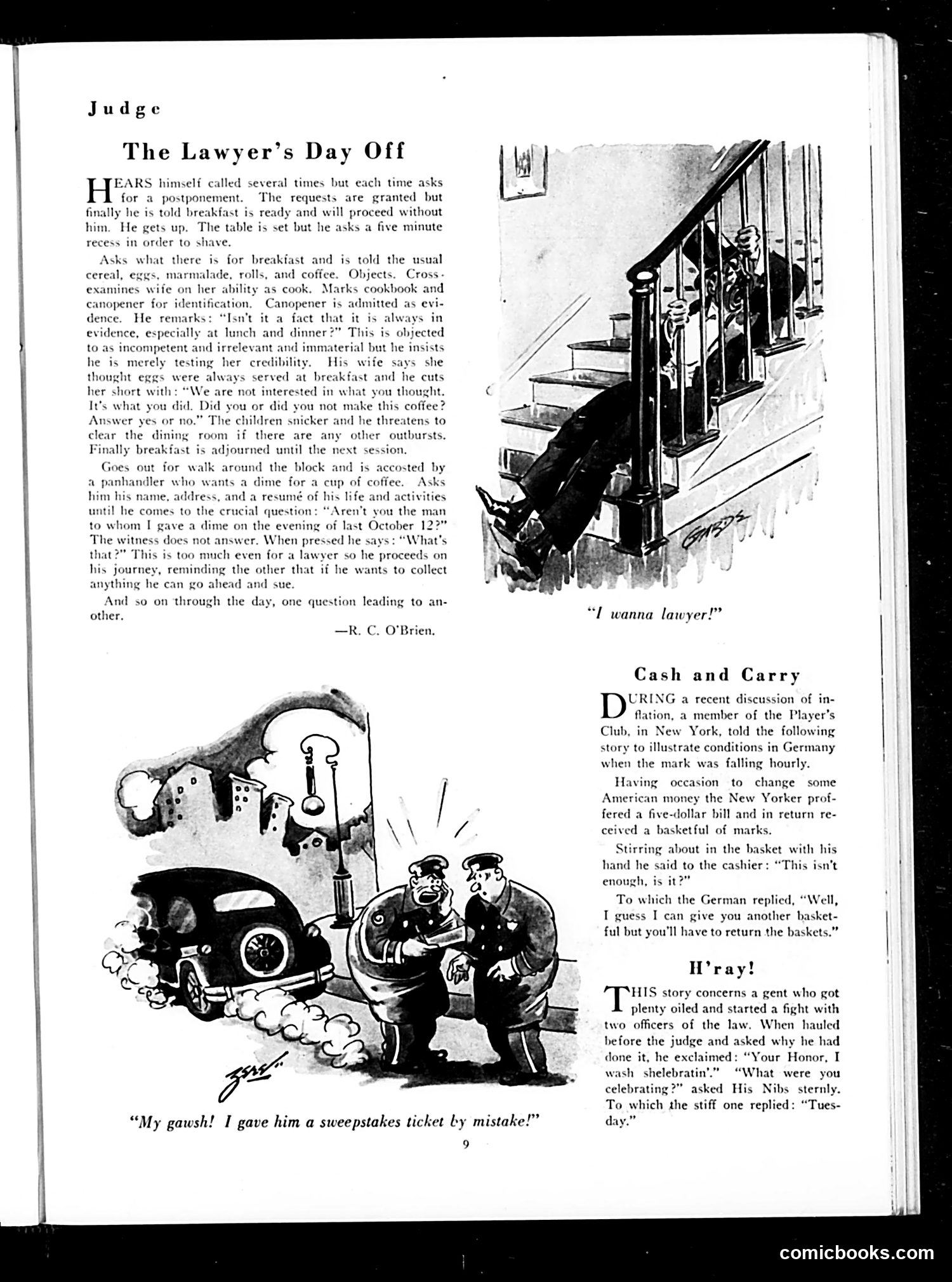
Judge The Lawyer’s Day Off RS himself called several times but each time asks for a postponement. The requests are granted but finally he is told breakfast is ready and will proceed without him. He gets up, The table is set but he asks a five minute recess in order to shave. Asks what there is for breakfast and is told the usual cereal, eggs, marmalade, rolls, and coffee. Objects. Cross- examines wife on her ability as cook. Marks cookbook and canopener for ntification, Canopener is admitted a dence. He remarks: “Isn't it a fact that it is alwa evidence, especially at lunch and dinner to as incompetent and irrelevant and imm evi- ys in This is objected rial but he insists he is merely testing her credibility, His wife says she thought eggs were always served at breakfast and he cuts her short with: “We are not interested in what you thought. It's w you did. Did you or did you not make this coffee? Answer yes or no.” The children snicker and he threatens to r the dining room if there are any other outbursts. Finally breakfast is adjourned until the next sessiot Goes out for walk around the block and is a panhandler who wants a dime for a cup of coffe him his name, address, and a resumé of his li until he comes to the crucial question: “Aren't you the man to whom I gave a dime on the evening of last October 1 The witness does not answer. When pressed he says: “What's that?” This is too much even for a lawyer so he proceeds on his journey, reminding the other that if he wants to collect anything he can go ahead and sue. And so on through the day, one question leading to an- other, —R. C. O'Brien. ‘1 wanna lawyer!” Cash and Carry |B yarone a recent discussion of in- flation, a member of the Player's Club, in New York, told the following story to illustrate conditions in Germany when the mark was falling hourly. Having occasion to change some American money the New Yorker prof- fered a five-dollar bill and in return re- ceived a basketful of marks. Stirring about in the basket with his hand he said to the cashier: “This isn’t enough, is it?” To which the German replied, “Well, I guess I can give you another basket- | ful but you'll have to return the baskets.” | H’ray! HIS story concerns a gent who got plenty oiled and started a fight with two officers of the law. When hauled before the judge and asked why he had done it, he exclaimed: “Your Honor, I wash shelebratin’.”. “What were you celebrating?” asked His Nibs sternly. To which the stiff one replied: “Tues- day.” comicbooks.com