A complete issue · 41 pages · 1934
Judge — June 1934
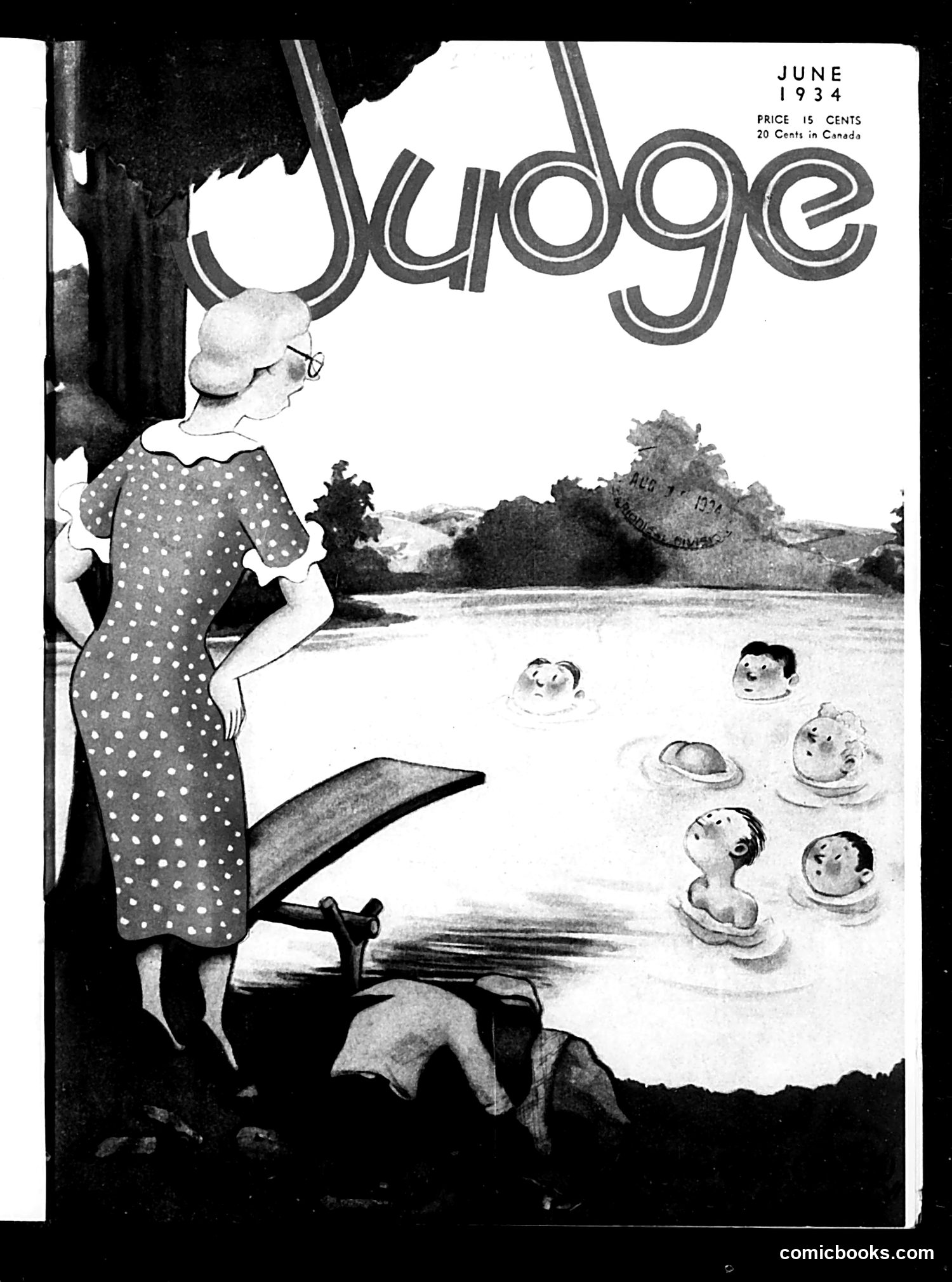
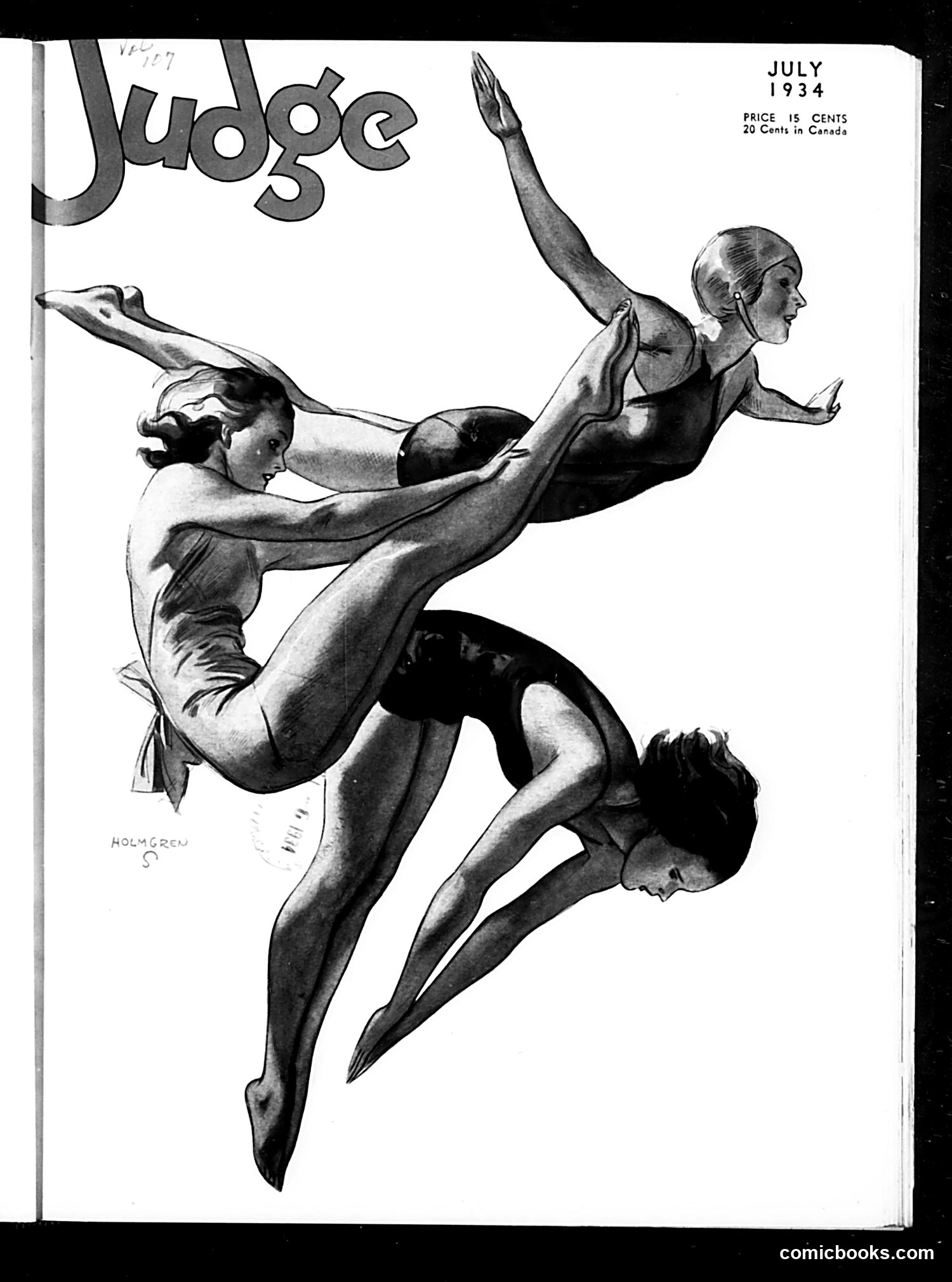
# Judge Magazine, June 1934 This cover depicts a woman in a polka-dot dress observing several children swimming or bathing in water. The cartoon likely satirizes summer recreation during the Great Depression era. The exaggerated, somewhat grotesque rendering of the children's faces suggests social commentary—possibly mocking working-class leisure activities, or commenting on public bathing practices of the period. The woman's fashionable dress and glasses suggest she represents a middle or upper-class observer. Without additional context or visible text identifying specific figures, the precise satirical target remains unclear, though the composition suggests commentary on class differences or summer pastimes during this economically difficult period.
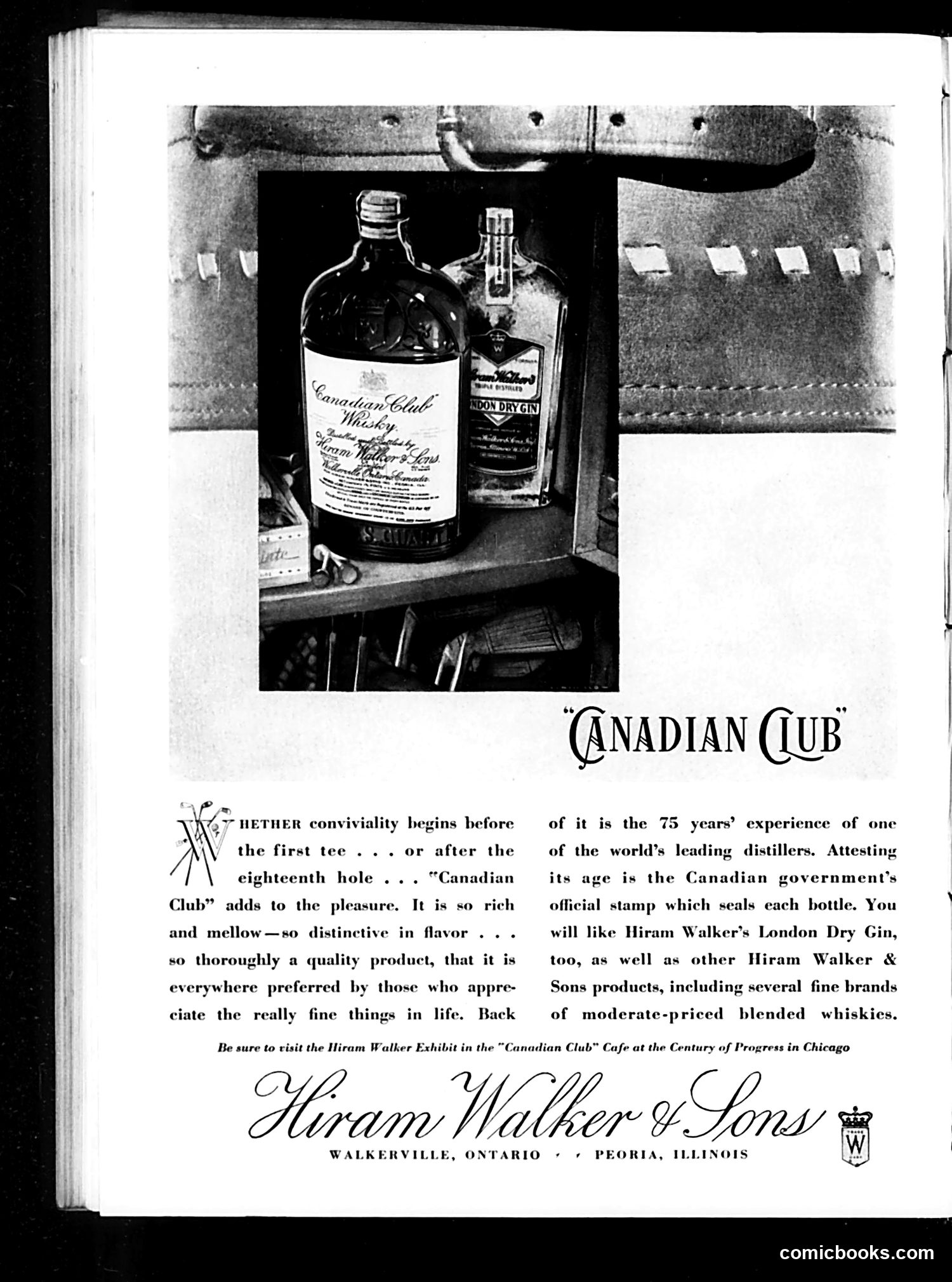
# Analysis This page is **primarily an advertisement**, not a political cartoon. It promotes "Canadian Club" whisky and other Hiram Walker & Sons spirits products. The ad features a photograph of liquor bottles in what appears to be a display case or cabinet. The marketing copy emphasizes the whisky's quality, 75 years of distillery experience, and Canadian government authentication stamps on bottles. It also mentions Hiram Walker's London Dry Gin and "moderate-priced blended whiskies." The ad invites readers to visit "the Hiram Walker Exhibit in the 'Canadian Club' Cafe at the Century of Progress in Chicago"—referencing the 1933 World's Fair. There is **no political satire or cartoon content** visible on this page; it is straightforward commercial advertising typical of Judge magazine's revenue model.
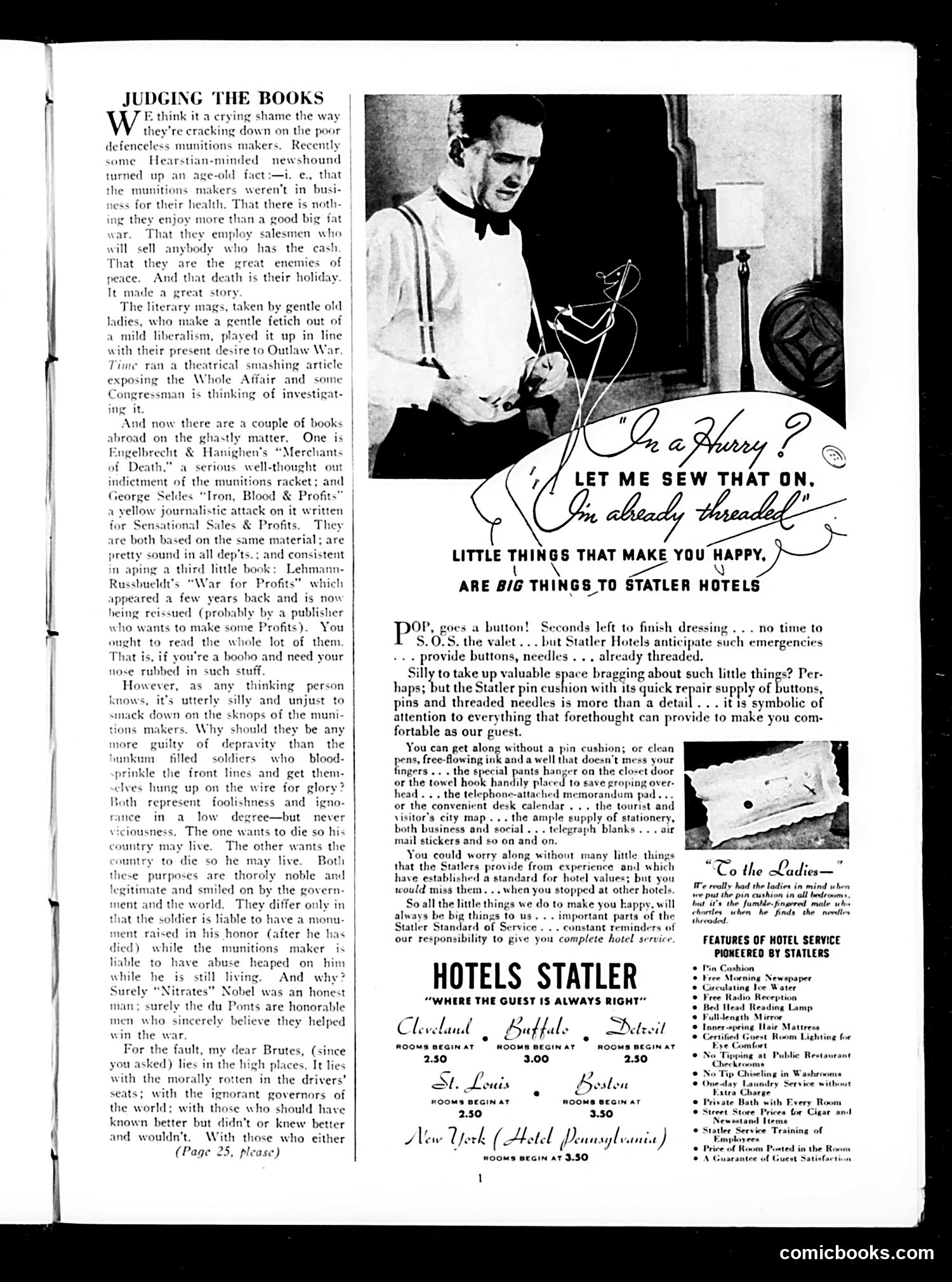
# Page Analysis This page is primarily a **Statler Hotels advertisement**, not a political cartoon. The top half contains an article titled "Judging the Books" criticizing munitions manufacturers and yellow journalism, followed by a photograph of a man sewing with the caption "Or a Hurry? Let Me Sew That On." The advertisement emphasizes Statler Hotels' attention to detail—providing buttons, needles, and thread for guests. The text humorously argues that such "little things" are actually "big things" that distinguish quality hotels and reflect the "Statler Standard of Service." The bottom half lists five Statler Hotel locations with room rates (ranging from $2.50-$3.50) and features of their service. This is primarily **commercial advertising**, not satire or political commentary.
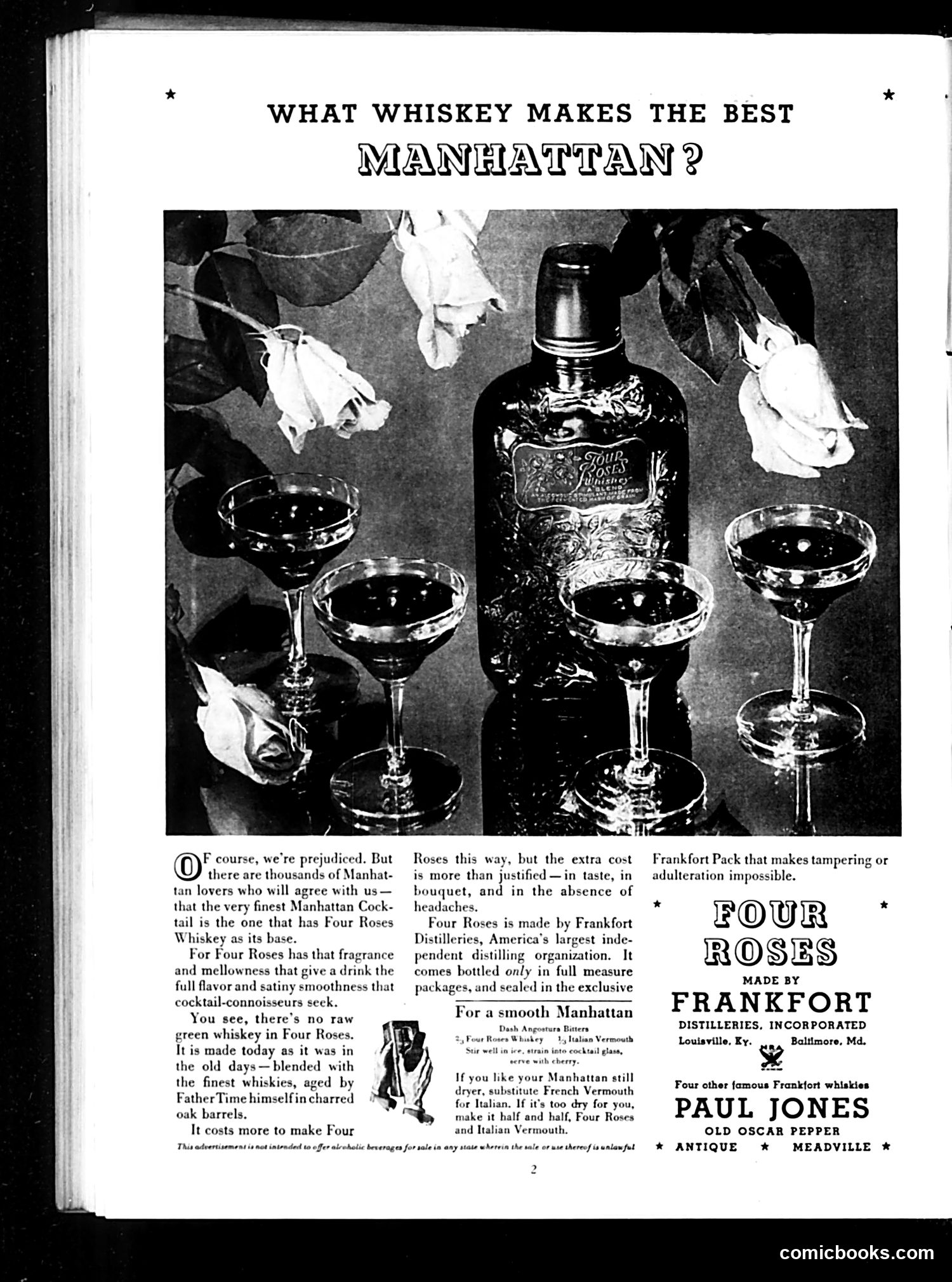
This page is primarily a **whiskey advertisement**, not political satire. It promotes Four Roses whiskey as the ideal base for Manhattan cocktails, targeting upscale drinkers during what appears to be the Prohibition era or its aftermath. The advertisement emphasizes Four Roses' superiority: no "raw green whiskey," aged properly in oak barrels, and sealed in tamper-proof bottles by Frankfort Distilleries in Louisville, Kentucky. The elegant black-and-white photograph shows sophisticated cocktail glasses alongside roses and the whiskey bottle. The text positions Four Roses as premium and costly but worth the expense for taste and smoothness. It includes a recipe variation for those preferring drier Manhattans using French Vermouth. This is marketing content, not editorial commentary or political humor.
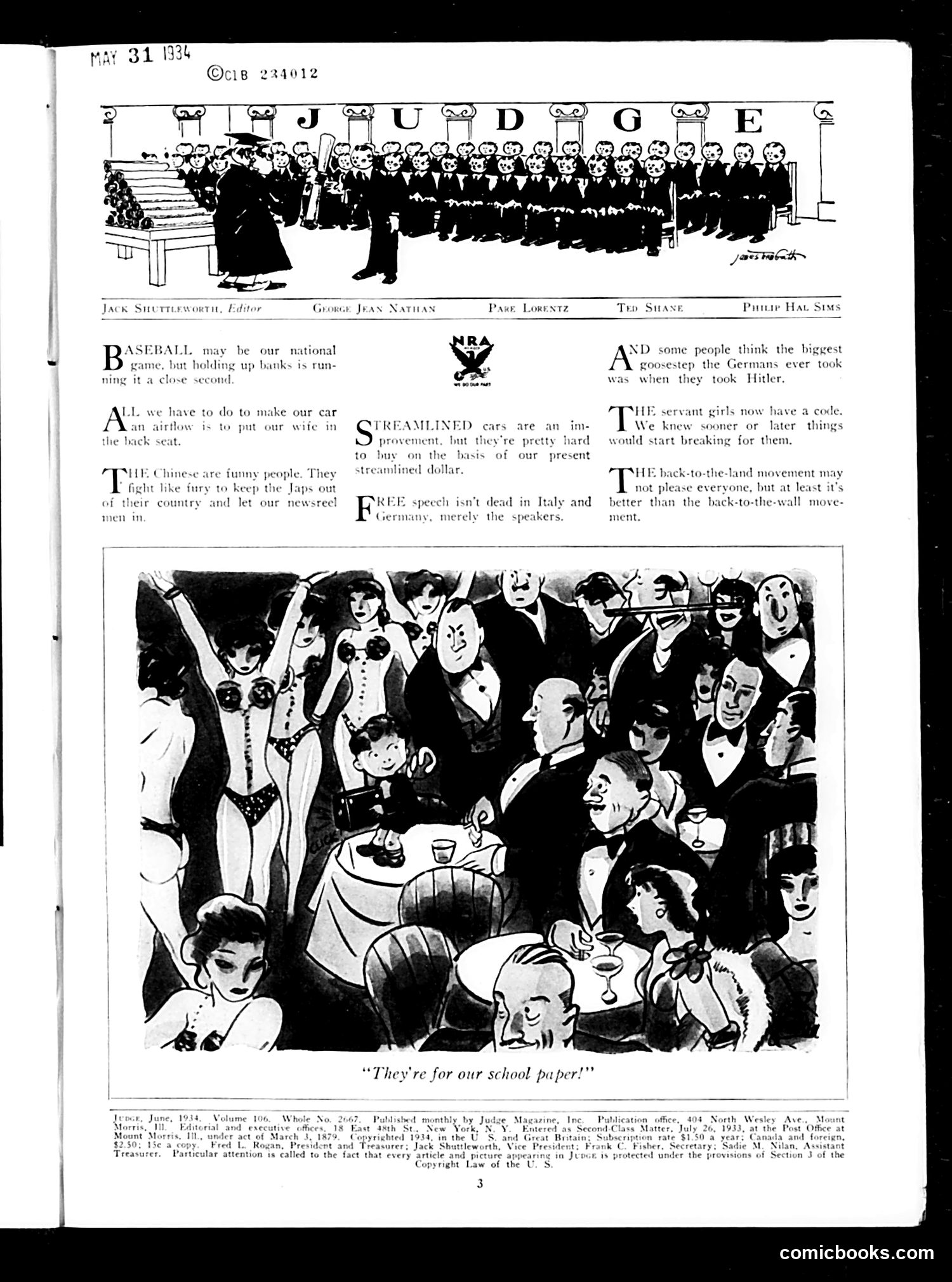
# Analysis of Judge Magazine Page (May 31, 1934) The page contains editorial commentary on contemporary issues rather than a traditional political cartoon. The editorial quips critique: 1. **Baseball and banking**: A joke about holding up banks being "running it a close second" to baseball suggests Depression-era anxiety about financial institutions. 2. **Cars and wives**: Satirizes consumer culture and gender relations ("put our wife in the back seat"). 3. **Hitler and goose-stepping**: References Nazi Germany's recent rise, mocking Hitler's ideology. 4. **Servant girls and codes**: Appears to reference labor regulations or unionization efforts affecting domestic workers. 5. **Free speech**: Notes that free speech remains protected in Italy and Germany "merely the speakers" — dark irony about fascist censorship. The bottom illustration depicts a glamorous nightclub scene, captioned "They're for our school paper!" — likely satirizing sensationalism or inappropriate content.
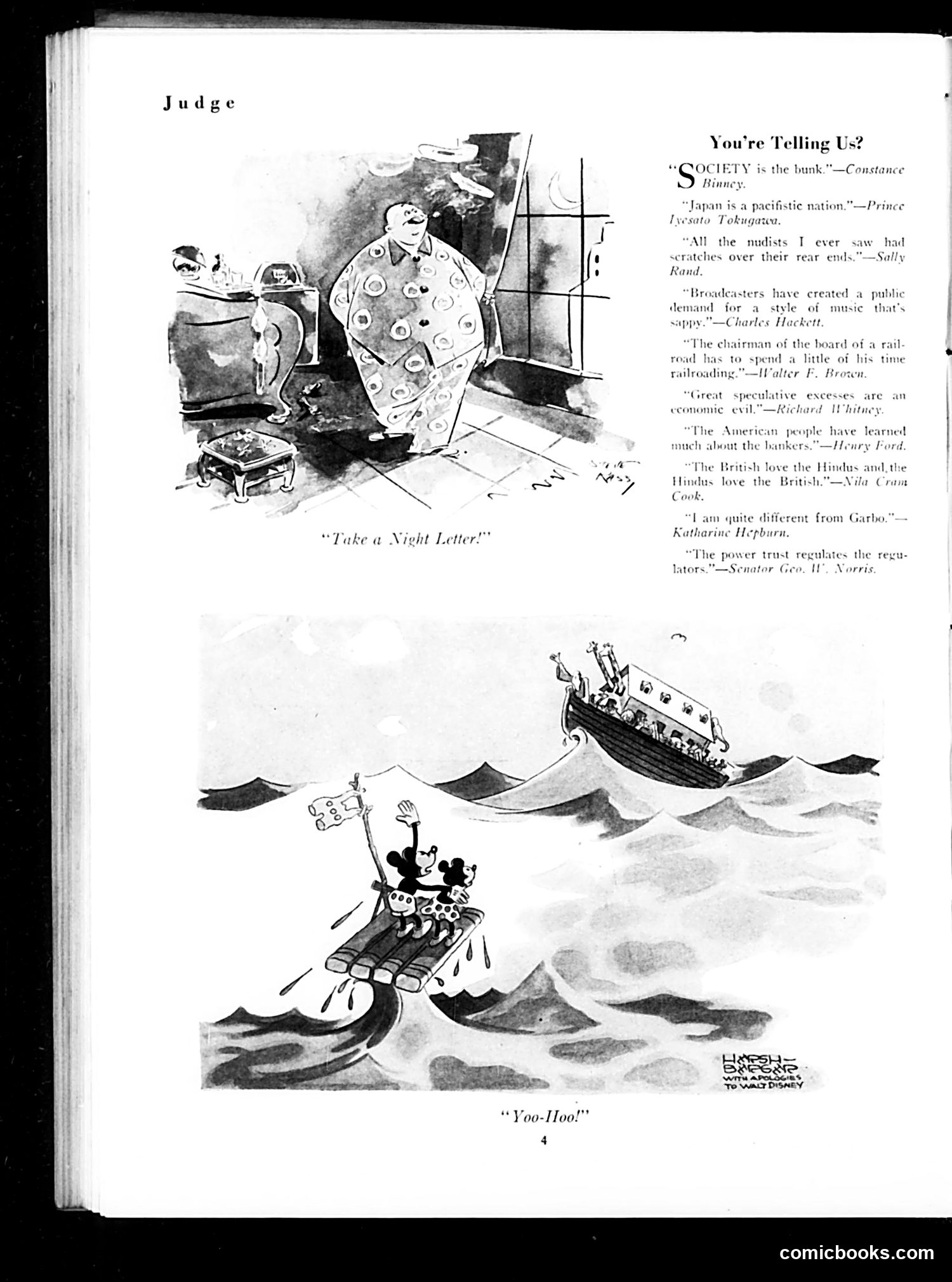
# Analysis of Judge Magazine Page This page contains two political cartoons and a "You're Telling Us?" section of satirical quotes. **"Take a Night Letter"** (top): Depicts a bloated judge surrounded by money and legal papers, suggesting judicial corruption or that judges accept bribes. The "night letter" reference—a Western Union telegram service—implies illicit late-night communications with those seeking favorable rulings. **"Yoo-Hoo!"** (bottom): Shows Mickey Mouse characters on a raft signaling a ship, likely satirizing American entertainment's global reach or possibly commenting on rescue/aid situations, though the specific reference is unclear without additional context. The "You're Telling Us?" quotes mock various public figures and institutions—from bankers to broadcasters to political leaders—reflecting popular cynicism about authority during this era.
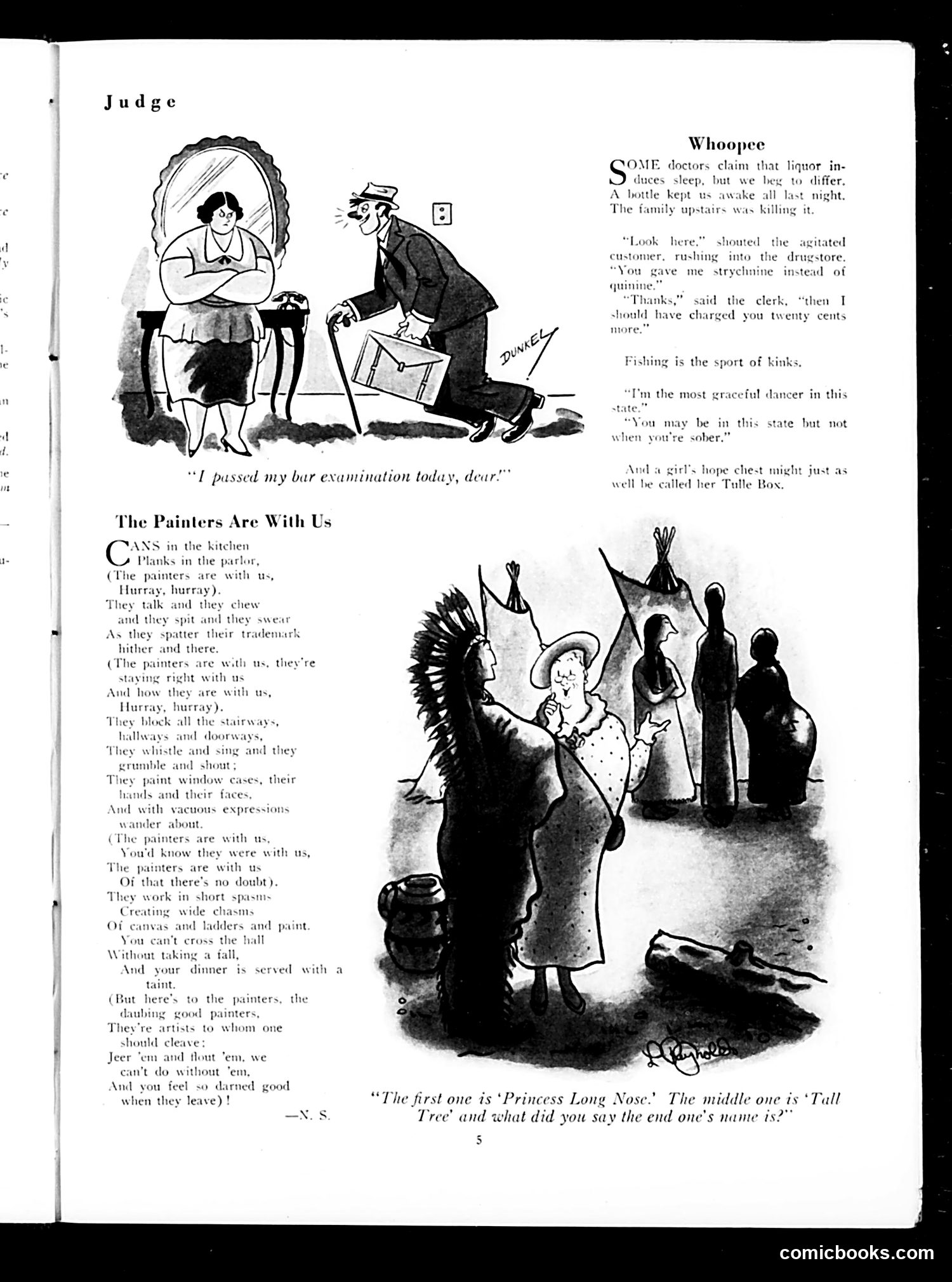
# Analysis of Judge Magazine Page **Top Cartoon ("Judge"):** A woman sits in an examination chair while a man (appearing to be a doctor or examiner) enters. The caption reads "I passed my bar examination today, dear!" This satirizes women entering the legal profession—likely early 20th century when female lawyers were rare and controversial. The joke appears to mock the idea of a woman as a lawyer, treating it as an absurd achievement worthy of comedic treatment. **"The Painters Are With Us":** A humorous poem about house painters creating mess and disruption during home renovation work. This is general domestic satire with no specific political reference—simply mocking the chaos painters cause during jobs. **Lower Cartoon:** Shows a woman naming Native American dolls to other figures, suggesting stereotypical naming conventions of the era.
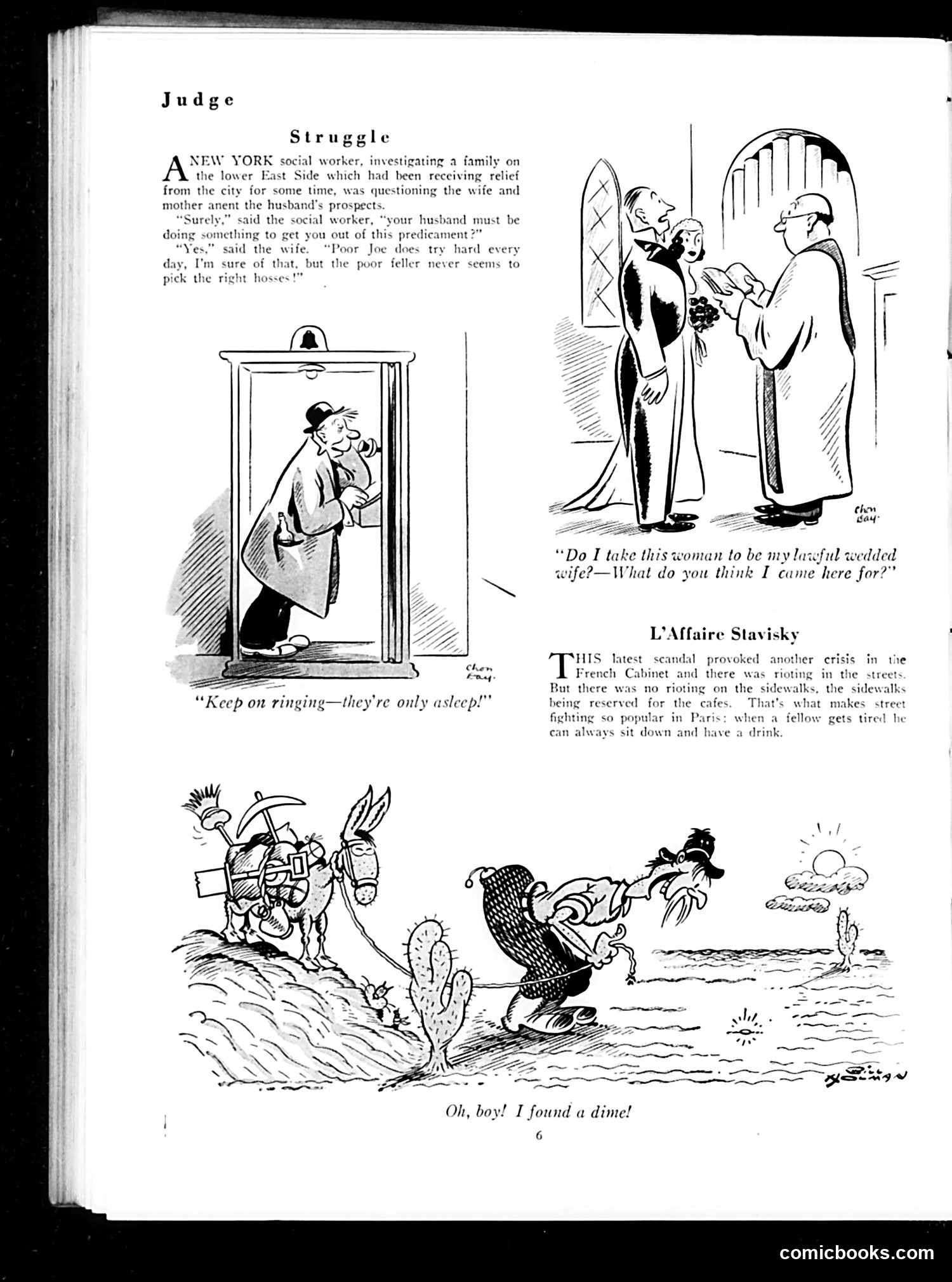
# Analysis of Judge Magazine Page This page contains three unrelated satirical cartoons: 1. **"Struggle"** (top left): A social worker interviews a poor family on the Lower East Side. The wife complains her husband won't work to improve their situation. The satire critiques both poverty and the difficulty of social intervention. 2. **"Do I take this woman..."** (top right): A judge presides over what appears to be a bigamy case, satirizing marital scandals and legal proceedings. 3. **"L'Affaire Slavsky"** (bottom): Commentary on a French political scandal causing Cabinet crisis and street rioting. The text notes Parisians' preference for café culture over protest, satirizing French political volatility and social priorities. The cartoons reflect Judge's focus on urban social problems, legal absurdities, and international political turmoil.
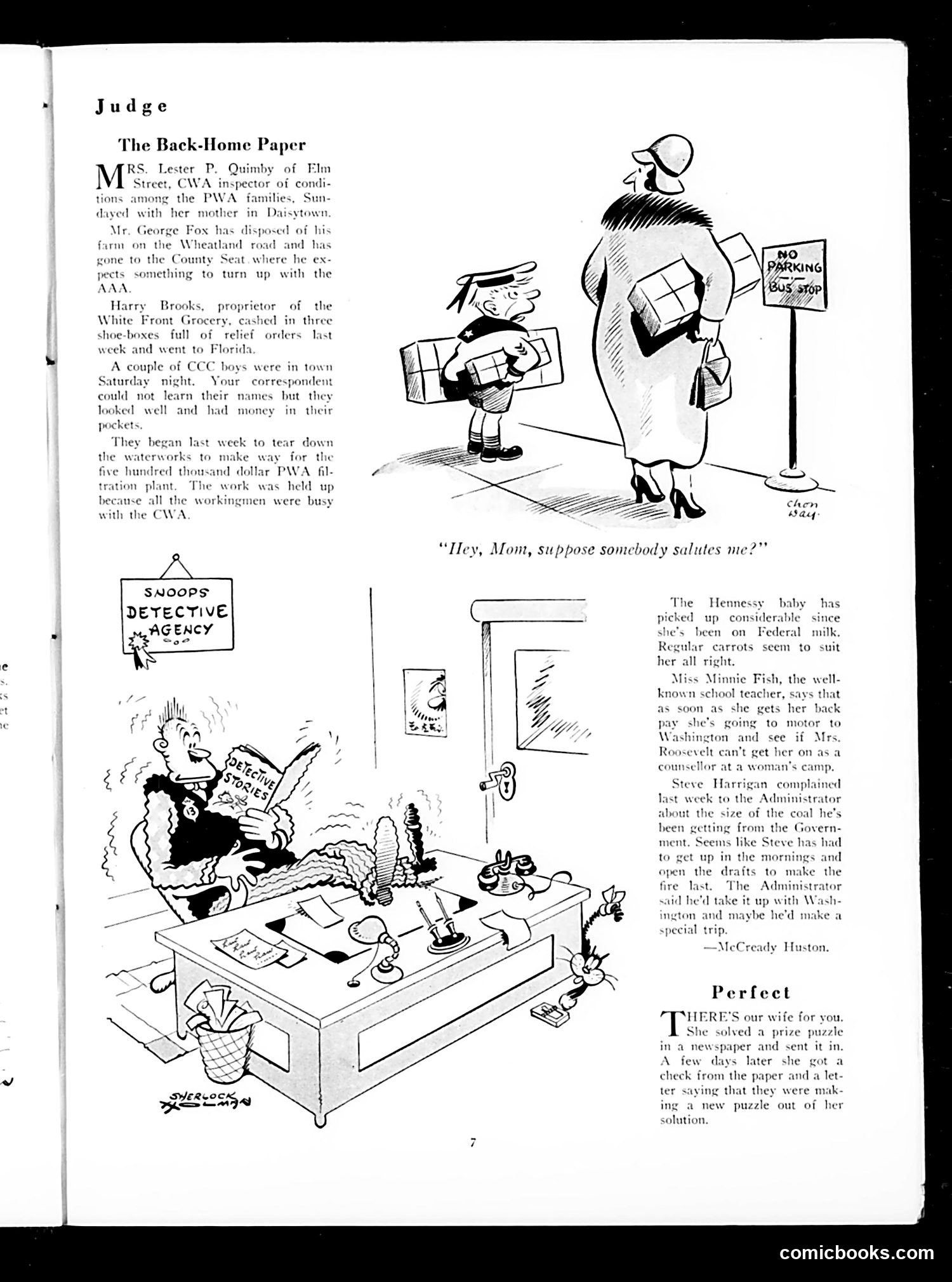
# Explaining "The Back-Home Paper" to Modern Readers This page satirizes New Deal government programs of the 1930s Depression era through small-town gossip. The column references the **CWA** (Civil Works Administration), **PWA** (Public Works Administration), **AAA** (Agricultural Adjustment Administration), and **CCC** (Civilian Conservation Corps)—all actual New Deal agencies. The jokes mock how these programs affected ordinary people: farmers disposing of land hoping for AAA support, grocery owners cashing relief checks, young men from the CCC looking prosperous, and government projects like waterworks being torn down and rebuilt. The cartoon shows a boy carrying boxes (likely relief packages), joking about military salutes—suggesting these government handouts resembled military-style provisions. The "Snoops Detective Agency" panel satirizes bureaucratic incompetence. Overall, Judge presents New Deal aid as both absurd and potentially corrupting, reflecting conservative skepticism about Depression-era government intervention, while acknowledging its pervasive presence in American life.
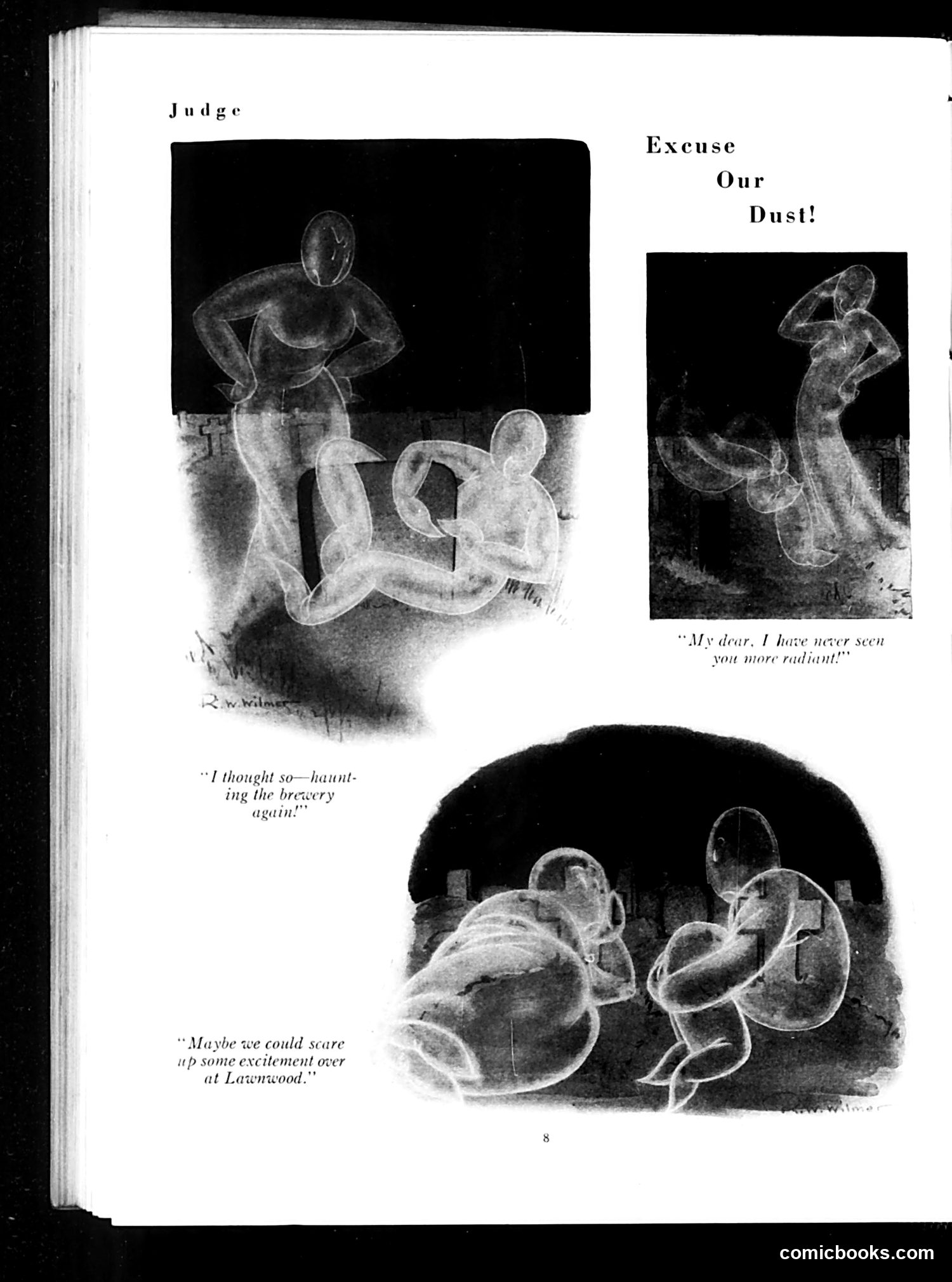
This page from *Judge* satirizes Prohibition-era speakeasies and illegal alcohol consumption. The X-ray style illustrations reveal ghost-like figures engaged in drinking activities—the visual conceit being that these hidden, illicit behaviors are "exposed" through the transparent overlay. The title "Excuse Our Dust!" suggests ongoing disruption, likely referencing the chaos of Prohibition enforcement. The dialogue references "haunting the brewery" and seeking "excitement over at Lawnwood" (apparently a known speakeasy location), implying that despite legal bans, people continue patronizing illegal drinking establishments. The cartoon mocks both the futility of Prohibition and the public's casual disregard for the law, presenting underground drinking culture as an accepted social reality that persists despite official attempts to eliminate it.
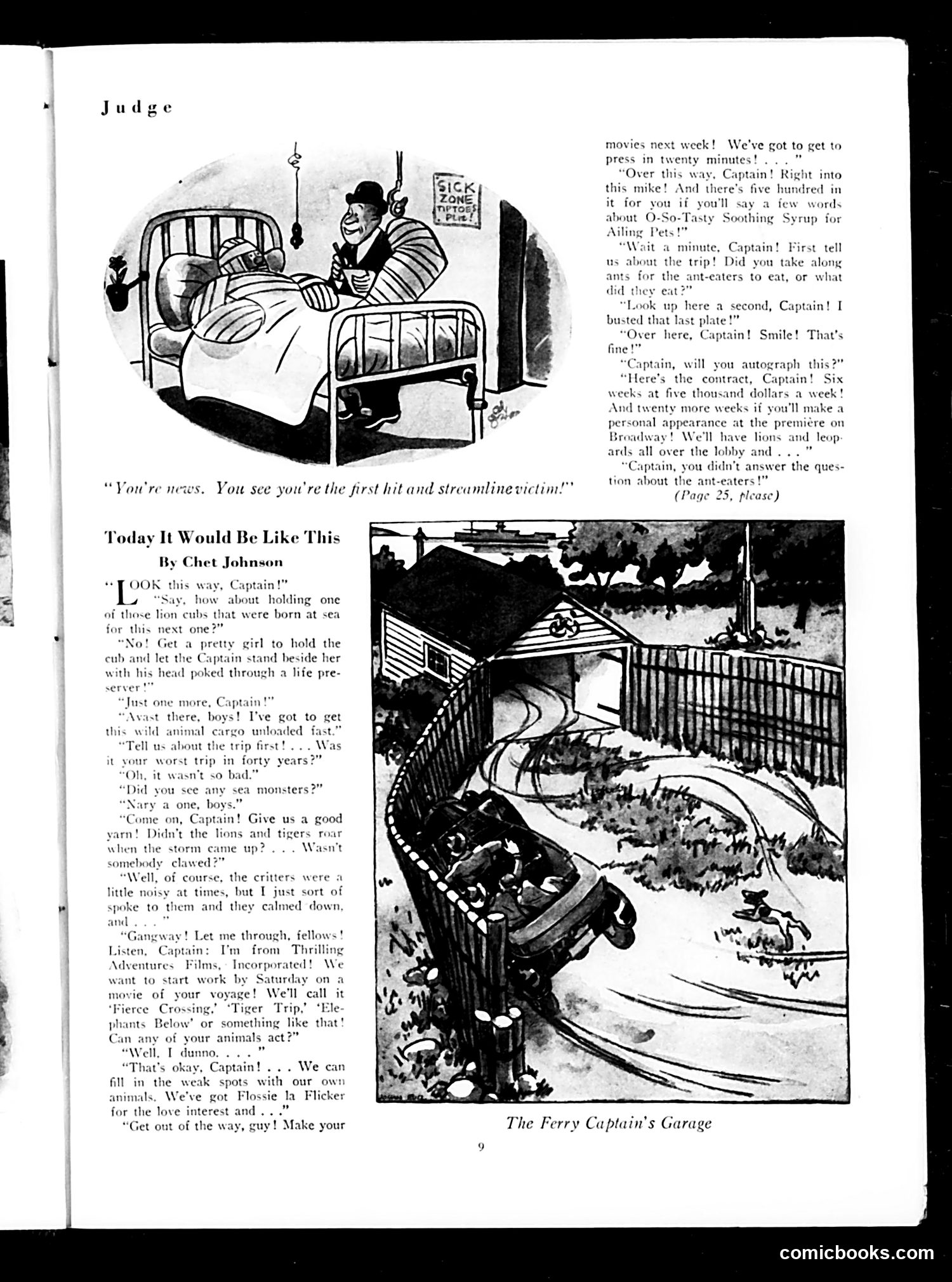
# "Today It Would Be Like This" — Judge Magazine Satire This two-part piece by Chet Johnson satirizes the celebrity circus surrounding exotic animal expeditions and early film promotion. The top cartoon shows a hospital patient besieged by reporters, photographers, and film executives—each demanding different things: interviews, photos, contracts, autographs, and product endorsements. The caption "You're news. You see you're the first hit and streamline-viction!" captures the absurdity of instant fame-making. The accompanying story parodies this further: a sea captain arriving with wild animals is immediately mobbed by competing demands—journalists wanting sensational tales, filmmakers pitching movie deals ("Fierce Crossing," "Tiger Trip"), and agents offering five-thousand-dollar weekly contracts. The humor lies in how the captain's actual experience becomes irrelevant; everyone wants their version of the story, not the truth. This reflects 1920s-era anxieties about media sensationalism, celebrity manufacturing, and how technology (radio, film, photography) transforms real events into commodified entertainment.
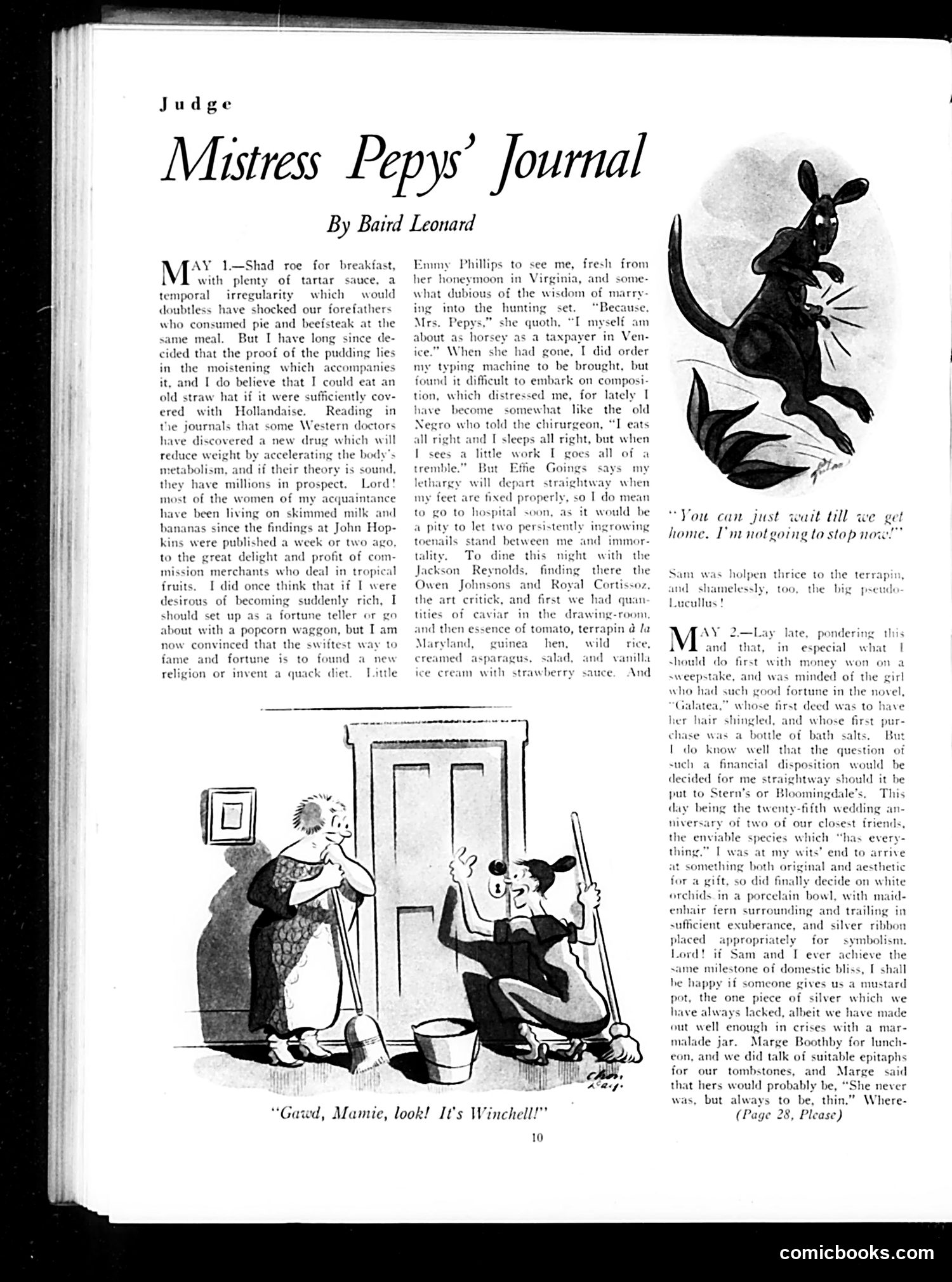
# Mistress Pepys' Journal - Explanation for Modern Readers This is a humorous column styled as a fictional diary entry, parodying Samuel Pepys' famous 17th-century journal. The satire targets 1920s-30s society frivolities and fads. **The Main Jokes:** The narrator mocks contemporary women obsessing over a new "weight-reduction drug" discovered at Johns Hopkins. She quips that fortune-telling or selling diet products would be the fastest route to wealth—satirizing how gullible people are about quick-fix solutions. **Social References:** The column name-drops real figures (art critic Royal Cortissoz, journalist Walter Winchell in the cartoon), luxurious foods (caviar, terrapin), and upper-class concerns (wedding gifts, orchids). The lower cartoon depicts someone excited about spotting Winchell, a famous gossip columnist—mocking celebrity obsession. **The Satire:** The piece ridicules wealthy women's superficiality: their trendy diets, conspicuous consumption, marital anxiety, and preoccupation with appearing young and thin. The closing jab at "Marge" epitomizes this—even her epitaph should claim eternal youth.