
Judge, 1934-06 · page 21 of 41
Judge — June 1934 — page 21: what you’re looking at
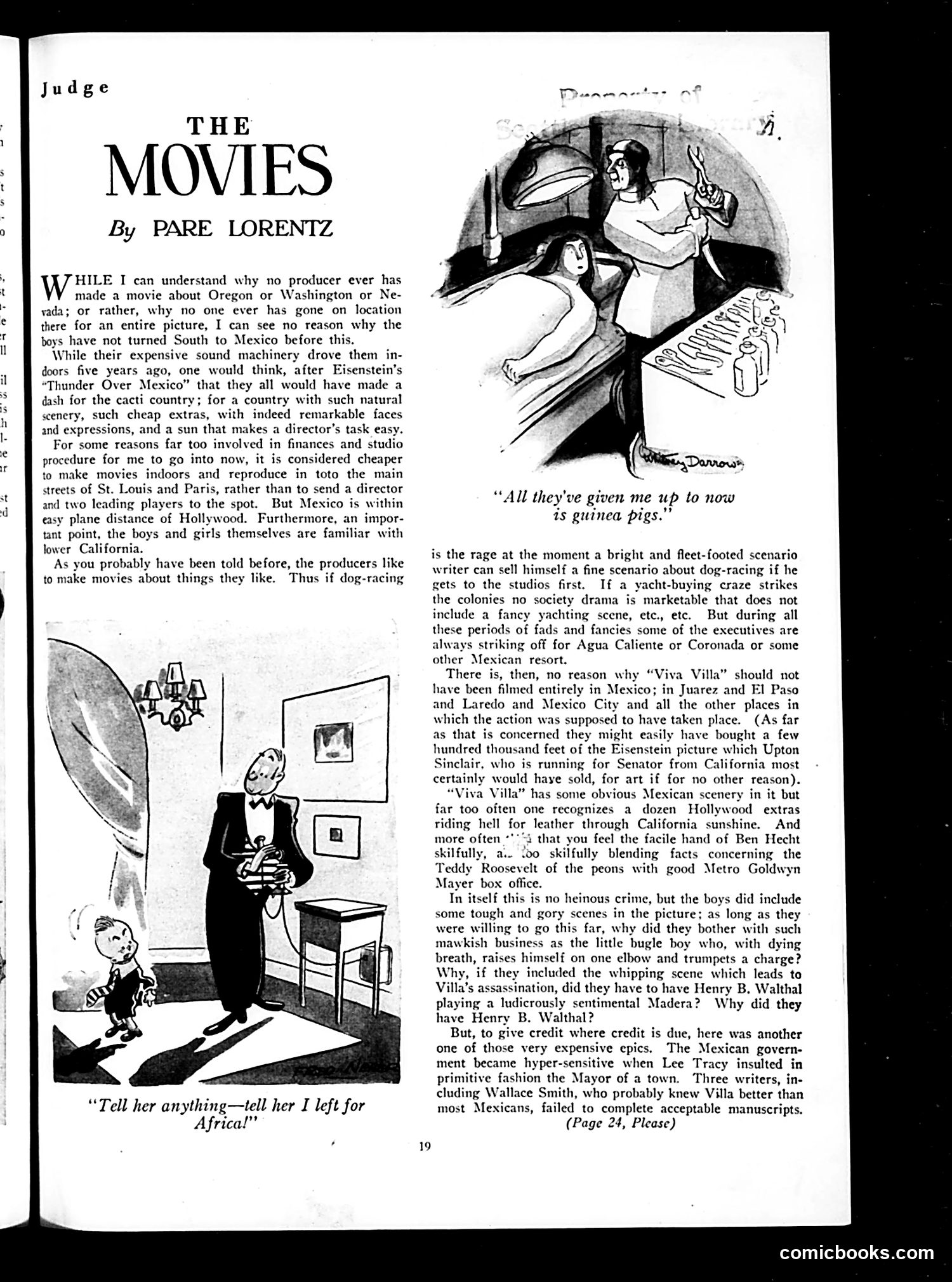
A restored page from Judge, 1934-06. Page through the whole issue in the reader above.
📄 Transcribed text from this page (OCR, searchable)
Machine-transcribed from the original scan — historical spelling and the odd misread are preserved.
Judge THE MOVIES By PARE LORENTZ HILE I can understand why no producer ever has made a movie about Oregon or Washington or Ne- vada; or rather, why no one ever has gone on location there for an entire picture, I can see no reason why the boys have not turned South to Mexico before this. While their expensive sound machinery drove them in- doors five years ago, one would think, after Eisenstein’s “Thunder Over Mexico” that they all would have made a dash for the cacti count for a country with such natural scenery, such cheap extr with indeed remarkable faces and expressions, and a sun that makes a director’s task easy. For some reasons far too involved in finances and studio procedure for me to go into now, it is considered cheaper to make movies indoors and reproduce in toto the main streets of St. Louis and Paris, rather than to send a director and two leading players to the spot. But Mexico is within easy plane distance of Hollywood. Furthermore, an impor- tant point, the boys and girls themselves are familiar with lower California. As you probably have been told before, the producers like to make movies about things they like. Thus if dog-racing “Tell her anything—tell her I left for Africa!” “All they've given me up to now ts guinea pigs.” is the rage at the moment a bright and fleet-footed scenario writer can sell himself a fine scenario about dog-racing if he gets to the studios first. If a yacht-buying craze strikes the colonies no society drama is marketable that does not include a fancy yachting scene, etc., etc. But during all these periods of fads and fancies some of the executives are always striking off for Agua Caliente or Coronada or some other Mexican resort. There is, then, no reason why “Viva Villa” should not have been filmed entirely in Mexico; in Juarez and El Paso and Laredo and Mexico City and all the other places in which the action was supposed to have taken place. (As far as that is concerned they might easily have bought a few hundred thousand feet of the Eisenstein picture which Upton Sinclair, who is running for Senator from California most certainly would haye sold, for art if for no other reason). “Viva Villa” has some obvious Mexican scenery in it but far too often one recognizes a dozen Hollywood extras riding hell for leather through California sunshine. And more often ***“4 that you feel the facile hand of Ben Hecht skilfully, a. loo skilfully blending facts concerning the Teddy Roosevelt of the peons with good Metro Goldwyn Mayer box office. In itself this is no heinous crime, but the boys did include some tough and gory scenes in the picture; as long as they were willing to go this far, why did they bother with such mawkish business as the little bugle boy who, with dying breath, raises himself on one elbow and trumpets a charge? Why, if they included the whipping scene which leads to Villa’s assassination, did they have to have Henry B. Walthal playing a ludicrously sentimental Madera? Why did they have Henry B. Walthal? But, to give credit where credit is due, here was another one of those very expensive epics. The Mexican govern- ment became hyper-sensitive when Lee Tracy insulted in primitive fashion the Mayor of a town. Three writers, in- cluding Wallace Smith, who probably knew Villa better than most Mexicans, failed to complete acceptable manuscripts. (Page 24, Please) comicbooks.com