
Judge, 1934-06 · page 14 of 41
Judge — June 1934 — page 14: what you’re looking at
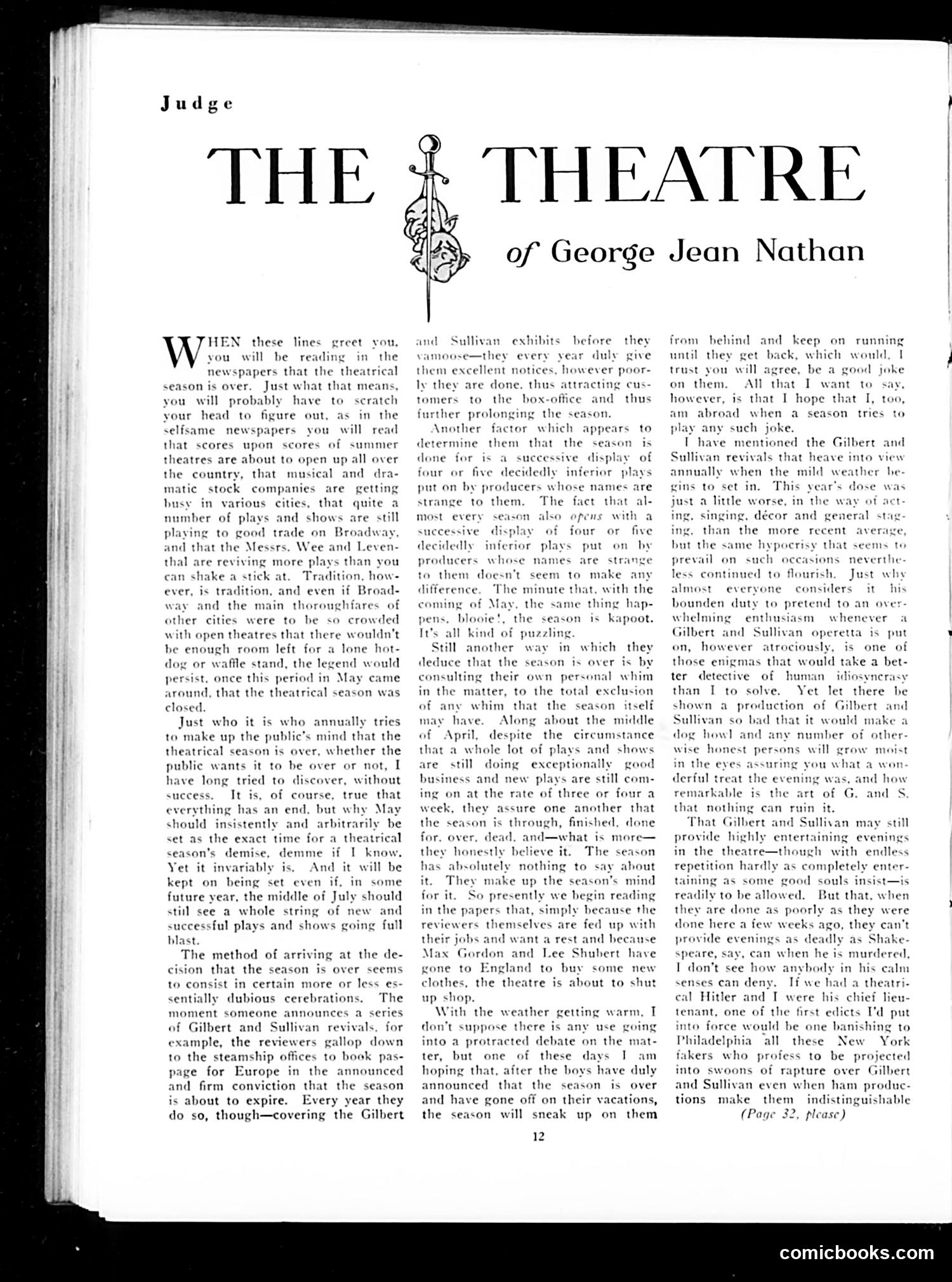
A restored page from Judge, 1934-06. Page through the whole issue in the reader above.
📄 Transcribed text from this page (OCR, searchable)
Machine-transcribed from the original scan — historical spelling and the odd misread are preserved.
JHEN these lines greet you, you will be reading in the pers that the theatrical season is over. Just what that means, you will probably have to scratch your head to figure out, as in the newsp selfsame newspapers you will read that scores upon scores of summer theatres are about to open up all over the country, that musical and dra- matic stock companies are getting husy in various cities, that quite a number of plays and shows are still playing to good trade on Broadway, and that the Messrs. Wee and Leve thal are reviving more plays than you can shake a stick at. Tradition, how- ever, is tradition, and even if Broad- way and the main thoroughfares of other cities were to be so crowded with open theatres that there wouldn't he enough room left for a lone hot- dog or waffle stand, the legend would persist, once this period in May came around, that the theatrical season was closed. Just who it is who annually tries to make up the public’s mind that the theatrical season is over, whether the public wants it to be over or not, I have long tried to discover, without success. It is, of course, true that everything has an end, but why May should insistently and arbitrarily be set as the exact time for a thea ison’s demise, demme if I know. Yet it invariably is, And it will be kept on being set even if, in some future year, the middle of July should still see a whole string of new and successful plays and shows going full blast The method of arriving at the de- cision that the season is over seems to consist in certain more or less es- sentially dubious cerebrations. The moment someone announces a series of Gilbert and Sullivan revivals, for example, the reviewers gallop « to the steamship offices to be page for Europe in the announced and firm conviction that the season is about to expire. Every year they do so, though—covering the Gilbert ical of George ind Sullivan exhibits before they duly give wever poor- vamoose—they every ye them excellent notices, h ly they are done. thus attracting cus- tomers to the box-office and thus further prolonging the season. Another factor which app determine them that the season. is rs to done for is a successive display of four or five decidedly inferior plays put on by producers whose names are strange to them. The fact that al- most every season also opens with a successive display f four or five decidedly inferior plays put on by ducers whose names are strange pr to them doesn't seem to make an ute that, with the p- the season is kapoot. difference. The n sming of May, the same thing he pens, blooie It’s all kind of puzzling Still another way in which they deduce that the season is over is by consulting their own personal whim in the matter, to the total exclusion of any whim that the season itself may have. Along about the middle of April, despite the circumstance a whole lot of plays and shows are still doing exceptionally good business and new plays are still com- ra week, they assure one another that ing on at the rate of three or fo the season is through, finished, done for. over. dead, and—what is more— they honestly believe it. The se: son say about it. They make up the season's mind for it. So presently we begin reading in the papers that, simply because the reviewers themselves are fed up with their jobs and want a rest and because Max Gordon and Lee Shubert have one to England to buy some new clothes, the theatre is about to shut up shop. has absolutely nothing With the weather getting warm, I don’t suppose there is any use going into a protracted debate on the mat- ter, but one of hoping that, after the boys have duly announced that the season is over and have gone off on their vacations, the season will sneak up on them 12 these days IT am THEATRE Jean Nathan from behind and keep on running until they get back, which would, I trust you will agree, be a good joke on them, All that I want to say, however, is that I hope that I, too, 1 when a season tries to play any such joke. I have mentioned the Gilbert and Sullivan revivals that h annually when the mild weather be- am abro, © into view gins to set in. This year’s dose was just a little worse, in the way of act singing. décor and g neral st ing. than the more recent average but the same hypocrisy that seems t prevail on such oceasions neverthe- ied to flourish. Just w less cor bounden duty to pretend to an ov relmi enthusiasm whenever a Gilbert and Sullivan operetta is put on, however atrociously, is one of those enigmas that would take a bet- ter detective of human idiosyner: than I to solve. Yet let there be shown a production of Gilbert and Sullivan so bad that it we dog howl and 2 id make a iy number of other- wise honest persons will grow moist in the eyes assuring you what a won derful treat the evening w remarkable is the art of G. and S that nothing can ruin it. That Gilbert and Sullivan may still s, and how provide highly entertaining evening in the theatre—t repetition hardly as completely enter- ough with endless tainin some good souls insist—is dily to be allowed, But that. when are done as poorly as they were done here a few weeks ago, they can't provide evenings as deadly as Shake- speare, say, can when he is mur¢ I don’t see how anybody in his calm senses can deny. If we had a theatri- cal Hitler and T were his chief lieu- tenant, one of the first edicts I'd put into force would be one banishing to Philadelphia all these New York fakers who profess to be projected into swoons of rapture over Gilbert and Sullivan even when ham produc- tions make them indistinguishable (Page 32, please) the ed, comicbooks.com