A complete issue · 36 pages · 1933
Judge — November 1933
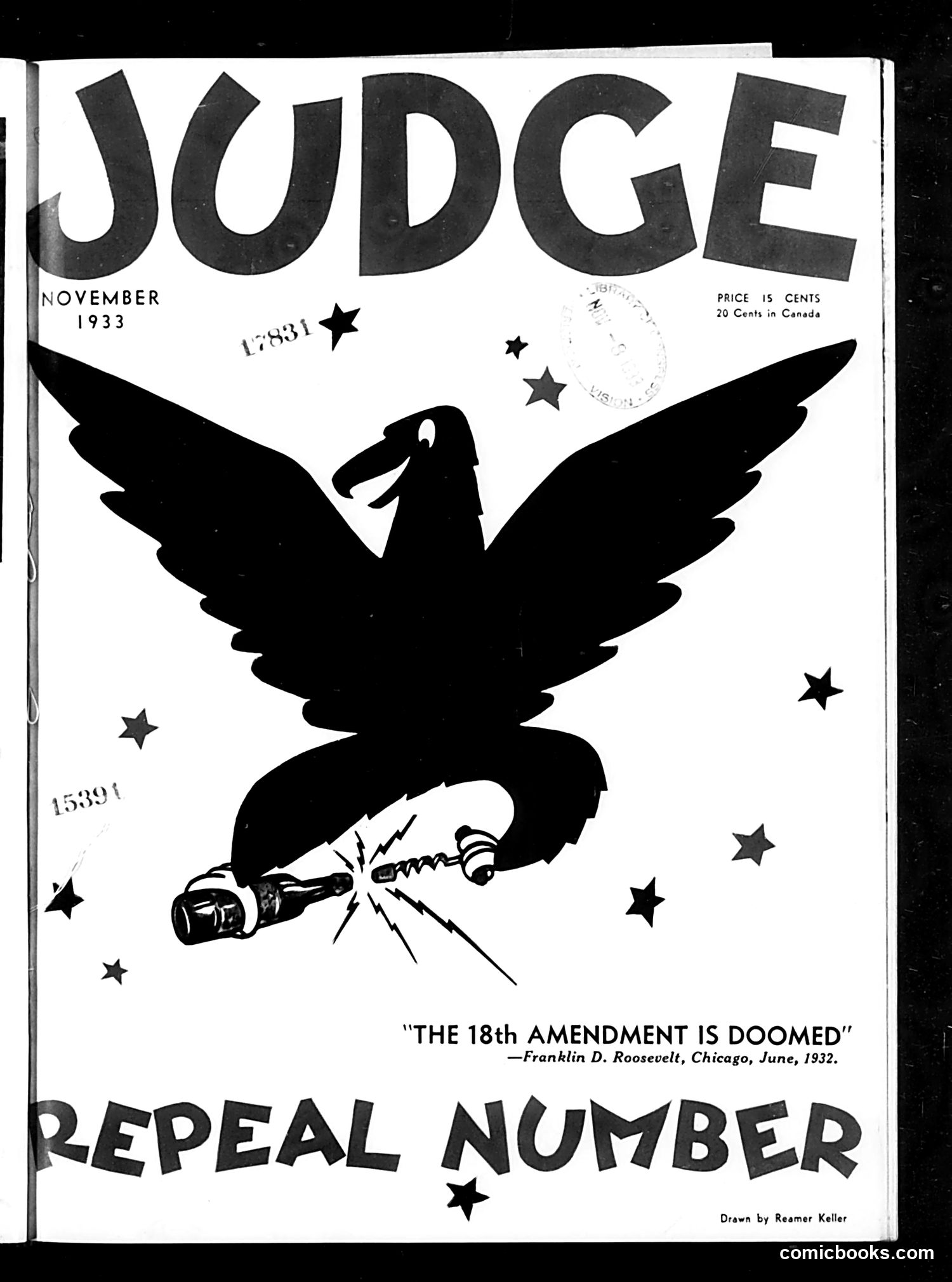
# Judge Magazine, November 1933: "Repeal Number" This is the cover of Judge's special issue celebrating the repeal of Prohibition. The eagle—a symbol of America—clutches a broken bottle, surrounded by stars. The quote from Franklin D. Roosevelt (dated June 1932) reads "THE 18th AMENDMENT IS DOOMED," referencing his support for ending alcohol prohibition. The 18th Amendment, ratified in 1920, had banned alcohol production and sale. By 1933, during the Great Depression, repeal gained momentum. Roosevelt supported it, and the 21st Amendment repealed Prohibition in December 1933—just weeks after this issue. Judge's satirical message is celebratory: the magazine mocks Prohibition as a failed policy, depicting its end as patriotic American victory.
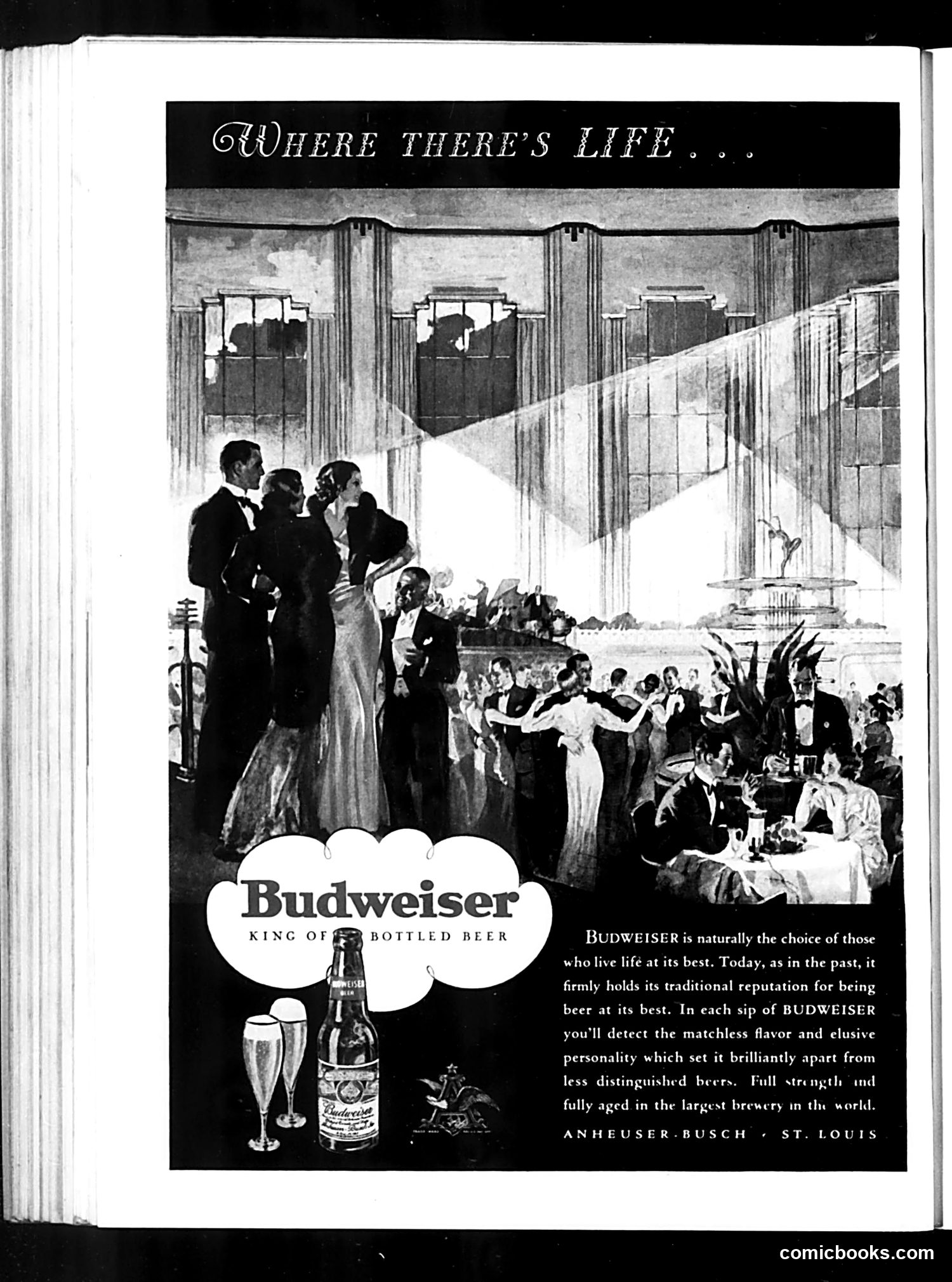
# Analysis This is primarily a **Budweiser advertisement**, not political satire. The tagline "WHERE THERE'S LIFE..." depicts an elegant social gathering—well-dressed men and women at what appears to be an upscale outdoor event or party, with servers and entertainment visible. The advertisement's message is that Budweiser beer is "naturally the choice of those who live life at its best"—associating the product with sophistication, leisure, and social status. The text emphasizes the beer's traditional reputation and quality ("Full strength and fully aged in the largest brewery in the world"). This represents typical early-to-mid 20th century aspirational advertising, linking consumer products to idealized lifestyles and class identity.
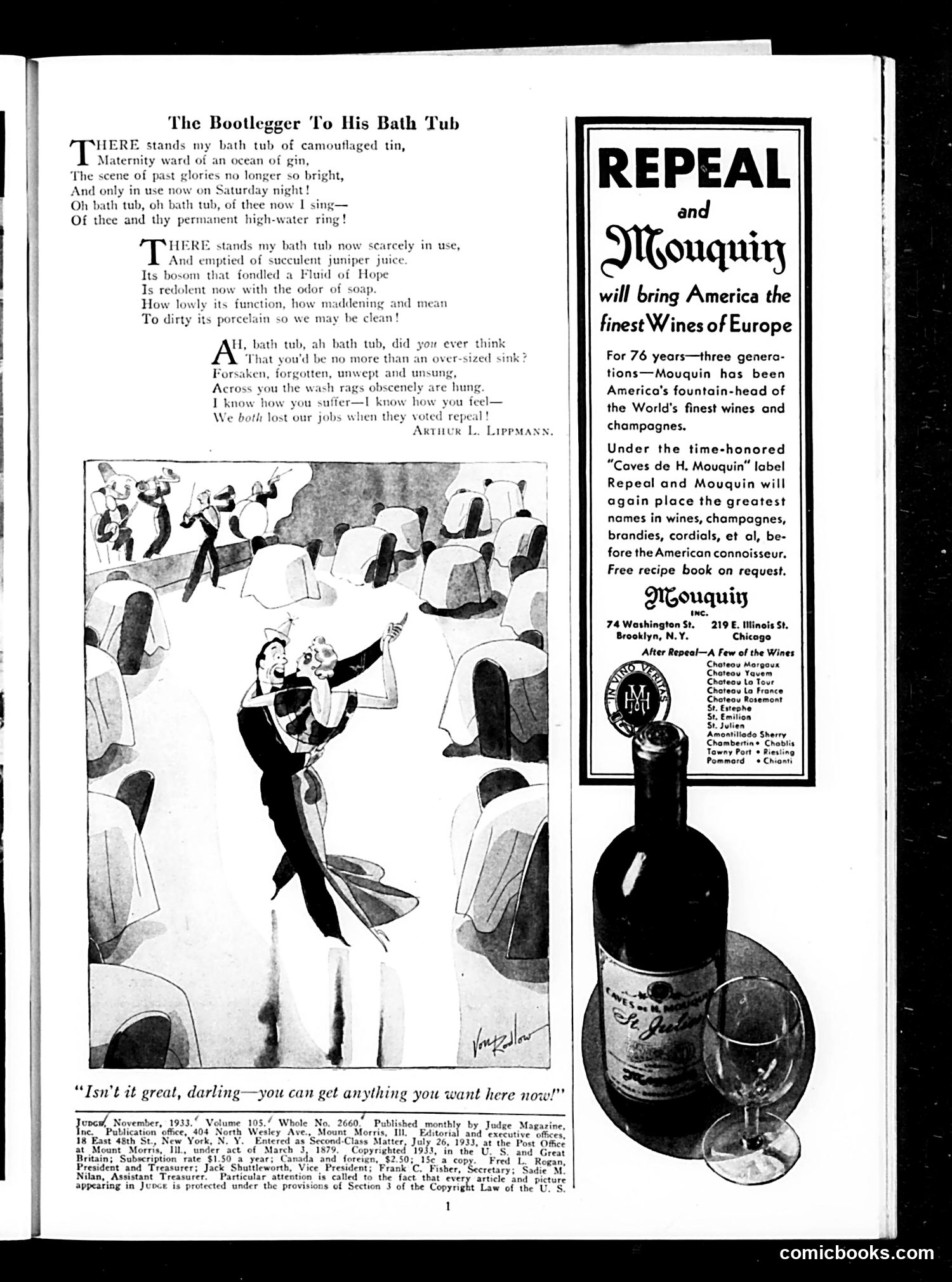
# "The Bootlegger To His Bath Tub" This page satirizes Prohibition-era bootlegging. The poem by Arthur L. Lippmann depicts a bootlegger mourning his now-defunct operation—his camouflaged tin bathtub previously used to manufacture illegal alcohol is now merely a bathtub. The illustration shows figures in white garments (appearing to be bathtub disguises or covers) in a snowy setting, suggesting how bootleggers concealed their operations. The accompanying Moquin wine advertisement celebrates Prohibition's repeal, promising the return of legitimate European wines to America after 76 years of prohibition. The juxtaposition is ironic: the satire mocks bootleggers whose illegal enterprises are being replaced by legal commerce. The issue is dated November 1933, shortly after Prohibition's repeal that December.
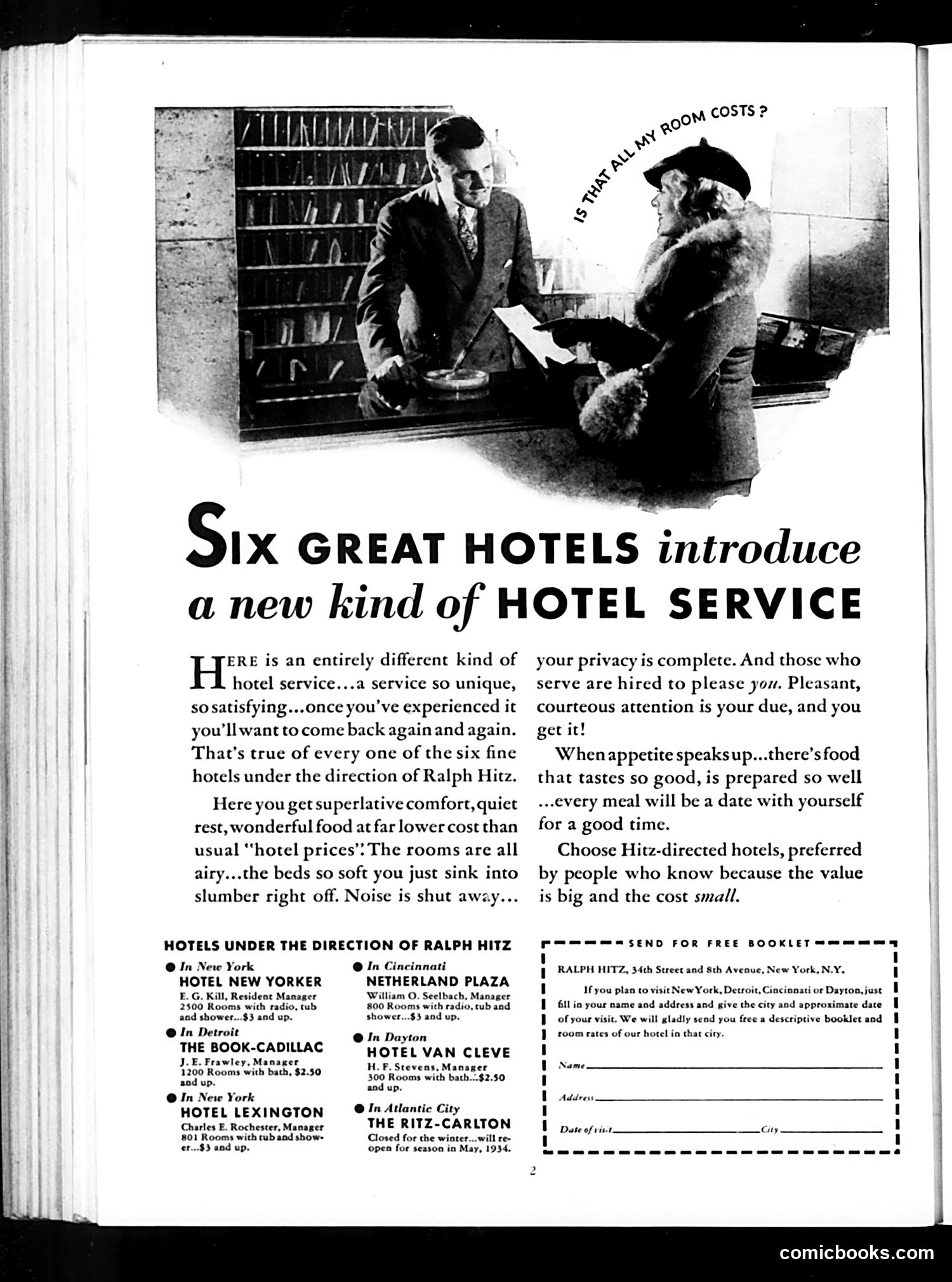
# Analysis This page is **primarily a hotel advertisement**, not satire or political commentary. It's a 1934 advertisement for six luxury hotels under the direction of Ralph Hitz, a prominent hotelier of that era. The illustration shows a hotel clerk at a desk speaking with an elegantly dressed female guest asking about room costs. The ad emphasizes "a new kind of hotel service" featuring comfort, good food at lower prices than typical hotels, and courteous attention. The only mildly humorous element is the guest's question—"Is that all my room costs?"—which sets up the ad's pitch that these Hitz-directed hotels offer exceptional value. This is straightforward advertising using light humor, not political satire. The page reflects 1930s Depression-era marketing emphasizing affordability and quality.
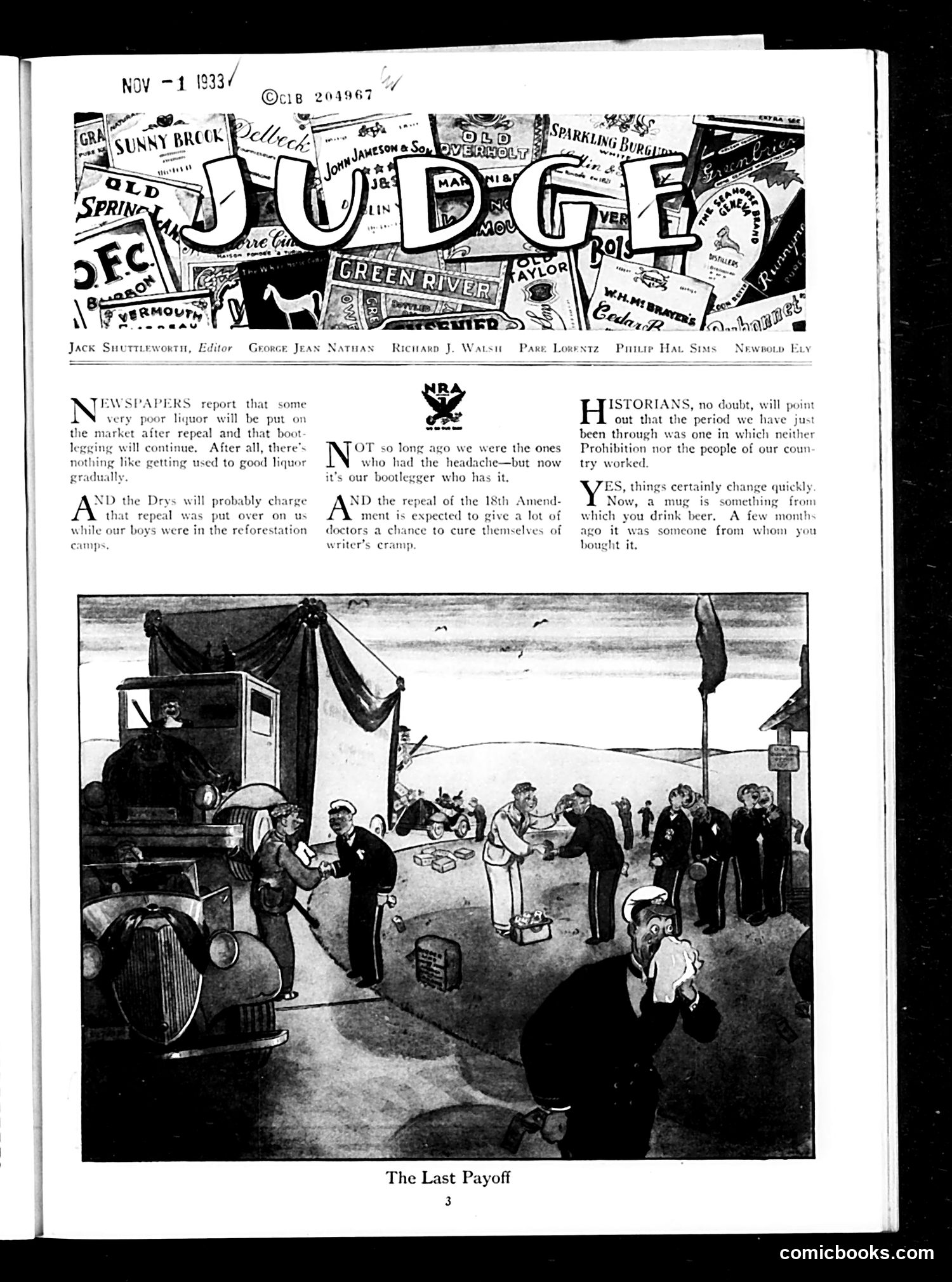
# "The Last Payoff" - Judge Magazine, November 1, 1933 This cartoon satirizes Prohibition's end. The image depicts what appears to be bootleggers or illegal liquor distributors receiving final payments as their underground operations shut down following Prohibition's repeal (December 1933). The editorial text above references the transition: newspapers report poor liquor will flood the legal market as Prohibition ends; the 18th Amendment's repeal is imminent. The commentary notes that bootleggers—who profited during the ban—now face obsolescence as legitimate commerce resumes. "The Last Payoff" caption suggests these illegal operators collecting their final profits before legal alcohol distribution replaces their black-market enterprise. The cartoon mocks how quickly the criminal liquor trade will become unnecessary once legitimate businesses can operate openly.
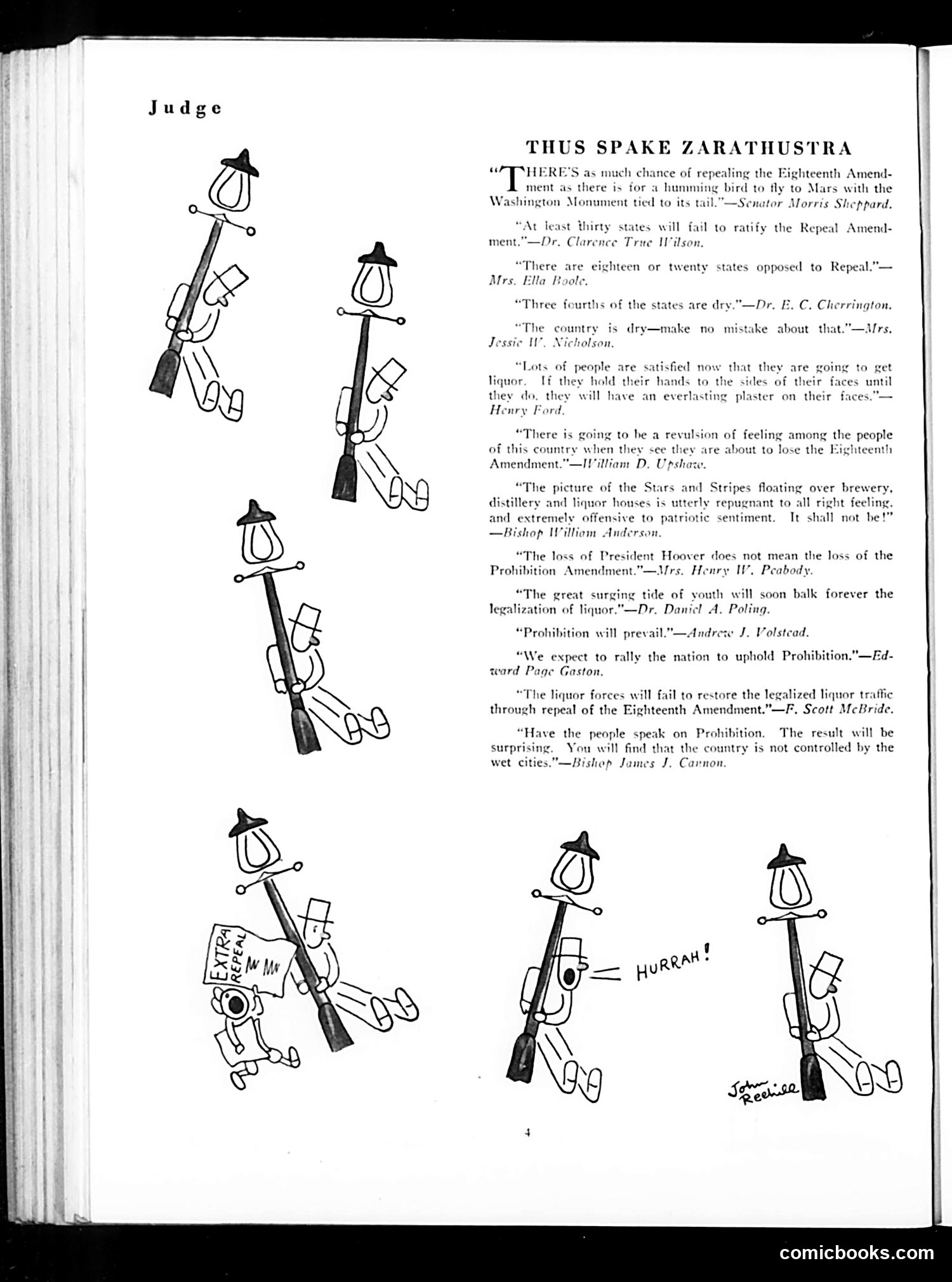
# Analysis: "Thus Spake Zarathustra" - Judge Magazine Prohibition Satire This page satirizes the 18th Amendment (Prohibition) through competing predictions from prominent figures. The cartoons depict a "Judge" character—personified as a rifle-wielding figure with a liquor bottle for a head—balancing precariously on one leg, visually representing Prohibition's instability. The quotes from Senator Sheppard, Dr. Clarence Wilson, and others debate whether Prohibition will succeed or fail. The satire mocks both prohibitionists' confidence and their opponents' pessimism, suggesting the amendment's fate remains uncertain and ridiculous. The final cartoon shows the Judge celebrating "Hurrah!" alongside a small figure holding "For Me" papers—likely mocking how different groups claimed Prohibition served their interests while the policy's actual consequences remained unpredictable.
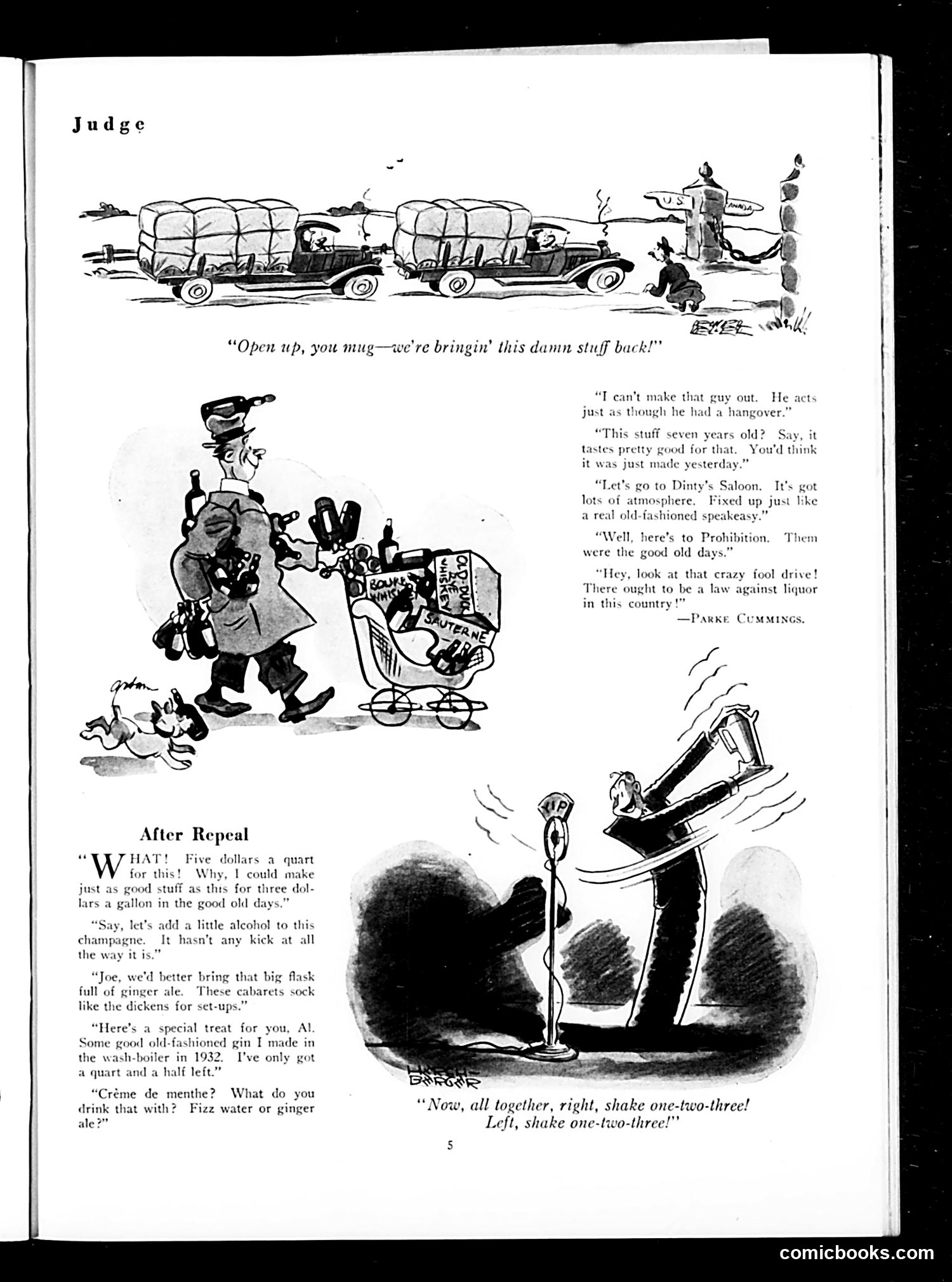
# Explanation of "Judge" Page This page satirizes Prohibition's repeal (the 1933 end of the alcohol ban). The top cartoon shows bootleggers brazenly returning contraband liquor in trucks, mocking law enforcement's inability to stop illegal alcohol distribution. The middle cartoon depicts a drunk man surrounded by bottles and liquor advertisements—satirizing how quickly commercialized alcohol returned after repeal. The bottom cartoon shows people shaking a large cocktail shaker, labeled "Now, all together, right, shake one-two-three!"—mocking the public's enthusiastic embrace of legal drinking. The accompanying text contains period-appropriate jokes about homemade liquor quality and cocktail recipes. The satire targets both the chaos following repeal and society's immediate return to heavy drinking after fourteen years of prohibition. The cartoonist—likely Parke Cummings (credited)—presents repeal as a chaotic, morally questionable development.
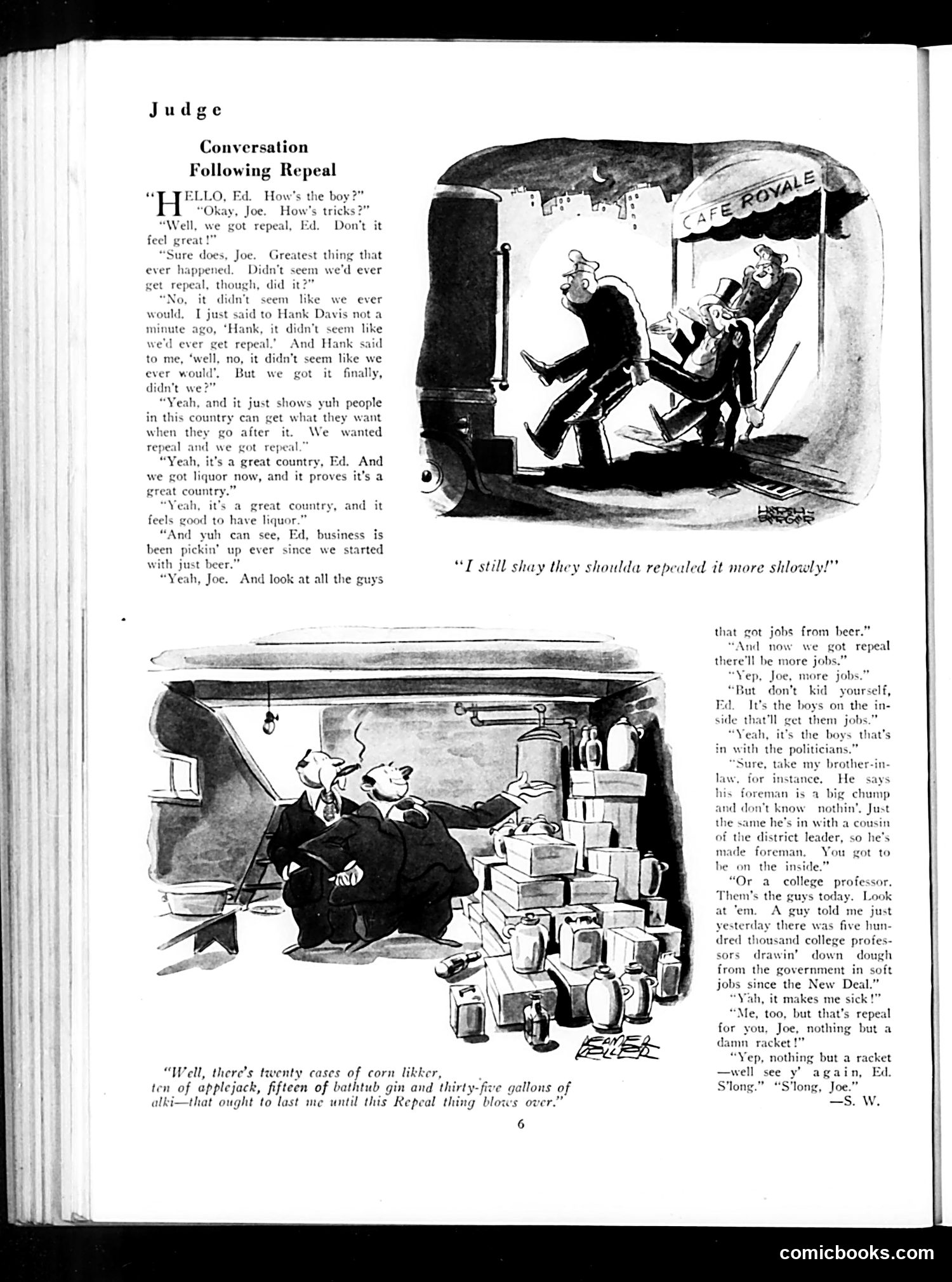
# Analysis This page satirizes the consequences of Prohibition's repeal. The conversation between characters named Ed and Joe celebrates the return of legal alcohol, but mocks how quickly it has created new corruption and patronage problems. The two cartoons illustrate the satire: the top shows men relaxing at a cafe, while the bottom depicts two figures surrounded by stacks of cases—representing the bootlegging/distribution industry that has boomed since repeal. The joke targets what the text calls "the boys on the inside" and "the boys that's in with the politicians"—suggesting repeal hasn't eliminated criminal enterprise but rather shifted it into government-connected circles. References to "college professors drawin' down dough from the government in soft jobs" and comparisons to "a big chump foreman" imply New Deal patronage and corruption replaced Prohibition-era bootlegging as the real racket.
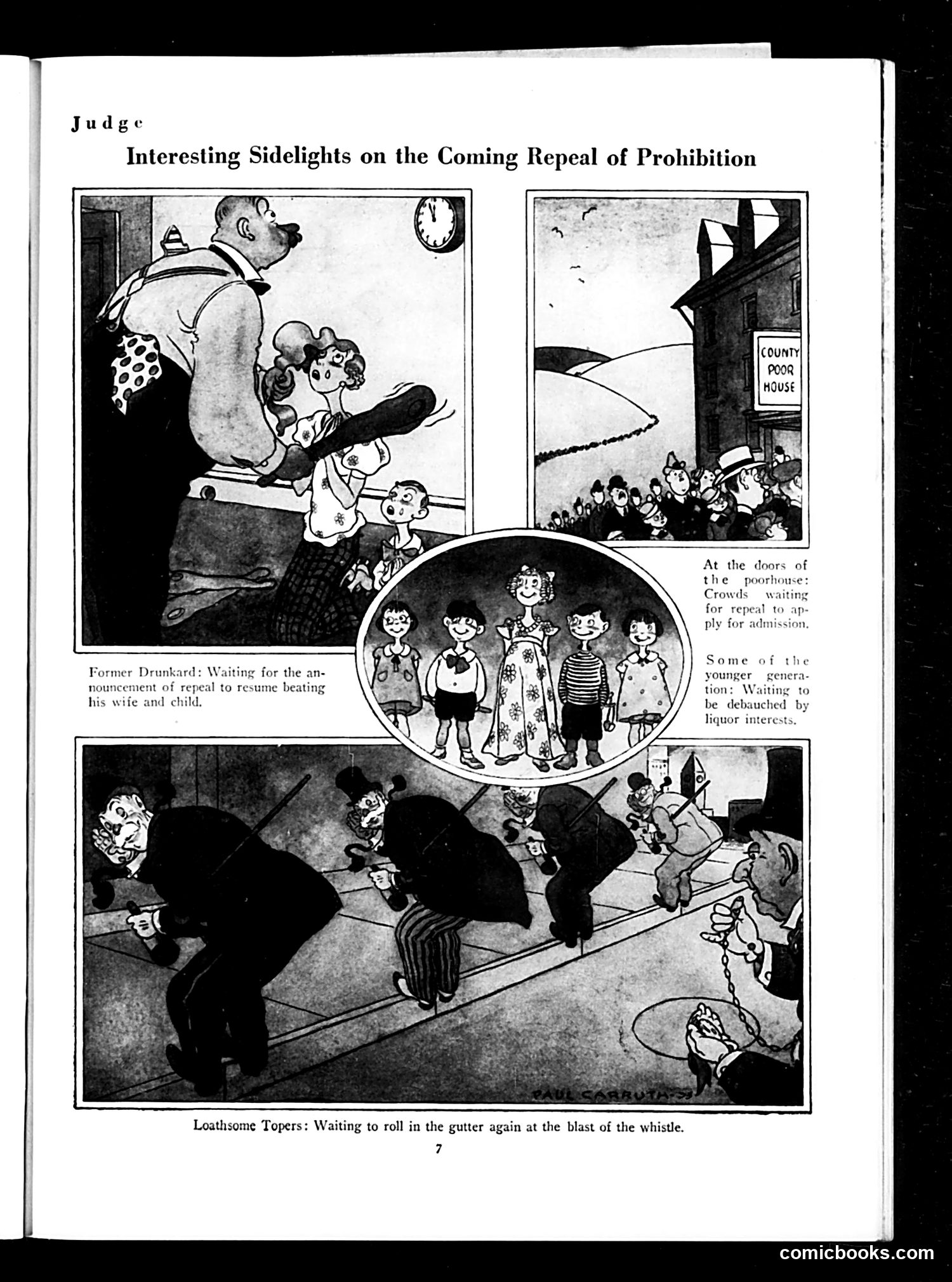
# Analysis: "Interesting Sidelights on the Coming Repeal of Prohibition" This Judge magazine page satirizes opposition to Prohibition's repeal (ratified in 1933). The cartoons present apocalyptic scenarios meant to convince readers that ending Prohibition would be catastrophic: **Top left:** A "former drunkard" eagerly awaits repeal to resume domestic violence against his wife and child—implying alcohol abuse caused family harm. **Top right:** The "poorhouse" fills with crowds expecting admission once drinking resumes, suggesting alcohol consumption leads to destitution. **Center circle:** Children representing "the younger generation" might be "debauched by liquor interests"—fear-mongering about youth corruption. **Bottom:** "Loathsome topers" (habitual drinkers) wait to "roll in the gutter," depicting alcoholics in degradation. The satire cuts both ways: Judge presents these as inevitable consequences of repeal while implicitly mocking prohibitionists' dire predictions as exaggerated propaganda.
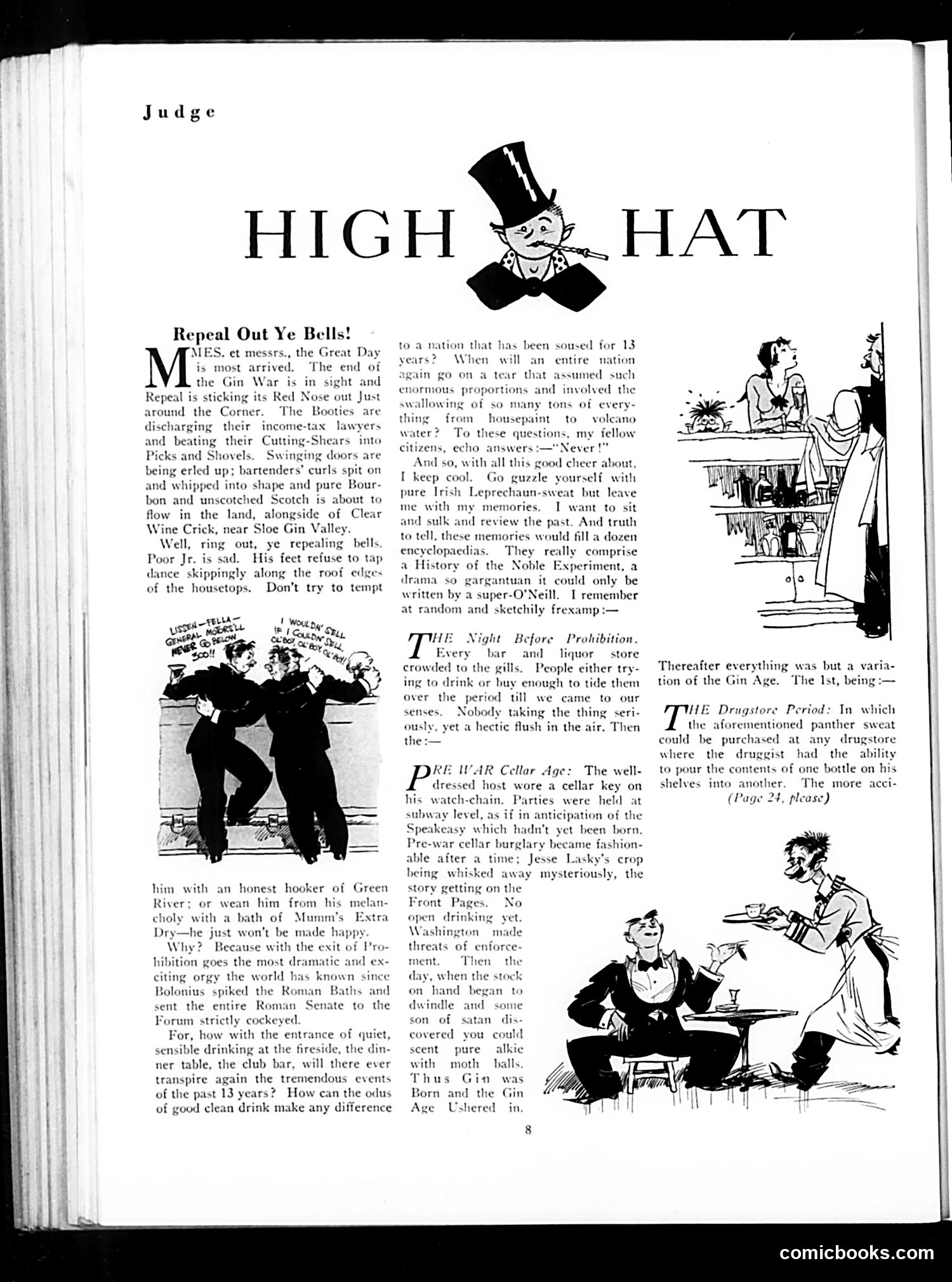
# Analysis for Modern Readers This Judge magazine page satirizes the end of Prohibition through the voice of a melancholy character lamenting alcohol's return to legality. The humor operates on multiple levels: **The Core Joke:** A prohibitionist mourns that Prohibition's repeal eliminates the *drama* and *excitement* that illegal drinking provided. The 13-year period of lawbreaking created memorable chaos—speakeasies, bathtub gin, cellar keys as status symbols, drugstore alcohol schemes—that legal, "sensible drinking" cannot match. **Historical Context:** The piece references real Prohibition-era phenomena (Jesse Lasky's wine theft, speakeasies) and specific drinking periods: the pre-Prohibition "Gin Age," the "Pre-War Cellar Age" (when hosts stored wine), and the "Drugstore Period" (when pharmacists sold alcohol under the guise of medicinal purposes). **The Satire:** Judge mocks both prohibitionists' naivety and the drinking culture's excess. The narrator's complaint—that legal drinking lacks excitement—inadvertently reveals Prohibition's true appeal: lawlessness itself, not temperance. Published around 1933 (Prohibition's end), this reflects contemporary debates about alcohol's return.
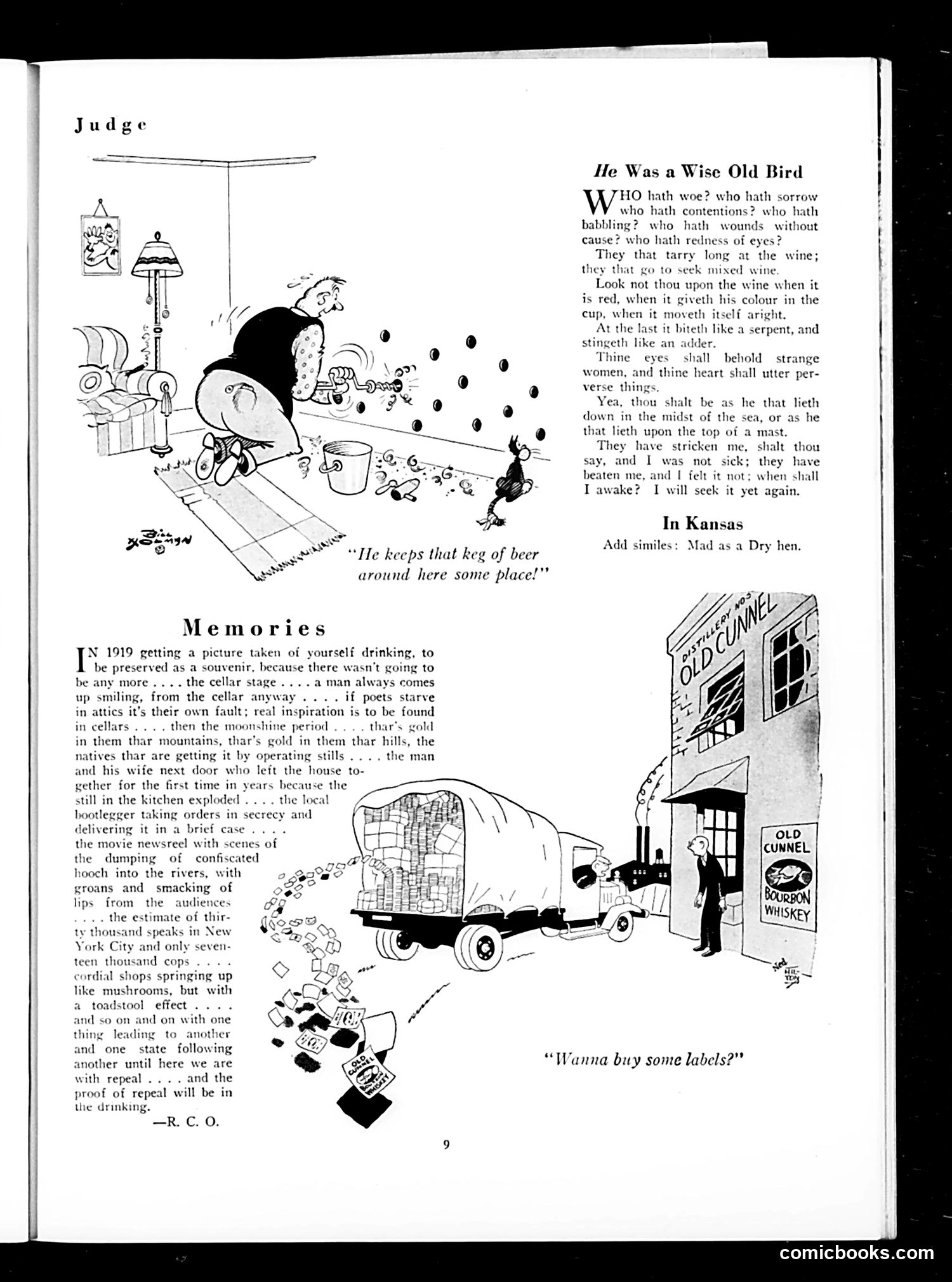
# Analysis of Judge Magazine Page This page satirizes Prohibition era America (likely early 1920s). The top cartoon "Judge" shows a drunk man juggling bottles while a small figure chases him—mocking the futility of enforcing alcohol bans. "He Was a Wise Old Bird" pairs biblical warnings against drunkenness with contemporary Kansas references, suggesting the moral case against drinking proved ineffective. The "Memories" section by R.C.O. is nostalgic satire about Prohibition's actual effects: backyard stills, bootleggers, illegal speakeasies (thirty thousand in NYC versus seventeen thousand cops), confiscated liquor dumps, and the inevitable rise of "cordial shops" selling labels—euphemisms for illegal alcohol distribution networks. "In Kansas" depicts a bootlegger's truck, humorously asking "Wanna buy some labels?"—code for purchasing illegal liquor. The overall point: despite Prohibition's legal apparatus, Americans continued drinking through underground networks that flourished during the ban, making the law's enforcement impossible and its intent laughable.
# "The Theatre" by Judge Magazine This is a theater review column by Judge magazine critic George Jean Nathan. The page discusses whether theater is truly "dead" — a perennial claim Nathan dismisses as absurd, pointing to packed houses proving otherwise. Nathan reviews Eugene O'Neill's "Ah, Wilderness!" — calling it O'Neill's most important recent work. It's a folk comedy about an American family from 27 years prior, notable for abandoning O'Neill's experimental techniques (Expressionism, Impressionism) to return to simple, traditional dramaturgy like Ibsen. Nathan also mentions Irving Berlin's revue "As Thousands Cheer," describing it as featuring caricatures of world celebrities set to Berlin's music. The piece dismisses bad plays that opened the season as "dramatic zombies," while celebrating genuine theatrical hits as evidence the medium thrives. Nathan's sardonic tone throughout mocks critics who repeatedly pronounce theater dead while audiences pack venues.