
Judge, 1933-11 · page 14 of 36
Judge — November 1933 — page 14: what you’re looking at
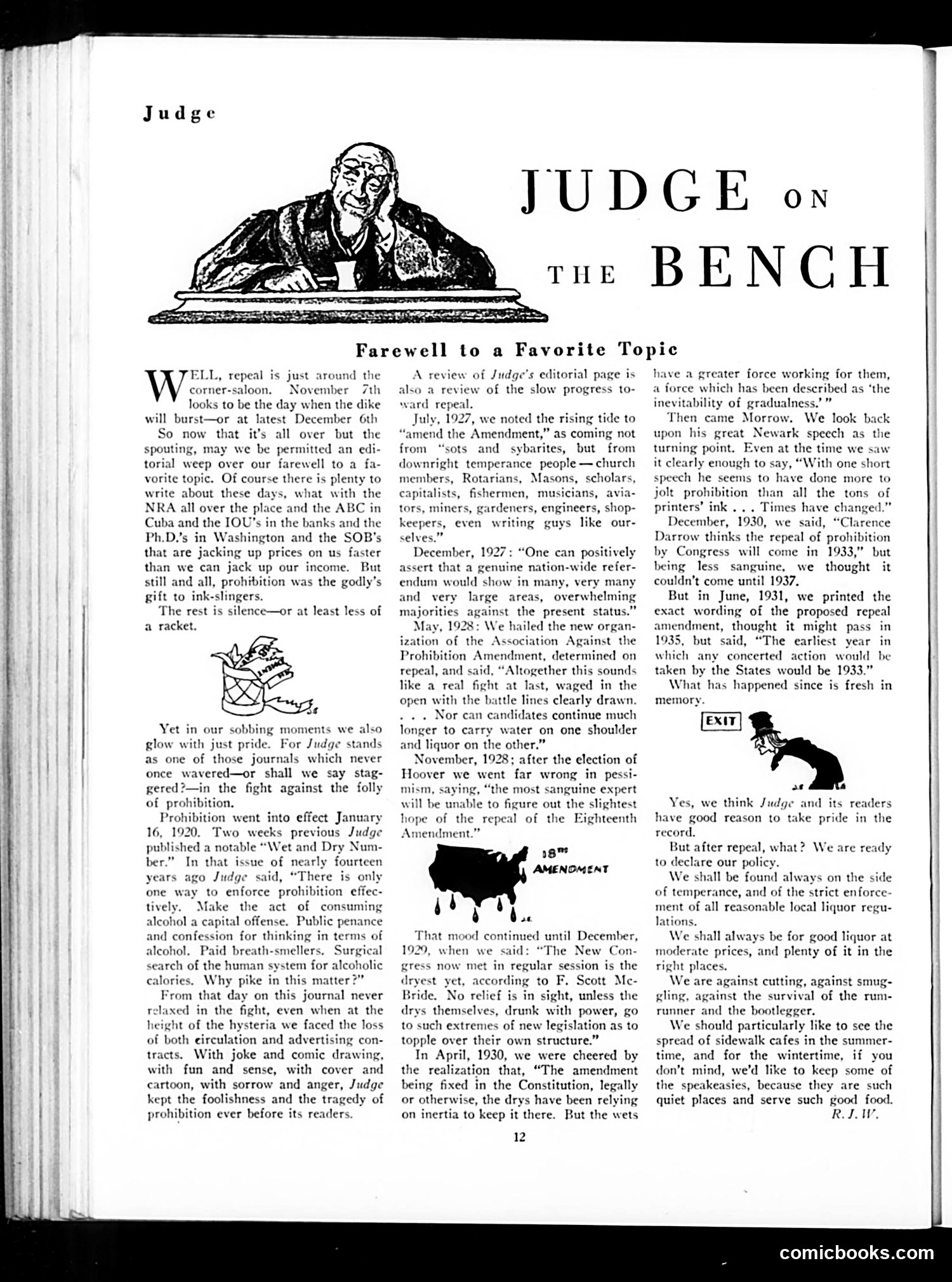
A restored page from Judge, 1933-11. Page through the whole issue in the reader above.
📄 Transcribed text from this page (OCR, searchable)
Machine-transcribed from the original scan — historical spelling and the odd misread are preserved.
JUDGE ox rue BENCH Farewell to a Favorite Topic ELL, repeal is just around the ‘orner-saloon. November 7th looks to be the day when the dike will burst—or at latest December 6th So now that it’s all over but the spouting, may we be permitted an edi- torial weep over our farewell to a fa- vorite topic. Of course there is plenty to write about these days, what with the NRA all over the place and the ABC in Cuba and the IOU’s in the banks and the Ph.D.’s in Washington and the SOB's that are jacking up prices on us faster than we can jack up our income. But still and all, prohibition was the godly’s gift to ink-slingers. The rest is silence—or at least less of a racket. at Yet in our sobbing moments we also glow with just pride. For Judge stands as one of those journals which never once wavered—or shall we say stag- gered?—in the fight against the folly of prohibition. Prohibition went into effect January 16, 1920. Two weeks previous Judge published a notable “Wet and Dry Num- ber.” In that issue of nearly fourteen years ago Judge said, “There is only to enforce prohibition effec- tively. Make the act of consuming alcohol a capital offense. Public penance and confession for thinking in terms of alcohol. Paid breath-smellers. Surgica ch of the human system for alcoholic calories. Why pike in this matter? rom that day on this journal never relaxed in the fight, even when at the height of the hysteria we faced the loss of both circulation and advertising con- tracts. With joke and comic drawing, with fun and sense, with cover and cartoon, with sorrow and anger, Judge kept the foolishness and the tragedy of prohibition ever before its readers. one way A review of Judge's editorial page is also a review of the slow progress to- ward repeal. July, 1927, we noted the rising tide to “amend the Amendment,” as coming not from “sots and sybarites, but from downright temperance people — church members, Rotarians, Masons, scholars, capitalists, fishermen, musicians, avia- tors, miners, gardeners, engineers, shop- keepers, even writing guys like our- selve December, 1927: “One can positively assert that a genuine nation-wide refer- endum would show in many, very many and very large areas, overwhelming majorities against the present status.” y, 1928: We hailed the new organ- ization of the Association Against the Prohibition Amendment, determined on , and said, “Altogether this sounds like a real fight at last, waged in the open with the battle lines clearly drawn. . » Nor can candidates continue much longer to carry water on one shoulder and liquor on the other.” ovember, 1928; after the election of Hoover we went far wrong in pessi- mism, saying, “the most sanguine expert will be unable to figure out the slightest hope of the repeal of the Eighteenth Amendment.” 18”* AMENOMENT er. That mood continu 1929, when we said: «d until December, New Con- gress now met in regular session is the dryest yet, according to F, Scott Me- 3ride. No relief is in sight, unless the drys themselves, drunk with power, go to such extremes of new legislation as to topple over their own structure.” In April, 1930, we were cheered by the realization that, “The amendment being fixed in the Constitution, legally or otherwise, the drys have been relying on inertia to keep it there. But the wets 12 have a gr ater force working for them, a force which has been described as ‘the inevitability of gradualnes: Then came Morrow. We look back upon his great Newark speech as the turning point. Even at the time we saw it clearly enough to say, “With one short speech he seems to have done more to jolt prohibition than all the tons of printers’ ink... Times have changed.” December, 1930, we said, “Clarence arrow thinks the repeal of prohibition by Congress will come in 1933,” but being less sanguine, we thought it couldn’t come until 1937, But in June, 1931, we printed the exact wording of the proposed repeal amendment, thought it might pass in 1935, but said, “The earliest year in which any concerted action would be taken by the States would be 1933.” What has happened since is fresh in memory. [exe] of Yes, we think Judge and its reade have good reason to take pride in the record, 3ut after repeal, what? We are ready to declare our policy. We shall be found always on the side of temperance, and of the strict enforce- ment of all reasonable local liquor regu- lations. We shall always be for good liquor at moderate prices, and plenty of it in the right plac We are against cutting, against smug- gling, against the survival of the rum- runner and the bootlegger. We should particularly like to sce the spread of sidewalk cafes in the summer- time, and for the wintertime, if you don’t mind, we'd like to keep some of the speakeasies, because they are such quiet places and serve such good food. R.ILW. comicbooks.com