
Judge, 1933-11 · page 23 of 36
Judge — November 1933 — page 23: what you’re looking at
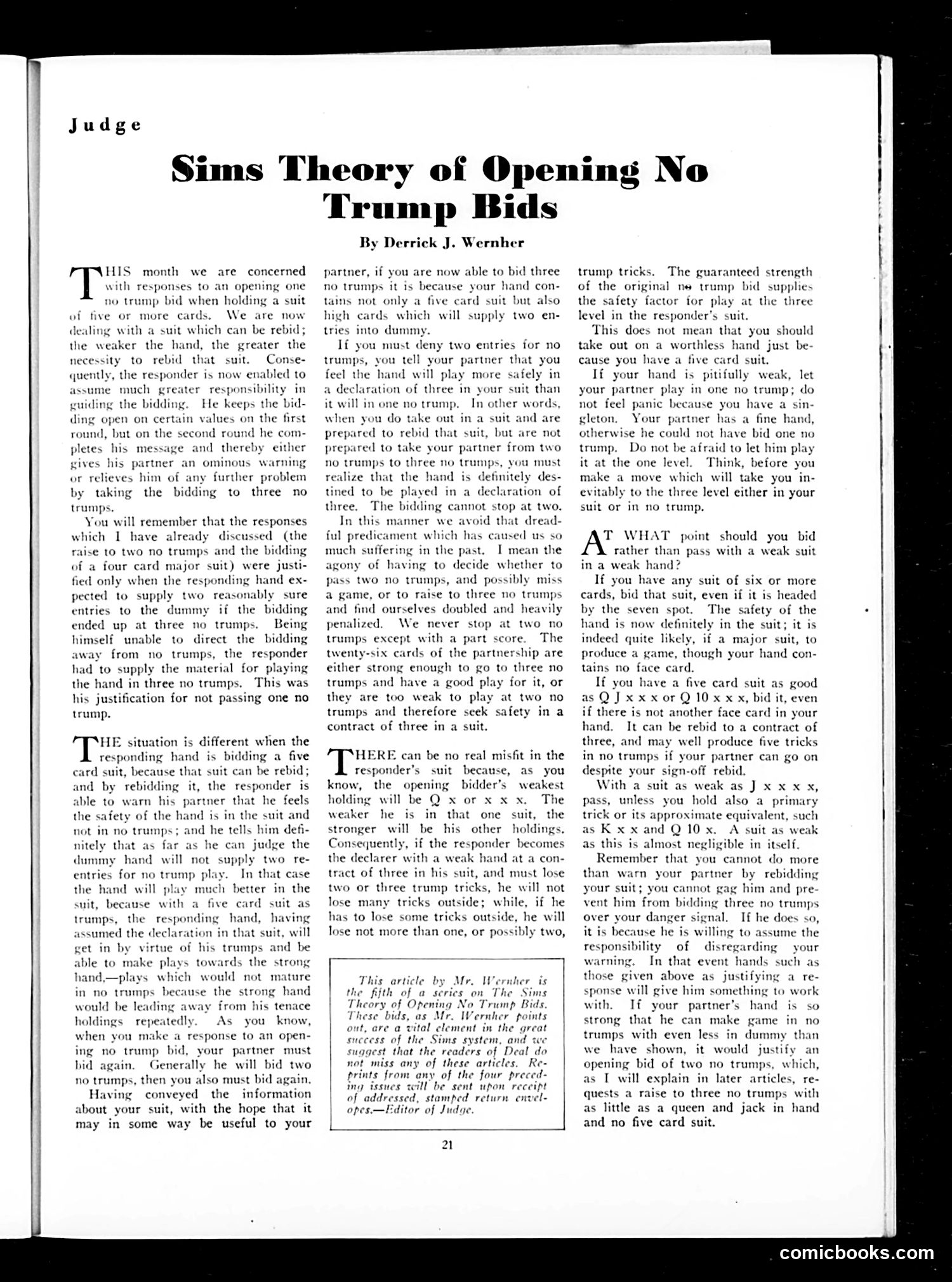
A restored page from Judge, 1933-11. Page through the whole issue in the reader above.
📄 Transcribed text from this page (OCR, searchable)
Machine-transcribed from the original scan — historical spelling and the odd misread are preserved.
Judge Sims Theory of Openins No HIS month we are concerned | with responses to an opening one no trump bid when holding a suit of five or more cards, We are dealing with a suit which can be rebid; the weaker the hand, the greater the necessity to rebid that suit. Conse- quently, the responder is now enabled to assume much greater responsibility in guiding the bidding. He keeps the bid- ding open on certain values on the first round, but on thi pletes his message and thereb: now second round he com- either tner an ominous warning or relieves him of any further problem by taking the bidding to three no trumps. You will remember that the responses which I have already discussed (the raise to two no trumps and the bidding of a four card major suit) were justi- fied only when the responding hand ex- pected to supply two reasonably sure entries to the dummy if the bidding ended up at three no trumps. Being himself unable to direct the bidding away from no trumps, the responder had to supply the material for playing the hand in three no trumps. This was his justification for not passing one no trump. gives his HE situation is different when the responding hand is bidding a five card suit, because that suit can be rebid; and by rebidding it, the responder is able to warn his partner that he feels the safety of the hand is in the suit and not in no trumps; and he tells him defi- nitely that as far as he can judge the dummy hand will not supply two re- entries for no trump play. In that case the hand will play much better in the card suit as hand, having jon in that suit, will his trumps and be suit, because wi trumps, the responding assumed the declara! get in by virtue of able to make pI five ywards the strong hand,—plays which would not mature in no trumps because the strong hand would be leading away from his tenace repeatedly As know, when you make a response to an open- ing no trump bid, your partner must hid again. Generally he will bid two no trumps, then you also must bid again, Having conveyed the information about your suit, with the hope that it may in some way be useful to your holdings you Trump Bids By Derrick J. Wernher partner, if you are now able to bid three no trumps it is because your hand con- tains not only a five card suit but also high cards which will supply two en- tries into dumm If you must deny two entries for no trumps, you tell your partner that you feel the hand will play more safely in a declaration of three in your suit than it will in one no trump. In other words, when you do take out in a suit and are prepared to rebid that suit, but are not prepared to take your partner from two no trumps to three no trumps, you must realize that the hand is definitely des- tined to be played in a declaration of three. The bidding cannot stop at two, In this manner we avoid that dread- ful predicament which has caused us so much suffering in the past. I mean the ony of having to decide whether to pass two no trumps, and possibly miss a game, or to raise to three no trumps and find ourselves doubled and heavily penalized. We never stop at two no trumps except with a part score. The twenty-six cards of the partnership are either strong enough to go to three no trumps and have a good play for it, or they are too weak to play at two no trumps and therefore seek safety in a contract of three in a suit HERE can be no real misfit in the responder’s suit because, as you know, the opening bidder's weakest holding will be Q x or x x x. The weaker he is in that one suit, the stronger will be his other holdings, Consequently, if the responder becomes the declarer with a weak hand at a con- tract of three in his suit, and must lose two or three trump tricks, he will not lose many tricks outside; while, if he has to lose some tricks outside, he will lose not more than one, or possibly two, This article Mr. Wernher is the fifth of a serics on The Sims Theory of Opening No Trump Bids. Th ids, as Mr. Wernher points ont, are a vital clement in the great success of the Sims system, and we suggest that the readers of Deal do not miss any of these articles. Re- prints from any of the four preced- iny issues will be sent upon receipt of addressed, stamped return en’ ditor of Judge trump tricks. The guaranteed strength of the original ne trump bid supy the safety factor for play at the level in the responder’s suit. This does not mean that you should take out on a worthless hand just be- cause you have a five card suit. If your hand is pitifully weak, let your partner play in one no trump; do not feel panic because you have a sin- gleton. Your partner has a fine hand, otherwise he could not have bid one no trump. Do not be afraid to let him play it at the one level. Think, before you make a move which will take you in- evitably to the three level either in your suit or in no trump. x WHAT point should you bid rather than pass with a weak suit in a weak hand? If you have any suit of six or more cards, bid that suit, even if it is headed by the seven spot. The safety of the hand is now definitely in the suit; it is indeed quite likely, if a major suit, to produce a game, though your hand con- tains no face card. If you have a five card suit as good as QJ x x x or Q 10 x x x, bid it, even if there is not another face card in your hand. It can be rebid to a contract of three, and may well produce five tricks in no trumps if your partner can go on despite your sign-off rebid. With a suit as weak as J x x x x, pass, unless you hold also a primary trick or its approximate equivalent, such as K x x and Q 10 A suit as weak as this is almost negligible in itself. Remember that you cannot do more than warn your partner by rebidding your suit; you cannot gag him and pre vent him from bidding three no trumps over your danger signal. If he does so, it is because he is willing to assume the responsibility of warning, disregarding your In that event hands such as those given above as justifying a re- sponse will give him something to work with. If your partner’s hand is so strong that he can make game in no trumps with even less in dummy than we have shown, it would justify an opening bid of two no trumps, which, as I will explain in later articles, re- quests a raise to three no trumps with as little as a queen and jack in hand and no five card suit. comicbooks.com