
Judge, 1933-11 · page 12 of 36
Judge — November 1933 — page 12: what you’re looking at
What you’re looking at
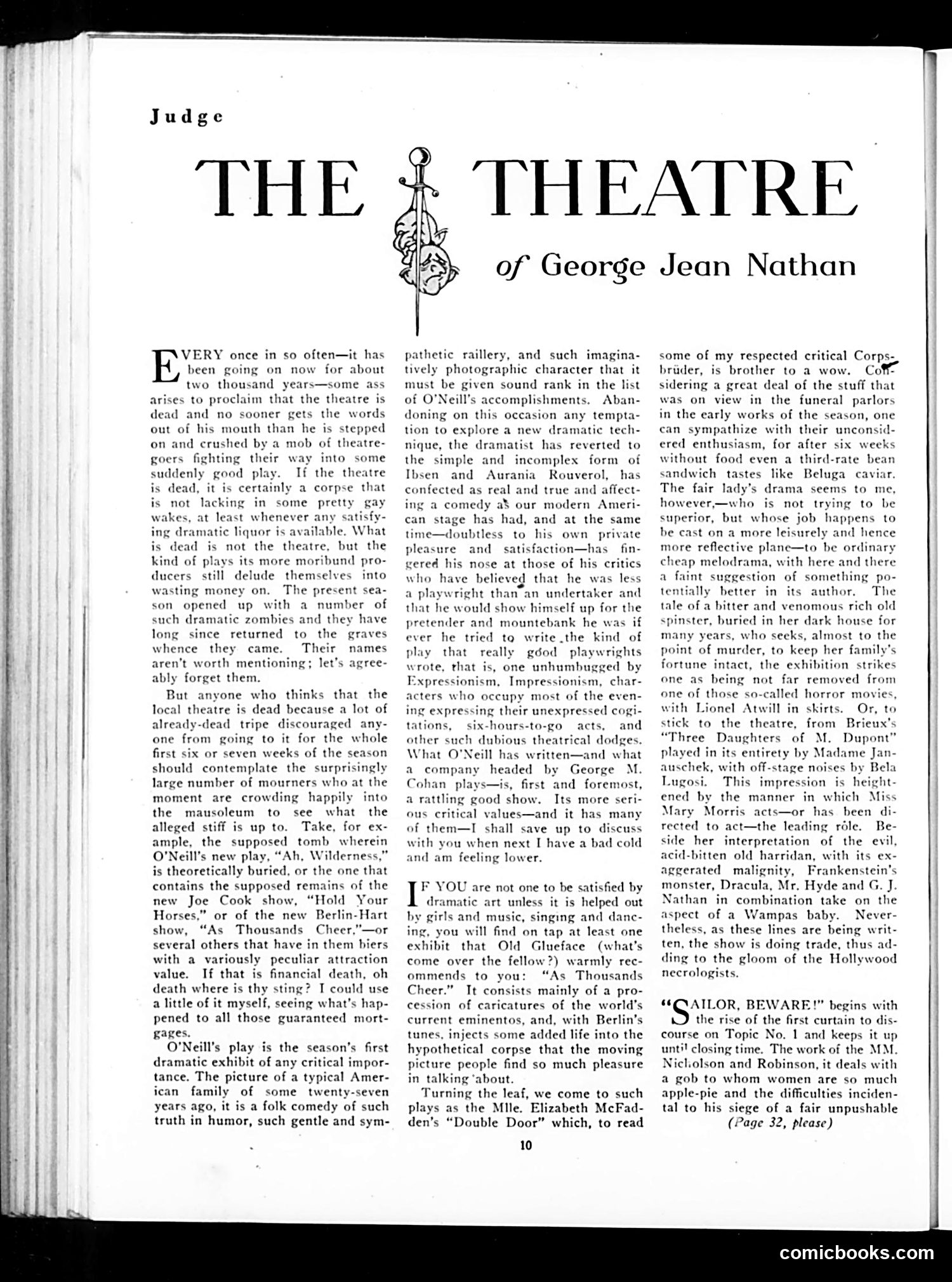
# "The Theatre" by Judge Magazine This is a theater review column by Judge magazine critic George Jean Nathan. The page discusses whether theater is truly "dead" — a perennial claim Nathan dismisses as absurd, pointing to packed houses proving otherwise. Nathan reviews Eugene O'Neill's "Ah, Wilderness!" — calling it O'Neill's most important recent work. It's a folk comedy about an American family from 27 years prior, notable for abandoning O'Neill's experimental techniques (Expressionism, Impressionism) to return to simple, traditional dramaturgy like Ibsen. Nathan also mentions Irving Berlin's revue "As Thousands Cheer," describing it as featuring caricatures of world celebrities set to Berlin's music. The piece dismisses bad plays that opened the season as "dramatic zombies," while celebrating genuine theatrical hits as evidence the medium thrives. Nathan's sardonic tone throughout mocks critics who repeatedly pronounce theater dead while audiences pack venues.
📄 Transcribed text from this page (OCR, searchable)
Machine-transcribed from the original scan — historical spelling and the odd misread are preserved.
t fi VERY once in so often—it has been going on now for about two thousand years—some ass arises to proclaim that the theatre is dead and no sooner gets the words out of his mouth than he is stepped on and crushed by a mob of theatre- goers fighting their way into some suddenly good play. If the theatre is dead, it is certainly a corpse that is not lacking in some pretty wakes, at least whenever ing dramatic liquor is av le. What is dead is not the tre, but the kind of plays its more moribund pro- ducers still delude themselves into wasting money on. The present sea- son opened up with a number of such dramatic zombies and they have long since returned to the graves whence they came. Their names aren’t worth mentioning; let's agree- ably forget them. But anyone who thinks that the local theatre is dead because a lot of already-dead tripe discouraged any- one from going to it for the whole first six or seven weeks of the season should contemplate the surprisingly large number of mourners who at the moment are crowding happily into the mausoleum to see what the alleged stiff is up to. Take, for ex- ample, the supposed tomb wherein O'Neill's new play, “Ah, Wilderness,” is theoretically buried, or the one that contains the supposed remains of the new Joe Cook show, “Hold Your Horses,” or of the new Berlin-Hart show, “As Thousands Cheer,”—or several others that have in them biers with a variously peculiar attraction value. If that is financial death, oh death where is thy sting? I could use a little of it myself, seeing what's hap- pened to all those guaranteed mort- gages. O'Neill's play is the season’s first dramatic exhibit of any critical impor- tance. The picture of a typical Amer- ican family of some twenty-seven years ago, it is a folk comedy of such truth in humor, such gentle and sym- ny satisty- pathetic raillery, and such im: tively photographic character that it must be given sound rank in the list of O'Neill’s accomplishments. Aban- doning on this occasion any tempta- tion to explore a new dramatic tech- nique, the dramatist has reverted to the simple and incomplex form of Ibsen and Aurania Rouverol, has confected as real and true and affect- ing a comedy aS our modern Amer! can stage has had, and at the same time—doubtless to his own private pleasure and_ satisfaction—has _fin- gered his nose at those of his critics who have believed that he was less A - a playwright than an undertaker and that he would show himself up for the pretender and mountebank he was if ever he tried to write the kind of play that really géod_ playwrights wrote, that is, one unhumbugged by Expressionism, Impressionism, char- acters who occupy most of the even- ing expressing their unexpressed cc tations, six-hours-to-go acts, and other such dubious theatrical dodges. What O'Neill has written—and what a company headed by George M. Cohan plays—is, first and foremost, a rattling good show. Its more seri- ous critical values—and it has many of them—I shall save up to discuss with you when next I have a bad cold and am feeling lower. ] * YOU are not one to be satisfied by dramatic art unless it is helped out by girls and music, singing and danc- ing, you will find on tap at least one exhibit that Old Glueface (what's come over the fellow?) warmly rec- ommends to you: “As Thousands Cheer.” It consists nly of a pro- cession of caricatures of the world’s current eminentos, and, with Berlin's tunes, injects some added life into the hypothetical corpse that the moving picture people find so much pleasure in talking ‘about. Turning the leaf, we come to such plays as the Mlle. Elizabeth McFad- den’s “Double Door” which, to read 10 THEATRE of George Jean Nathan some of my respected critical Corps- brider, is brother to a wow. Co sidering a great deal of the stuff that was on view in the funeral parlors in the early works of the season, one can sympathize with their unconsid- ered enthusiasm, for after six weeks without food even a third-rate bean sandwich tastes like Beluga caviar. The fair lady’s drama seems to me, however—who is not trying to be superior, but whose job happens to be cast on a more leisurely and hence more reflective plane—to be ordinary cheap melodrama, with here and there a faint suggestion of something po- tentially better in its author. The ale of a bitter and venomous rich old inster, buried in her dark house for ts, who seeks, almost to the point of murder, to keep her family’s fortune intact, the exhibition strikes one as being not far removed from one of those so-called horror movies, with Lionel Atwill in skirts. Or, to stick to the theatre, from Brieux’s Three Daughters of M. Dupont” played in its entirety by M ] auschek, with off-stage noises by Bela Lugosi. This impression is height- ened by the manner in which Miss Mary Morris acts—or has been di- rected to act—the leading réle. Be- side her interpretation of the evil, acid-bitten old harridan, with its ex- aggerated malignity, ankenstein’s monster, Dracula, Mr, Hyde and G. J. Nathan in combination take on the aspect of a Wampas baby. Never- theless, as these lines are being writ- ten, the show is doing trade, thus ad- ding to the gloom of the Hollywood necrologists. 66QAILOR, BEWARE!” begins with the rise of the first curtain to dis- course on Topic No. 1 and keeps it up unti! closing time. The work of the MM. Nicholson and Robinson, it deals with a gob to whom women are so much apple-pie and the difficulties inciden- tal to his siege of a fair unpushable (Page 32, please) comicbooks.com