
Judge, 1933-11 · page 18 of 36
Judge — November 1933 — page 18: what you’re looking at
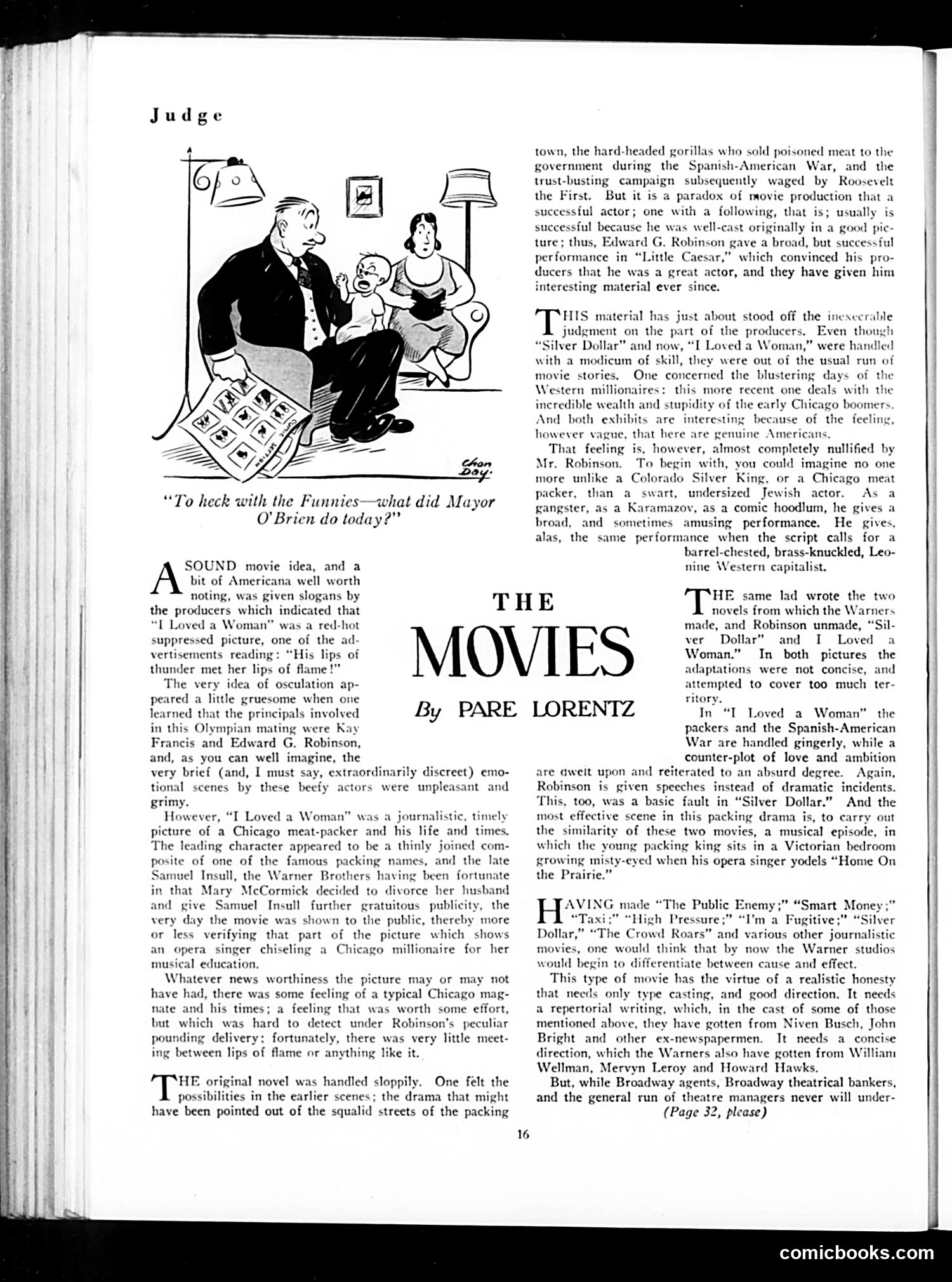
A restored page from Judge, 1933-11. Page through the whole issue in the reader above.
📄 Transcribed text from this page (OCR, searchable)
Machine-transcribed from the original scan — historical spelling and the odd misread are preserved.
“To heck with the Funnies—what did Mayor O'Brien do today?” SOUND movie idea, and a bit of Americana well worth noting, wa given slogans by the producers which indicated that THE “I Loved a Woman” was a red-hot suppressed picture, one of the vertisements reading: “His lips of thunder met her lips of flame!” The very idea of osculation ap- peared a little gruesome when one learned that the principals involved in this Olympian mating were Kay Francis and Edward G. Robinson, and, as you can well imagine, the very brief (and, I must say, extraordinarily discreet) emo- tional scenes by these beefy actors were unpleasant and grimy. However, “I Loved a Woman” was a journalistic, timely picture of a Chicago meat-packer and his life and times. The leading character appeared to be a thinly joined com- posite of one of the famous packing names, and the late Samuel Insull, the Warner Brothers having been fortunate in that Mary McCormick decided to divorce her husband and give Samuel Insull further gratuitous publicity, the very day the movie was shown to the public, thereby more or less verifying that part of the picture which shows an opera singer chiseling a Chicago millionaire for her musical education. Whatever news worthiness the picture may or may not have had, there was some feeling of a typical Chicago mag- nate and his times; a feeling that was worth some effort but which was hard to detect under Robinson's peculiar pounding delivery; fortunately, there was very little meet- ing between lips of flame or anything like it. HE original novel was handled sloppily. One felt the possibilities in the earlier scenes; the drama that might have been pointed out of the squalid streets of the packing town, the hard-headed gorillas who sold poisoned meat to the government during the Spanish-American War, and the trust-busting campaign subsequently waged by Roosevelt the First. But it is a paradox of movie production that a successful actor; one with a following, that is; usually is successful because he was well-cast originally in a good pic- ture; thus, Edward G. Robinson gave a broad, but successful performance in “Little Caesar,” which convinced his pro- ducers that he was a great actor, and they have given him interesting material ever since. HIS material has just about stood off the inexecrable judgment on the part of the producers. Even though ilver Dollar” and now, “I Loved a Woman,” were handled with a modicum of skill, they were out of the usual run of movie stories. One concerned the blustering days of the Western millionaires: this more recent one deals with the incredible wealth and stupidity of the early Chicago boomers And both exhibits are interesting because of the feeling, however vague, that here are genuine Americans. That feeling is, however, almost completely nullified by Mr. Robinson. To begin with, you could imagine no one more unlike a Colorado Silver King, or a Chicago meat packer, than a swart, undersized Jewish actor, As a gangster, as a Karamazov a comic hoodlum, he g broad, and sometimes amusing performance. He gives. alas, the same performance when the script calls for a barrel-chested, brass-knuckled, Leo- nine Western capitalist. HE same lad wrote the two novels from which the Warners made, and Robinson unmade, “Sil- ver Dollar” and I Loved a Woman.” In both pictures the adaptations were not concise, and attempted to cover too much ter- ritory, By PARE LORENTZ In “I Loved a Woman" the packers and the Spanish-American War are handled gingerly, while a counter-plot of love and ambition are aweit upon and reiterated to an absurd degree. Again, Robinson is given speeches instead of dramatic incidents. This, too, was a basic fault in “Silver Dollar.” And the most effective scene in this packing drama is, to carry out the similarity of these two movies, a musical episode, in which the young packing king sits in a Victorian bedroom growing misty-eyed when his opera singer yodels “Home On the Prairie.” AVING made “The Public ‘Smart Money axi;” “High Pressure ;” “I'm a Fugitive;” “Silver Dolla’ he Crowd Roars” and various other journalistic movies, one would think that by now the Warner studios would begin to differentiate between cause and effect. This type of movie has the virtue of a realistic honesty that needs only type casting, and good direction. It needs a repertorial writing, which, in the cast of some of those mentioned above, they have gotten from Niven Busch, John Bright and other ex-newspapermen. It needs a concise direction, which the Warners also have gotten from William Wellman, Mervyn Leroy and Howard Hawks. But, while Broadway agents, Broadway theatrical bankers, and the general run of theatre managers never will under- (Page 32, please) comicbooks.com