
Judge, 1933-11 · page 21 of 36
Judge — November 1933 — page 21: what you’re looking at
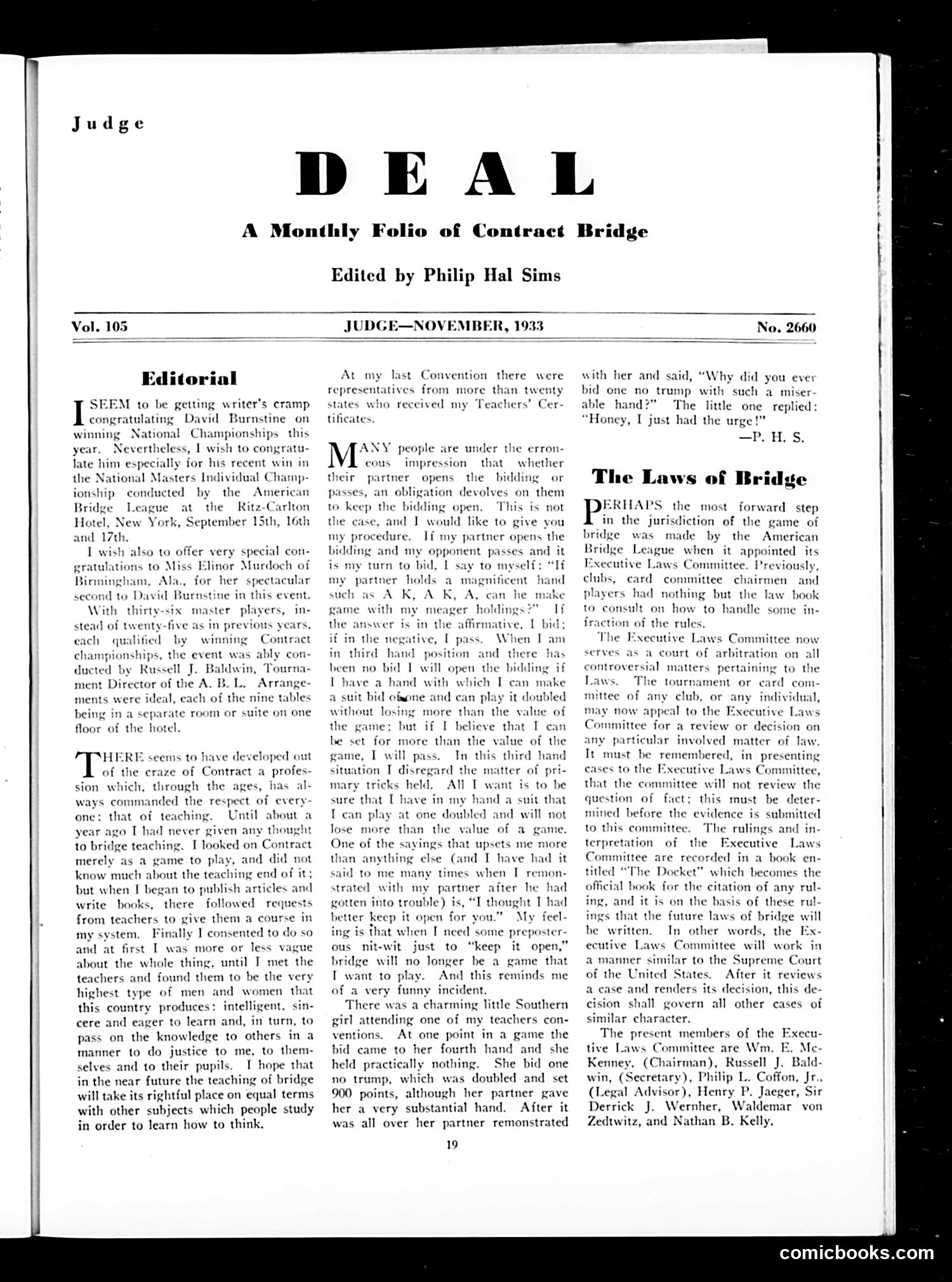
A restored page from Judge, 1933-11. Page through the whole issue in the reader above.
📄 Transcribed text from this page (OCR, searchable)
Machine-transcribed from the original scan — historical spelling and the odd misread are preserved.
DEAL of Contract Bridge Edited by Philip Hal Sims Editorial s 1 to be getting writer’s cramp Toeeauuune David Burnstine on winning National Championships. this year. Nevertheless, | wish to congratu- late him especially for his recent win in the National Masters Individual Champ- ionship conducted by the American Bridge League at the Ritz-Carlton Hotel, New York, September 15th, 16th and 17¢ I wis! gratulati Birn am, also to offer very special con- 1s to Miss Elinor Murdoch of Ala., second to David Burnstine With thirty-six master players, in- stead of twenty-five as in previous years, Contract sly con- for her spectacular his event. each winning char »s, the event wi ducted by Russell J. Baldwin, Tourna- ment Director of the A. B.L, Arrange- were ideal, each of the nine tables qualified by pior men being floor of the hotel. 1a separate room or stite on one HERE seems te of the craze of Contract a profes- sion which, through the ways commanded the respect of every one: that of te g. Until about a year ago T had never given any thou to bridge teaching. I looked on Contract merely as a game to play, and did not know much about the teaching end of it; but when I began to publish articles and write books, there followed reques from teachers to give them a course in my system. Finally I consented to do so and at first I was more or less vague about the whole thing, until I met the teachers and found them to be the very highest type of men and women t this country produces: intelligent, sin- cere and eager to learn and, in turn, to pass on the knowledge to others in a manner to do justice to me, to them- selves and to their pupils. [I hope that in the near future the teaching of bridge will take its rightful place on equal terms with other subjects which people study in order to learn how to think, have developed out ges, has al- No, 2660 At my last Convention there representatives from om were ore than twenty states who received my Teachers’ Cer- tificates. ANY people are under the cous that opens the erron- impression partner whether bidding or on them This is not their passes, an obligation devoly to keep the bidding open. the case, and I would like to give you my procedure. If my partner opens the bidding and my opponent passes and it is my , L say to myself: “If my or a gnificent such can he with holdings ? the answer is in the affirmative, if in the neg When in third hand position and been no bid [ will open the bidding if I have a hand with which I can make a suit bid ofone and can play it doubl without losing more than game ive, [ pass here he value believe that T car re than the value of t game, I will pass. In this third he situation I disregard the matter of pri mary tricks held. All T want is to be sure that [ have in my hand a suit that Tecan play at one doubled and will not lose more than the value of a game. the game; but if I he set for m One of the sayings that upsets me more than anything else (and I have had it said to me many times when with my partner into trouble) is ought T had better keep it open for you.” My feel- ing is that when [ need some preposter- nit-wit just to “keep it open,’ bridge will no longer be a game that I want to play. And this reminds me of a very funny incident. There was a charming little Southern girl attending one of my teachers con- ventions. At one point in a game the bid came to her fourth hand and she held practically nothing. She bid one no trump, which was doubled and. set 900 points, although her partner ga her a very substantial hand. After it was all over her partner remonstrated 19 I remon- after he had ous with her and said, “Why did you ever bid one no trump with such a miser able hand?” The little one replied: “Honey, I just had the urge!” H. S. The Laws of Bridge P RHAPS the most forward step in the jurisdiction of the game of bridge was made by the American Bridge League when it appointed its Executive Laws Committee. Previously, clul card committee chairmen and players had nothing but the law book to consult on how to handle some in- fraction of the rules, The Executive Laws Committee now serves as a court of arbitration on all I matters pertaining to the tournament or card com- club, or any individual, appeal to the Executive Laws Committee for a review or deci any particular involved matte It must be remembere the Ex that the comr comtrover Laws. Thi mittee of may now jon on of law. in presenting cutive Laws Committee, ttee will not review the question of fact; this must be deter- mined before the evidence is submitted to this committee. The terpretation of the Com: rulings and in- ecutive Laws are recorded in a book en- titled “The Docket” which becomes the official book for the citation of any rul- ing, and it is on the basis of these rul- ings that the future laws of bridge will be written. In other words, the ecutive Laws Committee will work in a manner similar to the Supreme Court of the United States. After it reviews a case and renders its decision, this de- cision shall govern all other cases of similar character. The present members of the Execu- tive Laws Committee are Wm, E. Mc- Kenney, (Chairman), Russell J. Bald- win, (Secretary), Philip L. Coffon, Jr.. (Legal Advisor), Henry P. Jaeger, Sir Derrick J. Wernher, Waldemar Zedtwitz, and Nathan B. Kelly, ittee von comicbooks.com