
Judge, 1933-11 · page 22 of 36
Judge — November 1933 — page 22: what you’re looking at
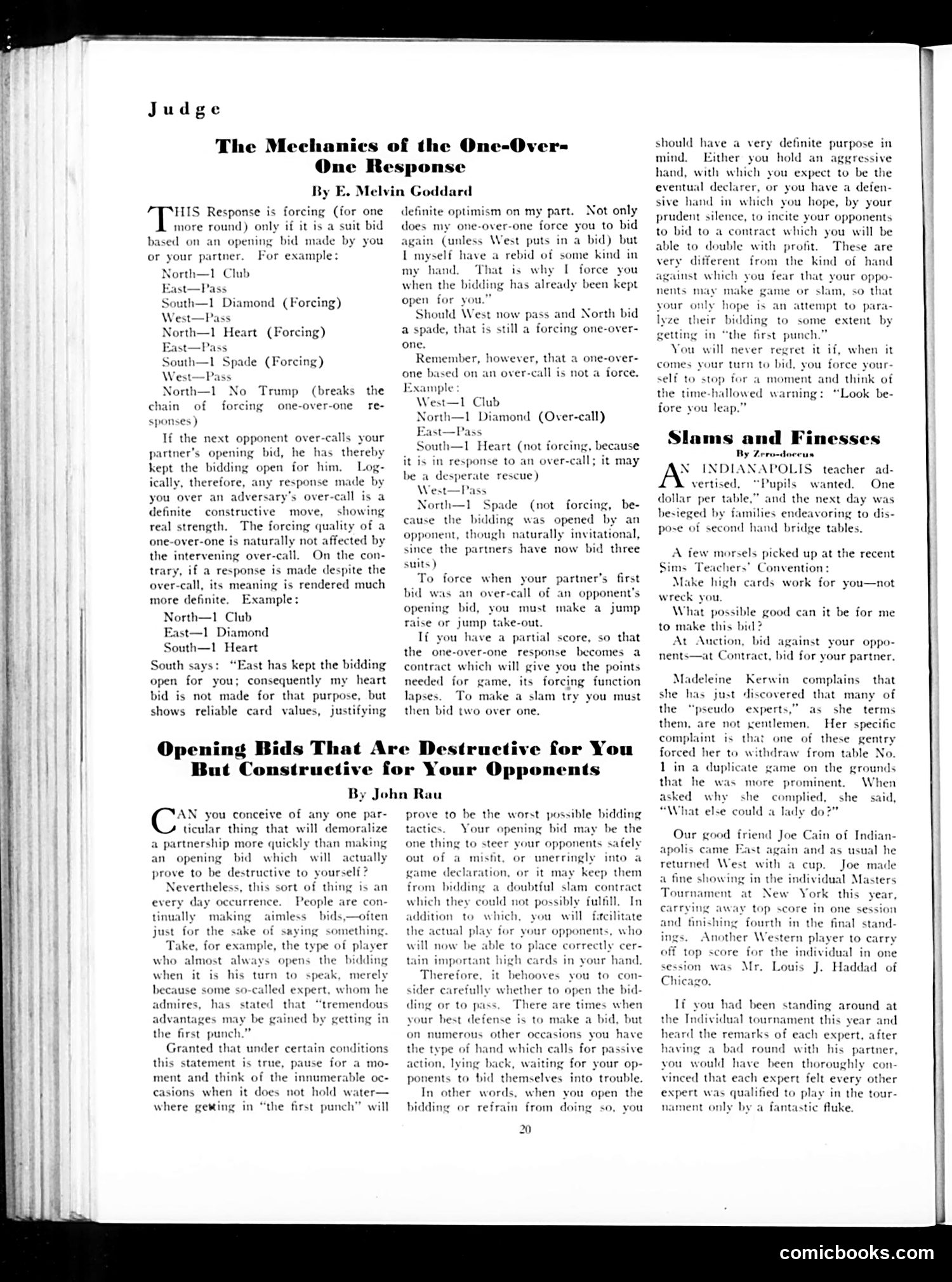
A restored page from Judge, 1933-11. Page through the whole issue in the reader above.
📄 Transcribed text from this page (OCR, searchable)
Machine-transcribed from the original scan — historical spelling and the odd misread are preserved.
| Judge The Mechanics of the Onc-Over- One Response By E. Melvin Goddard HIS Response is forcing (for one more round) only if it is a suit bid based on an opening bid made by you or your partn For example: ‘orth—1 Club East—Pass South—1 Diamond (Forcing) West—Pass North—1 Heart (Forcing) West North—1 No Trump (breaks the chain of forcing one-over-one re- es) le (Forcin spot If the next opponent over-calls your partner’s opening bid, he has thereby kept the bidding open for him. Li ically, therefore, any response made by you over an adversary’s over-call is a definite constructive move, showing real strength. The forcing quality of a one-over-one is naturally not affected by the intervening over-call. On the con- trary, if a response is made despite the over-call, i aning is rendered much more definite. mople: North—1 Club East—1 Diamond South—1 Heart South says: “East has kept the bidding open for you; consequently my heart bid is not made for that purpose, but shows reliable card values, justifying defini € optimism on my part. Not only does my one-over-one force you to bid again (unless West puts in a bid) but L myself have a rebid of some kind in my hand. That is why I force you when the bidding has already been kept open for you.” Should West now pass and North bid a spade, that is still a one, Remember, however, that a one-over- one bi Example —1 Club Diamond (Over-call) East—Pass South—1 Heart (not forcing, because it is in response to an over-call; it may be a desperate rescue) West—Pas: rth—l Spade (not forcing, be- cause the bidding was opened by an opponent, though naturally invitational, since the partners have now bid three suit forcing one-over- 1 on an over-call is not ¢ force. ‘o force when your partner's first bid was an over-call of an opponent's opening bid, you must make a jump raise or jump take-out. If you have a partial score, so that the one-over-one response becomes a contract which will give you the points needed for game, its forcing function lapses. To make a slam try you must then bid two over one, Opening Bids That Are Destructive for You But Constructive for Your Opponent By John Rau AN you conceive of any one par- ticular thing that will demoralize a partnership more quickly than making an opening bid which will actually prove to be destructive to yourself? Nevertheless, this sort of thing is an every day occurrence. People are con- tinually “making aimless just for the sake of saying Take, for example, the type of pls who almost ddin when it is his turn to speak, merely because some so-called expert, whom he admires, has stated that “tremendous advantages may be gained by getting in the first punch.” Granted that under certain conditions this statement is true, pause for a mo- ment and think of the innumerable oc- ions when it does not hold water— where getting in “the first punch” will always opens the | prove to be the worst possible bidding tactics. Your opening bid may be the one thing to steer your opponents safely out of a misfit, or unerringly into a game declaration, or it may keep them from biddi which the: addition to the a a doubtful slam contract could not possibly fulfill, In rich, you will ftcilitate al play for your opponents, v will now be able to place correctly c hand. behooves you to con- sider carefully whet 1. gh cards in your bid, but on numerous other occasions you have the type of hand which ca your hest « Ils for passive tion, lying back, waiting for your op- ponents to bid themselves into trouble. In other words, when you open the hidding or refrain from doing so, you 20 should have a very definite purpose in mind. her you hold an aggressive hand, with which you expect to be the eventual declarer, or you have a defen- sive hand in which you hope, by your prudent silence to incite your opponents to bid to a contract which you will be able to double with profit. very hese are different from the kind of hand inst: wh you fear that your oppo- nents may make game or slam, so that your ¢ ope is an attempt to para- iyze their bidding to some extent. by getting in “the first punch You will never regret it if, when it comes your turn to bid, you force your- self to stop for a moment and think of ne time-hallowed warning: “Look be- fore you leap.” lams and Finesse: By Zero -ous AY INDIANAPOLIS teacher ad- vertised, “Pupils wanted. One dollar per table,” and the next day was besieged by families endeavoring to dis- pose of second hand bridge tables. A few morsels picked up at the recent ms auchers’ Convention: Make high cards work for you—not wreck you. What possible good can it be for me to make this bi At Aucti nents—at n, bid against your oppo- omtract, bid for your partner. Madeleine Kerwin complains that she has just discovered that many of the “pseudo expert as she terms them, are not gentlemen. Her specific mplaint is that one of these gentry forced her to withdraw from table No. 1 in a duplicate game on the grounds that he was more prominent. When asked why she complied, she said, “What else could a lady do?” Our good friend Joe C came FE. ‘ain of Ine ust again and as usual he returned West with a cup Joe made a fine showing in th e individual Masters Tournament at New York this year, carrying away top score in one sess! and _finis 1 stand- it Another Western player to carry f top score for the individual in one m was Mr. Louis J. Haddad of <0. ing fourth in the fi Chic If you had been standing around at the Individual tournament this year and heard the remarks of each expe fter having a bad round with his partner, you would have been thoroughly con- vinced that each expert felt every expert was qual: nament onl) comicbooks.com