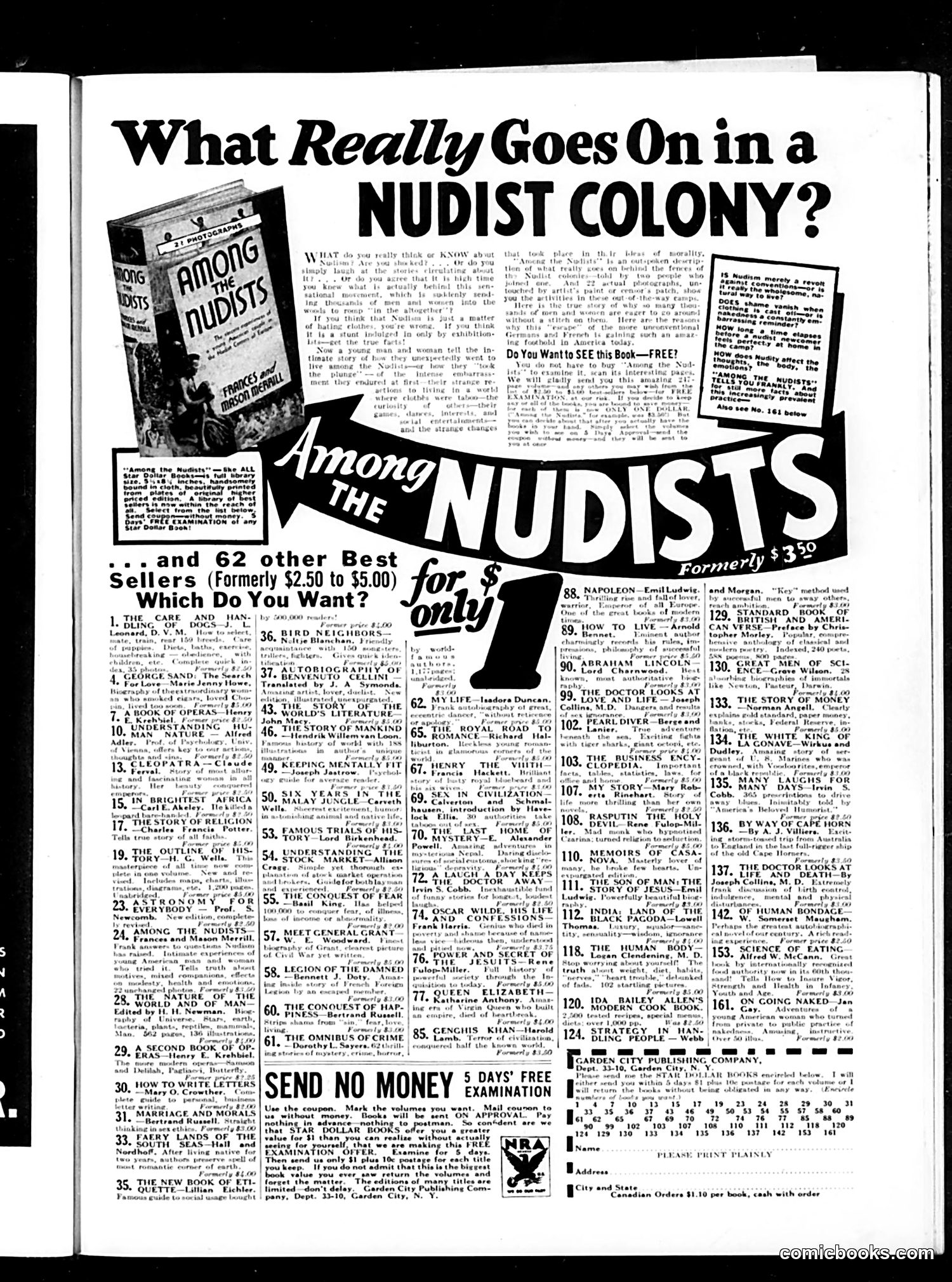
A complete issue · 38 pages · 1933
Judge — October 1933
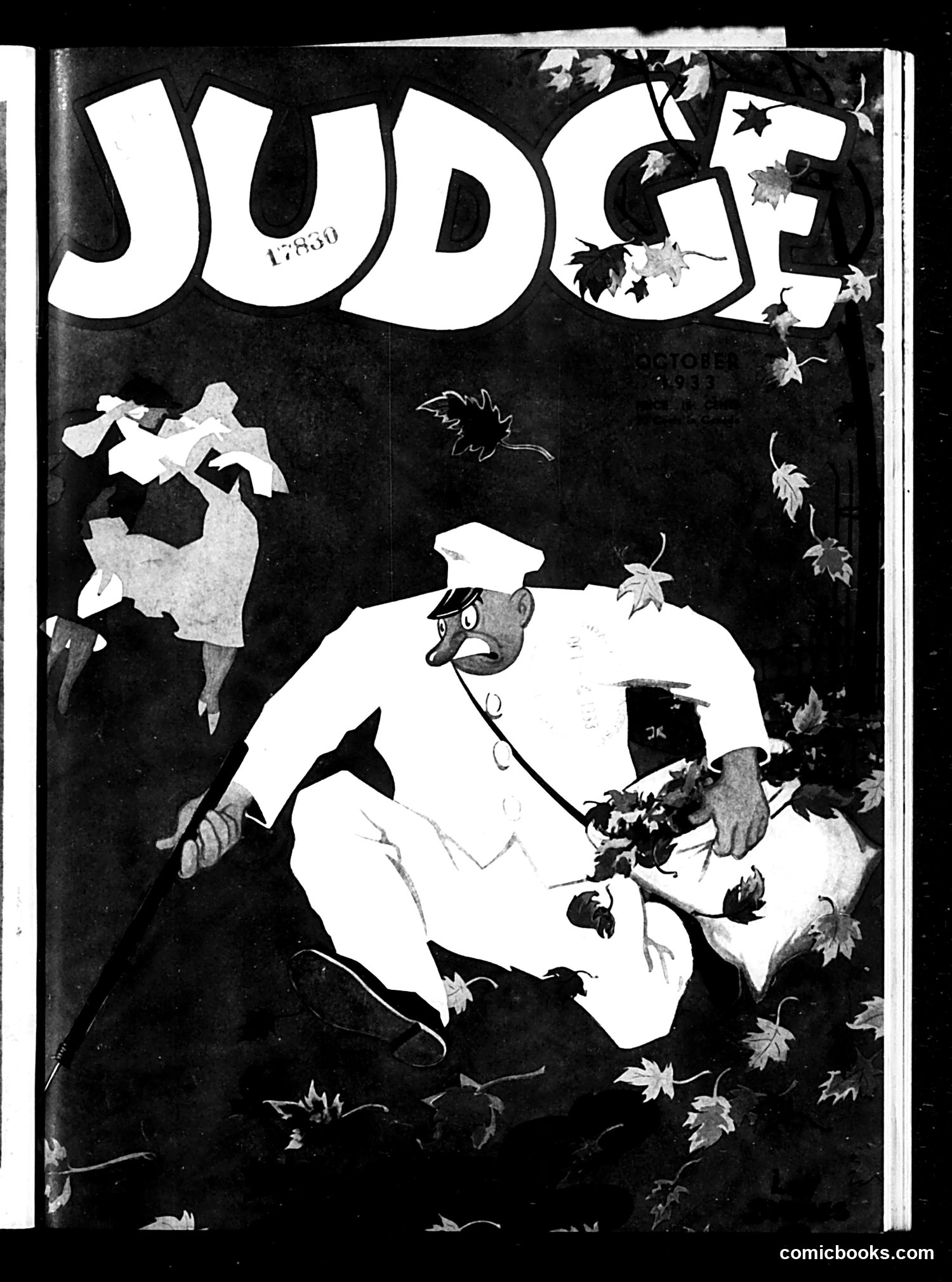
# Analysis This appears to be a cover from **Judge** magazine, an American satirical publication. The large letters "JUDGE" dominate the top, with decorative autumn leaves surrounding the scene. The central figure is a caricatured chef or cook in white chef's attire and hat, depicted with exaggerated features typical of early 20th-century American political cartooning. The chef appears to be preparing or handling something (possibly food/vegetation), surrounded by falling autumn leaves. Without clearer context or visible caption text, the specific political or social reference is unclear. The chef's prominent position and caricatured style suggest commentary on a public figure or institution, but the precise satirical point—whether addressing labor issues, food safety, political leadership, or another contemporary concern—cannot be determined with certainty from the image alone.
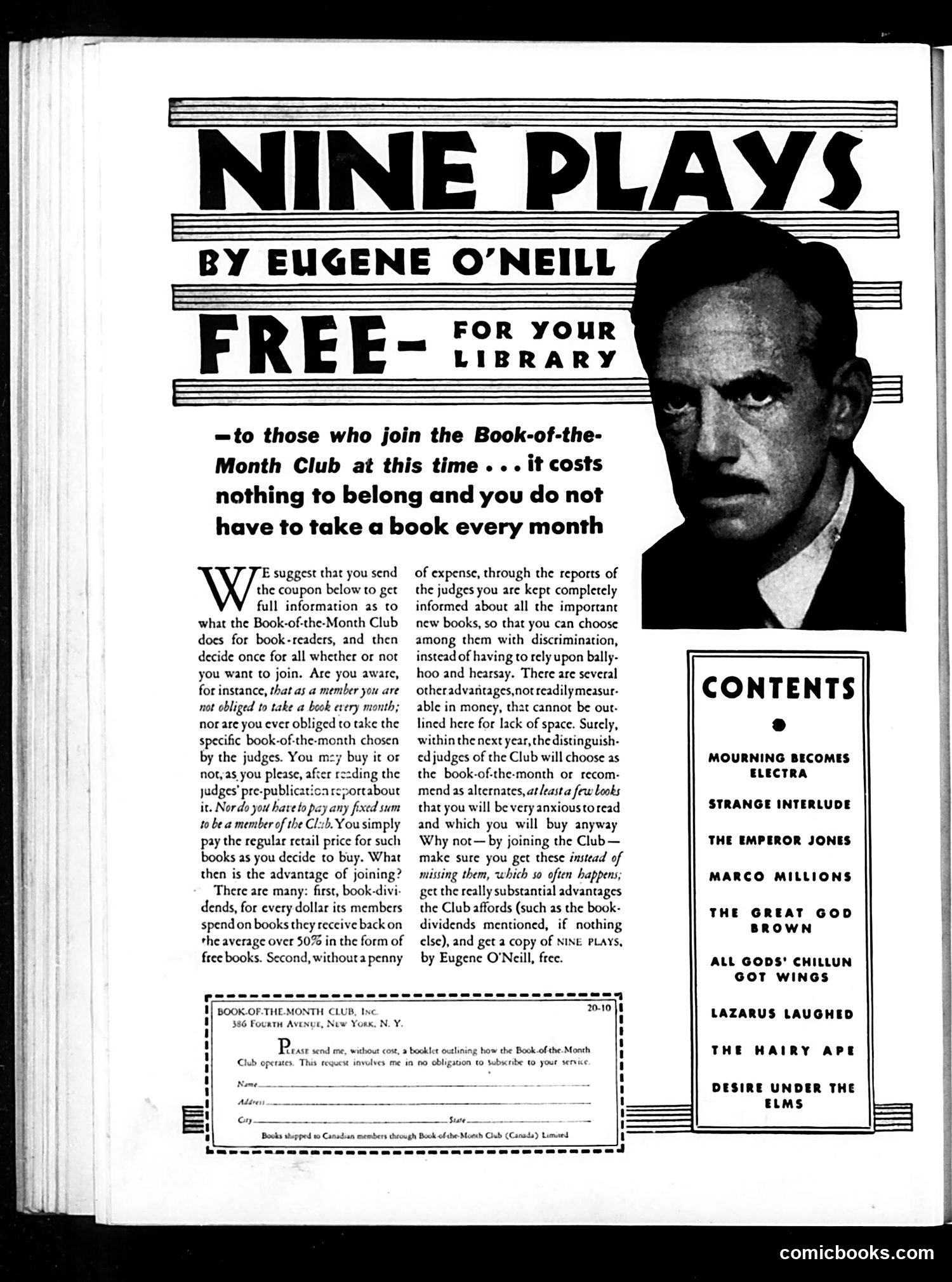
# Analysis This page is primarily **advertising, not satire or political commentary**. It promotes the Book-of-the-Month Club, offering Eugene O'Neill's "Nine Plays" free to new members. The photograph shows a **stern-faced man in formal attire**—likely O'Neill himself, though not explicitly identified. The advertisement emphasizes the Club's value proposition: membership costs nothing, members aren't obligated to purchase monthly selections, and they receive substantial discounts (averaging over 25% savings). The listed plays in the contents box include titles like "Mourning Becomes Electra" and "Desire Under the Elms," establishing O'Neill's reputation as a serious dramatist. This represents **mid-20th century direct marketing**, using celebrity endorsement and membership incentives to drive subscriptions. There is no satirical content present.
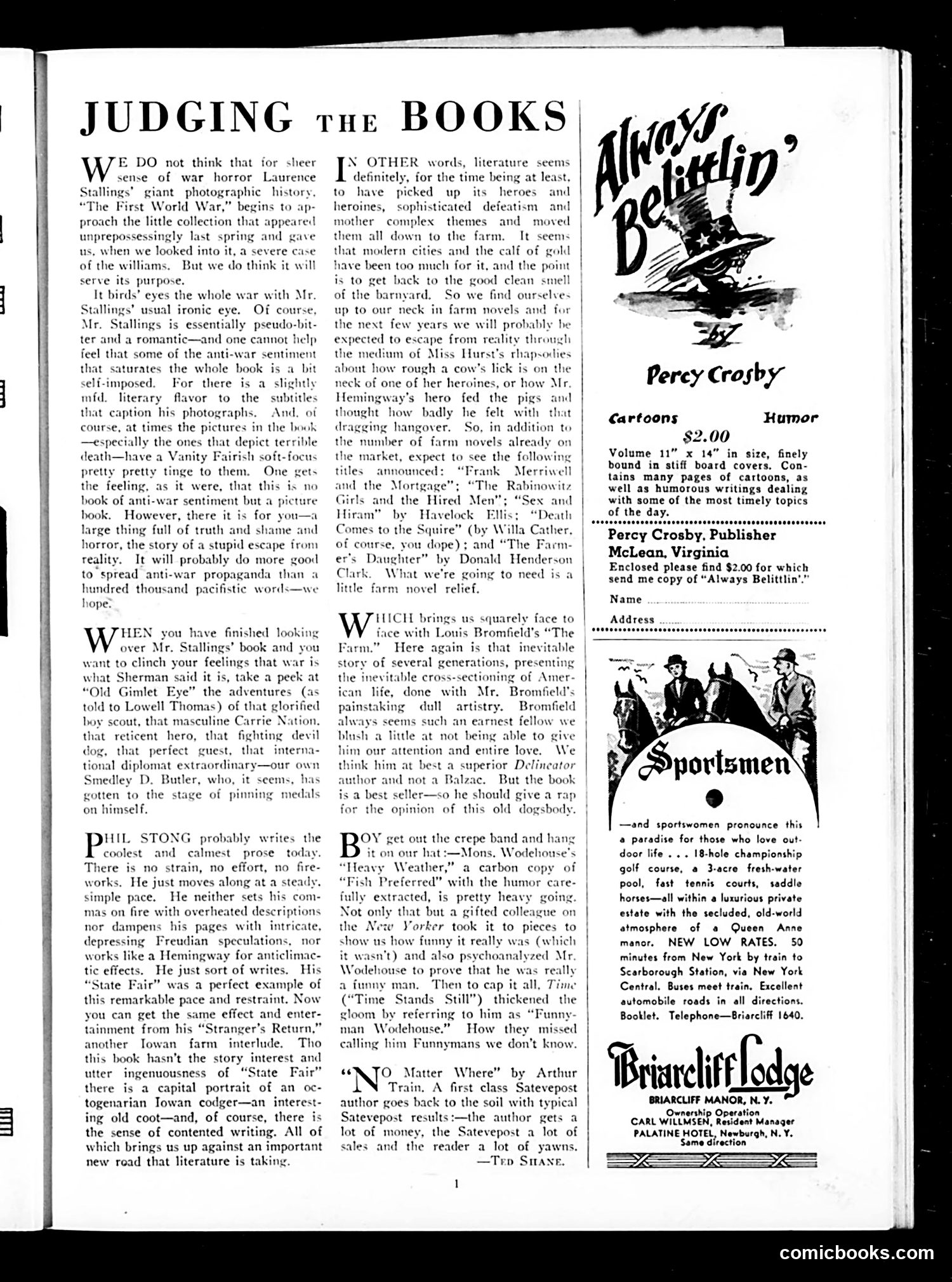
# Analysis of Judge Magazine Page This page is primarily **book reviews and advertising** rather than political satire. The left column reviews farm novels and wartime literature by authors like Laurence Stallings and Louis Bromfield. The reviewer discusses their literary merits and anti-war sentiment. The right side advertises **Percy Crosby's cartoon collection** ("Always Believin'") and two leisure destinations: **Sportsmen** (a golf/hunting resort) and **Briarcliff Lodge** (a Westchester hotel). The only illustration is Percy Crosby's cartoon logo—a bird in flight—which advertises his humor collection, not political commentary. There is **no political cartoon or satire visible** on this page. It represents Judge's shift toward lifestyle advertising and literary criticism during this period.
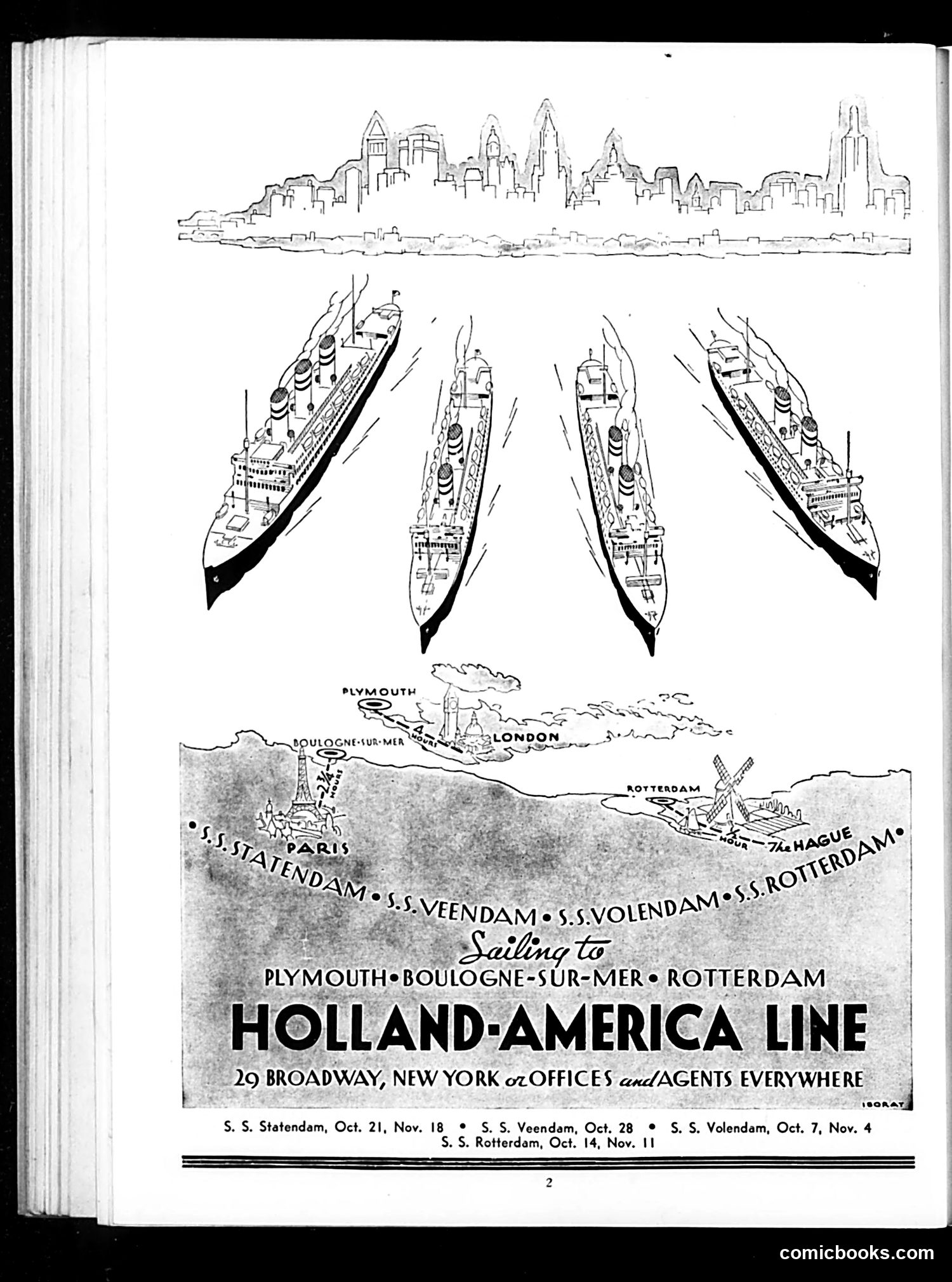
# Analysis This page is primarily **advertising, not satire or political commentary**. The Holland-America Line shipping company presents its transatlantic passenger service with illustrated views of four steamships (S.S. Statendam, Veendam, Volendam, and Rotterdam) and a stylized New York City skyline. The map shows the sailing route: **Plymouth → Boulogne-sur-Mer → Rotterdam**, with stops in London and The Hague also marked. Departure dates are listed at bottom (October-November sailings). The "29 Broadway, New York" address indicates this is a recruiting advertisement for passengers, positioned in *Judge* magazine to reach affluent American readers interested in European travel during the interwar period. There is no satirical content—this is straightforward commercial advertising.
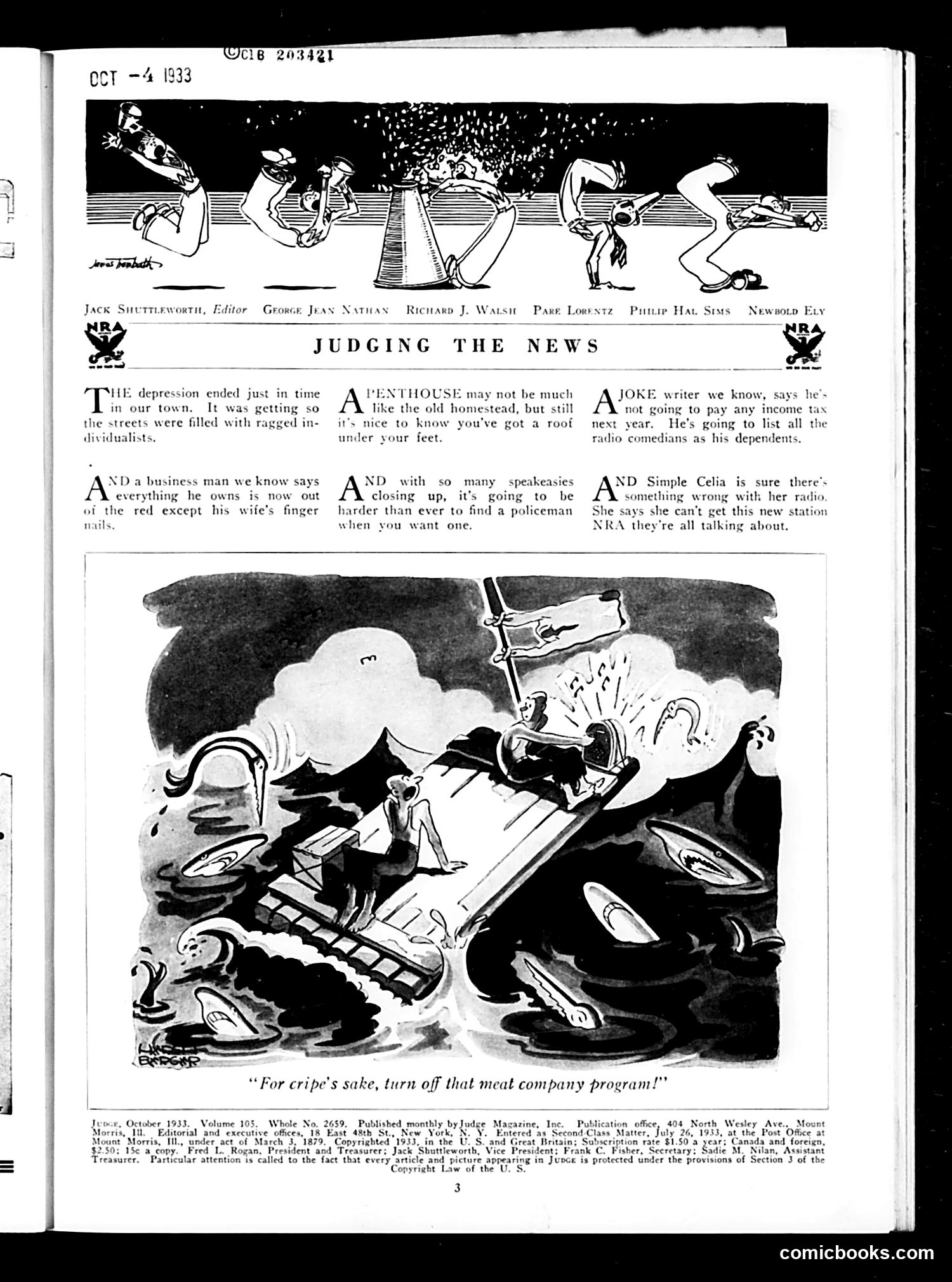
# Analysis of Judge Magazine Page, October 1933 This page features "Judging the News," a satirical commentary section typical of Judge magazine. The main cartoon depicts a chaotic scene with a figure wielding a gavel or mallet amid swirling clouds and debris, with a flag visible. The caption reads: "For cripe's sake, turn off that meal company program!" The accompanying text jokes reference Depression-era concerns: businesses struggling, difficulty finding police, radio programming (mentioning NRA and "Simple Celia"), and income tax worries. The cartoon likely satirizes New Deal programs or radio content from FDR's administration (early 1933), suggesting public frustration with either government broadcasts or commercial radio programming during economic hardship. The specific "meal company program" reference remains unclear without additional context.
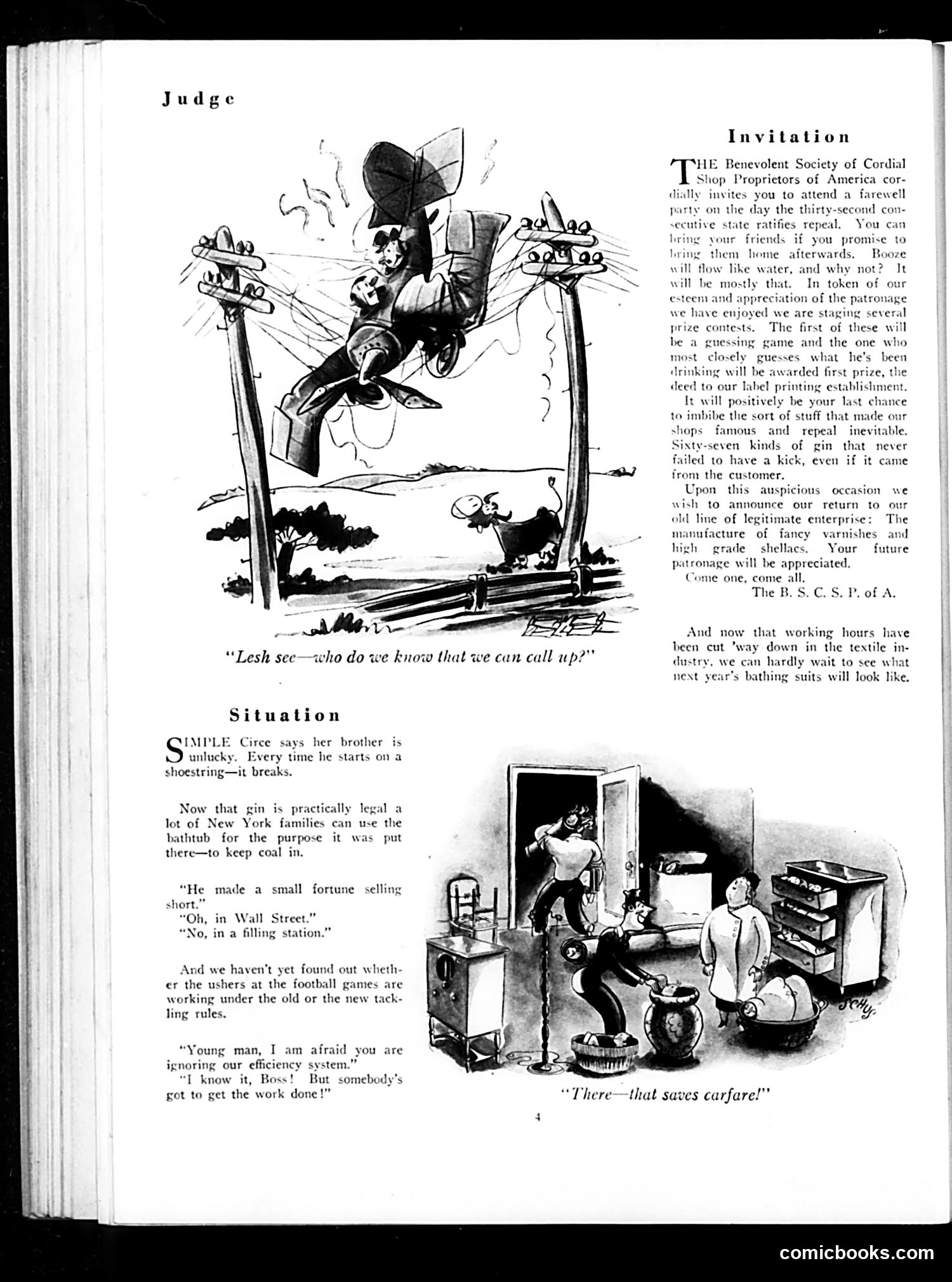
# Judge Magazine Page Analysis This page contains two distinct sections: **"Judge" (top cartoon):** A acrobat/performer is suspended between two poles while juggling. The caption "Lesh see—who do we know that we can call up?" suggests uncertainty about whom to contact. This likely satirizes someone attempting to maintain balance amid competing pressures or obligations—though the specific political figure or situation remains unclear without additional context. **"Situation" (bottom):** Comic vignettes mock workplace inefficiency and changing social norms. References to New York families misusing bathtubs, Wall Street fortunes, and football game ushers suggest post-Prohibition era satire. The final panel critiques "efficiency systems" as impractical when actual work needs doing—a common Jazz Age complaint about corporate management fads. Both sections employ humor to critique contemporary American society and workplace culture.
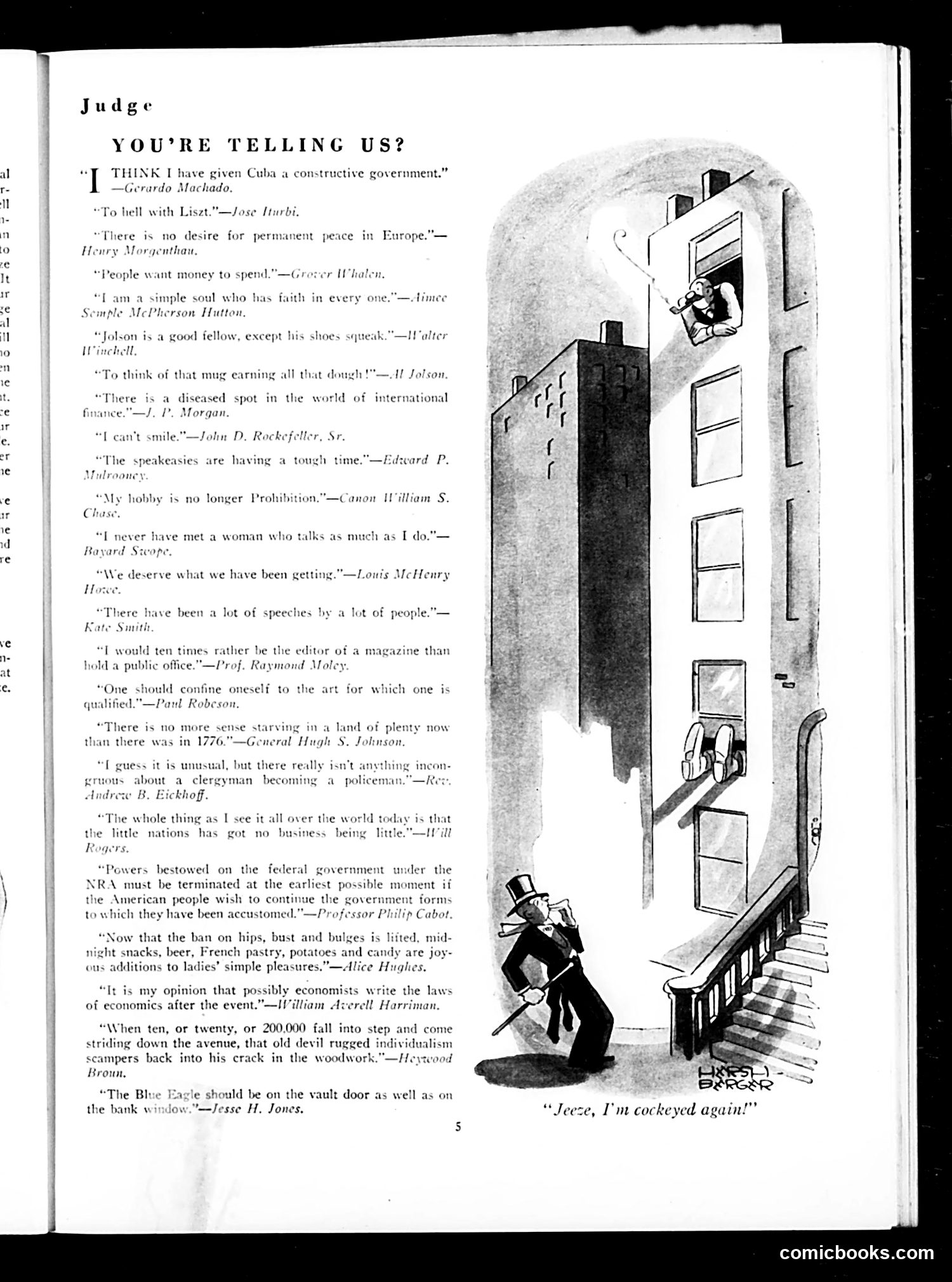
# Analysis of Judge Magazine Page This page consists primarily of **quotations from public figures**, not a political cartoon. The left column collects humorous, cynical quotes attributed to famous people—politicians, businessmen, and celebrities—on topics like government, Prohibition, economics, and social conditions. The **single cartoon** (right side) shows a man in a top hat repeatedly locked out of a tall building, exclaiming "Jeeze, I'm cocked again!" This appears to be satirizing **Prohibition-era troubles**—the figure's repeated lockouts and frustration likely reference the difficulty obtaining alcohol or accessing speakeasies during the ban. The cartoon's simple visual joke complements the page's broader satirical commentary on contemporary American social and political absurdities.
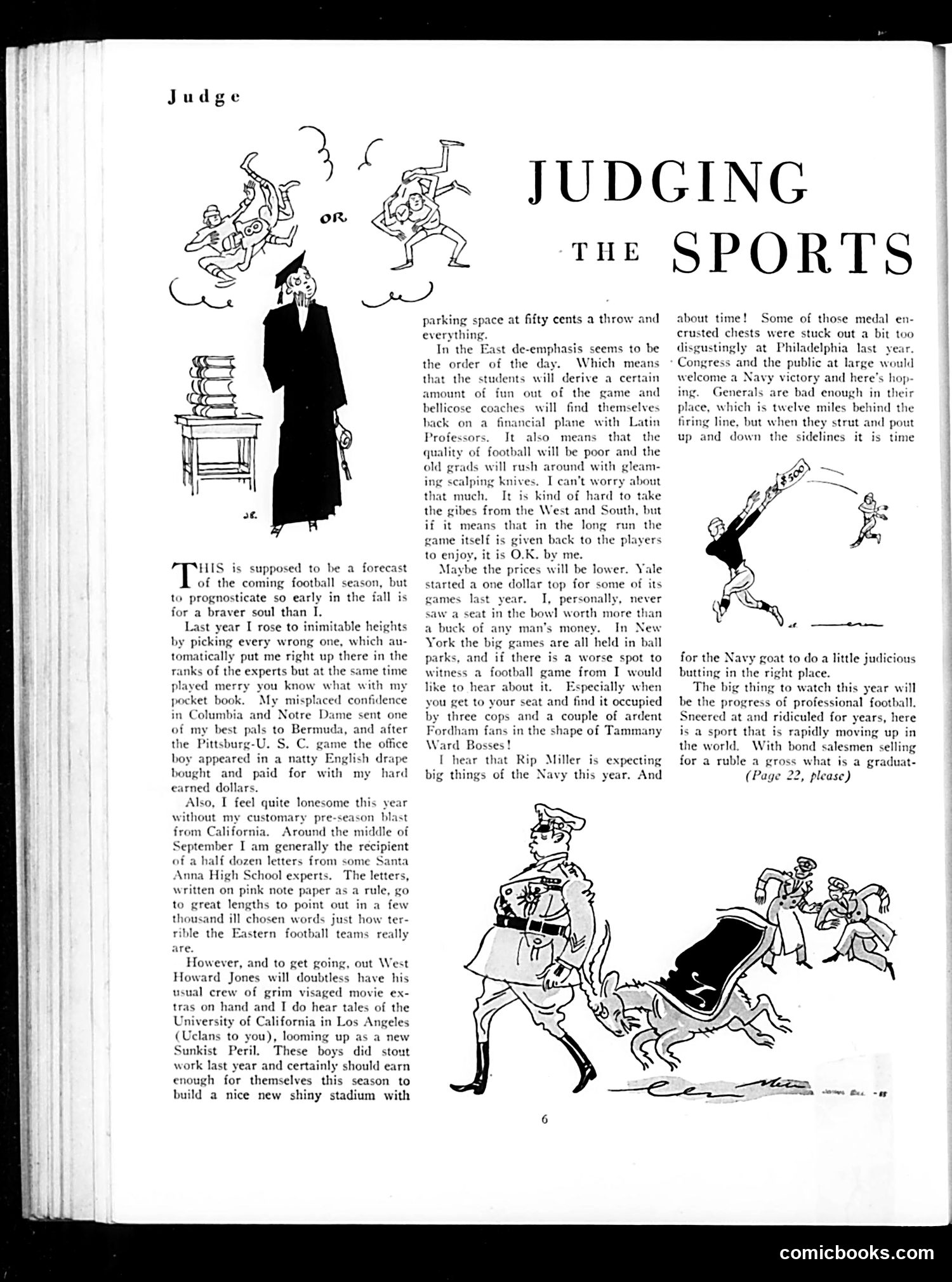
# "Judging the Sports" - Football Season Preview This is a satirical column about the upcoming football season, illustrated with humorous cartoons. The author critiques overpriced football tickets and inflated expectations around college and professional games. Key points of satire: - **Ticket prices**: The author mocks exorbitant costs for stadium seats, mentioning paying fifty cents for parking alone - **Eastern vs. Western football**: Letters from Santa Anna High School experts supposedly prove Eastern teams are overrated - **Coach Amos Alonzo Stagg reference**: The column discusses California football's reputation - **Yale's pricing**: Even Yale reduced ticket prices, suggesting the market correction is widespread - **Navy football**: Mentions Rip Miller expecting "big things" from Navy's program The cartoons depict judges/authorities making decisions about sports, with physical comedy illustrations accompanying the text's sardonic tone about commercialized collegiate athletics.
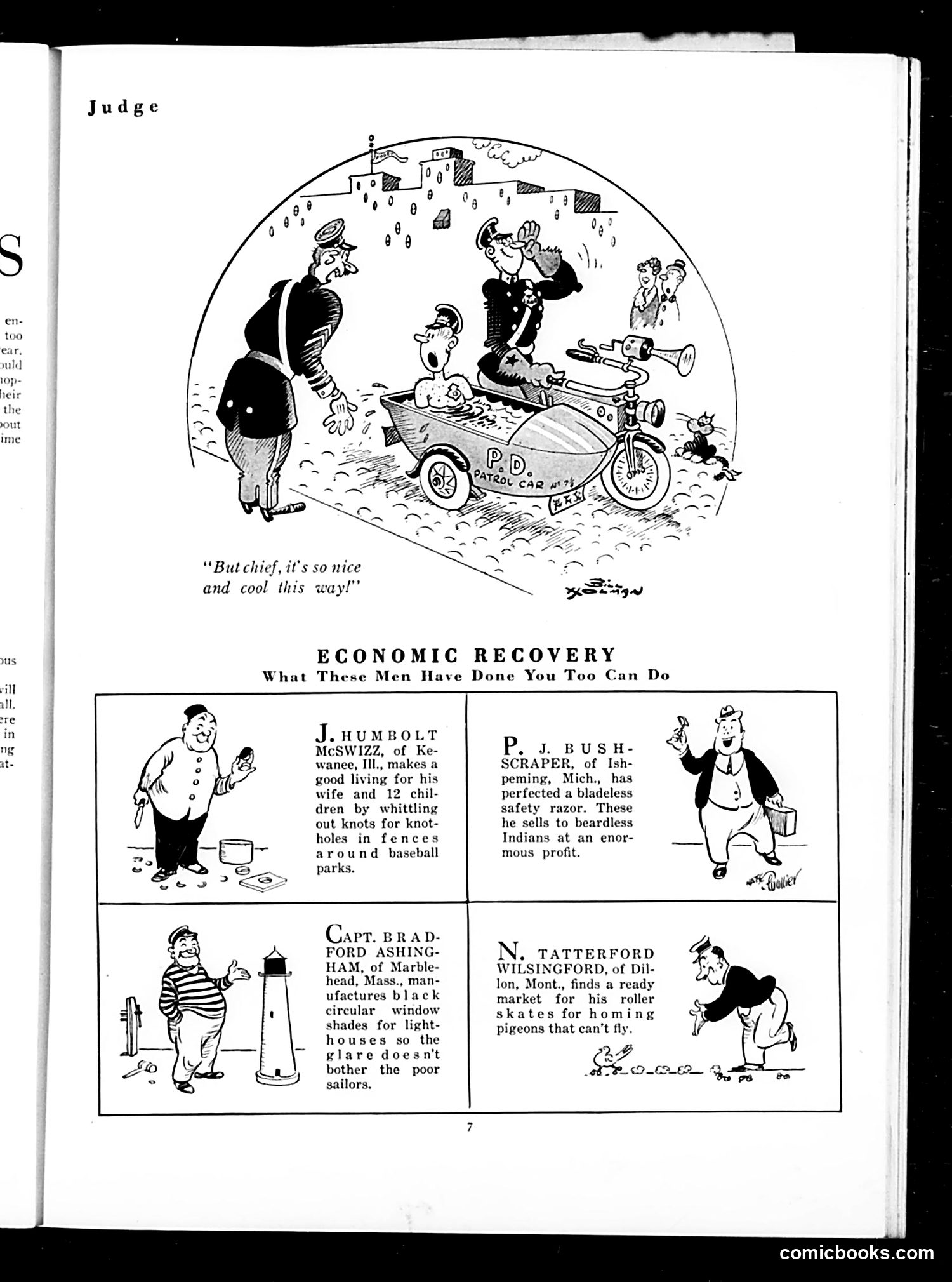
# Economic Recovery Satire This page satirizes Depression-era "self-help" entrepreneurship schemes. The top cartoon shows police officials admiring a child's elaborate patrol car, with the caption suggesting admiration for makeshift ingenuity. Below, "Economic Recovery: What These Men Have Done You Too Can Do" mocks absurd business ideas presented as legitimate success stories. Each example describes comically useless products: - Whittling knots for fence holes - Window shades for lighthouses (to protect sailors from glare) - A bladeless razor marketed to beardless Native Americans - Roller skates designed for homing pigeons unable to fly The satire targets the period's proliferation of dubious money-making schemes pitched to desperate Americans seeking economic recovery. Judge magazine ridicules both the con-artist promoters inventing fake markets and the desperation of people willing to try anything to survive economically. The crude drawings and impossible business premises emphasize the absurdity of the pitches.
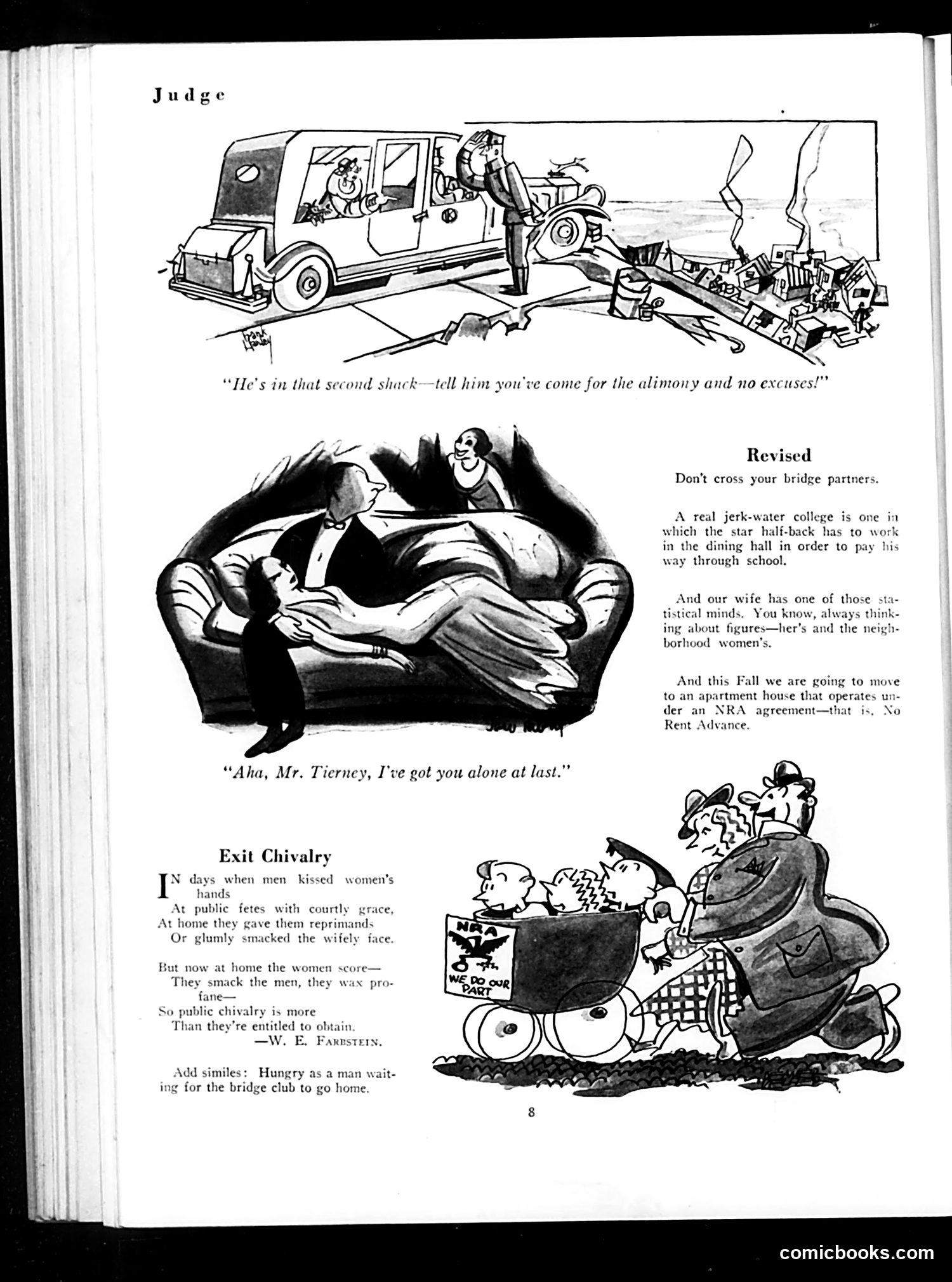
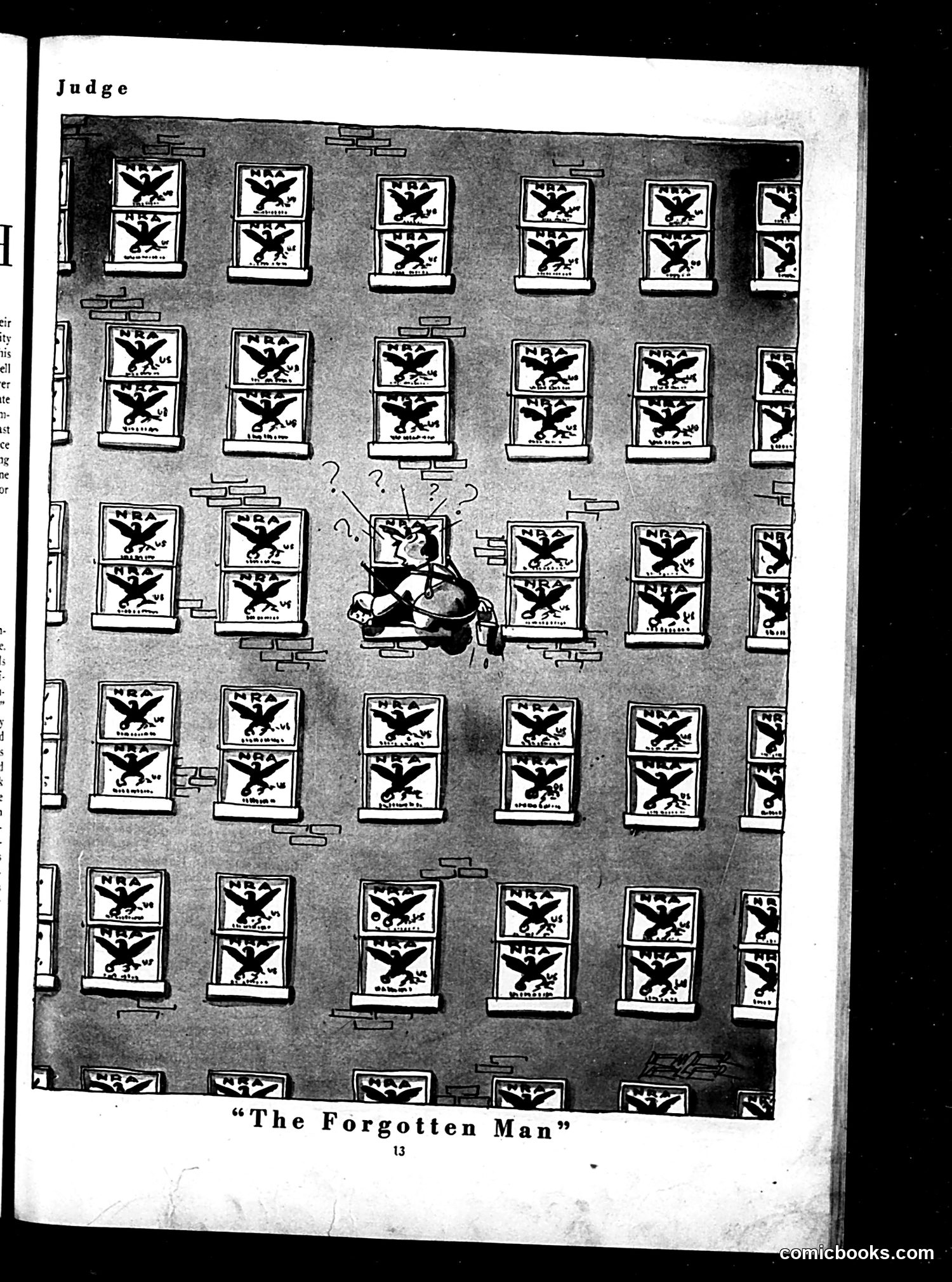
# Analysis of Judge Magazine Page This page contains several satirical pieces from an era when the **NRA (National Recovery Administration)** was active—likely the 1930s New Deal period. **Top cartoon**: A man confronts another about alimony payments during a car accident, satirizing divorce litigation and financial obligations. **Middle section ("Revised")**: Brief jokes mocking college athletics (star athletes working menial jobs), wives' preoccupation with appearance and gossip, and housing costs under NRA price controls. **Lower cartoon**: Shows a woman threatening a man alone—likely satirizing changing gender dynamics and women's newfound assertiveness. **"Exit Chivalry" poem**: The central satire. It contrasts idealized past courtship (men kissing women's hands publicly) with domestic reality (men striking wives), then inverts the equation: now women "score" by hitting men in retaliation. The point: public displays of chivalry are hypocritical when domestic abuse was normalized. The satirist argues men don't deserve public courtesy they didn't extend privately. The final joke equates a man waiting for his wife's bridge club to leave with extreme hunger—mocking domestic ennui.
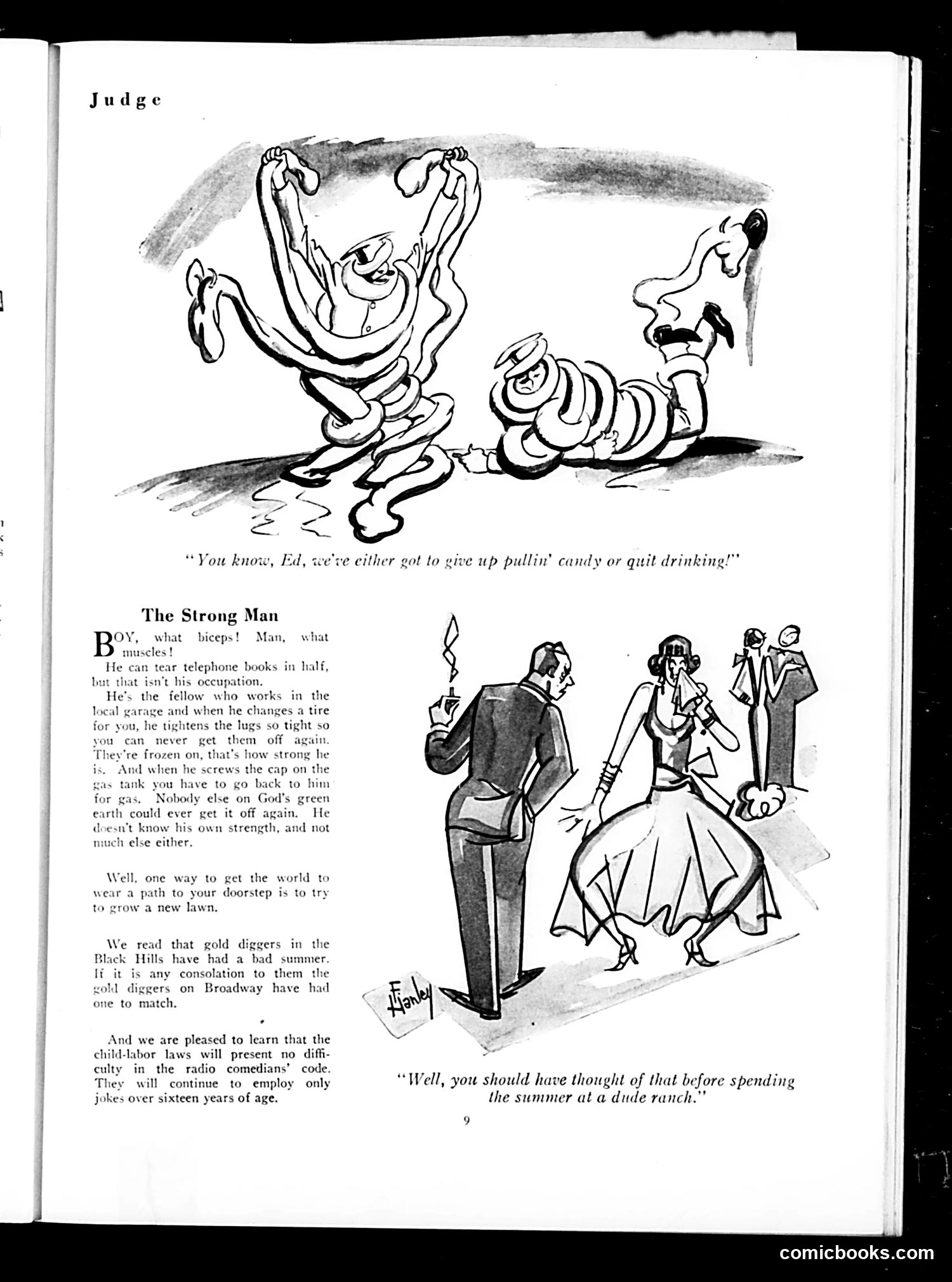
# "The Strong Man" - Judge Magazine Satire This page contains two satirical pieces: **Top cartoon**: Shows a man whose literal physical strength becomes a liability. He's so strong that when performing routine tasks—changing tires, opening gas caps—he over-tightens everything so severely that only he can undo it. The joke satirizes the "strong man" archetype: his strength, rather than being universally useful, actually creates dependency and frustration. It's commentary on misapplied or poorly-controlled power. **Bottom section**: "The Strong Man" essay continues the theme ironically, discussing a genuinely strong man's occupational hazard. The accompanying cartoon shows a woman at a dude ranch confronted by an angry man—she's spent money frivolously at a vacation spot while he struggles financially. The caption mocks her lack of foresight. The page also includes brief satirical notes about gold diggers (fortune-hunters) on Broadway having poor summers, and jokes about radio comedians' new code allowing only jokes "over sixteen years of age"—a jab at the enforced maturity of new broadcasting standards.
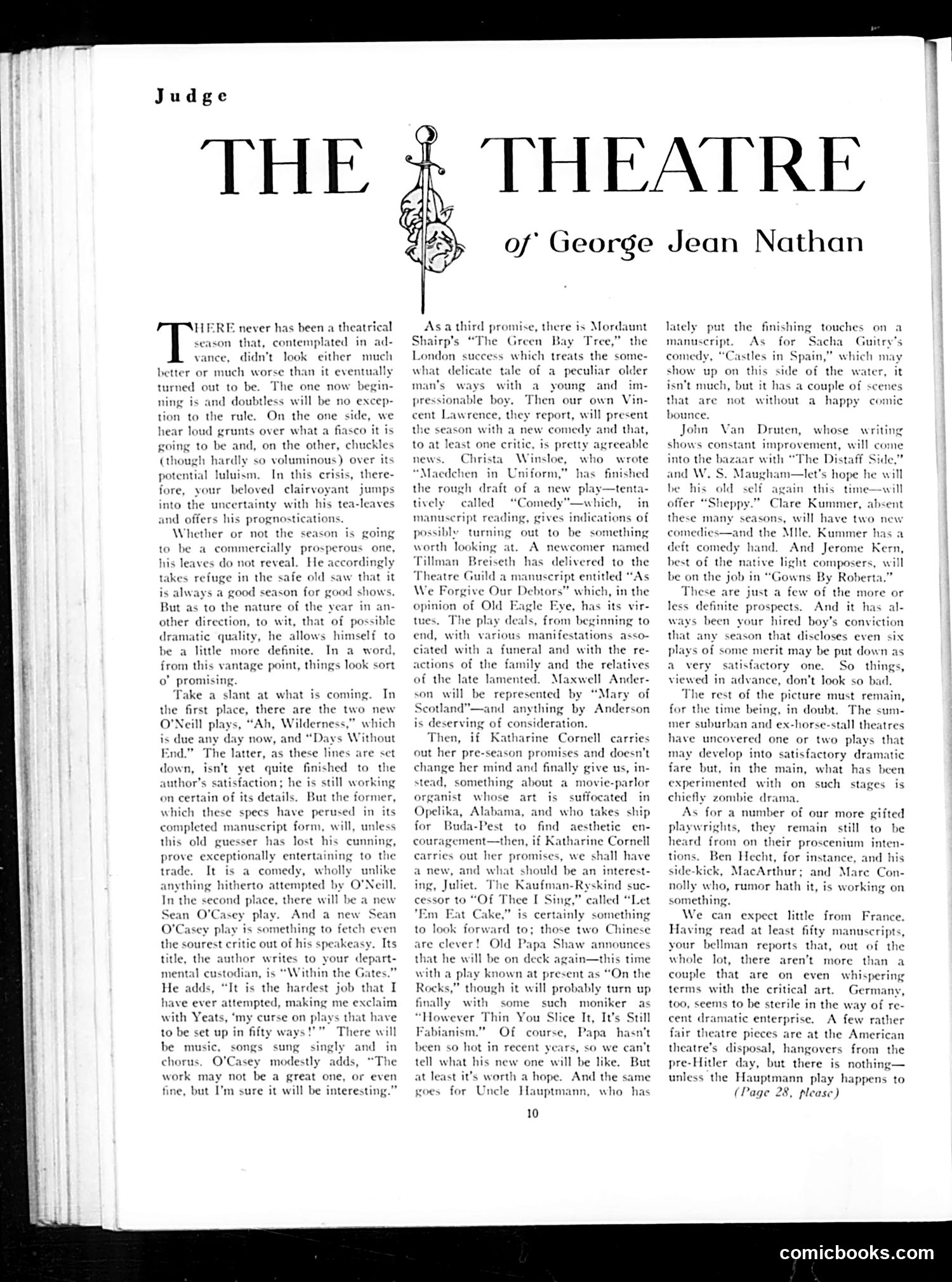
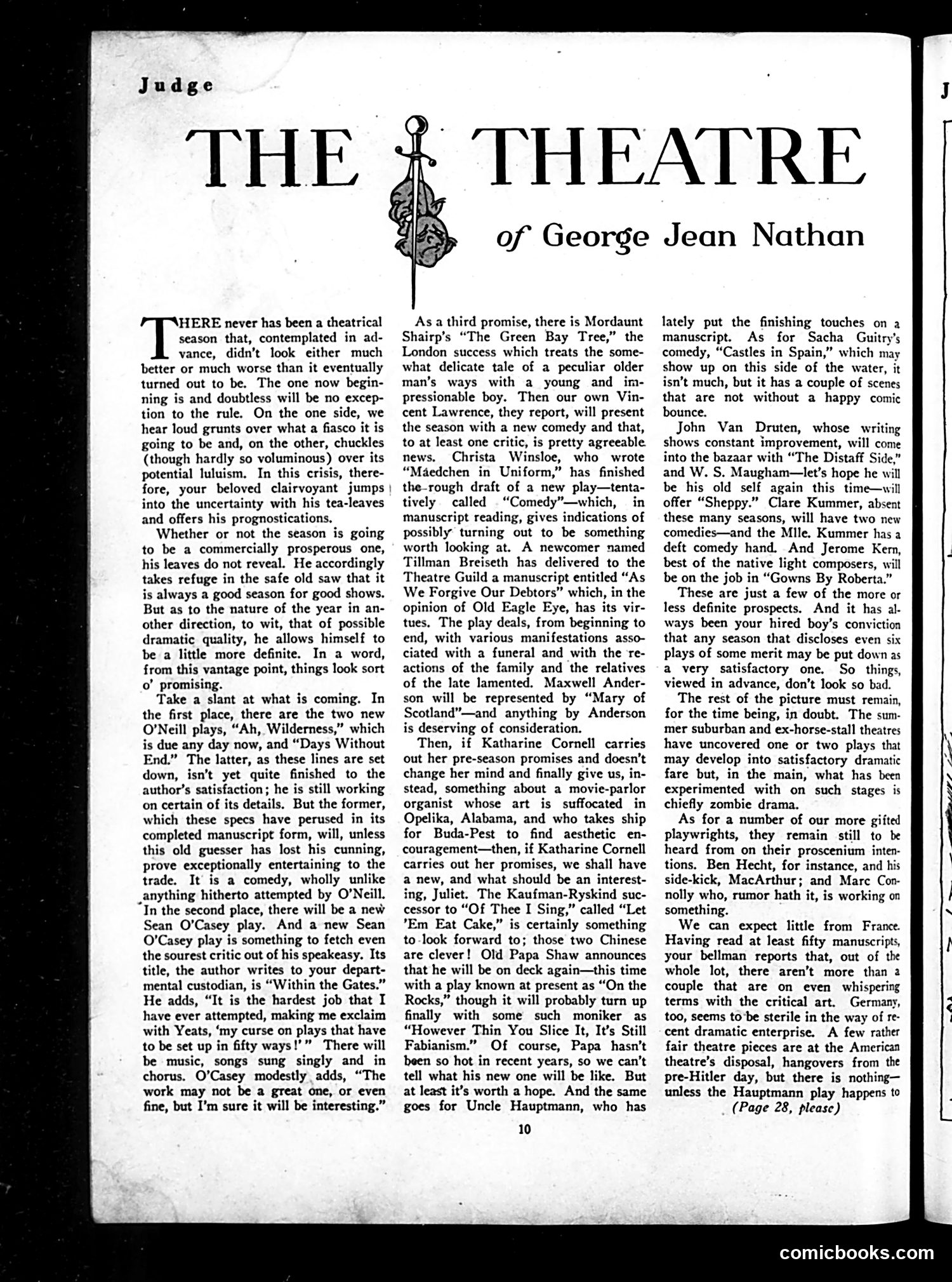
# "The Theatre of George Jean Nathan" This is a theater review column by Judge magazine's drama critic. The page contains no cartoon—it's entirely text discussing the upcoming theatrical season's prospects. Nathan surveys promising new plays, including Eugene O'Neill's "Ah, Wilderness!" and "Days Without End," Sean O'Casey's "Within the Gates," and works by Mordaunt Shairp and Maxwell Anderson. He expresses cautious optimism about the season's quality, though he withholds judgment on commercial success. The piece reflects 1930s Broadway culture, mentioning prominent figures like actress Katharine Cornell and playwright-producers like the Theater Guild. Nathan's tone is characteristic of Judge's sophisticated, insider perspective on American entertainment—offering sardonic predictions while acknowledging theatrical uncertainty. The review demonstrates how theater criticism functioned as substantial cultural commentary in this era.