
Judge, 1933-10 · page 16 of 38
Judge — October 1933 — page 16: what you’re looking at
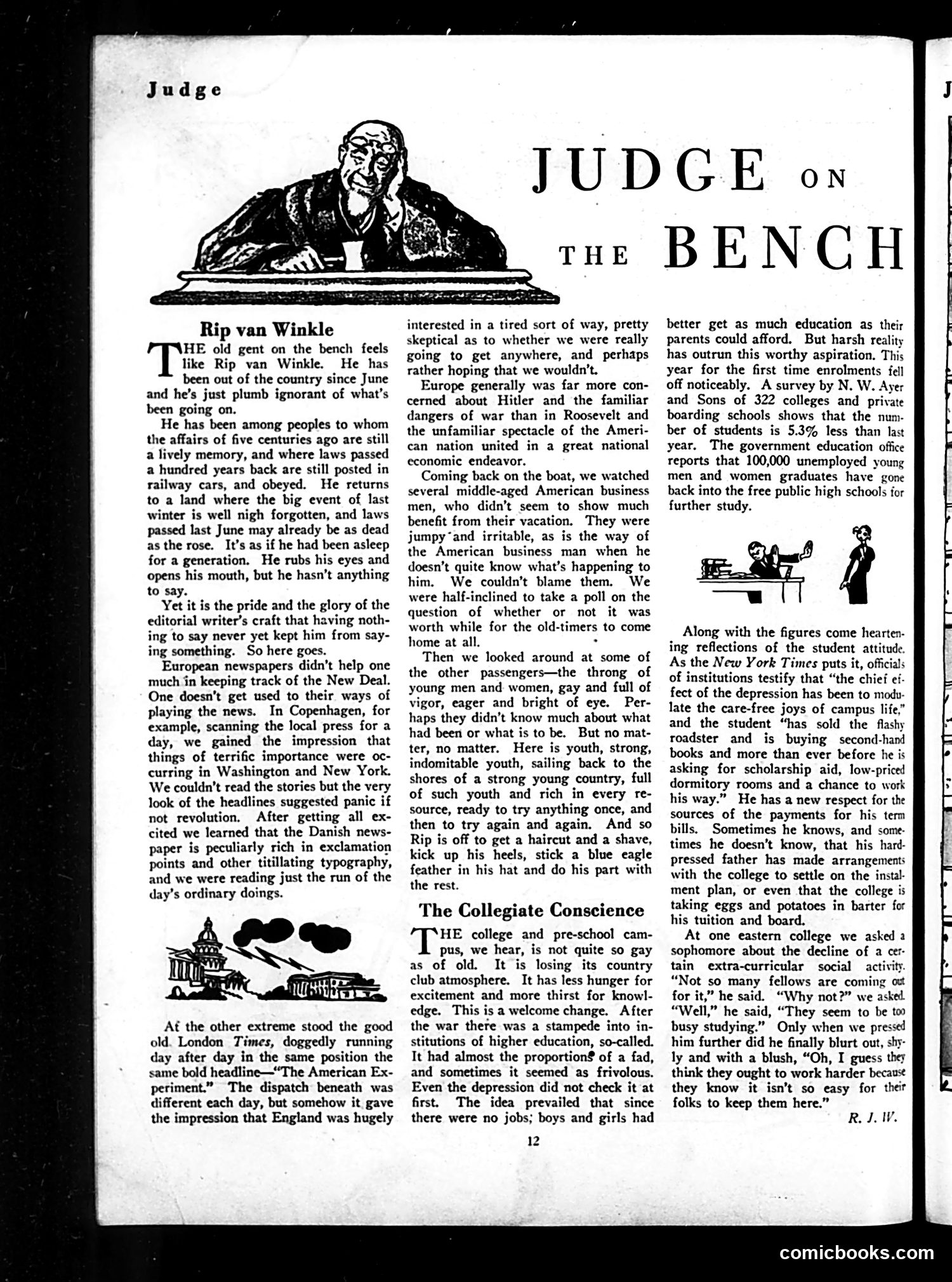
A restored page from Judge, 1933-10. Page through the whole issue in the reader above.
📄 Transcribed text from this page (OCR, searchable)
Machine-transcribed from the original scan — historical spelling and the odd misread are preserved.
HE old gent on the bench feels like Rip van Winkle. He has been out of the country since June and he’s just plumb ignorant of what’s been going on. He has been among peoples to whom the affairs of five centuries ago are still a lively memory, and where laws passed a hundred years back are still posted in railway cars, and obeyed. He returns to a land where the big event of last winter is well nigh forgotten, and laws passed last June may already be as dead as the rose. It’s as if he had been asleep for a generation. He rubs his eyes and opens his mouth, but he hasn’t anything to say. Yet it is the pride and the glory of the editorial writer’s craft that having noth- ing to say never yet kept him from say- ing something. So here goes. European newspapers didn’t help one much in keeping track of the New Deal. One doesn’t get used to their ways of playing the news. In Copenhagen, for example, scanning the local press for a day, we gained the impression that things of terrific importance were oc- curring in Washington and New York. We couldn’t read the stories but the very look of the headlines suggested panic if not revolution. After getting all ex- cited we learned that the Danish news- paper is peculiarly rich in exclamation points and other titillating typography, and we were reading just the run of the day’s ordinary doings. Wipe Aft the other extreme stood the good old. London Times, doggedly running day after day in the same position the same bold headline—“The American Ex- periment.” The dispatch beneath was different each day, but somehow it gave the impression that England was hugely JUDGE on interested in a tired sort of way, pretty skeptical as to whether we were really going to get anywhere, and perhaps rather hoping that we wouldn’t. Europe generally was far more con- cerned about Hitler and the familiar dangers of war than in Roosevelt and the unfamiliar spectacle of the Ameri- can nation united in a great national economic endeavor. Coming back on the boat, we watched several middle-aged American business men, who didn’t seem to show much benefit from their vacation. They were jumpy‘and irritable, as is the way of the American business man when he doesn’t quite know what’s happening to him. We couldn't blame them. We were half-inclined to take a poll on the question of whether or not it was worth while for the old-timers to come home at all. is Then we looked around at some of the other passengers—the throng of young men and women, gay and full of vigor, eager and bright of eye. Per- haps they didn’t know much about what had been or what is to be. But no mat- ter, no matter. Here is youth, strong, indomitable youth, sailing back to the shores of a strong young country, full of such youth and rich in every re- source, ready to try anything once, and then to try again and again. And so Rip is off to get a haircut and a shave, kick up his heels, stick a blue eagle feather in his hat and do his part with the rest. The Collegiate Conscience HE college and pre-school cam- pus, we hear, is not quite so gay as of old. It is losing its country club atmosphere. It has less hunger for excitement and more thirst for knowl- edge. This is a welcome change. After the war there was a stampede into in- stitutions of higher education, so-called. It had almost the proportion® of a fad, and sometimes it seemed as frivolous. Even the depression did not check it at first. The idea prevailed that since there were no jobs; boys and girls had 12 better get as much education as their parents could afford. But harsh reality has outrun this worthy aspiration. This year for the first time enrolments fell off noticeably. A survey by N. W. Ayer and Sons of 322 colleges and private boarding schools shows that the num- ber of students is 5.3% less than last year. The government education office reports that 100,000 unemployed young men and women graduates have gone back into the free public high schools for further study. A | Along with the figures come hearten- ing reflections of the student attitude. As the New York Times puts it, officials of institutions testify that “the chief ef- fect of the depression has been to modu- late the care-free joys of campus life,” and the student “has sold the flashy roadster and is buying second-hand books and more than ever before he is asking for scholarship aid, low-priced dormitory rooms and a chance to work his way.” He has a new respect for the sources of the payments for his term bills. Sometimes he knows, and some- times he doesn’t know, that his hard- pressed father has made arrangements with the college to settle on the instal- ment plan, or even that the college is taking eggs and potatoes in barter for his tuition and board. At one eastern college we asked a sophomore about the decline of a cer- tain extra-curricular social activity. “Not so many fellows are coming ot for it,” he said. “Why not?” we asked. “Well,” he said, “They seem to be too busy studying.” Only when we pressed him further did he finally blurt out, shy- ly and with a blush, “Oh, I guess they think they ought to work harder because they know it isn’t so easy for their folks to keep them here.” R.IW. comicbooks.com