
Judge, 1933-10 · page 21 of 38
Judge — October 1933 — page 21: what you’re looking at
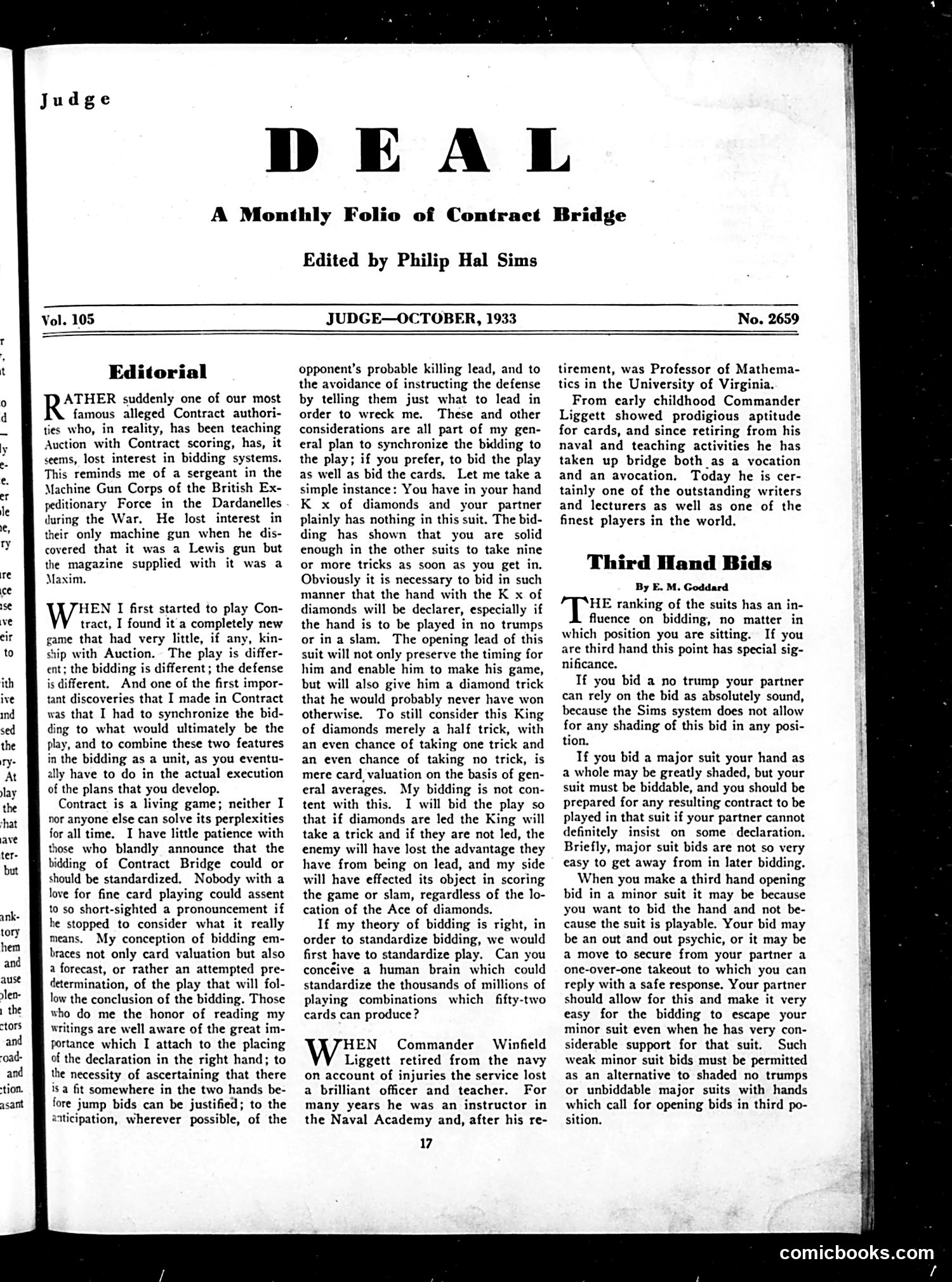
A restored page from Judge, 1933-10. Page through the whole issue in the reader above.
📄 Transcribed text from this page (OCR, searchable)
Machine-transcribed from the original scan — historical spelling and the odd misread are preserved.
asant Judge DEAL A Monthly Folic of Contract Vol. 105 Edited by Philip Hal Sims Bridge JUDGE—OCTOBER, 1933 No. 2659 Editorial ATHER suddenly one of our most famous alleged Contract authori- ties who, in reality, has been teaching Auction with Contract scoring, has, it seems, lost interest in bidding systems. This reminds me of a sergeant in the Machine Gun Corps of the British Ex- peditionary Force in the Dardanelles during the War. He lost interest in their only machine gun when he dis- covered that it was a Lewis gun but the magazine supplied with it was a Maxim. HEN I first started to play Con- tract, I found it a completely new game that had very little, if any, kin- ship with Auction. The play is differ- ent; the bidding is different; the defense is different. And one of the first impor- tant discoveries that I made in Contract was that I had to synchronize the bid- ding to what would ultimately be the play, and to combine these two features in the bidding as a unit, as you eventu- ally have to do in the actual execution of the plans that you develop. Contract is a living game; neither I nor anyone else can solve its perplexities for all time. I have little patience with those who blandly announce that the bidding of Contract Bridge could or should be standardized. Nobody with a love for fine card playing could assent to so short-sighted a pronouncement if he stopped to consider what it really means. My conception of bidding em- braces not only card valuation but also a forecast, or rather an attempted pre- determination, of the play that will fol- low the conclusion of the bidding. Those who do me the honor of reading my writings are well aware of the great im- portance which I attach to the placing of the declaration in the right hand; to the necessity of ascertaining that there isa fit somewhere in the two hands be- fore jump bids can be justified; to the anticipation, wherever possible, of the opponent's probable killing lead, and to the avoidance of instructing the defense by telling them just what to lead in order to wreck me. These and other considerations are all part of my gen- eral plan to synchronize the bidding to the play; if you prefer, to bid the play as well as bid the cards. Let me take a simple instance: You have in your hand K x of diamonds and your partner plainly has nothing in this suit. The bid- ding has shown that you are solid enough in the other suits to take nine or more tricks as soon as you get in. Obviously it is necessary to bid in such manner that the hand with the K x of diamonds will be declarer, especially if the hand is to be played in no trumps or ina slam. The opening lead of this suit will not only preserve the timing for him and enable him to make his game, but will also give him a diamond trick that he would probably never have won otherwise. To still consider this King of diamonds merely a half trick, with an even chance of taking one trick and an even chance of taking no trick, is mere card valuation on the basis of gen- eral averages. My bidding is not con- tent with this. I will bid the play so that if diamonds are led the King will take a trick and if they are not led, the enemy will have lost the advantage they have from being on lead, and my side will have effected its object in scoring the game or slam, regardless of the lo- cation of the Ace of diamonds. If my theory of bidding is right, in order to standardize bidding, we would first have to standardize play. Can you conceive a human brain which could standardize the thousands of millions of playing combinations which fifty-two cards can produce? HEN Commander Winfield Liggett retired from the navy on account of injuries the service lost a brilliant officer and teacher. For many years he was an instructor in the Naval Academy and, after his re- 17 tirement, was Professor of Mathema- tics in the University of Virginia. From early childhood Commander Liggett showed prodigious aptitude for cards, and since retiring from his naval and teaching activities he has taken up bridge both as a vocation and an avocation. Today he is cer- tainly one of the outstanding writers and lecturers as well as one of the finest players in the world. Third Hand Bids By E. M. Goddard HE ranking of the suits has an in- fluence on bidding, no matter in which position you are sitting. If you are third hand this point has special sig- nificance, If you bid a no trump your partner can rely on the bid as absolutely sound, because the Sims system does not allow for any shading of this bid in any posi- tion. If you bid a major suit your hand as a whole may be greatly shaded, but your suit must be biddable, and you should be prepared for any resulting contract to be played in that suit if your partner cannot definitely insist on some declaration. Briefly, major suit bids are not so very easy to get away from in later bidding. When you make a third hand opening bid in a minor suit it may be because you want to bid the hand and not be- cause the suit is playable. Your bid may be an out and out psychic, or it may be a move to secure from your partner a one-over-one takeout to which you can reply with a safe response. Your partner should allow for this and make it very easy for the bidding to escape your minor suit even when he has very con- siderable support for that suit. Such weak minor suit bids must be permitted as an alternative to shaded no trumps or unbiddable major suits with hands which call for opening bids in third po- sition. comicbooks.com /