
Judge, 1933-10 · page 14 of 38
Judge — October 1933 — page 14: what you’re looking at
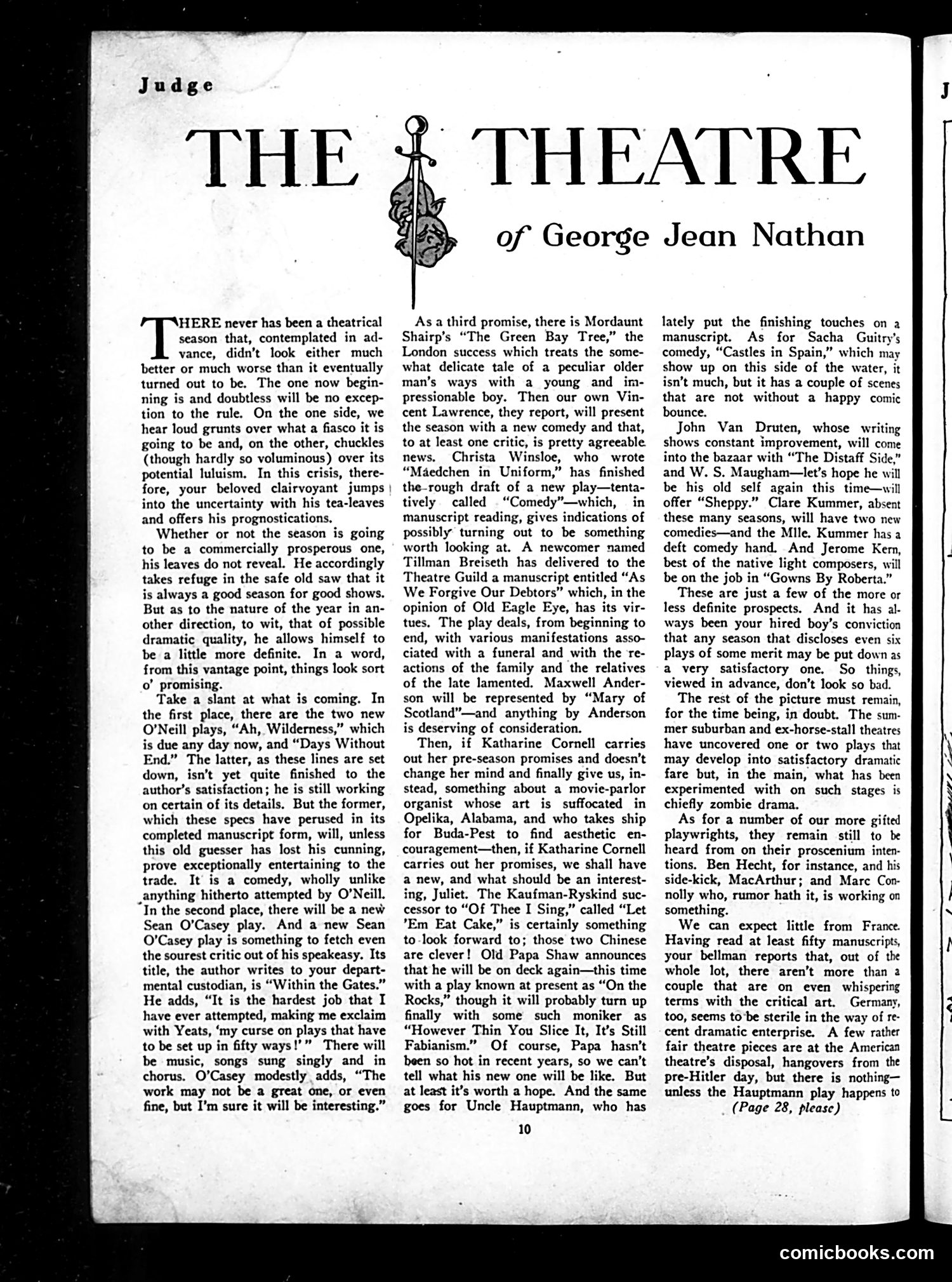
A restored page from Judge, 1933-10. Page through the whole issue in the reader above.
📄 Transcribed text from this page (OCR, searchable)
Machine-transcribed from the original scan — historical spelling and the odd misread are preserved.
r | NHERE never has been a theatrical season that, contemplated in ad- vance, didn’t look either much better or much worse than it eventually turned out to be. The one now begin- ning is and doubtless will be no excep- tion to the rule. On the one side, we hear loud grunts over what a fiasco it is going to be and, on the other, chuckles (though hardly so voluminous) over its potential luluism. In this crisis, there- fore, your beloved clairvoyant jumps | into the uncertainty with his tea-leaves and offers his prognostications, Whether or not the season is going to be a commercially prosperous one, his leaves do not reveal. He accordingly takes refuge in the safe old saw that it is always a good season for good shows. But as to the nature of the year in an- other direction, to wit, that of possible dramatic quality, he allows himself to be a little more definite. In a word, from this vantage point, things look sort o’ promising. Take a slant at what is coming. In the first place, there are the two new O’Neill plays, “Ah, Wilderness,” which is due any day now, and “Days Without End.” The latter, as these lines are set down, isn’t yet quite finished to the author’s satisfaction; he is still working on certain of its details. But the former, which these specs have perused in its completed manuscript form, will, unless this old guesser has lost his cunning, prove exceptionally entertaining to the trade. It is a comedy, wholly unlike anything hitherto attempted by O’Neill. In the second place, there will be a new Sean O’Casey play. And a new Sean O'Casey play is something to fetch even the sourest critic out of his speakeasy. Its title, the author writes to your depart- mental custodian, is “Within the Gates.” He adds, “It is the hardest job that I have ever attempted, making me exclaim with Yeats, ‘my curse on plays that have to be set up in fifty ways!’” There will be music, songs sung singly and in chorus. O’Casey modestly adds, “The work may not be a great one, or even fine, but I’m sure it will be interesting.” As a third promise, there is Mordaunt Shairp’s “The Green Bay Tree,” the London success which treats the some- what delicate tale of a peculiar older man’s ways with a young and im- pressionable boy. Then our own Vin- cent Lawrence, they report, will present the season with a new comedy and that, to at least one critic, is pretty agreeable news. Christa Winsloe, who wrote “Maedchen in Uniform,” has finished the-rough draft of a new play—tenta- tively called “Comedy”—which, in manuscript reading, gives indications of possibly turning out to be something worth looking at. A newcomer named Tillman Breiseth has delivered to the Theatre Guild a manuscript entitled “As We Forgive Our Debtors” which, in the opinion of Old Eagle Eye, has its vir- tues, The play deals, from beginning to end, with various manifestations asso- ciated with a funeral and with the ‘re- actions of the family and the relatives of the late lamented. Maxwell Ander- son will be represented by “Mary of Scotland”—and anything by Anderson is deserving of consideration. Then, if Katharine Cornell carries out her pre-season promises and doesn’t change her mind and finally give us, in- stead, something about a movie-parlor organist whose art is suffocated in Opelika, Alabama, and who takes ship for Buda-Pest to find aesthetic en- couragement—then, if Katharine Cornell carries out her promises, we shall have a new, and what should be an interest- ing, Juliet. The Kaufman-Ryskind suc- cessor to “Of Thee I Sing,” called “Let ’Em Eat Cake,” is certainly something to-look forward to; those two Chinese are clever! Old Papa Shaw announces that he will be on deck again—this time with a play known at present as “On the Rocks,” though it will probably turn up finally with some such moniker as “However Thin You Slice It, It’s Still Fabianism.” Of course, Papa hasn't been so hot in recent years, so we can’t tell what his new one will be like. But at least it’s worth a hope. And the same goes for Uncle Hauptmann, who has 10 TRE Jean Nathan lately put the finishing touches on a manuscript. As for Sacha Guitry’s comedy, “Castles in Spain,” which may show up on this side of the water, it isn’t much, but it has a couple of scenes that are not without a happy comic bounce. John Van Druten, whose writing shows constant improvement, will come into the bazaar with “The Distaff Side,” and W. S. Maugham—let’s hope he will be his old self again this time—will offer “Sheppy.” Clare Kummer, absent these many seasons, will have two new comedies—and the Mlle, Kummer has a deft comedy hand. And Jerome Ker, best of the native light composers, will be on the job in “Gowns By Roberta.” These are just a few of the more or less definite prospects. And it has al- ways been your hired boy’s conviction that any season that discloses even six plays of some merit may be put down as a very satisfactory one. So things, viewed in advance, don’t look so bad. The rest of the picture must remain, for the time being, in doubt. The sum- mer suburban and ex-horse-stall theatres have uncovered one or two plays that may develop into satisfactory dramatic fare but, in the main, what has been experimented with on such stages is chiefly zombie drama. As for a number of our more gifted playwrights, they remain still to be heard from on their proscenium inten- tions. Ben Hecht, for instance, and his side-kick, MacArthur; and Marc Con- nolly who, rumor hath it, is working on something. We can expect little from France. Having read at least fifty manuscripts, your bellman reports that, out of the whole lot, there aren’t more than 2 couple that are on even whispering terms with the critical art. Germany, too, seems to’be sterile in the way of re- cent dramatic enterprise. A few rather fair theatre pieces are at the American theatre’s disposal, hangovers from the pre-Hitler day, but there is nothing— unless the Hauptmann play happens to (Page 28, please) comicbooks.com