
Judge, 1933-10 · page 20 of 38
Judge — October 1933 — page 20: what you’re looking at
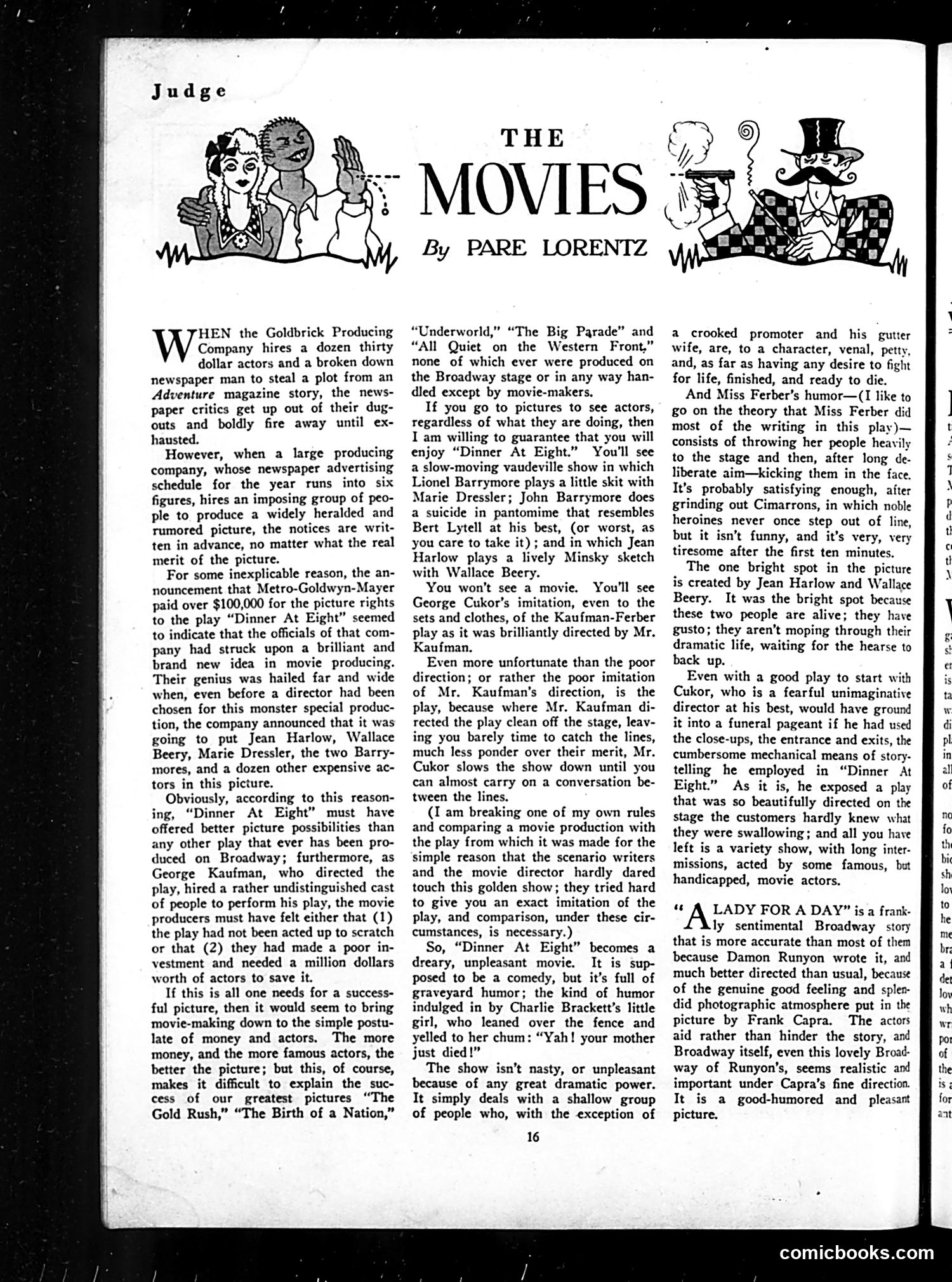
A restored page from Judge, 1933-10. Page through the whole issue in the reader above.
📄 Transcribed text from this page (OCR, searchable)
Machine-transcribed from the original scan — historical spelling and the odd misread are preserved.
HEN the Goldbrick Producing W Company hires a dozen thirty dollar actors and a broken down newspaper man to steal a plot from an Adventure magazine story, the news- paper critics get up out of their dug- outs and boldly fire away until ex- hausted. However, when a large producing company, whose newspaper advertising schedule for the year runs into six figures, hires an imposing group of peo- ple to produce a widely heralded and rumored picture, the notices are writ- ten in advance, no matter what the real merit of the picture. For some inexplicable reason, the an- nouncement that Metro-Goldwyn-Mayer paid over $100,000 for the picture rights to the play “Dinner At Eight” seemed to indicate that the officials of that com- pany had struck upon a brilliant and brand new idea in movie producing. Their genius was hailed far and wide when, even before a director had been chosen for this monster special produc- tion, the company announced that it was going to put Jean Harlow, Wallace Beery, Marie Dressler, the two Barry- mores, and a dozen other expensive ac- tors in this picture. Obviously, according to this reason- ing, “Dinner At Eight” must have offered better picture possibilities than any other play that ever has been pro- duced on Broadway; furthermore, as George Kaufman, who directed the play, hired a rather undistinguished cast of people to perform his play, the movie producers must have felt either that (1) the play had not been acted up to scratch or that (2) they had made a poor in- vestment and needed a million dollars worth of actors to save it. If this is all one needs for a success- ful picture, then it would seem to bring movie-making down to the simple postu- late of money and actors. The more money, and the more famous actors, the better the picture; but this, of course, makes it difficult to explain the suc- cess of our greatest pictures “The Gold Rush,” “The Birth of a Nation,” THE OVIES “Underworld,” “The Big Parade” and “All Quiet on the Western Front,” none of which ever were produced on the Broadway stage or in any way han- dled except by movie-makers, If you go to pictures to see actors, regardless of what they are doing, then I am willing to guarantee that you will enjoy “Dinner At Eight.” You'll see a slow-moving vaudeville show in which Lionel Barrymore plays a little skit with Marie Dressler; John Barrymore does a suicide in pantomime that resembles Bert Lytell at his best, (or worst, as you care to take it) ; and in which Jean Harlow plays a lively Minsky sketch with Wallace Beery. You won't see a movie. You'll see George Cukor’s imitation, even to the sets and clothes, of the Kaufman-Ferber play as it was brilliantly directed by Mr. Kaufman, Even more unfortunate than the poor direction; or rather the poor imitation of Mr. Kaufman's direction, is the play, because where Mr. Kaufman di- rected the play clean off the stage, leav- ing you barely time to catch the lines, much less ponder over their merit, Mr. Cukor slows the show down until you can almost carry on a conversation be- tween the lines. (I am breaking one of my own rules and comparing a movie production with the play from which it was made for the simple reason that the scenario writers and the movie director hardly dared touch this golden show; they tried hard to give you an exact imitation of the play, and comparison, under these cir- cumstances, is necessary.) So, “Dinner At Eight” becomes a dreary, unpleasant movie. It is sup- posed to be a comedy, but it’s full of graveyard humor; the kind of humor indulged in by Charlie Brackett’s little girl, who leaned over the fence and yelled to her chum: “Yah! your mother just died!” The show isn’t nasty, or unpleasant because of any great dramatic power. It simply deals with a shallow group of people who, with the exception of 16 a crooked promoter and his gutter wife, are, to a character, venal, petty, and, as far as having any desire to fight for life, finished, and ready to die. And Miss Ferber’s humor—(I like to go on the theory that Miss Ferber did most of the writing in this play)— consists of throwing her people heavily to the stage and then, after long de- liberate aim—kicking them in the face. It’s probably satisfying enough, aiter grinding out Cimarrons, in which noble heroines never once step out of line, but it isn’t funny, and it’s very, very tiresome after the first ten minutes. The one bright spot in the picture is created by Jean Harlow and Wallace Beery. It was the bright spot because these two people are alive; they have gusto; they aren’t moping through their dramatic life, waiting for the hearse to back up. Even with a good play to start with Cukor, who is a fearful unimaginative director at his best, would have ground it into a funeral pageant if he had used the close-ups, the entrance and exits, the cumbersome mechanical means of story- telling he employed in “Dinner At Eight.” As it is, he exposed a play that was so beautifully directed on the stage the customers hardly knew what they were swallowing; and all you have left is a variety show, with long inter- missions, acted by some famous, but handicapped, movie actors. “ LADY FOR A DAY” is a frank- ly sentimental Broadway story that is more accurate than most of them because Damon Runyon wrote it, and much better directed than usual, because of the genuine good feeling and splen- did photographic atmosphere put in the picture by Frank Capra. The actors aid rather than hinder the story, and Broadway itself, even this lovely Broad- way of Runyon’s, seems realistic and important under Capra’s fine direction. It is a good-humored and_ pleasant picture, comicbooks.com