A complete issue · 36 pages · 1933
Judge — January 1933
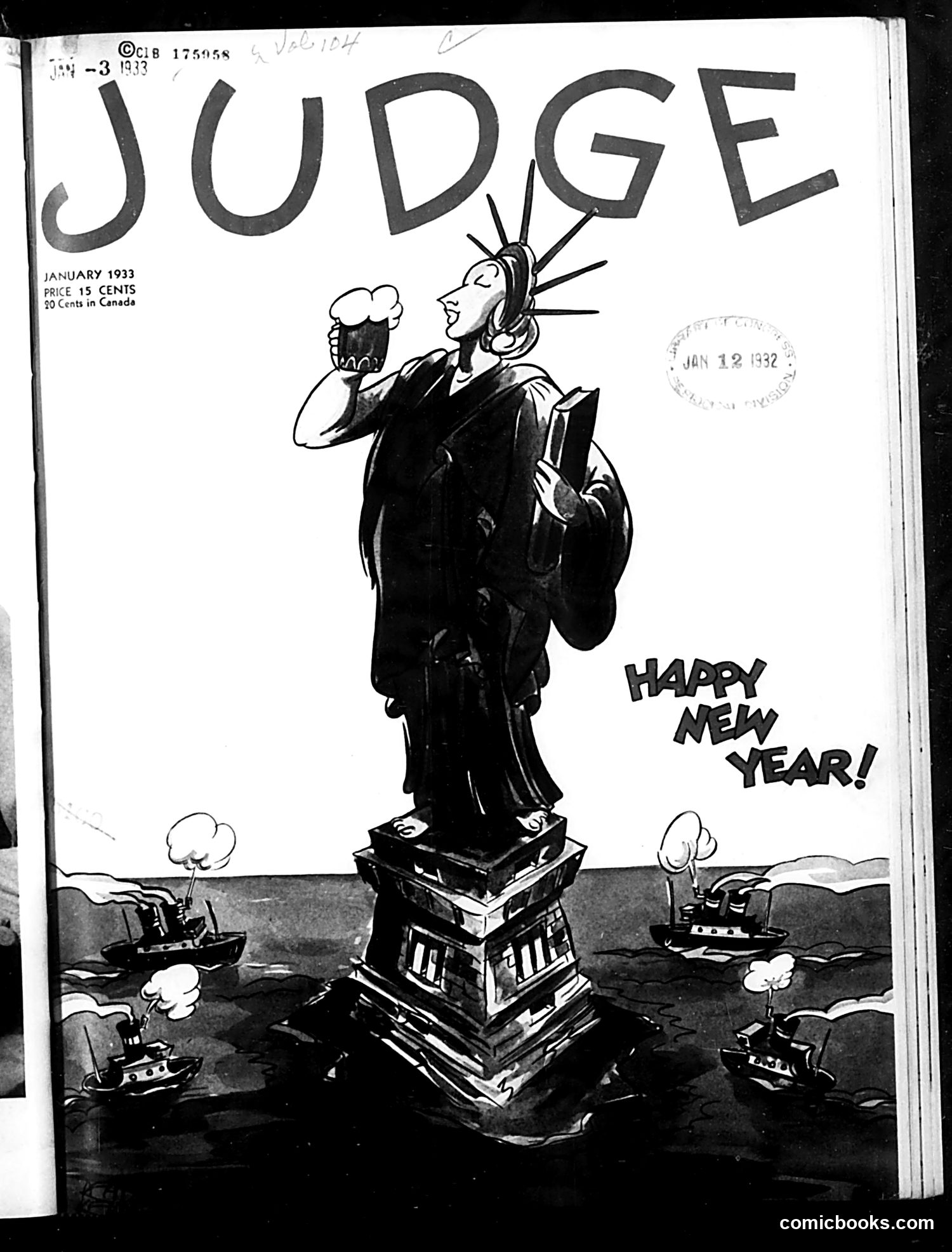
# Judge Magazine Cover Analysis - January 1933 This is a New Year's greeting cover depicting Lady Liberty (identifiable by her crown and torch) standing atop a pedestal, holding a beer stein and celebrating "Happy New Year!" Below her, warships fire celebratory shots in a harbor scene. The cartoon likely references the imminent end of Prohibition, which occurred in December 1933 (just months after this January issue). The beer stein—illegal to publicly celebrate just months earlier—symbolizes the anticipated repeal of the 18th Amendment. Lady Liberty's prominent display of alcohol suggests optimism about regaining this "freedom," with the military salutes emphasizing the significance of this constitutional change. This represents the magazine's humorous take on a major political shift anticipated for 1933.
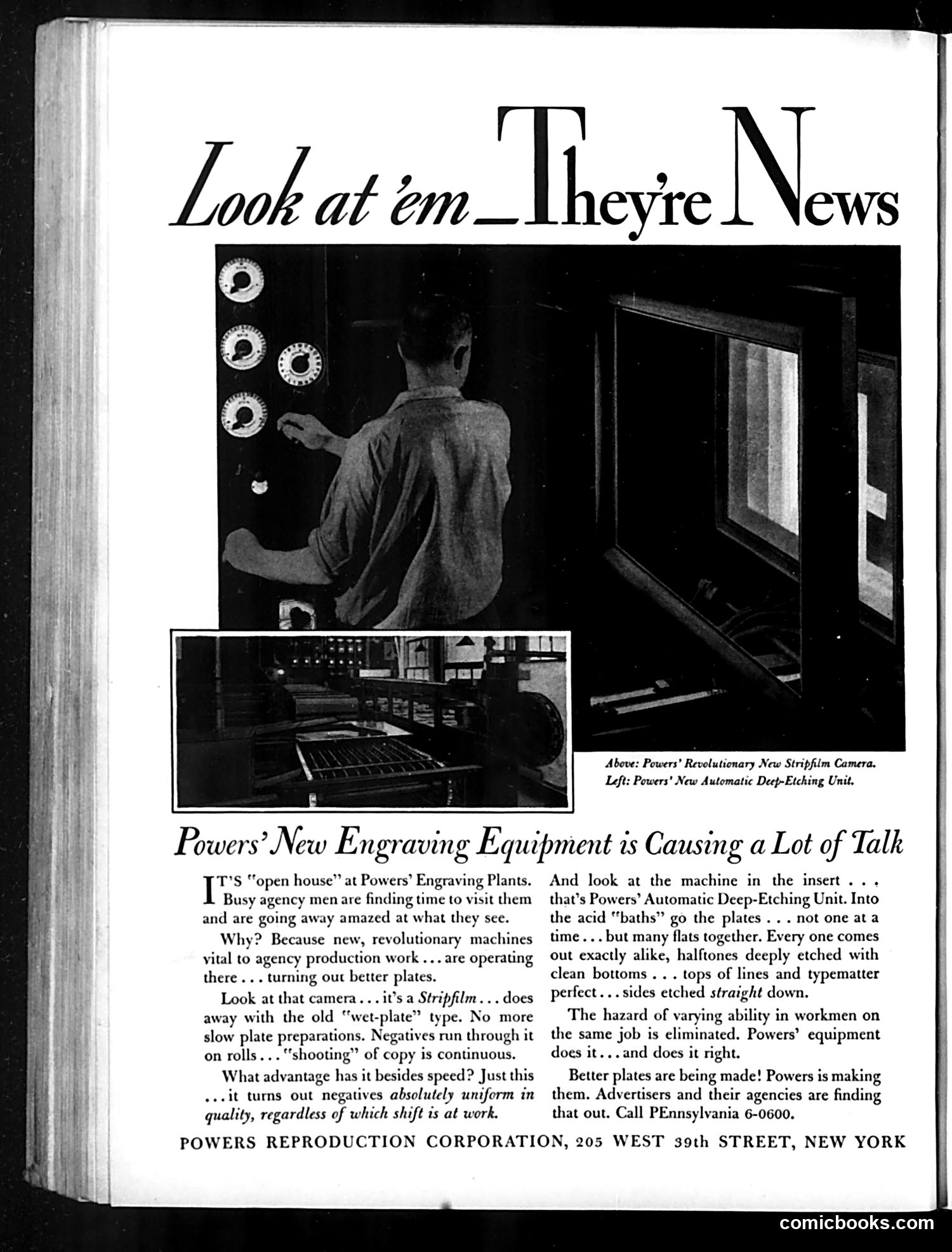
# Analysis This is **not a satirical cartoon** but rather a **trade advertisement** for Powers Reproduction Corporation, a printing/engraving equipment manufacturer. The page promotes their new "Stripfilm Camera" and "Automatic Deep-Etching Unit" as revolutionary technological advances for advertising agencies and print shops. The images show workers operating this equipment. The "satire" here is gentle corporate self-promotion: the headline "Look at 'em—They're News" frames the machines as newsworthy innovations. The text emphasizes that this equipment produces uniform, high-quality printing plates without the variable quality issues caused by different workers. For modern readers: this represents 1940s-era industrial advertising celebrating automation and technological improvement in the printing industry—a common Judge magazine feature during this period.
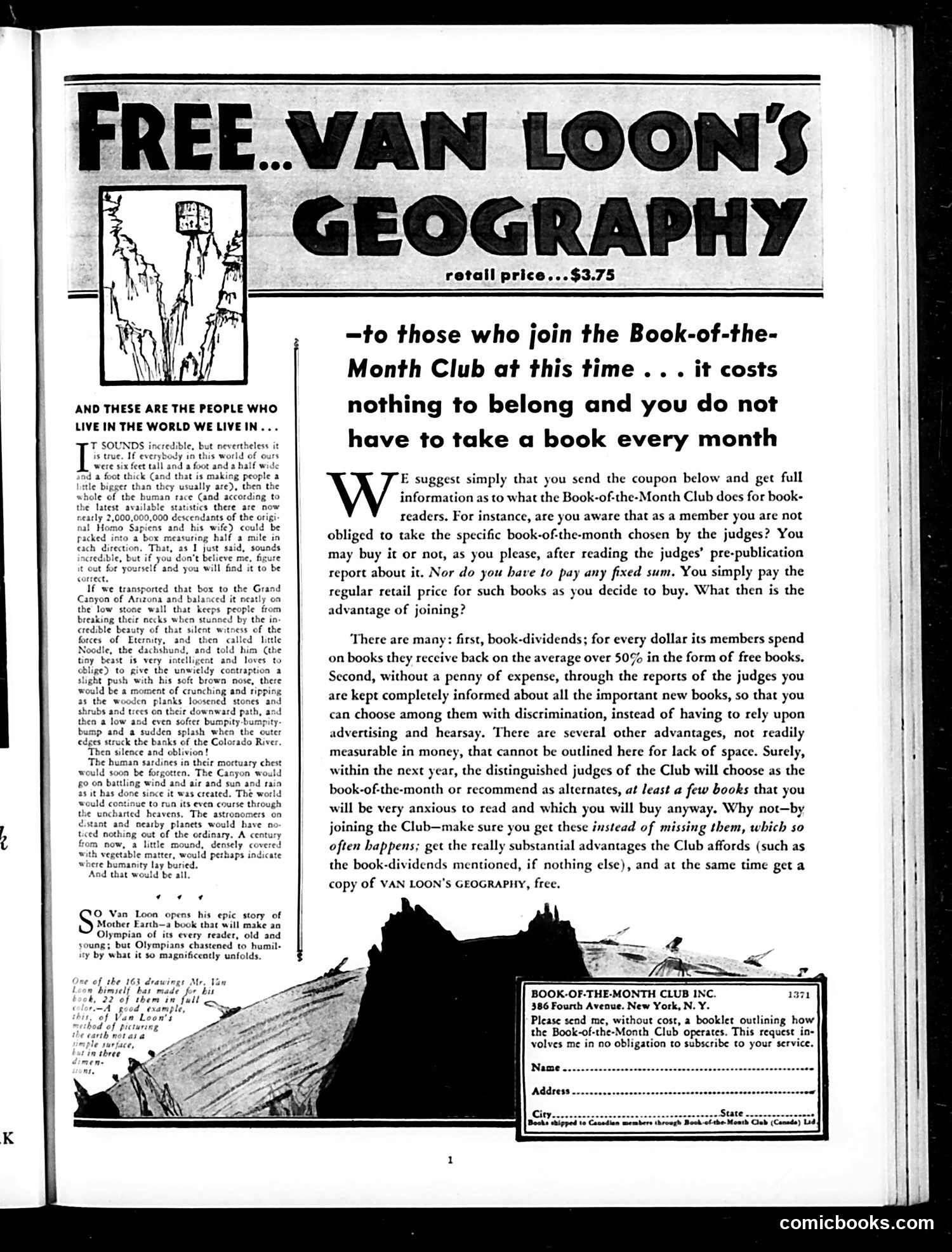
# Analysis This page is **primarily an advertisement**, not political satire. It promotes Van Loon's *Geography* textbook (retail price $3.75) and encourages joining the Book-of-the-Month Club. The visual elements include: - A small illustration of plants/flowers (relating to geography/nature) - A larger landscape illustration showing mountainous terrain with what appears to be a river or water features The text emphasizes the Book Club's benefits: no membership fees, book dividends (over 50% value back as free books), and access to judges' expert recommendations rather than relying on advertising. It positions joining as advantageous for readers seeking curated selections. The Van Loon mention references the author's reputation for making geography engaging and accessible to general readers, though the specific historical context of the textbook's prominence is unclear from this page alone.
# Analysis This page is primarily **advertising**, not political satire. The dominant content features two hotel advertisements: 1. **The Waldorf-Astoria** (top): A luxury hotel ad emphasizing its prestigious location, cuisine, and service on Park Avenue. 2. **Hotel Croydon** (bottom): A competing hotel advertising affordability and convenience for visitors to New York, with rates from $4 daily. The right column contains unrelated celebrity quotes under "YOU'RE TELLING US?"—brief witticisms attributed to figures like Norman Thomas and William Allen White, a common magazine feature of the era. There is **no political cartoon** on this page. The content reflects 1920s-30s New York commercial culture and Judge magazine's mix of advertising revenue with celebrity commentary rather than satirical commentary.
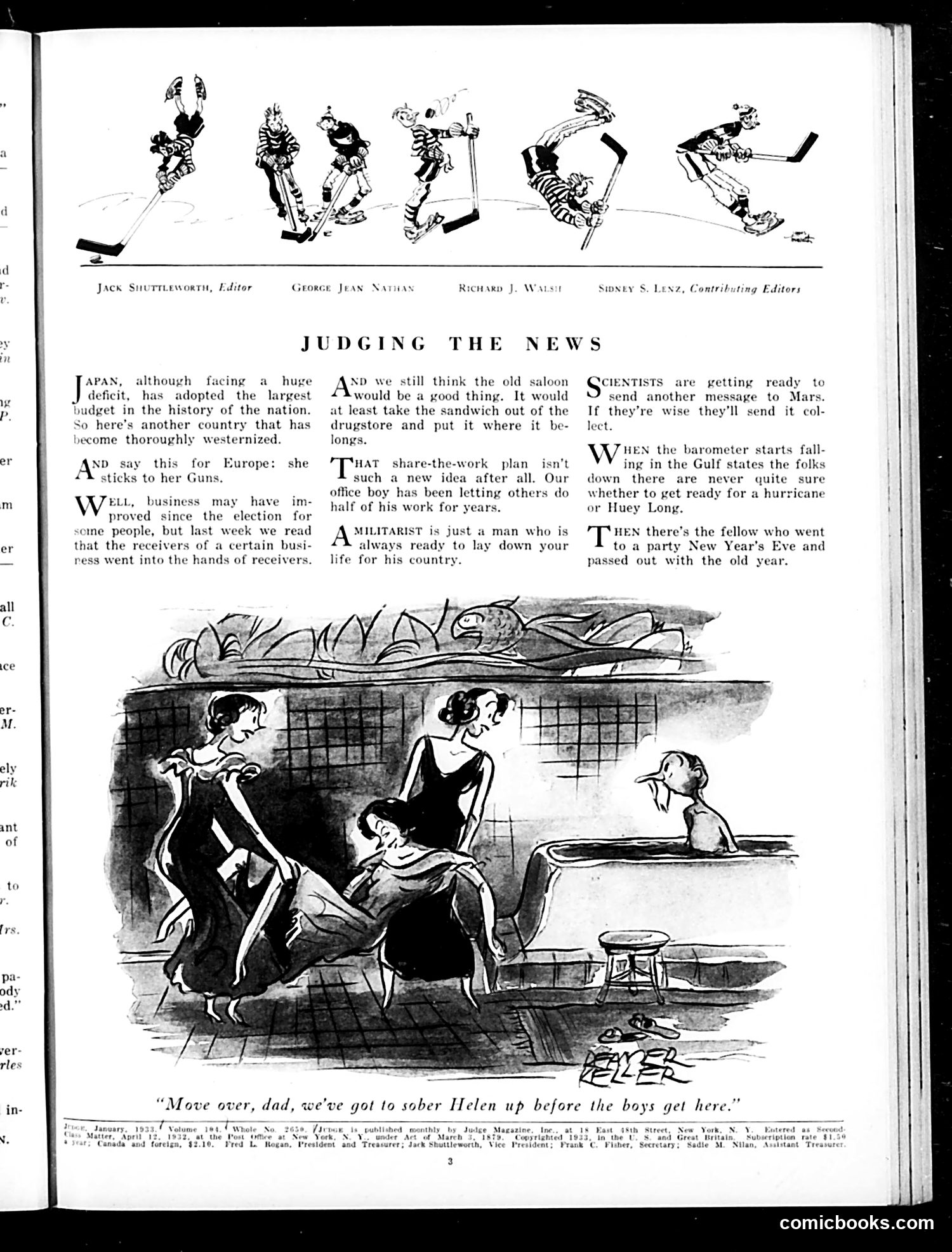
# "Judging the News" - January 1933 This page satirizes contemporary news events through brief editorial comments and a cartoon. **The cartoon** depicts a domestic scene where a woman urgently tells a man ("dad") to move a drunk man ("sober Helen up before the boys get here"). It jokes about priorities during Prohibition's final days—with alcohol illegal but apparently still present in homes. **The editorial snippets** mock various topics: Japan's budget deficit, Europe's militarism, business receiverships, share-the-work employment schemes, and scientists' Mars plans. The hockey player illustrations at the top appear decorative rather than directly related to the page content. The overall tone is cynical commentary on Depression-era politics and social hypocrisy, particularly regarding Prohibition enforcement as the era neared its repeal.
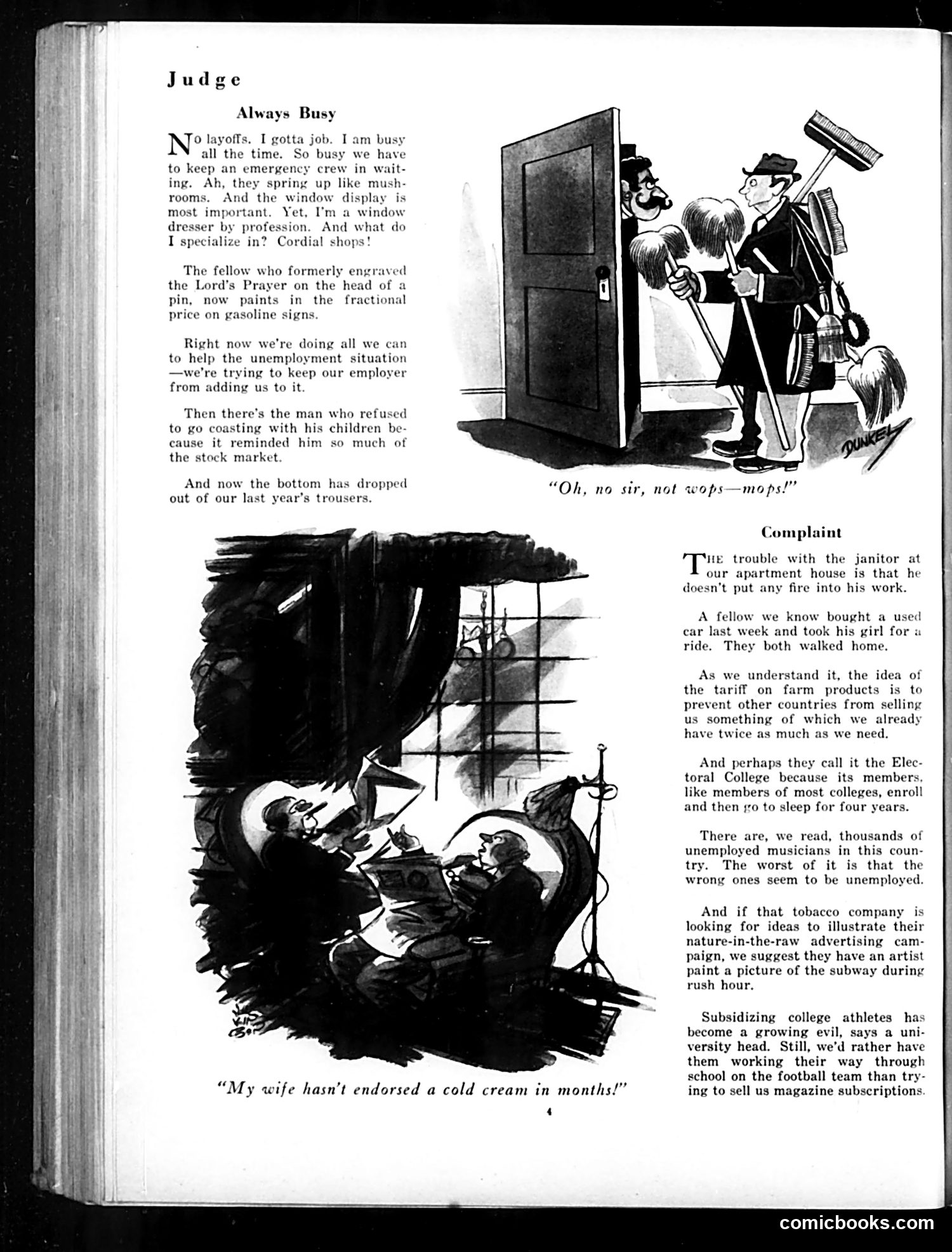
# Analysis of Judge Magazine Page **"Always Busy" (top cartoon):** A judge satirizes society's misplaced priorities. While people anxiously crowd a window display (likely related to stock market or economic concerns), he notes the irony: window dressing is his profession—literally arranging displays. The commentary critiques how people obsess over superficial economic indicators while ignoring deeper problems. **"Complaint" (text section):** A series of satirical observations about contemporary issues: a janitor's poor work ethic, a man buying a used car for a date, farm product tariffs, the Electoral College, unemployed musicians, advertising concepts, and college athletes selling magazine subscriptions. These appear to be brief, witty social critiques typical of Judge's satirical approach to 1920s-30s American life.
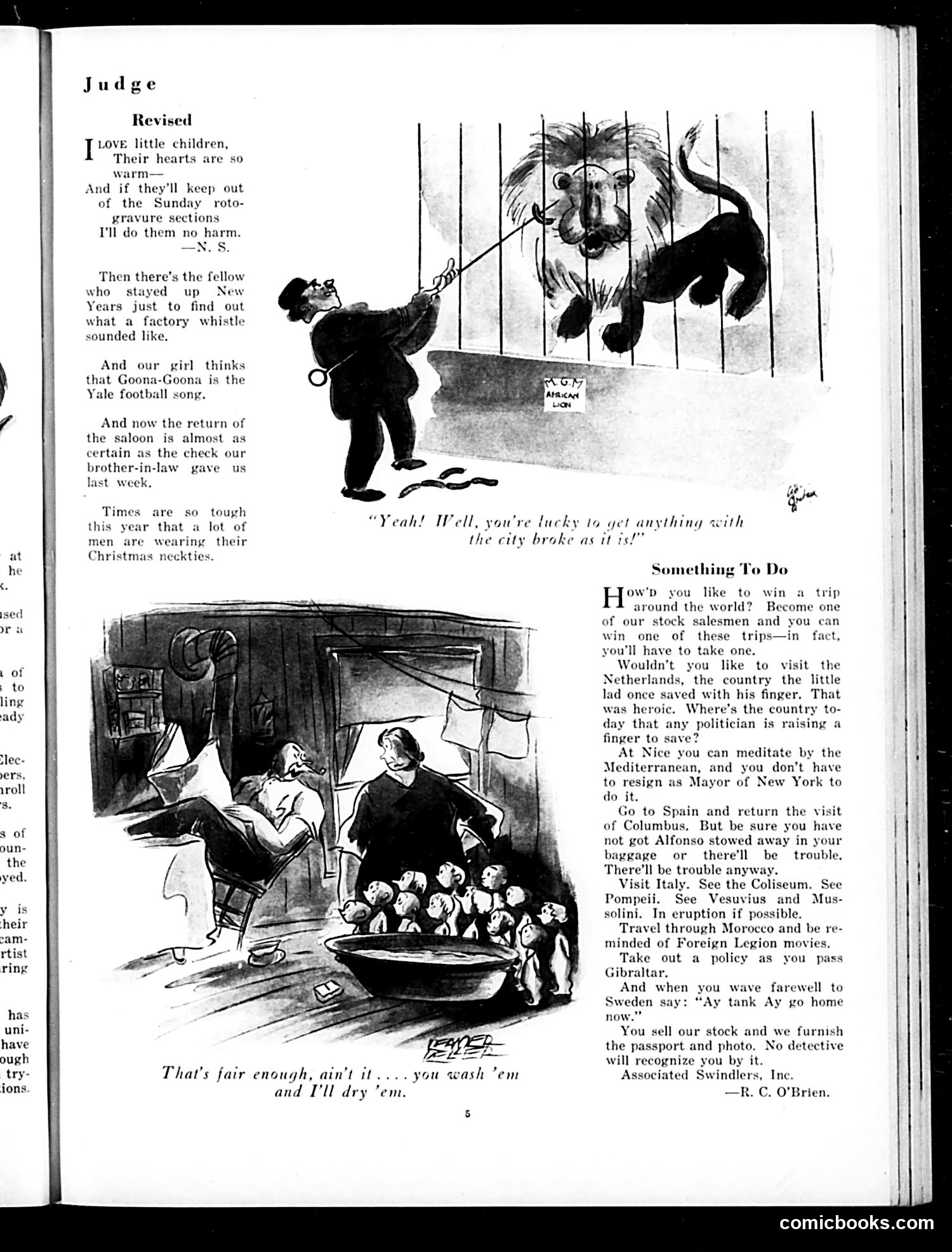
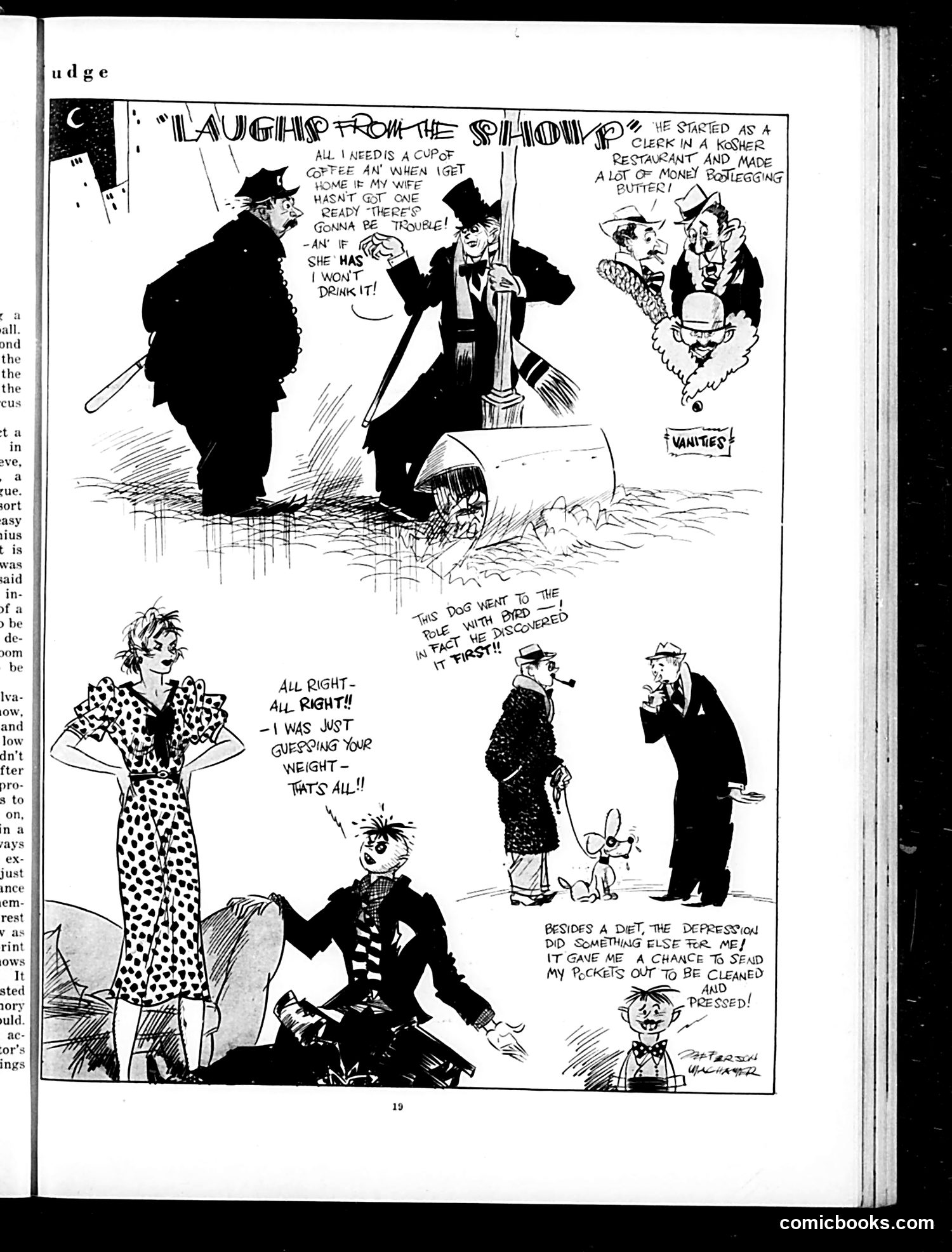
# Judge Magazine Page Analysis This page contains two cartoons and satirical commentary from an unspecified era (likely early 20th century based on style). **Top cartoon**: A man with a factory whistle confronts a donkey, captioned "Yeah! Well, you're lucky to get anything with the city broke as it is!" This appears to satirize urban economic hardship—the city's financial struggles are so severe that even animals should be grateful for basic provisions. **Bottom cartoon**: Shows a woman washing children while a man observes, captioned "That's fair enough, ain't it....you wash 'em and I'll dry 'em." This domestic humor reflects traditional gender roles and division of household labor. **"Something To Do"** section offers humorous travel suggestions for unemployed stock salesmen, satirizing the economic depression affecting business professionals.
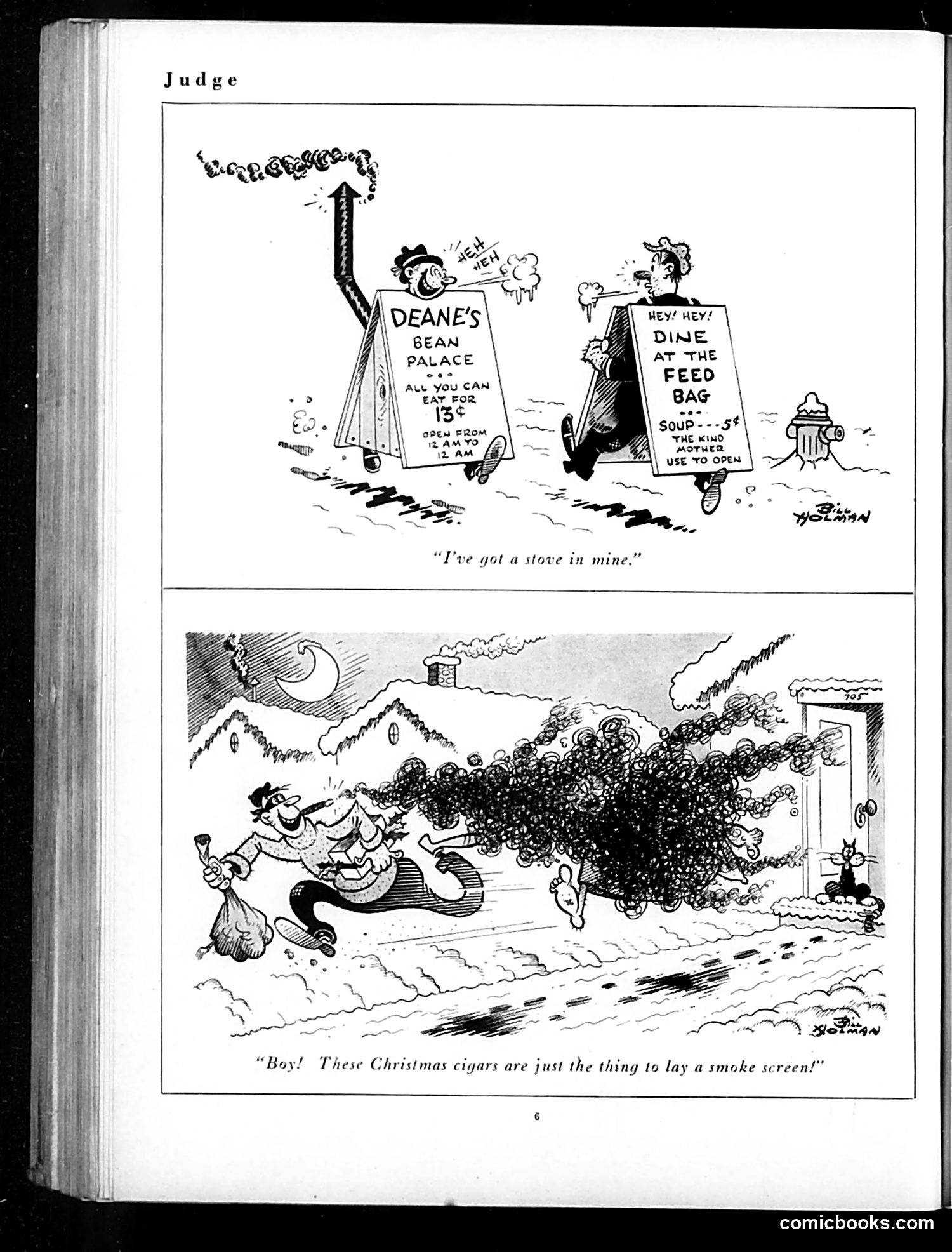
# Analysis of Judge Page This page contains two cartoons satirizing Depression-era commercialism and entrepreneurship. **Top cartoon**: Two men wearing sandwich boards advertise competing cheap eateries—"Deane's Bean Palace" (15¢ all-you-can-eat) and "Feed Bag" (soup for 5¢). The humor lies in their competitive boasting ("I've got a stove in mine"), mocking how desperate Depression entrepreneurs oversold minimal offerings. **Bottom cartoon**: Men use Christmas cigars to create a smoke screen, apparently to hide from someone or something. The joke appears to reference using cheap merchandise as deception—"just the thing to lay a smoke screen"—satirizing how inferior holiday goods were marketed to unsuspecting consumers. Both cartoons mock working-class struggles and dubious commercial practices during economically desperate times.
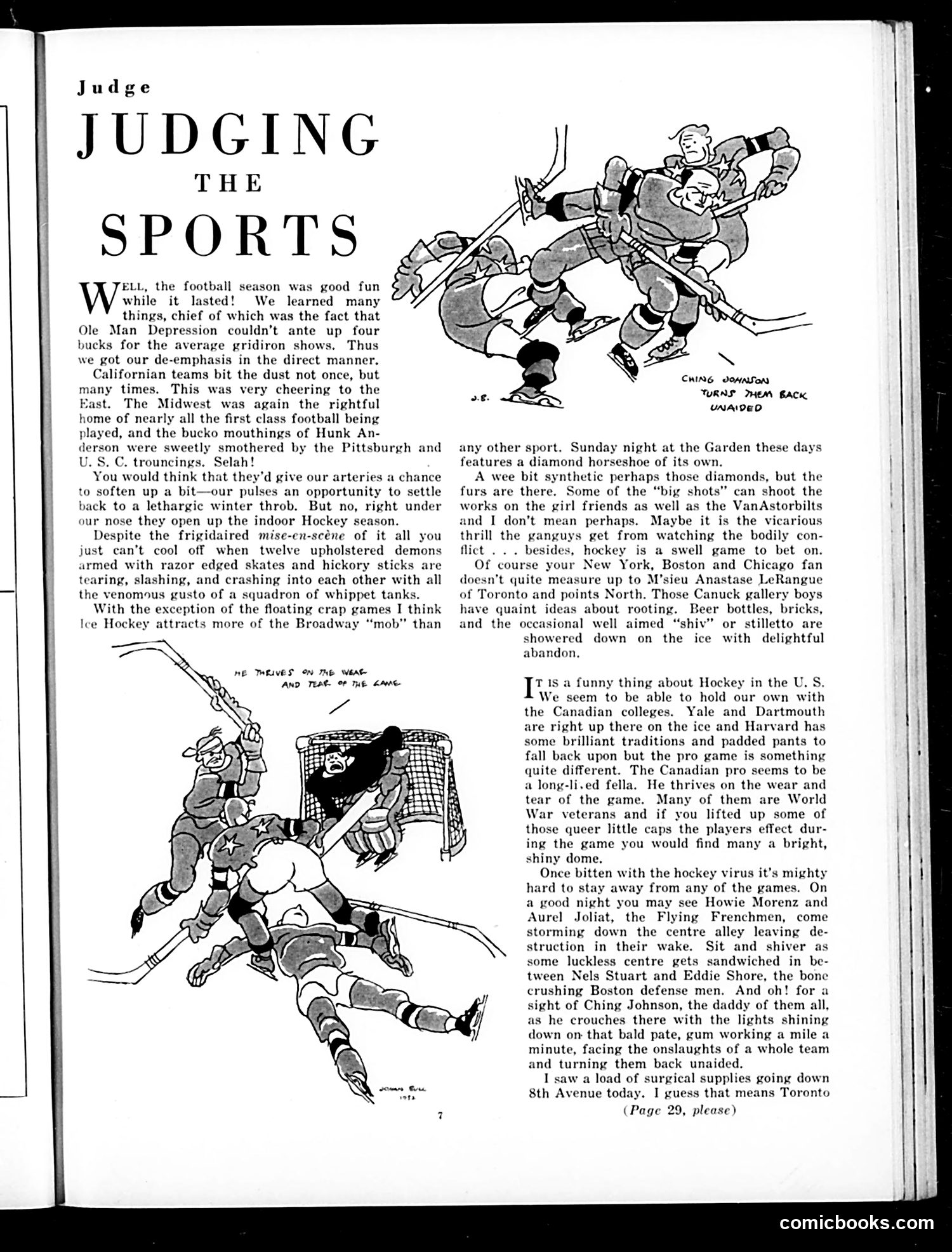
# Judging the Sports: A Depression-Era Commentary This *Judge* magazine article satirizes American sports during the Great Depression. The author notes that the economic crisis has decimated football attendance—"Ole Man Depression couldn't ante up four bucks"—forcing de-emphasis of the sport. The cartoons humorously depict the violent, physical nature of ice hockey, which the author suggests attracts Broadway's "mob" crowd seeking vicarious thrills from bodily conflict. Named players like Howie Morenz, Aurel Joliat (the "Flying Frenchmen"), Nels Stuart, Eddie Shore, and Ching Johnson are praised for their toughness—particularly Johnson, depicted as a tough, bald veteran who single-handedly stops opponents. The satire contrasts American and Canadian hockey culture, suggesting Canadian fans' passionate (violent) rooting style—"Beer bottles, bricks...and the occasional well aimed 'shiv'"—surpasses American spectators' restraint. The closing joke about surgical supplies heading to Toronto implies the Canadian game's brutality necessitates medical supplies.
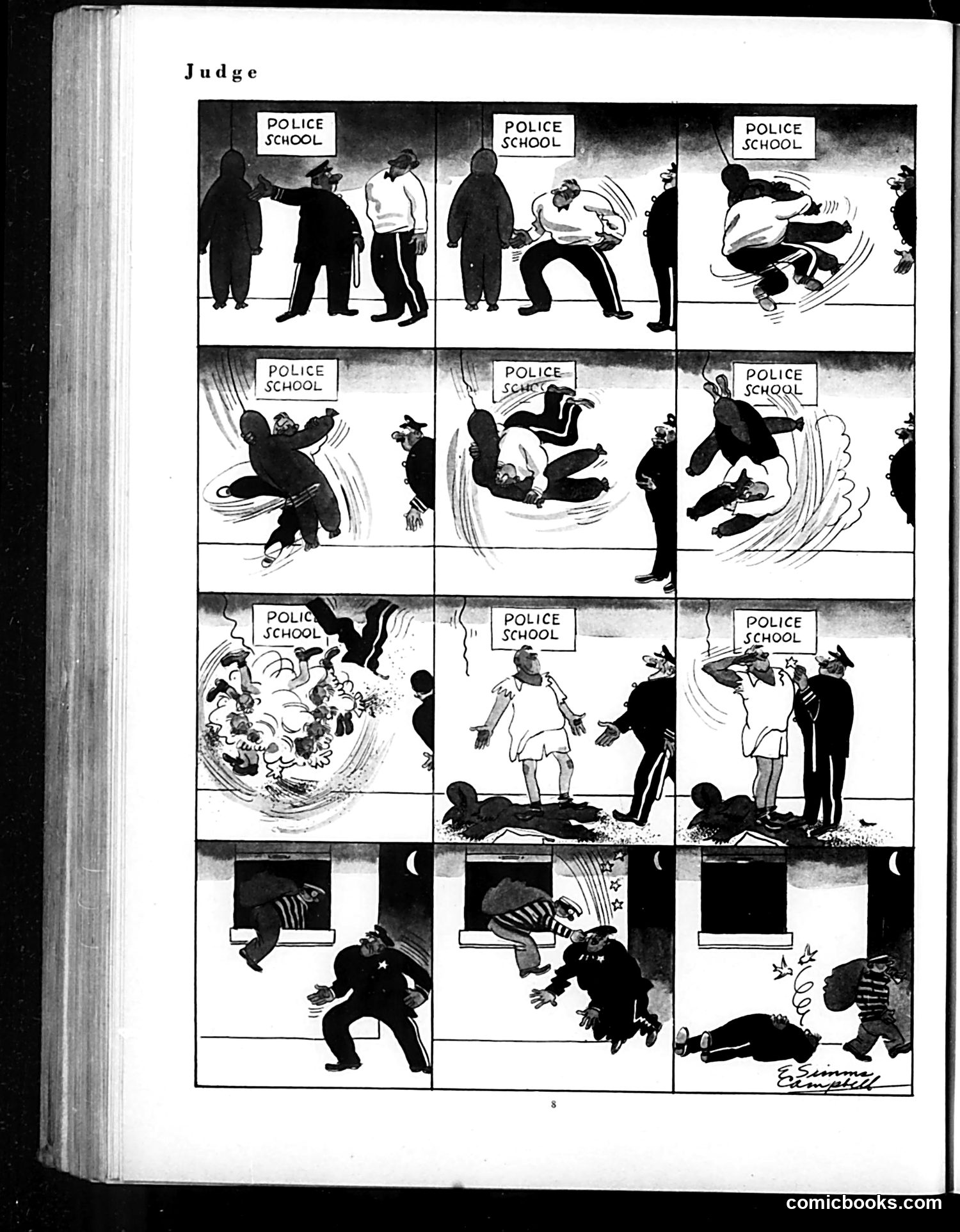
# "Judge" Political Cartoon: Police School This single-panel comic satirizes police training or police brutality through a sequential narrative at a "Police School." The cartoon depicts officers progressively using more violent tactics—from initial confrontations to throwing suspects, culminating in nighttime scenes of officers attacking figures on the ground. The satire appears to critique either inadequate police training that encourages excessive force, or mock the normalization of police violence as an accepted "school" curriculum. The repetition of "POLICE SCHOOL" labels emphasizes how violence becomes systematized and taught rather than aberrant behavior. The final nighttime panels suggest violence occurring beyond public oversight, possibly criticizing how such conduct goes unpunished when hidden from daylight scrutiny. Without a visible date, the specific historical context remains unclear, though the critique of police violence has remained relevant across American history.
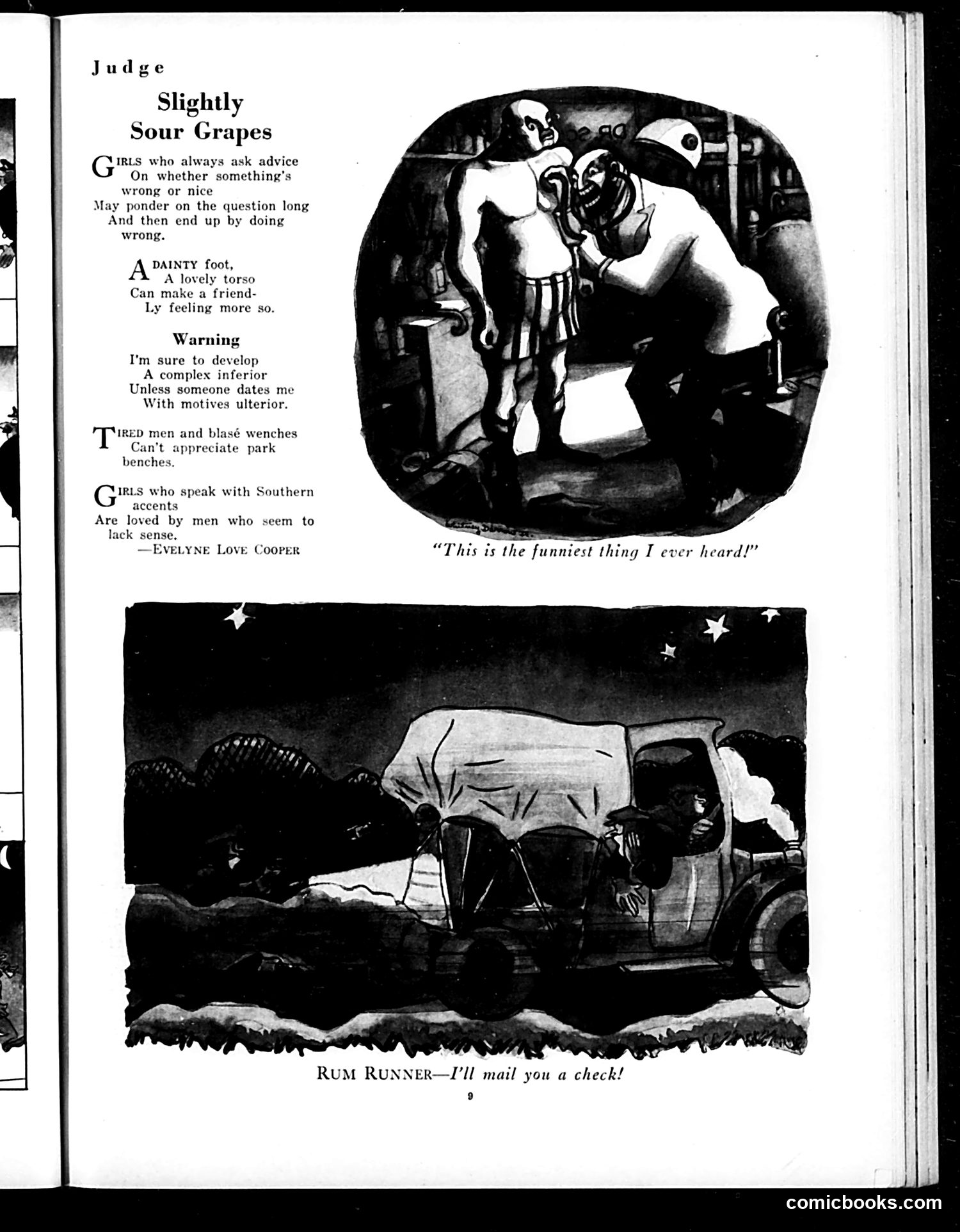
# Judge Magazine Page Analysis This page contains two distinct satirical pieces: **"Slightly Sour Grapes"** (top) offers cynical commentary on 1920s dating and gender dynamics. The verses mock women who seek romantic advice yet behave poorly, men attracted to Southern-accented women (implying lack of intelligence), and the general superficiality of courtship. The accompanying photograph shows what appears to be a humorous/flirtatious scene, with the caption "This is the funniest thing I ever heard!" **"Rum Runner"** (bottom) is a Prohibition-era joke. It depicts a car at night with a large container, captioned "I'll mail you a check!" This references the illegal liquor trade during Prohibition (1920-1933). The humor lies in the casual, transactional nature of bootlegging—suggesting someone is purchasing illegal alcohol with a mailed check, treating criminal activity like ordinary commerce. Both pieces reflect 1920s social concerns: dating culture and Prohibition enforcement.
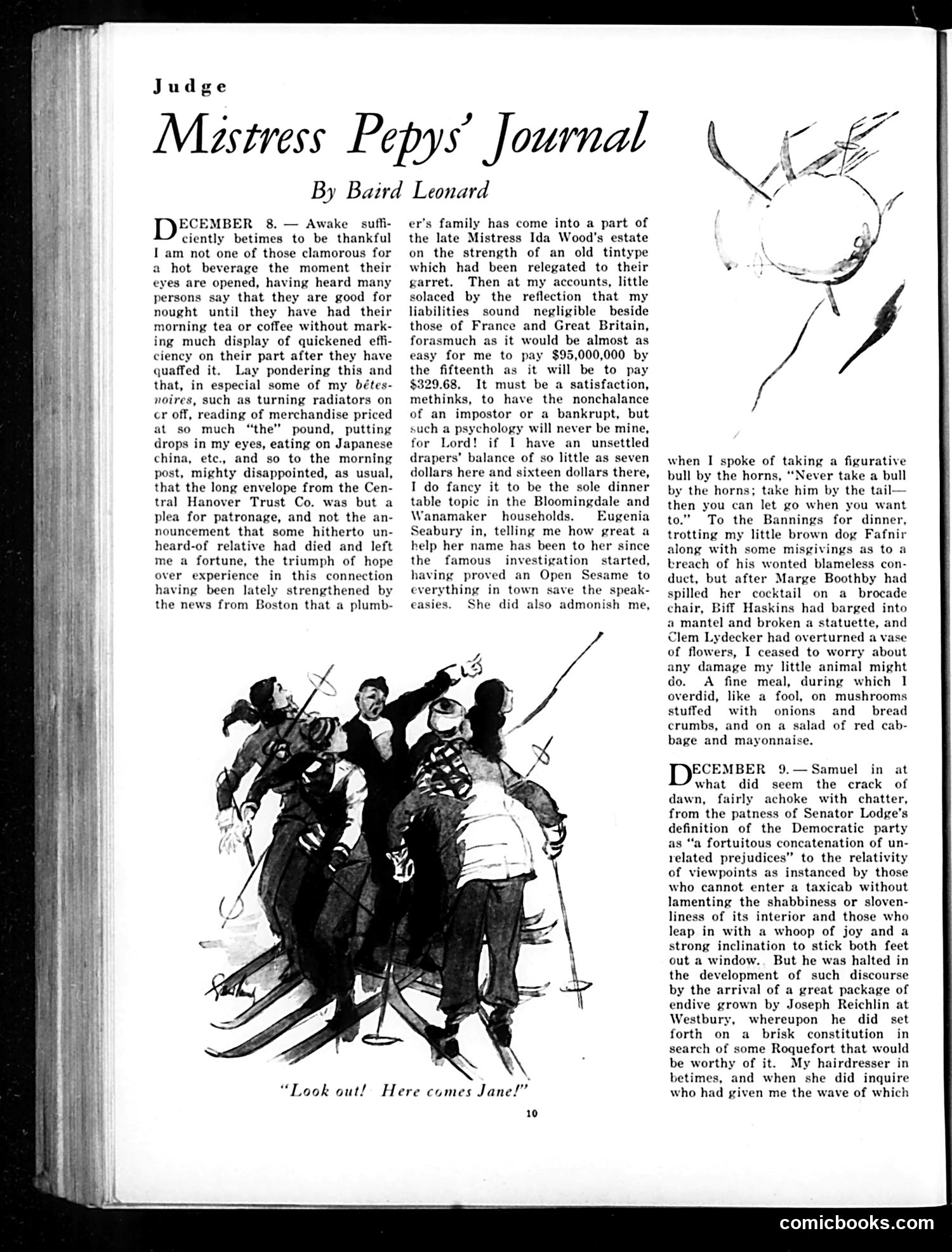
# "Mistress Pepys' Journal" - Judge Magazine Satire This is a humor column by Baird Leonard parodying Samuel Pepys's famous 17th-century diary, transplanting his format to 1920s America. The satire targets upper-middle-class anxieties and pretensions. The entry mocks: - **Financial anxiety**: The narrator obsesses over small debts ($329.68) while casually noting France and Britain owe vastly more - **Social gossip**: References to "Eugenia Seabury" and a famous investigation (likely the Seabury investigations into NYC corruption) - **Dinner party mishaps**: The cartoon shows clumsy guests causing damage, yet the narrator ceases worrying—satirizing how the wealthy normalize chaos among themselves - **Snobbish consumption**: Detailed discussion of expensive foods (endive, Roquefort) - **Political commentary**: Senator Lodge's definition of Democrats as a "fortuitous concatenation" of unrelated prejudices The humor lies in applying Pepys's dignified diary style to trivial, neurotic modern concerns, exposing class vanity.