
Judge, 1933-01 · page 24 of 36
Judge — January 1933 — page 24: what you’re looking at
A restored page from Judge, 1933-01. Page through the whole issue in the reader above.
📄 Transcribed text from this page (OCR, searchable)
Machine-transcribed from the original scan — historical spelling and the odd misread are preserved.
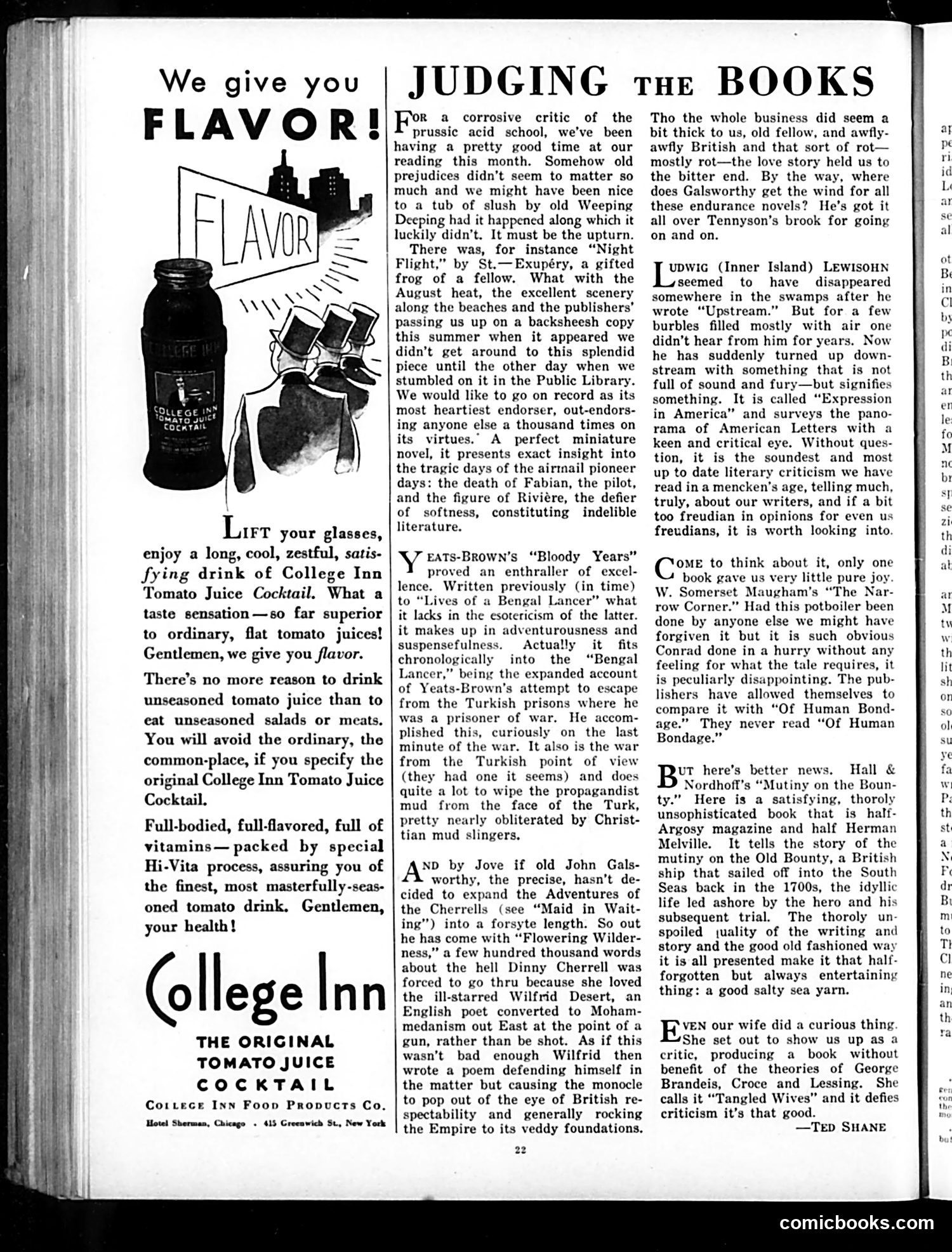
We give you FLAVOR! Lit your glasses, enjoy a long, cool, zestful, satis- fying drink of College Inn Tomato Juice Cocktail. What a taste sensation—so far superior to ordinary, flat tomato juices! Gentlemen, we give you flavor. There’s no more reason to drink unseasoned tomato juice than to eat unseasoned salads or meats. You will avoid the ordinary, the common-place, if you specify the original College Inn Tomato Juice Cocktail. Full-bodied, full-flavored, full of vitamins— packed by special Hi-Vita process, assuring you of the finest, most masterfully-seas- oned tomato drink. Gentlemen, your health! Glhesallins THE ORIGINAL TOMATO JUICE COCKTAIL Cottece Inn Foon Propucts Co. Hotel Sherman, Chicago . 415 Greeawich St, New York JUDGING tHe BOOKS R a corrosive critic of the prussic acid school, we've been having a pretty good time at our reading this month. Somehow old prejudices didn’t seem to matter so much and we might have been nice to a tub of slush by old Weeping Deeping had it happened along which it luckily didn’t. It must be the upturn. There was, for instance “Night Flight,” by St.—Exupéry, a gifted frog of a fellow. What with the August heat, the excellent scenery along the beaches and the publishers’ passing us up on a backsheesh copy this summer when it appeared we didn’t get around to this splendid piece until the other day when we stumbled on it in the Public Library. We would like to go on record as its most heartiest endorser, out-endors- ing anyone else a thousand times on its virtues.” A perfect miniature novel, it presents exact insight into the tragic days of the airtnail pioneer days: the death of Fabian, the pilot, and the figure of Riviére, the defier of softness, constituting indelible literature. EATS-Brown’s “Bloody Years” proved an enthraller of excel- lence. Written previously (in time) to “Lives of a Bengal Lancer” what it lacks in the esotericism of the latter. it makes up in adventurousness and suspensefulness. Actually it fits chronologically into the “Bengal Lancer,” being the expanded account of Yeats-Brown’s attempt to escape from the Turkish prisons where he was a prisoner of war. He accom- plished this, curiously on the last minute of the war. It also is the war from the Turkish point of view (they had one it seems) and does quite a lot to wipe the propagandist mud from the face of the Turk, pretty nearly obliterated by Christ- tian mud slingers, Aw by Jove if old John Gals- worthy, the precise, hasn’t de- cided to expand the Adventures of the Cherrells (see “Maid in Wait- ing’) into a forsyte length. So out he has come with “Flowering Wilder- ness,” a few hundred thousand words about the hell Dinny Cherrell was forced to go thru because she loved the ill-starred Wilfrid Desert, an English poet converted to Moham- medanism out East at the point of a gun, rather than be shot. As if this wasn't bad enough Wilfrid then wrote a poem defending himself in the matter but causing the monocle to pop out of the eye of British re- spectability and generally rocking the Empire to its veddy foundations. 22 Tho the whole business did seem a bit thick to us, old fellow, and awfly- awfly British and that sort of rot— mostly rot—the love story held us to the bitter end. By the way, where does Galsworthy get the wind for all these endurance novels? He’s got it all over Tennyson’s brook for going on and on. upwic (Inner Island) LEWwIsOHN seemed to have disappeared somewhere in the swamps after he wrote “Upstream.” But for a few burbles filled mostly with air one didn’t hear from him for years. Now he has suddenly turned up down- stream with something that is not full of sound and fury—but signifies something. It is called “Expression in America” and surveys the pano- rama of American Letters with a keen and critical eye. Without ques- tion, it is the soundest and most up to date literary criticism we have read in a mencken’s age, telling much, truly, about our writers, and if a bit too freudian in opinions for even us freudians, it is worth looking into. Come to think about it, only one book gave us ver, le pure joy. W. Somerset Maugham's “The Nar- row Corner.” Had this potboiler been done by anyone else we might have forgiven it but it is such obvious Conrad done in a hurry without any feeling for what the tale requires, it is peculiarly disappointing. The pub- lishers have allowed themselves to compare it with “Of Human Bond- age.” They never read “Of Human Bondage.” UT here’s better news. Hall & Nordhoff’s “Mutiny on the Boun- ty.” Here is a satisfying, thoroly unsophisticated book that is half- Argosy magazine and half Herman Melville. It tells the story of the mutiny on the Old Bounty, a British ship that sailed off into the South Seas back in the 1700s, the idyllic life led ashore by the hero and his subsequent trial. The thoroly un- spoiled juality of the writing and story and the good old fashioned way it is all presented make it that half- forgotten but always entertaining thing: a good salty sea yarn. VEN our wife did a curious thing. She set out to show us up as a critic, producing a book without benefit of the theories of George Brandeis, Croce and Lessing. She calls it “Tangled Wives” and it defies criticism it’s that good. —TeED SHANE comicbooks.com