
Judge, 1933-01 · page 20 of 36
Judge — January 1933 — page 20: what you’re looking at
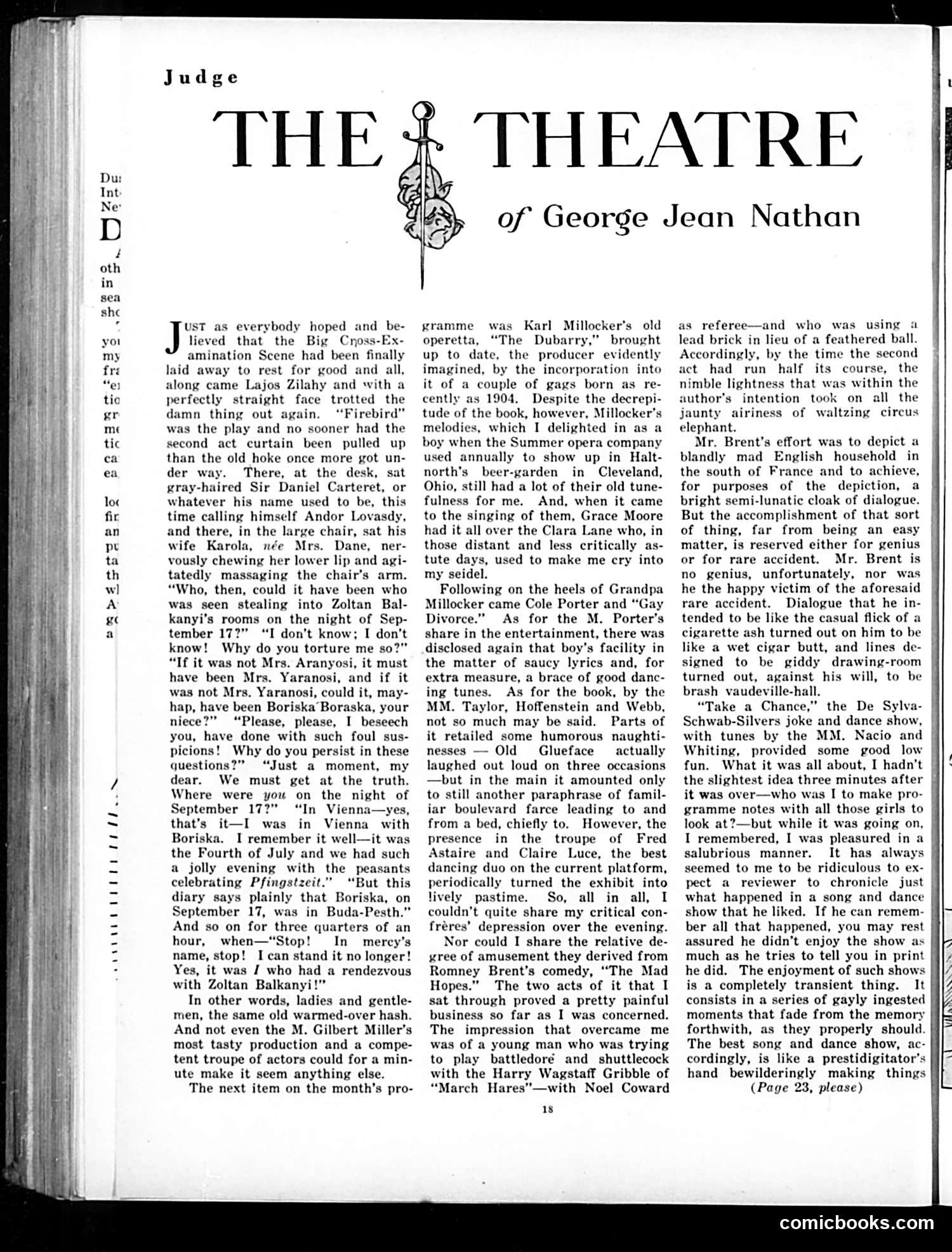
A restored page from Judge, 1933-01. Page through the whole issue in the reader above.
📄 Transcribed text from this page (OCR, searchable)
Machine-transcribed from the original scan — historical spelling and the odd misread are preserved.
tic gr tic ca ea loc fir an pe ta th wl x ee Jie as everybody hoped and be- lieved that the Big Cnoss-Ex- amination Scene had been finally laid away to rest for good and all, along came Lajos Zilahy and with a perfectly straight face trotted the damn thing out again. ‘‘Firebird” was the play and no sooner had the second act curtain been pulled up than the old hoke once more got un- der way. There, at the desk, sat gray-haired Sir Daniel Carteret, or whatever his name used to be, this time calling himself Andor Lovasdy, and there, in the large chair, sat his wife Karola, née Mrs. Dane, ner- vously chewing her lower lip and agi- tatedly massaging the chair’s arm. “Who, then, could it have been who was seen stealing into Zoltan Bal- kanyi’s rooms on the night of Sep- tember 172” “I don’t know; I don’t know! Why do you torture me so?” “If it was not Mrs. Aranyosi, it must have been Mrs. Yaranosi, and if it was not Mrs. Yaranosi, could it, may- hap, have been Boriska Boraska, your niece?” “Please, please, I beseech you, have done with such foul sus- picions! Why do you persist in these questions?” “Just a moment, my dear. We must get at the truth. Where were you on the night of September 172” “In Vienna—yes, that’s it—I was in Vienna with Boriska. I remember it well—it was the Fourth of July and we had such a jolly evening with the peasants celebrating Pfingstzeit.” “But this diary says plainly that Boriska, on September 17, was in Buda-Pesth.” And so on for three quarters of an hour, when—“Stop! In mercy’s name, stop! I can stand it no longer! Yes, it was J who had a rendezvous with Zoltan Balkanyi!” In other words, ladies and gentle- men, the same old warmed-over hash. And not even the M. Gilbert Miller’s most tasty production and a compe- tent troupe of actors could for a min- ute make it seem anything else. The next item on the month’s pro- gramme was Karl Millocker’s old operetta, “The Dubarry,” brought up to date, the producer evidently imagined, by the incorporation into it of a couple of gags born as re- cently as 1904. Despite the decrepi- tude of the book, however, Millocker’s melodies, which I delighted in as a boy when the Summer opera company used annually to show up in Halt- north’s beer-garden in Cleveland, Ohio, still had a lot of their old tune- fulness for me. And, when it came to the singing of them, Grace Moore had it all over the Clara Lane who, in those distant and less critically as- tute days, used to make me cry into my seidel. Following on the heels of Grandpa Millocker came Cole Porter and “Gay Divorce.” As for the M. Porter's share in the entertainment, there was disclosed again that boy's facility in the matter of saucy lyrics and, for extra measure, a brace of good danc- ing tunes. As for the book, by the MM. Taylor, Hoffenstein and Webb, not so much may be said. Parts of it retailed some humorous naughti- nesses — Old Glueface actually laughed out loud on three occasions —but in the main it amounted only to still another paraphrase of famil- iar boulevard farce leading to and from a bed, chiefly to. However, the presence in the troupe of Fred Astaire and Claire Luce, the best dancing duo on the current platform, periodically turned the exhibit into lively pastime. So, all in all, I couldn't quite share my critical con- fréres’ depression over the evening. Nor could I share the relative de- yree of amusement they derived from Romney Brent’s comedy, “The Mad Hopes.” The two acts of it that I sat through proved a pretty painful business so far as I was concerned. The impression that overcame me was of a young man who was trying to play battledoré and shuttlecock with the Harry Wagstaff Gribble of “March Hares”—with Noel Coward 18 THEATRE of George Jean Nathan as referee—and who was using a lead brick in lieu of a feathered ball. Accordingly, by the time the second act had run half its course, the nimble lightness that was within the author’s intention took on all the jaunty airiness of waltzing circus elephant. Mr. Brent’s effort was to depict a blandly mad English household in the south of France and to achieve, for purposes of the depiction, a bright semi-lunatic cloak of dialogue. But the accomplishment of that sort of thing, far from being an easy matter, is reserved either for genius or for rare accident. Mr. Brent is no genius, unfortunately, nor was he the happy victim of the aforesaid rare accident. Dialogue that he in- tended to be like the casual flick of a cigarette ash turned out on him to be like a wet cigar butt, and lines de- signed to be giddy drawing-room turned out, against his will, to be brash vaudeville-hall. “Take a Chance,” the De Sylva- Schwab-Silvers joke and dance show, with tunes by the MM. Nacio and Whiting, provided some good low fun. What it was all about, I hadn't the slightest idea three minutes after it was over—who was I to make pro- | gramme notes with all those girls to | look at?—but while it was going on, | I remembered, I was pleasured in a salubrious manner. It has always seemed to me to be ridiculous to ex- pect a reviewer to chronicle just what happened in a song and dance show that he liked. If he can remem- ber all that happened, you may rest assured he didn’t enjoy the show as much as he tries to tell you in print he did. The enjoyment of such shows is a completely transient thing. It consists in a series of gayly ingested moments that fade from the memory | forthwith, as they properly should. The best song and dance show, ac- cordingly, is like a prestidigitator’s hand bewilderingly making things (Page 23, please) comicbooks.com