
Judge, 1933-01 · page 15 of 36
Judge — January 1933 — page 15: what you’re looking at
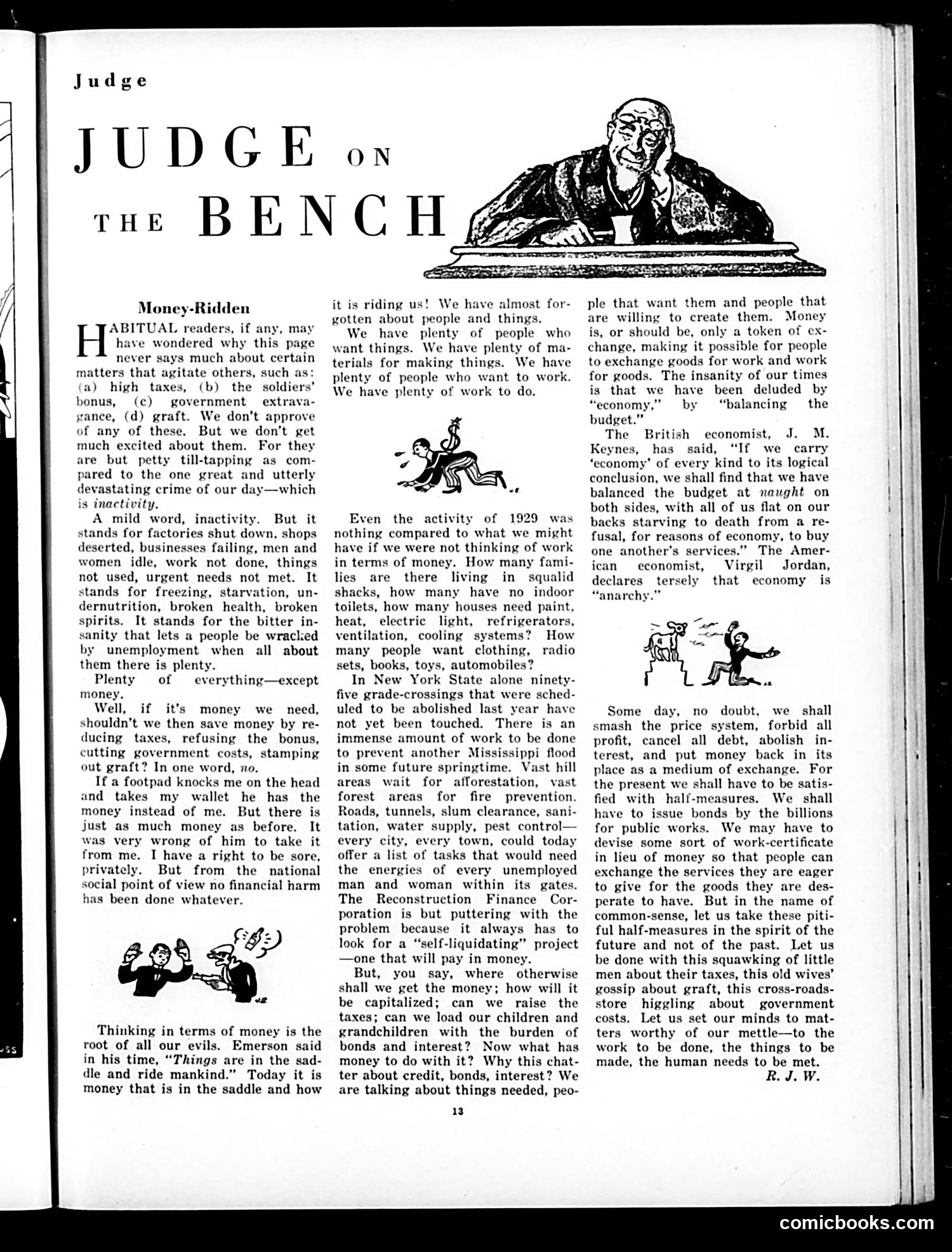
A restored page from Judge, 1933-01. Page through the whole issue in the reader above.
📄 Transcribed text from this page (OCR, searchable)
Machine-transcribed from the original scan — historical spelling and the odd misread are preserved.
Judge JUDGE ON ruse BENCH Money-Ridden ABITUAL readers, if any, may H have wondered why this never says much about certai matters that agitate others, such (a) high taxes, (b) the soldier bonus, (c) government ext sance, (d) graft. We don’t approve of any of these. But we don’t get much excited about them. For they are but petty till-tapping as com- pared to the one great and utterly devastating crime of our day—which is inactivity. A mild word, inactivity. But it stands for factories shut down, shops deserted, businesses failing, men and women idle, work not done, things not used, urgent needs not met. It stands for freezing, starvation, un- dernutrition, broken health, broken spirits. It stands for the bitter in- sanity that lets a people be wracked by unemployment when all about them there is plenty. Plenty of —everything—except money. Well, if it’s money we need, shouldn't we then save money by re- ducing taxes, refusing the bonus, cutting government costs, stamping out graft? In one word, no. If a footpad knocks me on the head and takes my wallet he has the money instead of me. But there is just as much money as before. It was very wrong of him to take it from me. I have a right to be sore, privately. But from the national social point of view no financial harm has been done whatever. Thinking in terms of money is the root of all our evils. Emerson said in his time, “Things are in the sad- dle and ride mankind.” Today it is money that is in the saddle and how it is riding us! We have almost for- gotten about people and things. We have plenty of people who want things. We have plenty of ma- terials for making things. We have plenty of people who want to work. We have plenty of work to do. - g « Even the activity of 1929 was nothing compared to what we might have if we were not thinking of work in terms of money. How many fami- lies are there living in squalid shacks, how many have no indoor toilets, how many houses need paint, heat, electric light, refrigerators, ventilation, cooling systems? How many people want clothing, radio sets, books, toys, automobiles? In New York State alone ninety- five grade-crossings that were sched- uled to be abolished last year have not yet been touched. There is an immense amount of work to be done to prevent another Mississippi flood in some future springtime. Vast hill areas wait for afforestation, vast forest areas for fire prevention. Roads, tunnels, slum clearance, sani- tation, water supply, pest control— every city, every town, could today offer a list of tasks that would need the energies of every unemployed man and woman within its gates. The Reconstruction Finance Cor- poration is but puttering with the problem because it always has to look for a “self-liquidating” project —one that will pay in money. But, you say, where otherwise shall we get the money; how will it be capitalized; can we raise the taxes; can we load our children and grandchildren with the burden of bonds and interest? Now what has money to do with it? Why this chat- ter about credit, bonds, interest? We are talking about things needed, peo- 13 ple that want them and people that are willing to create them. Money is, or should be, only a token of ex- change, making it possible for people to exchange goods for work and work for goods. The insanity of our times is that we have been deluded by “economy,” by “balancing the budget.” The British economist, J. M. Keynes, has said, “If we car ‘economy’ of every kind to its logicz conclusion, we shall find that we have balanced the budget at naught on both sides, with all of us flat on our backs starving to death from a re- fusal, for reasons of economy, to buy one another's serv! ” The Amer- ican economist, Virgil Jordan, declares tersely that economy is “anarchy.” Some day, no doubt, we shall smash the price tem, forbid all profit, cancel all debt, abolish in- terest, and put money back in its place as a medium of exchange. For the present we shall have to be satis- fied with half-measures. We shall have to issue bonds by the billions for public works. We may have to devise some sort of work-certificate in lieu of money so that people can exchange the services they are eager to give for the goods they are des- perate to have. But in the name of common-sense, let us take these piti- ful half-measures in the spirit of the future and not of the past. Let us be done with this squawking of little men about their taxes, this old wives’ gossip about graft, this cross-roads- store higgling about government costs. Let us set our minds to mat- ters worthy of our mettle—to the work to be done, the things to be made, the human needs to be met. R. J. W. comicbooks.com