
Judge, 1933-01 · page 17 of 36
Judge — January 1933 — page 17: what you’re looking at
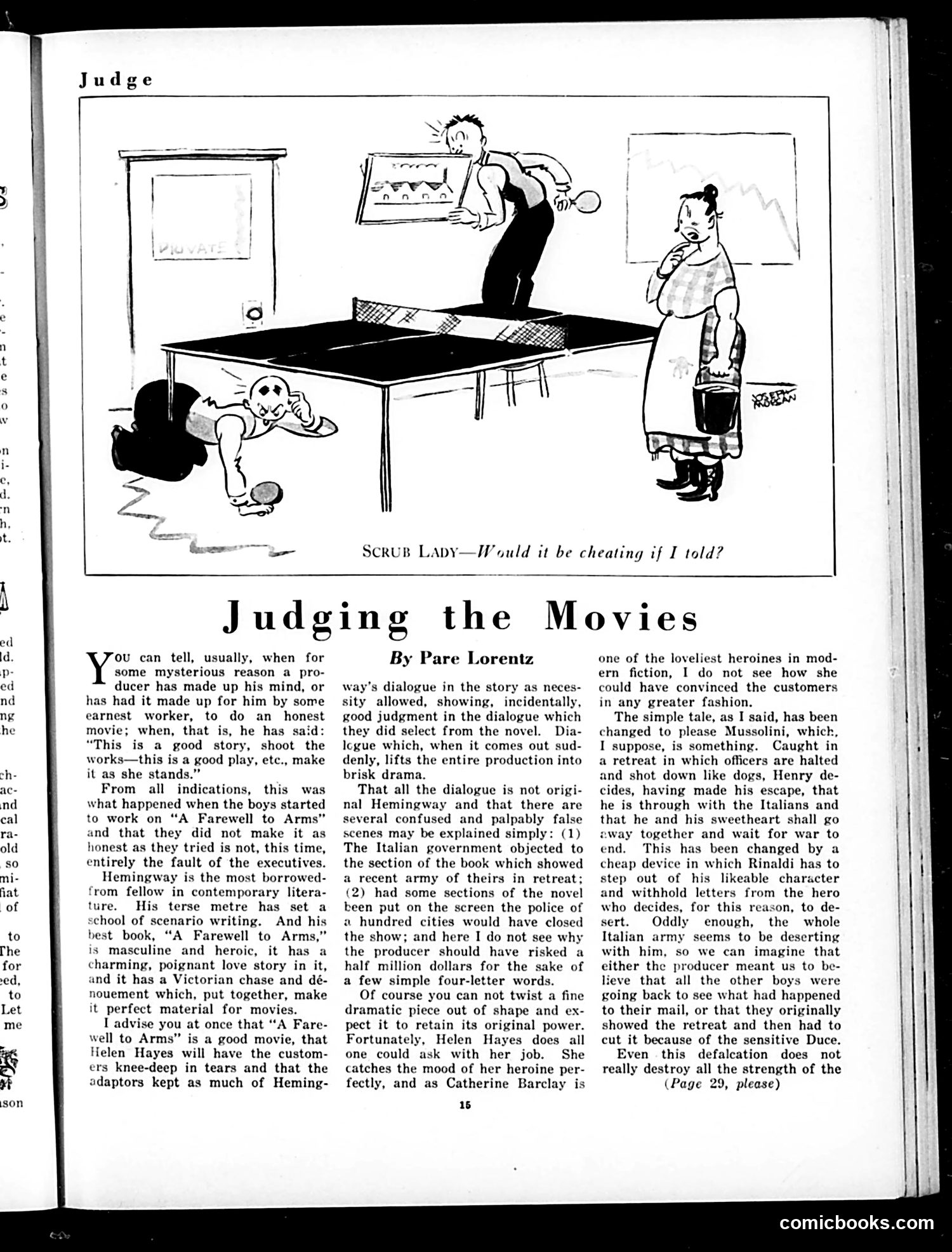
A restored page from Judge, 1933-01. Page through the whole issue in the reader above.
📄 Transcribed text from this page (OCR, searchable)
Machine-transcribed from the original scan — historical spelling and the odd misread are preserved.
J ) ed id. ed nd ng he cal ra- old so mi- fiat of to The for ed, to Let me : son ScruB LADY—W ould it be cheating if I told? Judging the Movies Yo can tell, usually, when for some mysterious reason a pro- ducer has made up his mind, or has had it made up for him by some earnest worker, to do an _ honest ie; when, that is, he has said: is a good story, shoot the works—this is a good play, etc., make it as she stands.” From all indications, this was what happened when the boys started to work on “A Farewell to Arms” and that they did not make it as honest as they tried is not, this time, entirely the fault of the executives. Hemingway is the most borrowed- from fellow in contemporary litera- ture. His terse metre has set a school of scenario writing. And his best book, “A Farewell to Arm: is masculine and heroic, it has a charming, poignant love story in it, and it has a Victorian chase and dé- nouement which, put together, make it perfect material for movies. I advise you at once that “A Fare- well to Arms” is a good movie, that Helen Hayes will have the custom- ers knee-deep in tears and that the adaptors kept as much of Heming- By Pare Lorentz y's dialogue in the story as neces- sity allowed, showing, incidentally, good judgment in the dialogue which they did select from the novel. Dia- Icgue which, when it comes out sud- denly, lifts the entire production into brisk drama. That all the dialogue is not origi- nal Hemingway and that there are several confused and palpably false scenes may be explained simply: (1) The Italian government objected to the section of the book which showed a recent army of theirs in retreat; (2) had some sections of the novel been put on the screen the police of a hundred cities would have closed the show; and here I do not see why the producer should have risked a half million dollars for the sake of a few simple four-letter words. Of course you can not twist a fine dramatic piece out of shape and ex- pect it to retain its original power. Fortunately, Helen Hayes does all one could ask with her job. She catches the mood of her heroine per- fectly, and as Catherine Barclay is 16 one of the loveliest heroines in mod- ern fiction, I do not see how she could have convinced the customers in any greater fashion. The simple tale, as I said, has been changed to please Mussolini, which, I suppose, is something. Caught in a retreat in which officers are halted and shot down like dogs, Henry de- cides, having made his escape, that he is through with the Italians and that he and his sweetheart shall go away together and wait for war to end. T has been changed by a cheap device in which Rinaldi has to step out of his likeable character and withhold letters from the hero who decides, for this reason, to de- sert. Oddly enough, the whole Italian army seems to be deserting with him, so we can imagine that either the producer meant us to be- lieve that all the other boys were going back to see what had happened to their mail, or that they originally showed the retreat and then had to cut it because of the sensitive Duce. Even this defalcation does not really destroy all the strength of the (Page 29, please) comicbooks.com