A complete issue · 36 pages · 1932
Judge — June 4, 1932
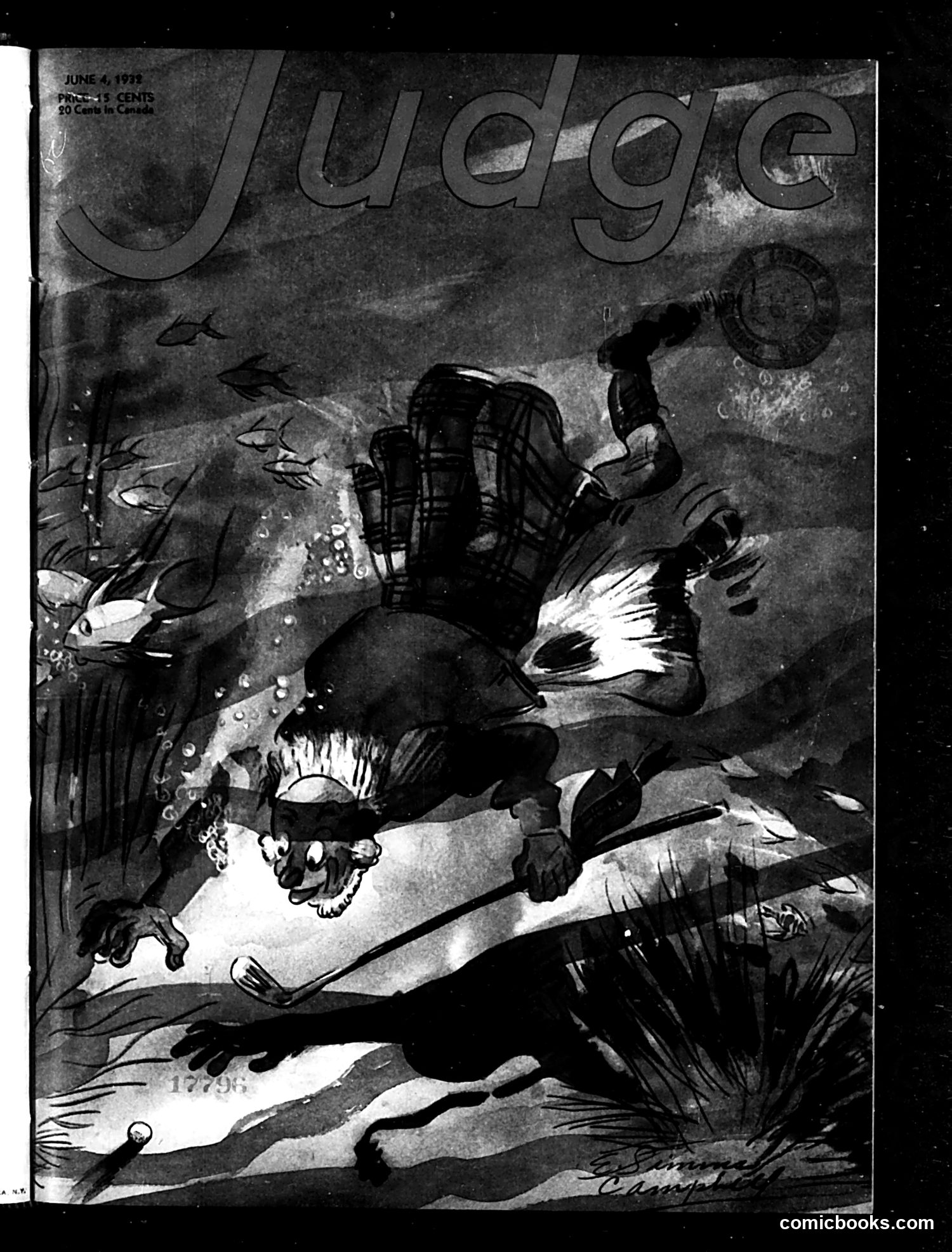
# Judge Magazine Cartoon Analysis This appears to be a June issue of **Judge** magazine (price 20 cents in Canada), a prominent American satirical publication. The cover illustration depicts an underwater scene with divers or swimmers in dramatic poses among aquatic vegetation and sea creatures. The artistic style and composition suggest this is likely political or social satire, though without clearer text or visible captions identifying specific figures or events, I cannot definitively state what particular political situation or public figures are being mocked. The dynamic, action-oriented composition and exaggerated artistic style typical of Judge's editorial cartoons indicates social commentary, but the specific target and satirical message remain unclear from this image alone.
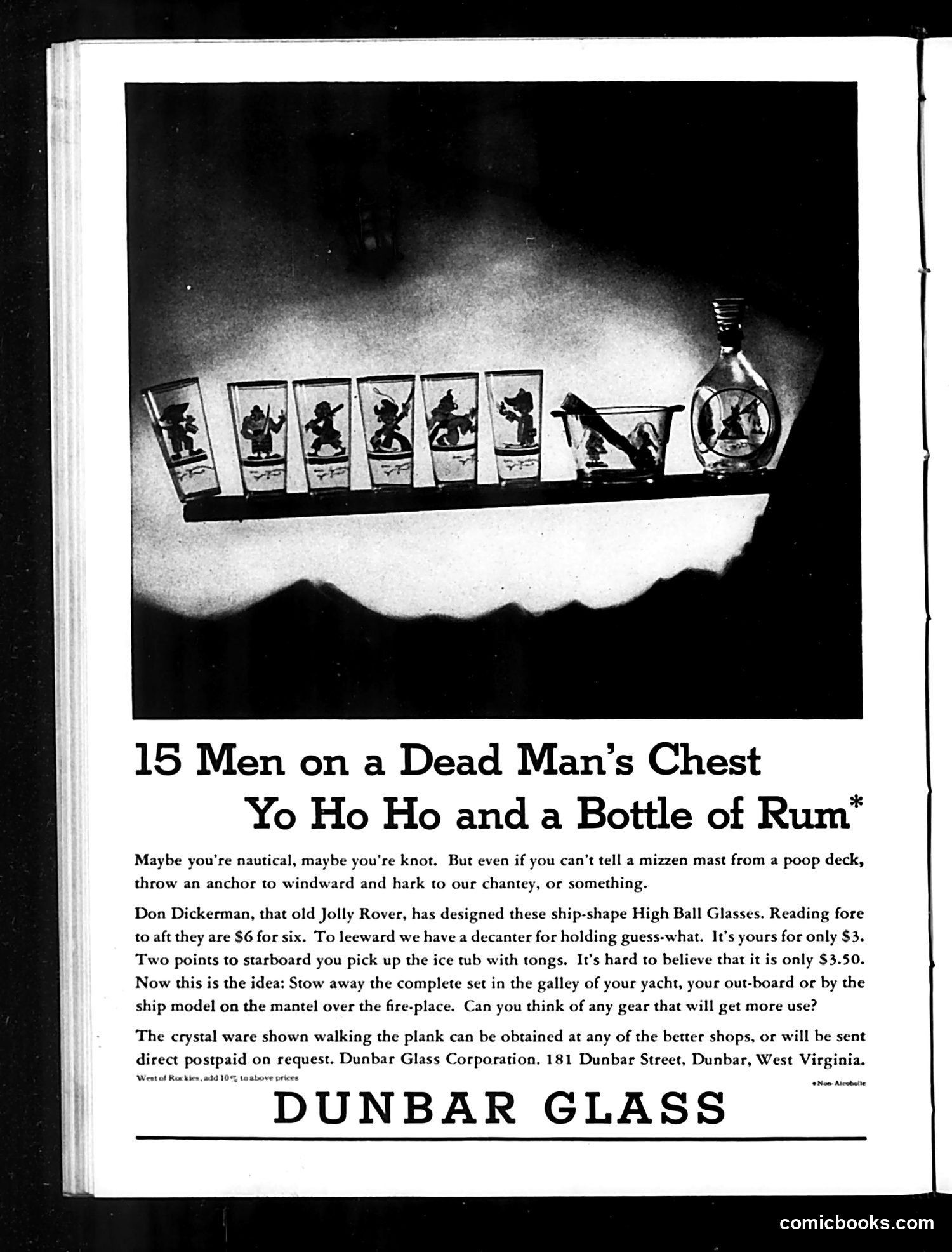
# Analysis This is primarily a **product advertisement** for Dunbar Glass Corporation, not political satire. The page advertises nautical-themed glassware designed by "Don Dickerman, that old Jolly Rover." The humorous copy adopts pirate/sailor vernacular ("mizzen mast," "poop deck," "hark to our chantey") to appeal to customers who fancy themselves nautical enthusiasts—whether genuinely knowledgeable or not ("maybe you're knautical, maybe you're knot"). The product line includes ship-shaped highball glasses ($6 per set of six), a decanter ($3), and an ice tub with tongs ($3.50). The satirical angle is gentle: it mocks aspirational consumers who want maritime décor to display on their yachts or mantels, suggesting these items represent quintessential "gear" for the nautically-minded. The title playfully references a pirate drinking song.
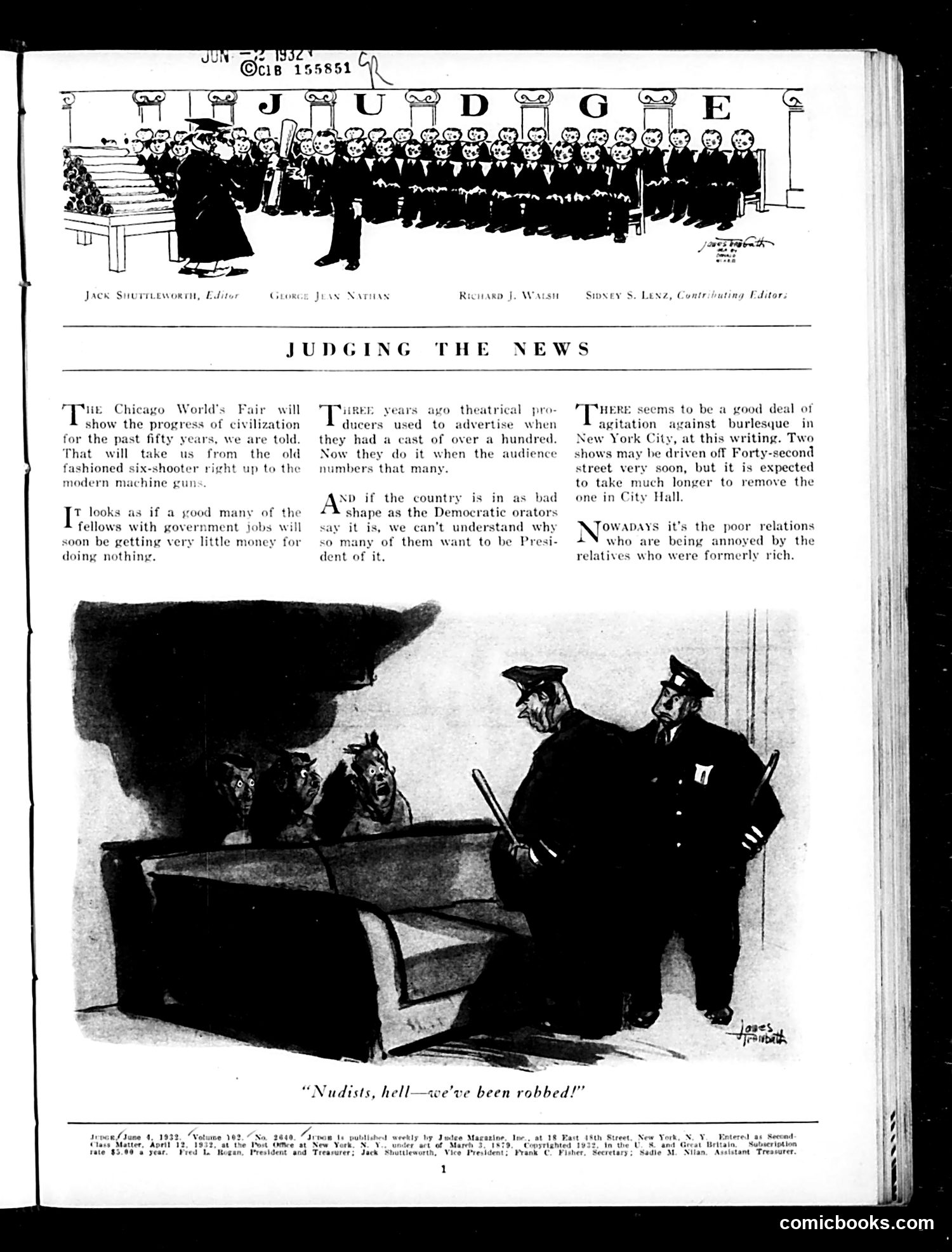
# Analysis of "Judging the News" Page This page from Judge magazine (dated June 2, 1932) contains editorial commentary and one cartoon titled "Nudists, hell—we've been robbed!" The cartoon depicts two police officers discovering what appears to be a robbery at a nudist establishment. The joke plays on the double meaning: nudists have "nothing to wear," so discovering a theft ("we've been robbed!") is absurd—they have no possessions to steal. The text snippets above discuss the 1932 Chicago World's Fair, theatrical advertising practices, and complaints about burlesque shows in New York City. One note sardonically observes that poor relations of formerly wealthy people now cause family friction—a pointed reference to the economic devastation of the Great Depression affecting class relationships. The overall tone reflects Depression-era cynicism about social upheaval and changing circumstances.
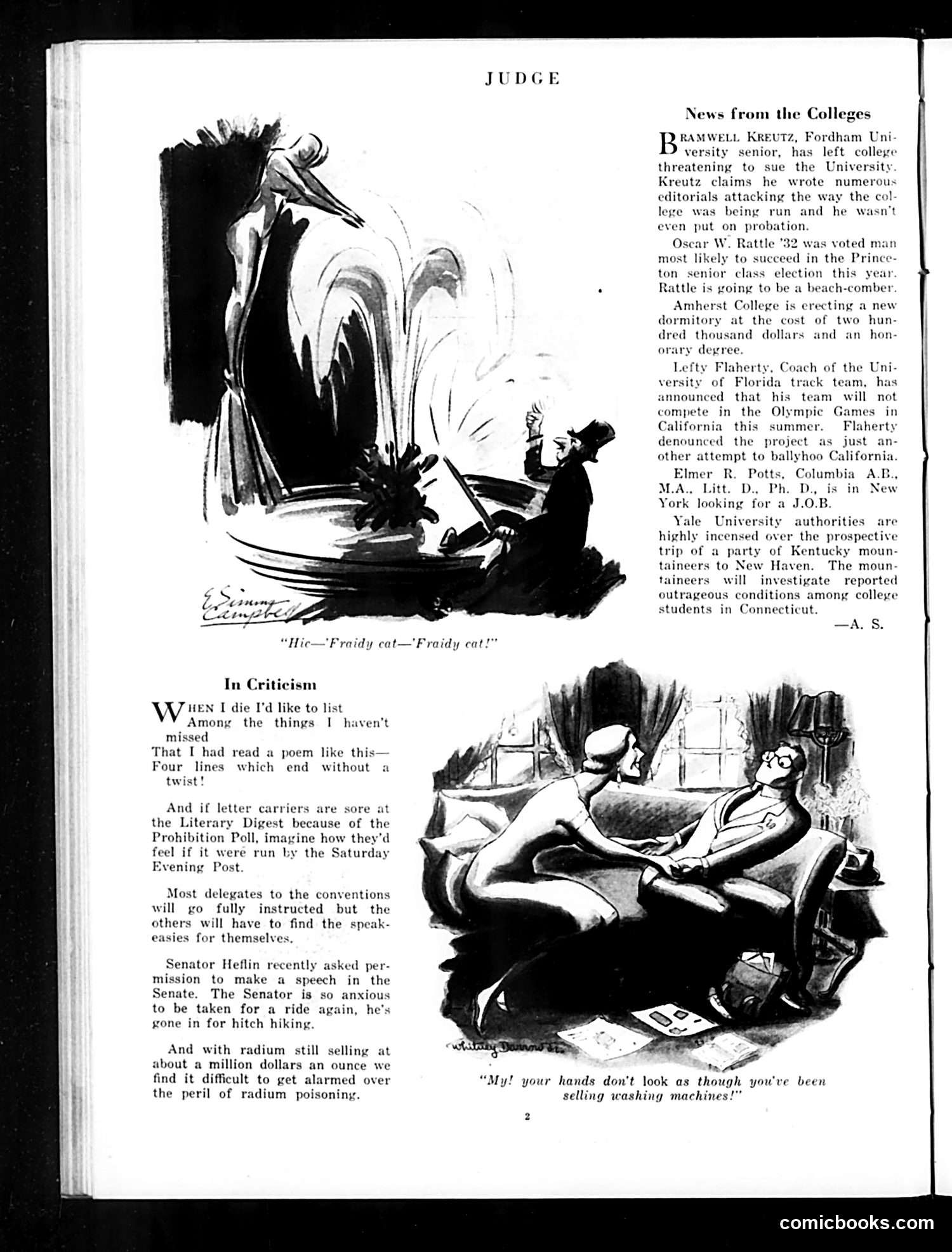
# Analysis of Judge Magazine Page The page contains two cartoons and college news items from an unspecified era (likely 1920s-30s based on style). **Top cartoon** ("Hic—Fraidy cat—Fraidy cat!"): Shows a skeleton confronting a frightened person, likely satirizing the Prohibition era's dangers—specifically bootleg alcohol or speakeasies. The skeleton represents death from contaminated liquor. **Bottom cartoon** ("My! your hands don't look as though you've been selling washing machines!"): Depicts a woman in domestic leisure being questioned about her hands, mocking the irony of salespeople claiming products work while showing no evidence of actual use—a common advertising criticism. The "In Criticism" section offers satirical commentary on contemporary issues including the Prohibition Poll, radium safety concerns, and Senator Heflin's public speaking anxieties.
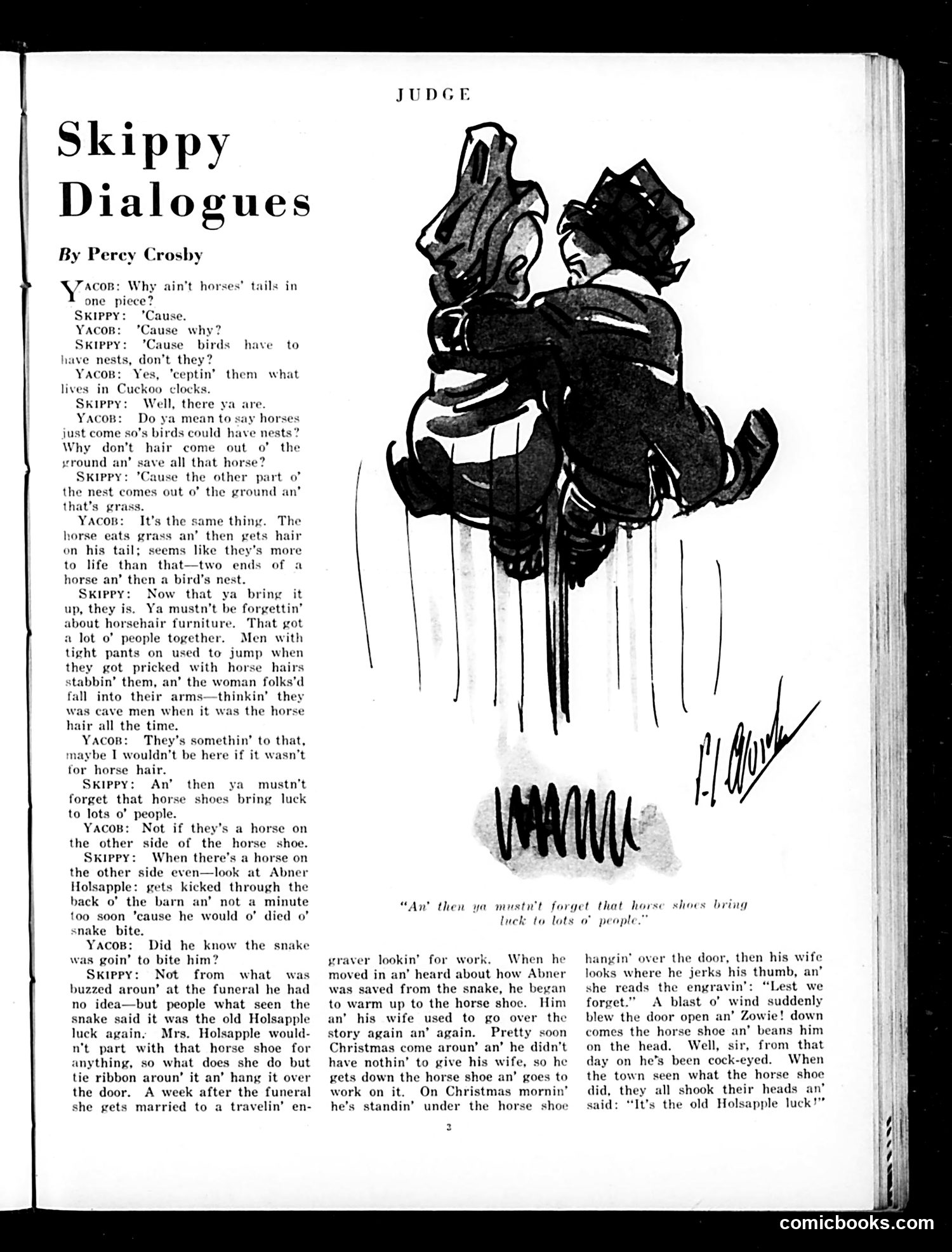
# "Skippy Dialogues" by Percy Crosby This page features a humorous dialogue between two characters—Yacob and Skippy—discussing the practical uses of horsehair. The conversation satirizes folk superstitions and everyday logic through a child's perspective. The joke centers on horseshoes as good-luck charms. Skippy points out the absurd contradiction: people treasure horseshoes for luck, yet the same horsehair used in furniture caused an accident (referencing "old Holsapple luck"). The narrative builds to a comic payoff where a snake bite is ironically blamed on the horseshoe's "old Holsapple luck" rather than actual danger. The cartoon mocks superstitious thinking by showing how people rationalize contradictory beliefs about the same object—treating horseshoes as both bringers and preventers of misfortune based on convenience.
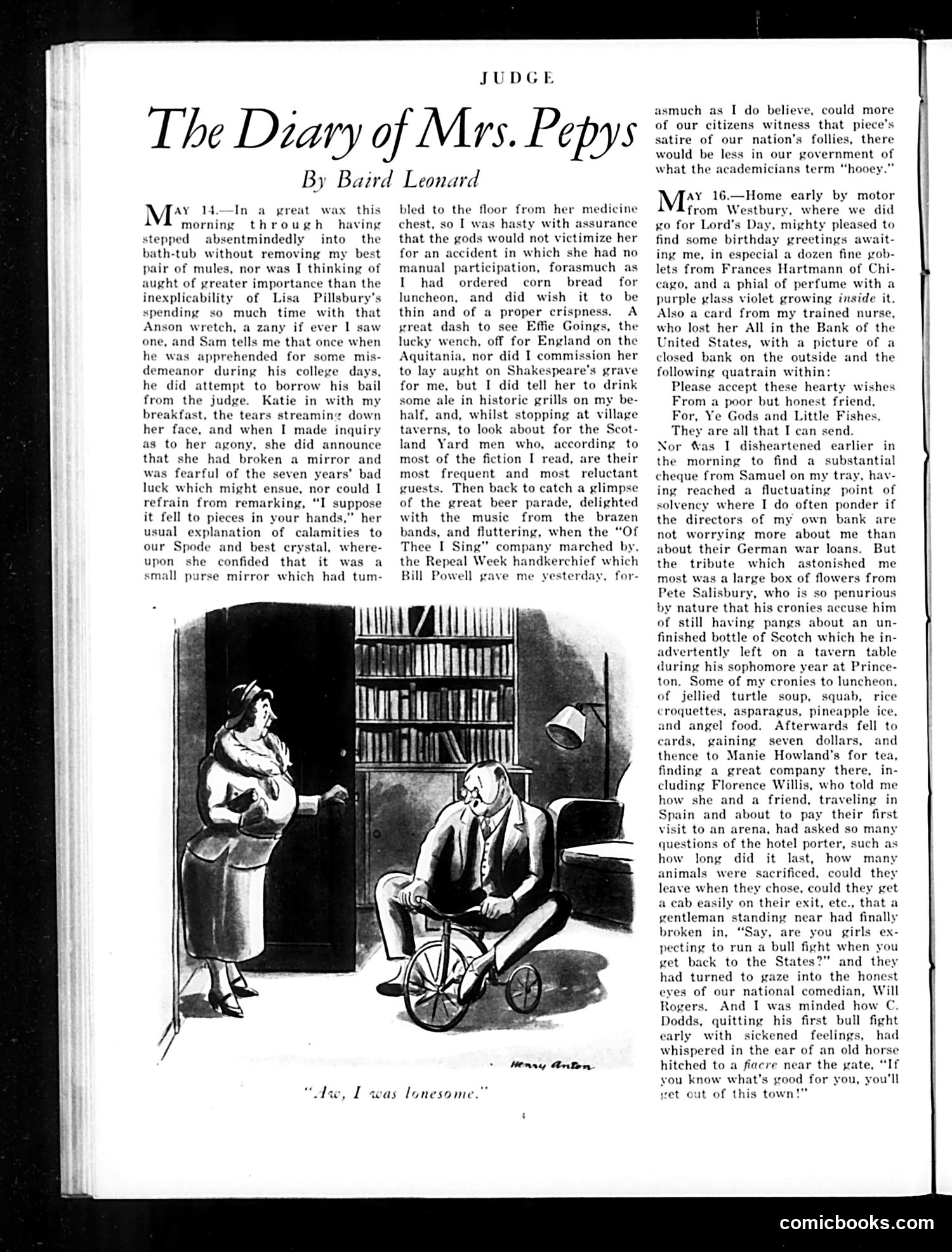
# "The Diary of Mrs. Pepys" by Baird Leonard This is a humorous diary entry feature, not political satire. The May 14 entry describes Mrs. Pepys's morning mishap—stepping into a bathtub without removing her best pair of mules, then worrying about her friend Lisa Pillsbury's injury from a mirror accident. The May 16 entry catalogs social activities: motoring, receiving birthday greetings and gifts (including a perfume bottle from Frances Hartmann), and attending luncheon at Manie Howland's where guests discuss a bullfighting arena visit and Will Rogers's comedic commentary. The illustration shows a woman and man in a domestic interior, with the caption "Alas, I was lonesome"—depicting the domestic comedy the diary documents.
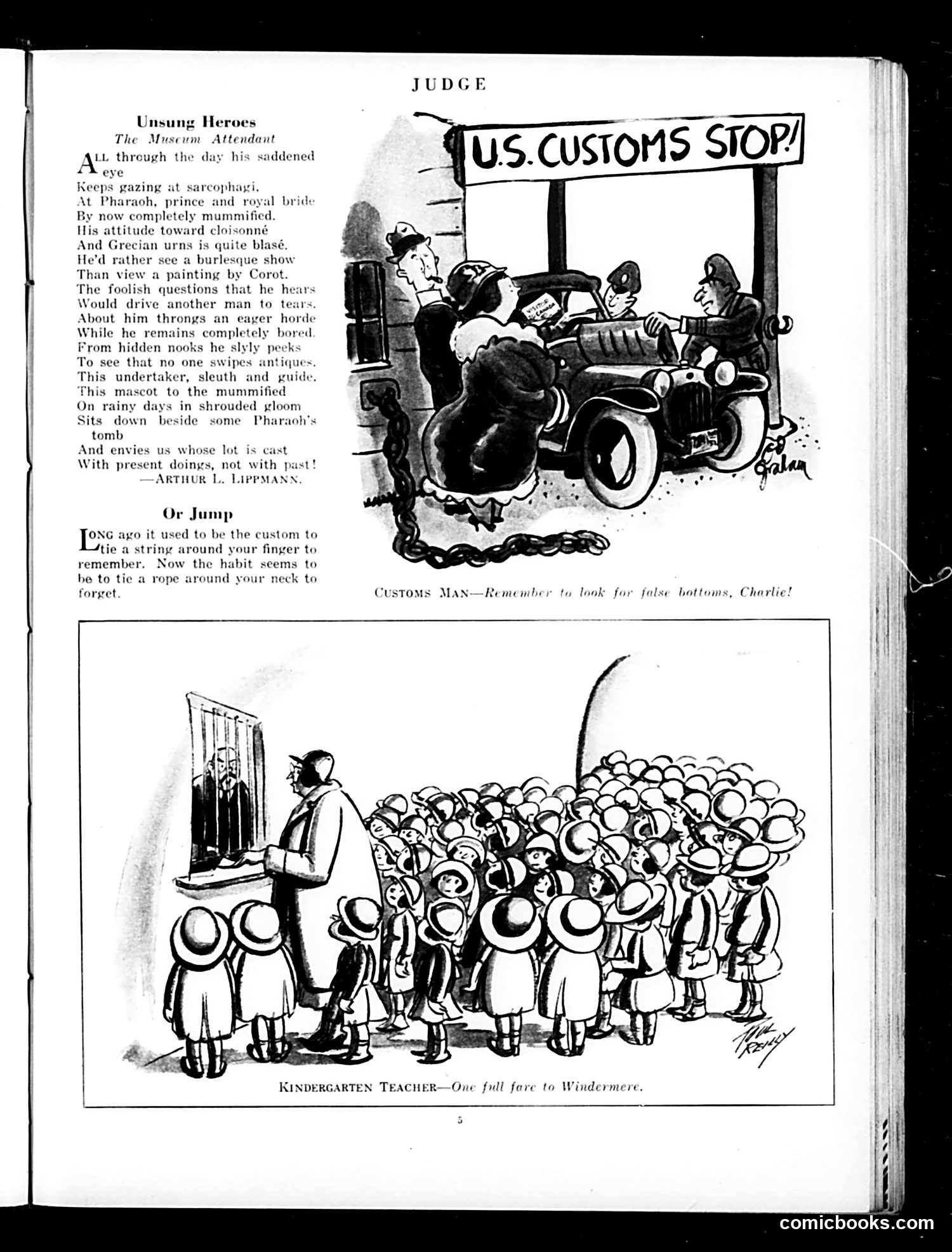
# Analysis of Judge Magazine Page This page contains two unrelated cartoons satirizing American institutions: **Top cartoon ("US Customs Stop!")**: Depicts smugglers in a car attempting to evade customs inspection. The joke plays on people hiding contraband by "jumping" the border—the accompanying poem "Or Jump" references old memory tricks (string around finger) becoming modern smuggling methods (rope around neck). It mocks both smugglers' desperation and customs enforcement challenges. **Bottom cartoon ("Kindergarten Teacher")**: Shows a crowded schoolroom where a kindergarten teacher must manage a massive class. The caption "One full fare to Windermere" suggests overcrowding, with students packed impossibly tight. This satirizes underfunded public education and inadequate classroom resources in early 20th-century America. Both cartoons critique social problems through exaggeration and visual humor typical of Judge's satirical style.
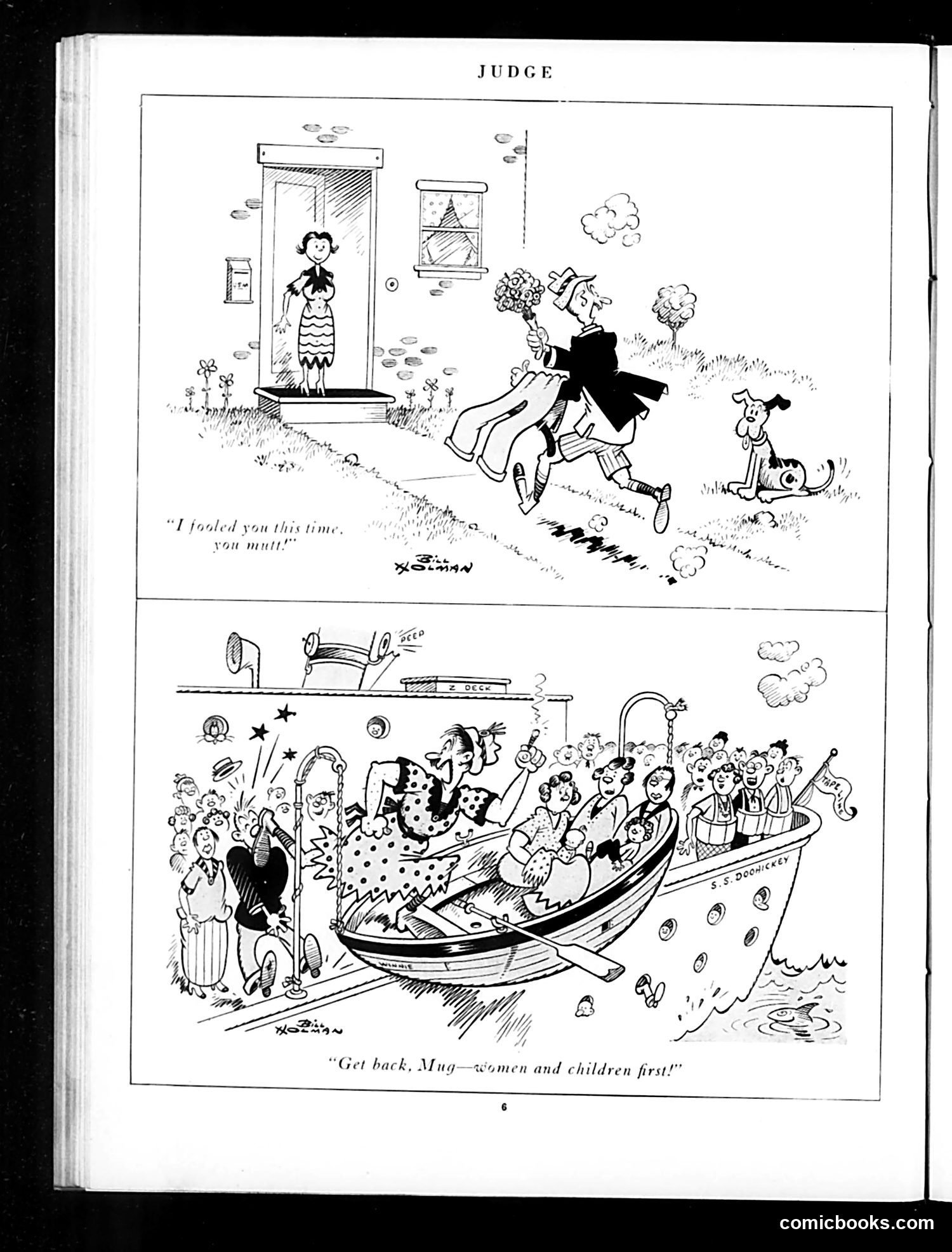
# Analysis of Judge Page This page contains two satirical cartoons. The first shows a woman at a house door saying "I looked you this time, you must!" to a man on a bicycle fleeing with flowers—likely depicting marital discord or a domestic dispute where the wife has literally locked him out. The second cartoon depicts a ship labeled "S.S. Decency" with crowds boarding and a figure (appearing to be a judge or authority figure) shouting "Get back, Mug—women and children first!" This appears to satirize social hypocrisy: someone representing moral authority or "decency" ironically demonstrates the opposite behavior by prioritizing protocol over genuine concern for vulnerable populations, suggesting elites mouth principles they don't practice.
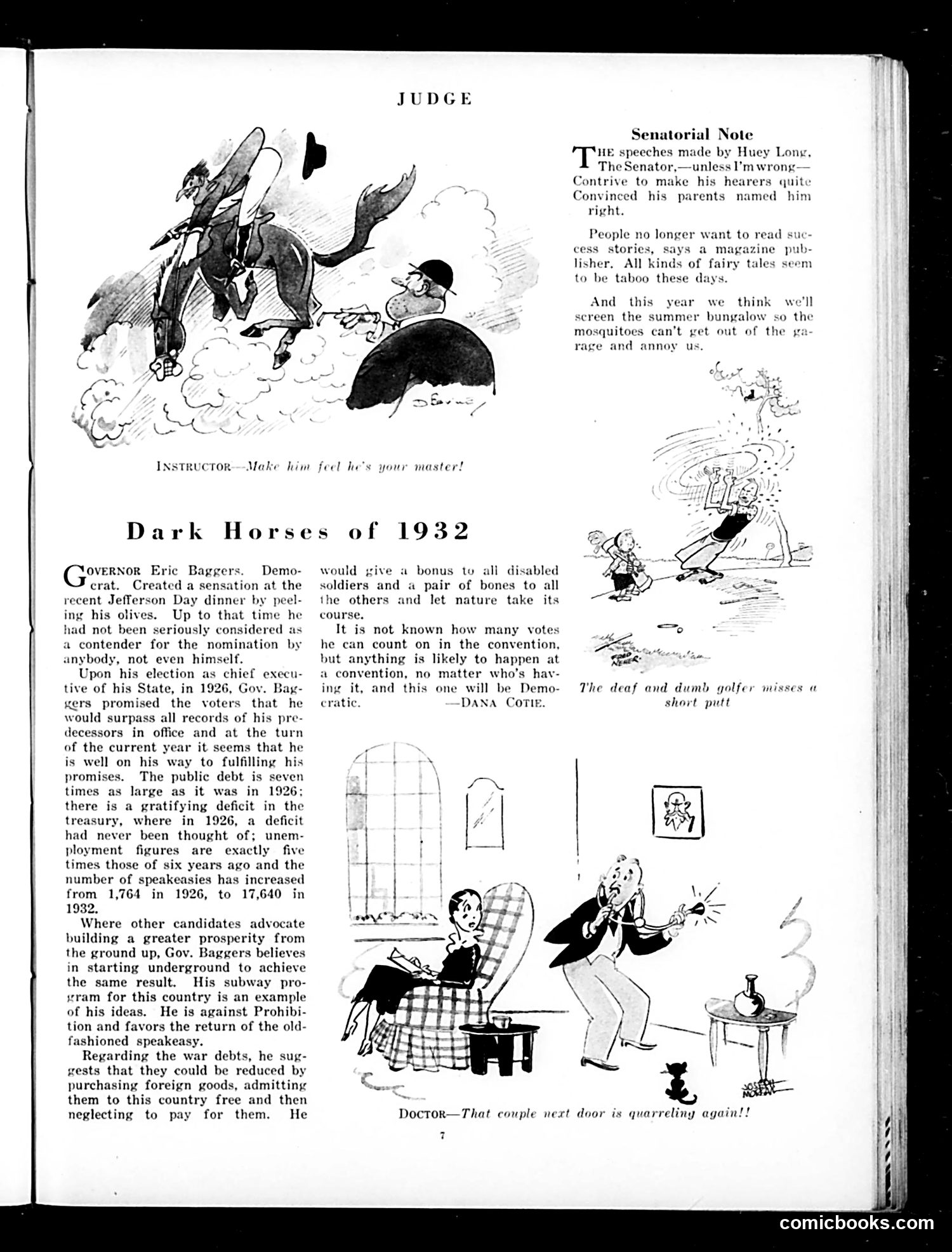
# "Dark Horses of 1932" Political Satire This page satirizes Governor Eric Baggers (likely a fictional stand-in for a Democratic politician during the 1932 election cycle). The text mocks his record since taking office in 1926, claiming he's actually *worsened* conditions: the public debt ballooned sevenfold, unemployment quintupled, and speakeasies increased tenfold—the opposite of promised prosperity. The satire's bite lies in its irony: Baggers claims to build prosperity "from the ground up" but actually works "underground" (a subway metaphor suggesting hidden corruption). His policy suggestions are absurd—paying war debts by importing goods free and refusing payment; giving soldiers bones instead of bonuses. The top cartoon shows an instructor with a wild horse labeled "Make him feel he's your master!"—mocking Baggers as an uncontrollable political force. Secondary items include a jab at Senator Huey Long's verbose speeches and a golf joke about deaf-and-dumb golfers. The page reflects 1932 Depression-era political anxiety about failed leadership.
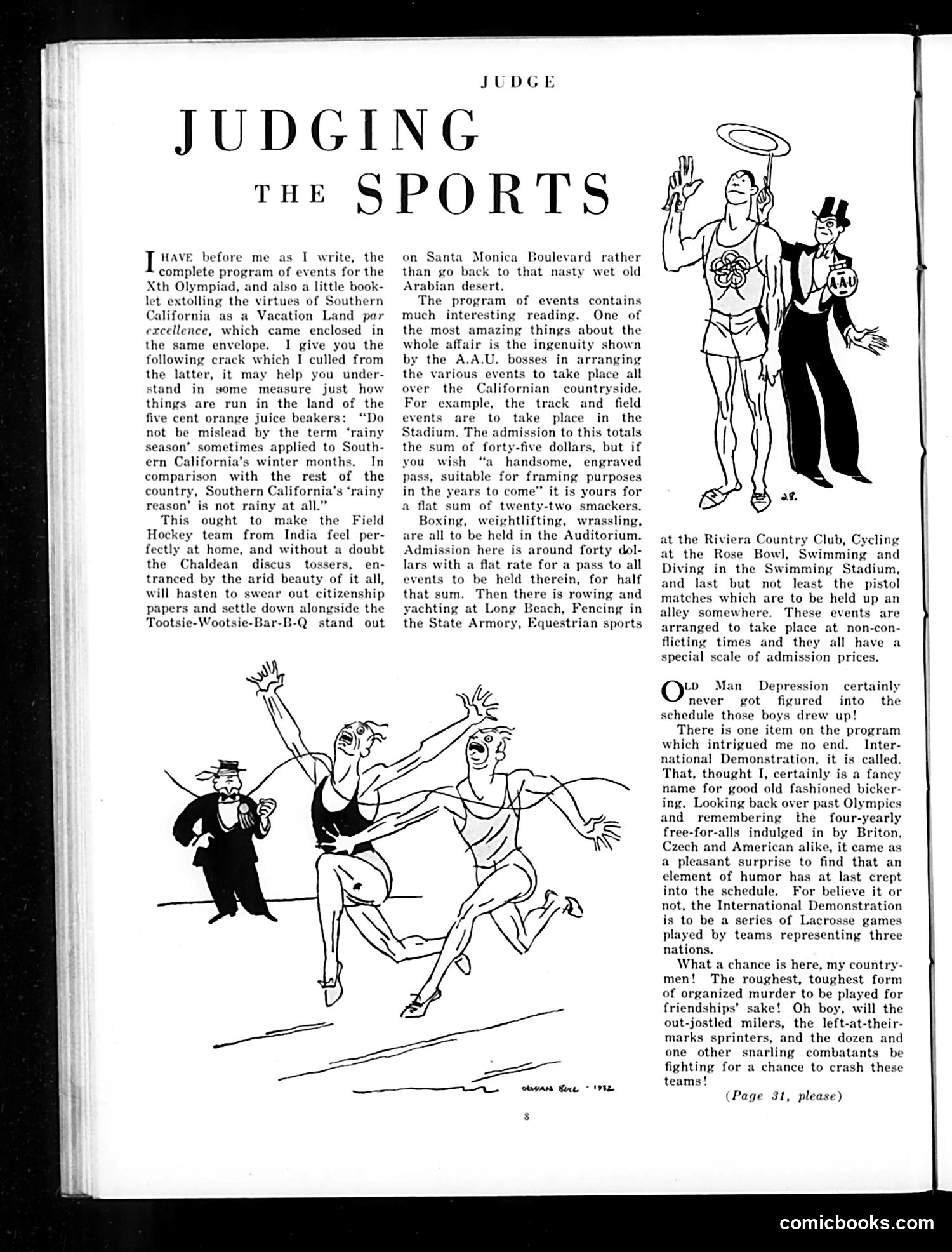
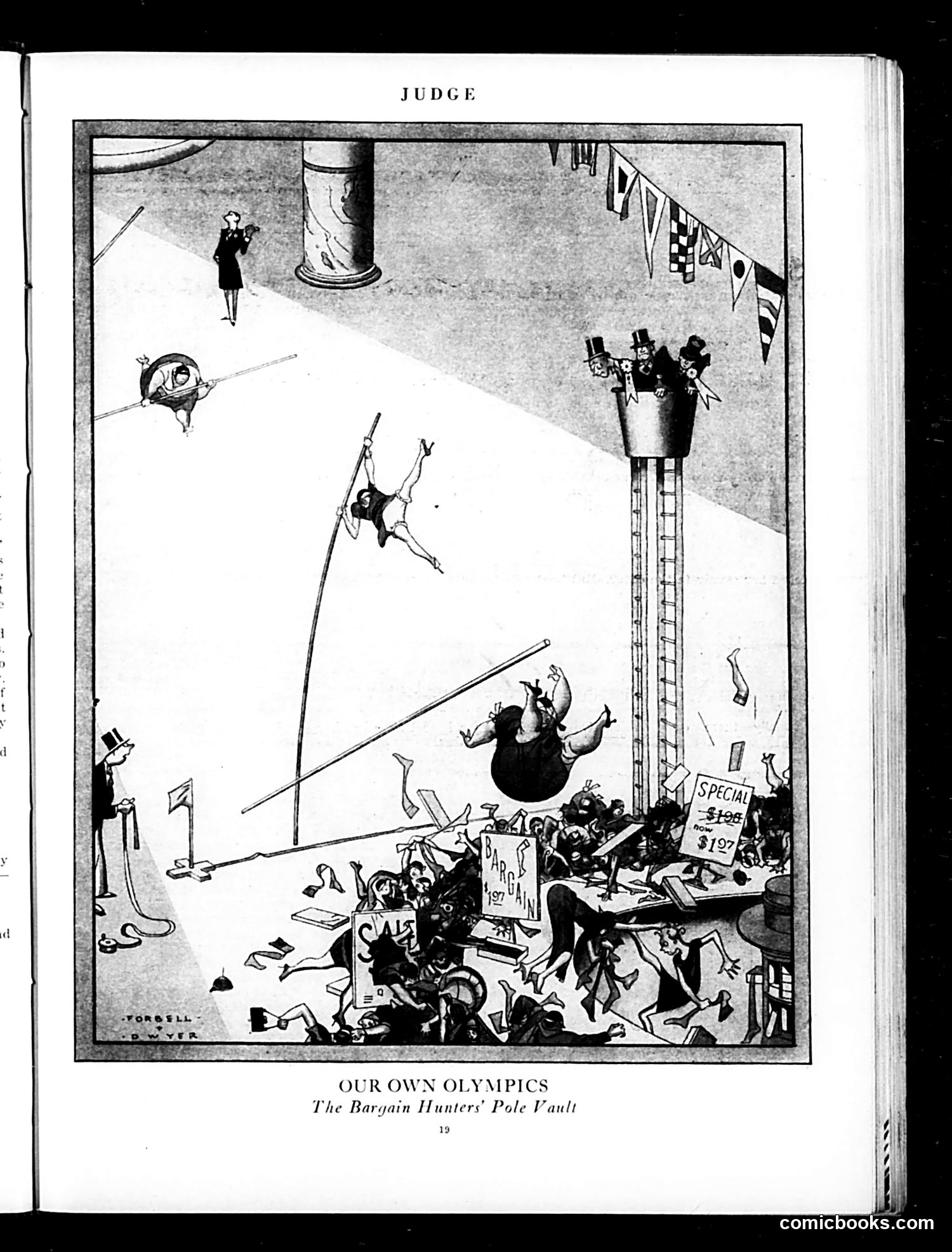
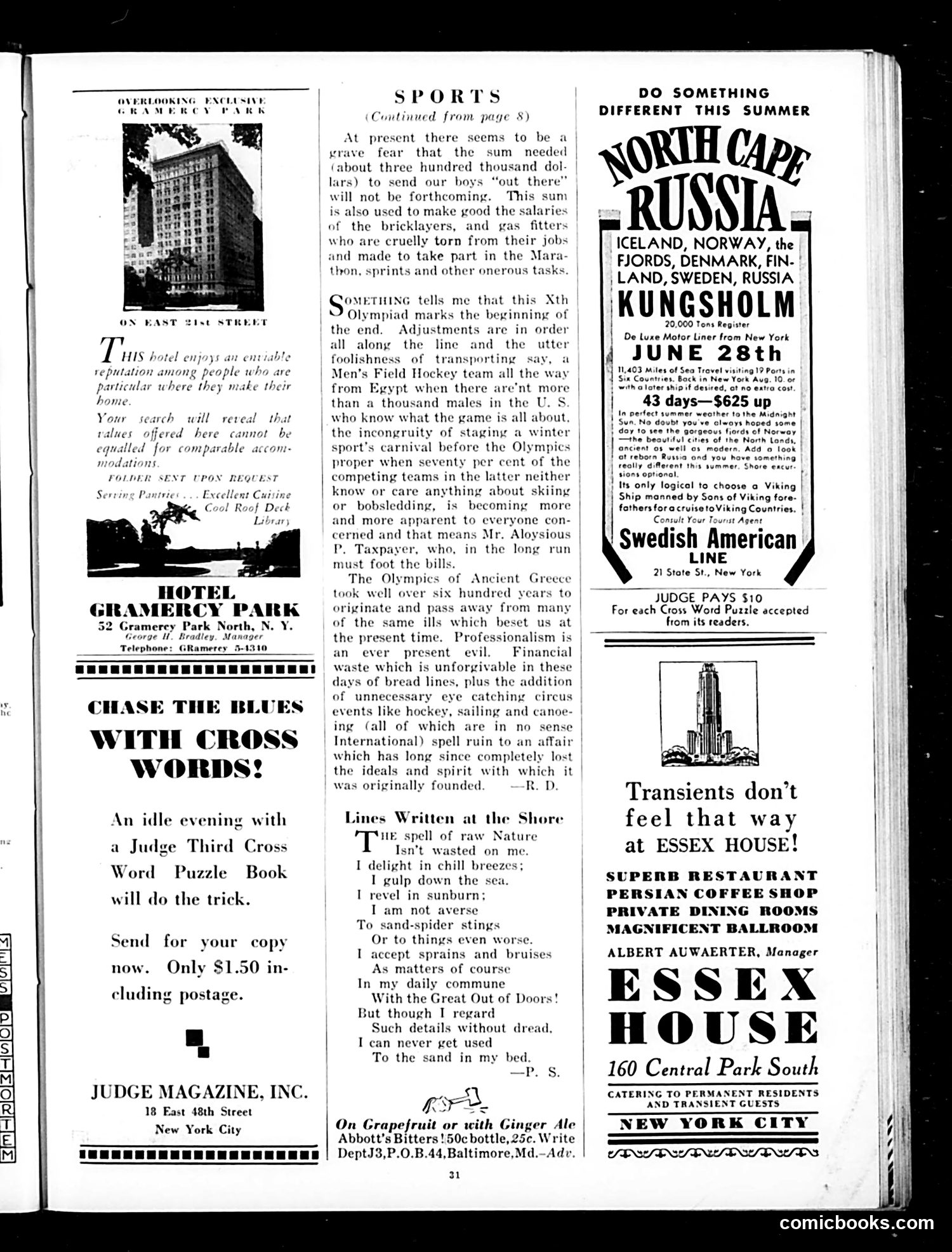
# "Judging the Sports" - Judge Magazine Article This is a satirical commentary on the Olympic Games being held in Southern California (appears to be the 1932 Los Angeles Olympics). The author mocks the grandiose promotion of California as a paradise while critiquing the Olympics' organization. The cartoons at top and bottom illustrate absurd Olympic scenarios—figures in exaggerated athletic poses, with one showing a formally-dressed man (likely an AAU official) amid jumping athletes. Key satirical points: - **The "rainy season" crack**: Mocking California's self-promotion as perpetually sunny, contrasting with actual weather - **Venue profiteering**: Events scattered across Southern California with inflated admission prices ($45 for track tickets; $22 for "engraved passes") - **The "International Demonstration"**: Sarcastically treating scheduled lacrosse games as organized mayhem, joking that competitive athletes will use this as an excuse for legitimate violence The tone suggests skepticism about Olympic commercialization and California's Chamber-of-Commerce marketing, while poking fun at international athletic rivalries as barely-contained hostility.
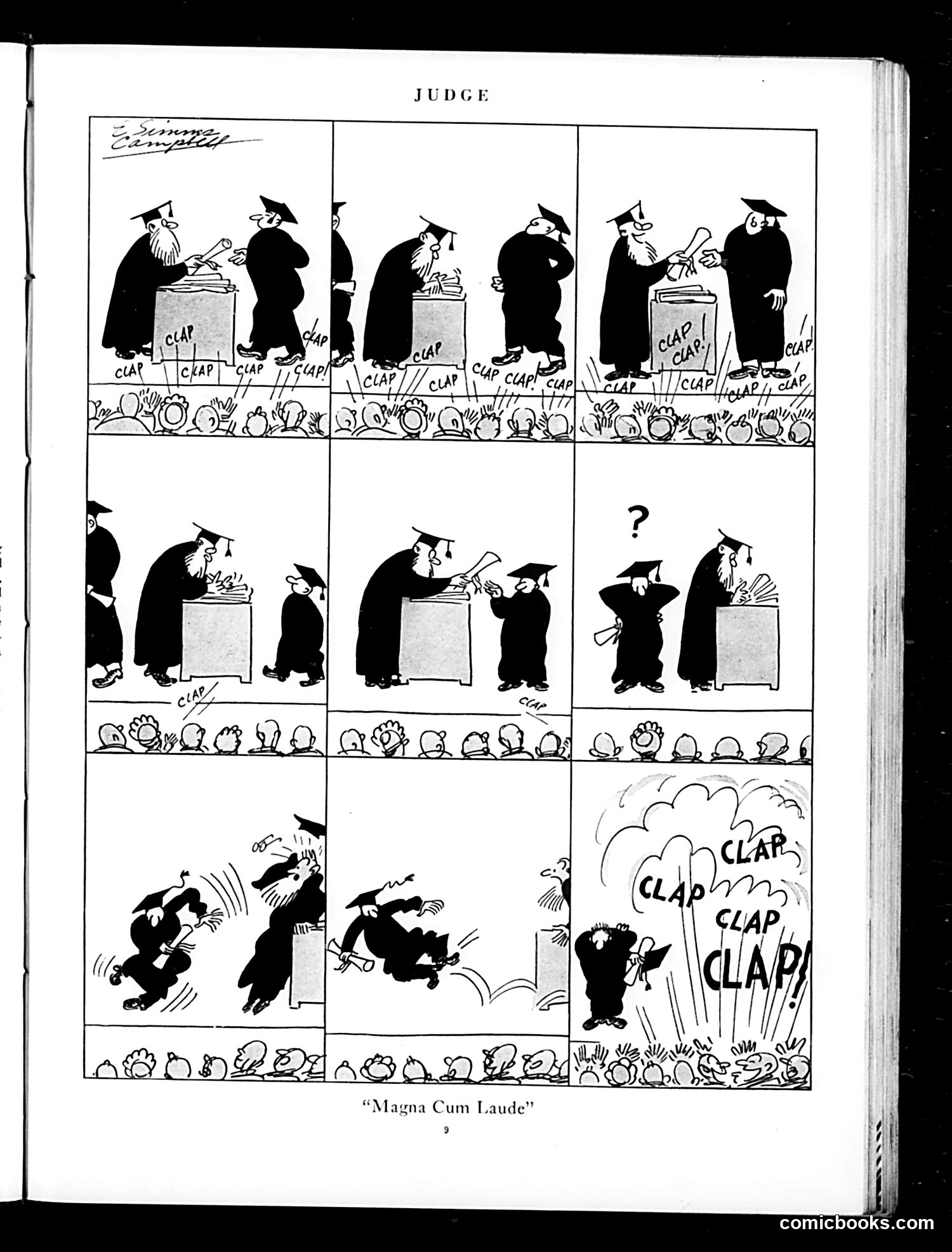
# "Magna Cum Laude" Political Cartoon This Judge cartoon satirizes judicial corruption or favoritism during verdict announcements. The top panels show judges accepting what appear to be bribes ("CLAP" sounds suggest applause or payoffs) from robed figures at voting/decision boxes, with audiences watching below. The middle section poses a question mark, suggesting "what happens next?" The bottom panels show the consequences: judges physically fighting or being thrown out, with escalating "CLAP" sounds becoming chaotic noise rather than approval. The Latin title "Magna Cum Laude" (highest academic honors) ironically mocks judges who conduct themselves with such dishonor. The cartoon criticizes how judicial decisions can be bought or influenced, depicting the inevitable chaos and loss of dignity when corruption is exposed. The specific historical context remains unclear without additional dating information.
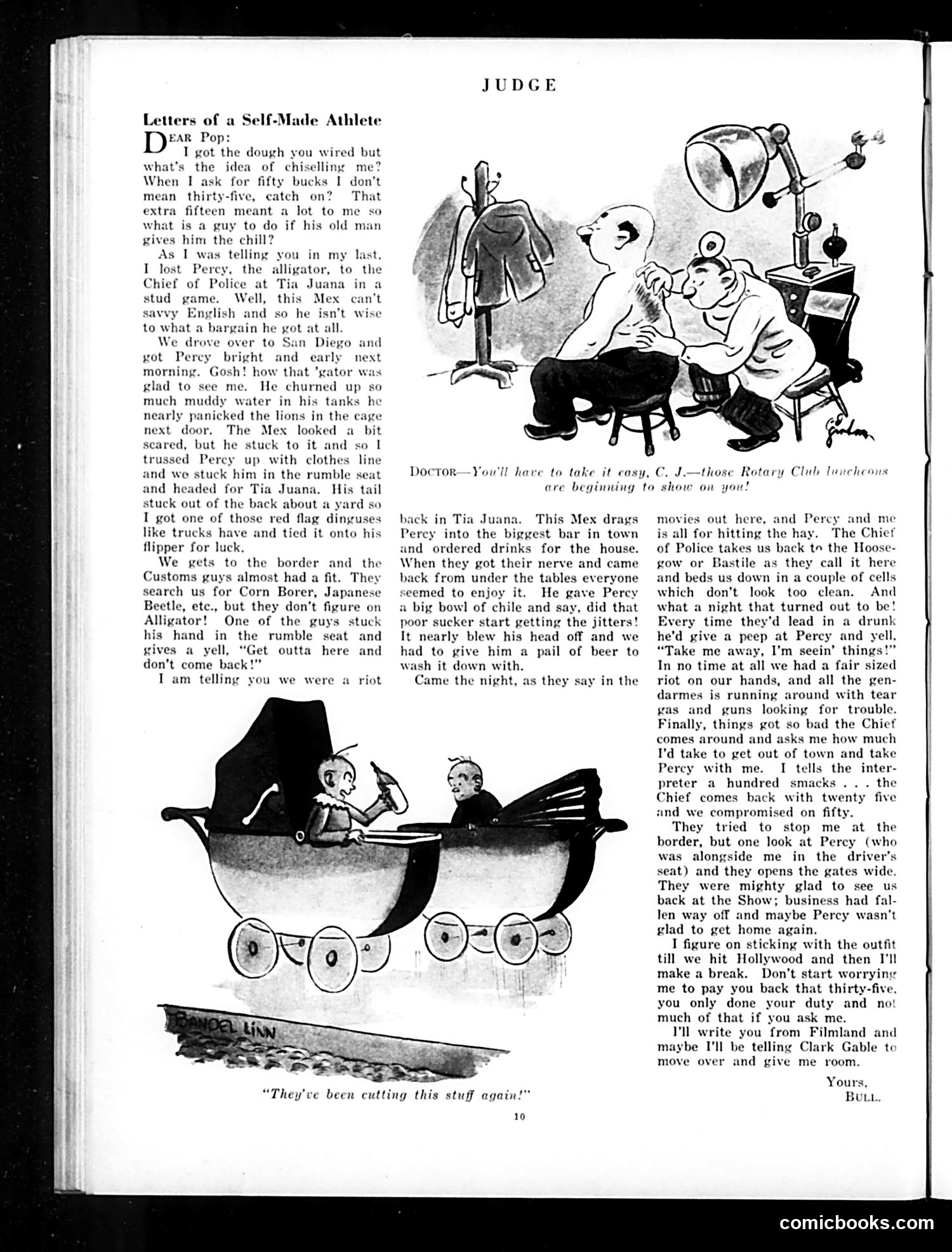
# "Letters of a Self-Made Athlete" - Judge Magazine This humorous letter-column entry satirizes brash, unscrupulous young men trying to make it in the entertainment world. The writer, "Bull," recounts absurd misadventures involving an alligator he lost gambling in Tijuana, then retrieves in comically chaotic fashion—smuggling it across the border, causing mayhem in a Mexican jail when the animal's spicy food causes digestive distress, and bribing officials. The satire targets several things: the writer's arrogance and entitlement (complaining his father didn't send enough money), his casual law-breaking, and his delusions of Hollywood stardom. The accompanying cartoons—showing a chaotic doctor's office and what appears to be a baby carriage mishap—reinforce the theme of reckless incompetence. The humor relies on the reader finding such irresponsible behavior and absurd situations ridiculous, mocking both petty crooks and aspiring showbiz figures of the era.