
Judge, 1932-06-04 · page 24 of 36
Judge — June 4, 1932 — page 24: what you’re looking at
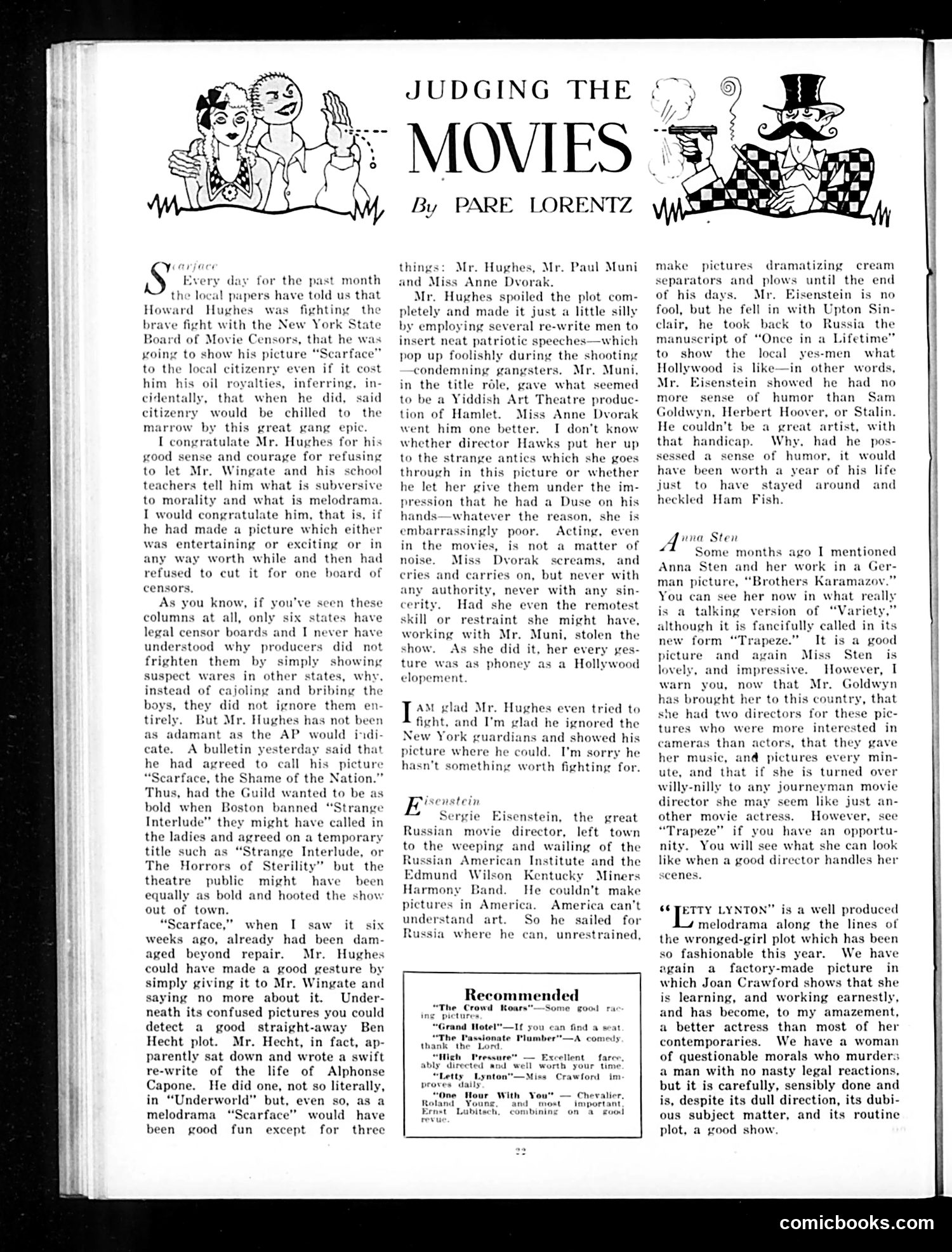
A restored page from Judge, 1932-06-04. Page through the whole issue in the reader above.
📄 Transcribed text from this page (OCR, searchable)
Machine-transcribed from the original scan — historical spelling and the odd misread are preserved.
ery day for the past month the local papers have told us that Howard Hughes was fighting the ve fight with the New York State dof Movie Censors, that h x to show his picture to the local citiz y even if it cost him his oil royalties, inferring, in- cidentally, that when he did, said citizenry would be chilled to the marrow by this great gang epic. I congratulate Mr. Hughes for his scood sense and courage for refusing to let Mr. Wingate and his school teachers tell him what is subversive to morality and what is melodrama. I would congratulate him, that is, if he had made a picture which either was entertaining or exciti or in any way worth while refused to cut it censors. As you know, if you've seen these columns at all, only six states have legal censor boards and I never have understood why producers did not frighten them by simply showing. suspect w in other states, why. instead of cajoling and bribing the they did not ignore them en But Mr. Hughes has not been s adamant the AP would indi- ate. A bulletin yesterday said that he had agreed to call his picture “Scarface, the Shame of the Nation.” Thus, had the Guild wanted to be as bold when Boston banned “Strange Interlude” they might have called in the ladies and agreed on a temporary title such as “Strange Interlude, or The Horrors of Sterility” but the theatre public might have been equally as bold and hooted the show out of town. Scarface,” for one board of when I saw it six weeks ago, already had been dam- aged beyond repair. Mr. Hughes could have made a good gesture by simply giving it to Mr. Wingate and saying) no more about it. Under- neath its confused pictures you could detect a good straight-away Ben Hecht plot. Mr. Hecht, in fact, ap- parently sat down and wrote a swift re-write of the life of Alphonse Capone. He did one, not so literally, in “Underworld” but, even so, as a melodrama “Scarface” would have been good fun except for three By PARE LORENTZ things: Mr. Hughes, Mr. Paul Muni and Miss Anne Dvorak. Mr. Hughes spoiled the plot com- pletely and made it just a little silly by employing sev re-write men to insert neat patriotic speeches—which pop up foolishly during the shooting condemning gangsters. Mr. Muni, in the title role, gave what seemed to be a Yiddish Art Theatre produc- tion of Hamlet. Miss Anne Dvorak went him one better. I don't know whether director Hawks put her up to the strange antics which she goes through in this picture or whethe he let her give them under the im- pression that he had a Duse on his hands—whatever the reason, she is embarrassingly poor. Acting, even in the movies, is not a matter of noise. Miss Dyorak screams, and cries and carries on, but never with any authority, never with any sin- cerity. Had she even the remotest skill or restraint she might have, working with Mr. Muni, stolen the show. As she did it, her every yes- s phoney as a Hollywood AM glad Mr. Hughes even tried to fight, and I'm glad he ignored the New York guardians and showed his picture where could. I’m sorry he hasn't something worth fighting for. isenstein E in 7 Sergie Eisenstein, the great Russian movie director, left town to the weeping and wailing of the Russian American Institute and the Edmund Wilson Kentucky Miners Harmony Band. He couldn't make pictures in America. America can't understand art. So he sailed for Russia where he can, unrestrained, Recommended “The Crowd Roars"—Some good ra “Grand Hotel"—If you ¢ nd a seat Pressure — Excellent farce ted and well worth your time “Letty Lynton” —Miss proves daily ne Hour With You" — Chevalier. " and. most important combining on a good Crawford im make pictures dramatizing cream separators and plows until the end of his day Mr. Eisenstein is no fool, but he fell in with Upton Sin- clair, he took back to Russia the manuscript of “Once in a Lifetime” to show the local yes-men what Hollywood is like—in other words, Mr. Eisenstein showed he had no more sense of humor than Sam Goldwyn, Herbert Hoover, or Stalin. He couldn't be a great artist, with that handicap. Why, had he pos- sessed a sense of humor, it would have been worth a year of his life just to have stayed around and heckled Ham Fish. Anna Sten Some months ago I mentioned Anna Sten and her work in a man picture, “Brothers Karamazov. You can see her now in what really is a talking version of “Variety,” although it is fancifully called in its new form *‘ It is a good picture and Miss Sten is lovely, and impressive. However, I warn you, now that Mr. Goldwyn has brought her to this country, that she had two directors for the: i tures who were more cameras than actors, y gave her music, and pictures every min- ute, and that if she is turned over willy-nilly to any journeyman movie director she may seem like just an- other movie actres However, see “Trapeze” you have an opportu- nity. You will see what she can look like when a good director handles her scenes. TTY LYNTON” is a well produced melodrama along the lines of the wronged-girl plot which has been so fashionable this ye: We have n a factory-made picture in which Joan Crawford shows that she is learning, and working earnest and has become, to my amazement, a better actress than most of her contemporaries. We have a woman of questionable morals who murders a man with no nasty legal reactions, but it is carefully, sensibly done and is, despite its dull direction, its dubi- ous subject matter, and its routine plot, a yood show. comicbooks.com