
Judge, 1932-06-04 · page 18 of 36
Judge — June 4, 1932 — page 18: what you’re looking at
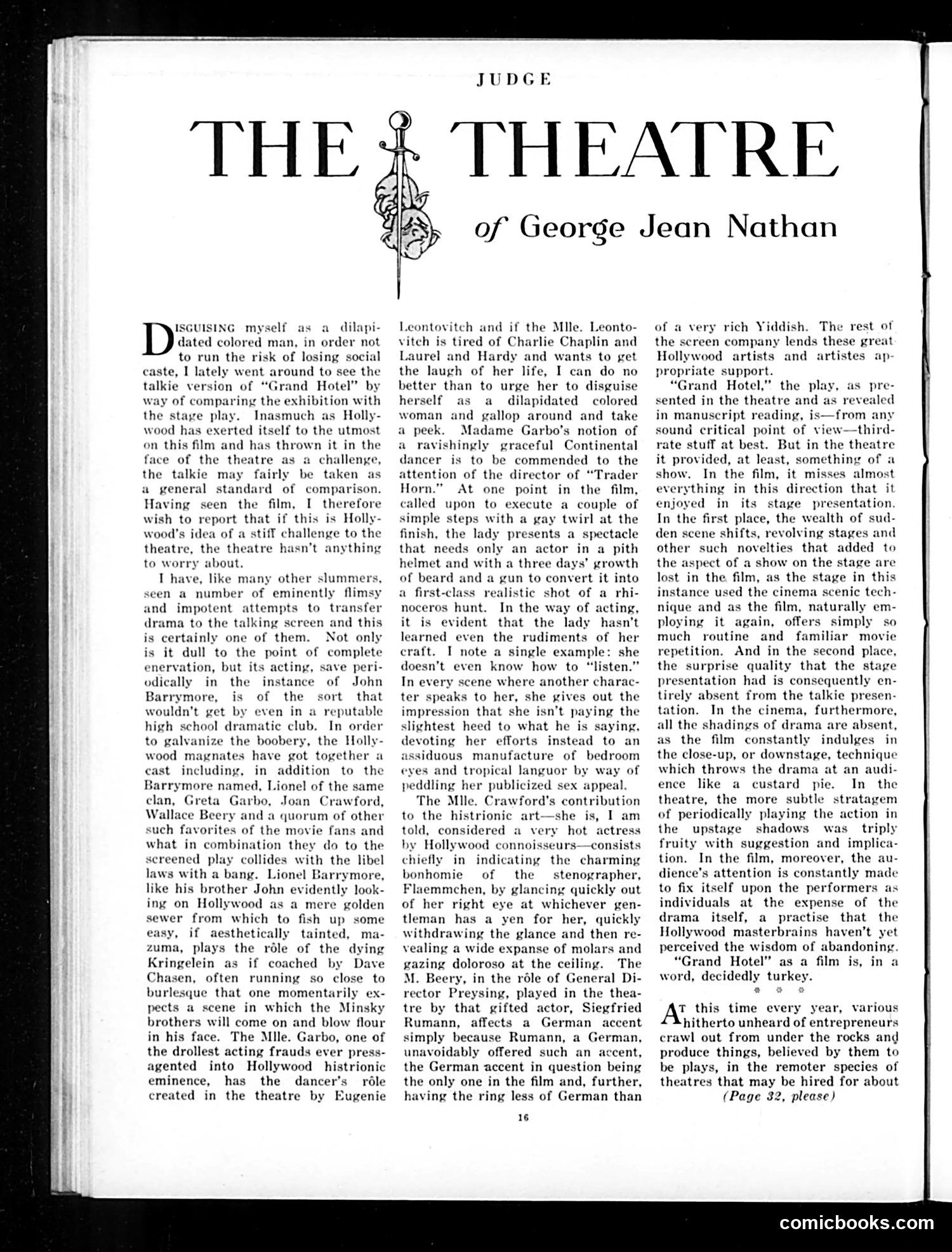
A restored page from Judge, 1932-06-04. Page through the whole issue in the reader above.
📄 Transcribed text from this page (OCR, searchable)
Machine-transcribed from the original scan — historical spelling and the odd misread are preserved.
SGUISING myself as a dilapi- dated colored man, in order not to run the risk of losing social aste, I lately went around to see the alkie version of “Grand Hotel” by of comparing the exhibition with the staye play. Inasmuch as Holly- wood has exerted itself to the utmost on this film and has thrown it in the face of the theatre as a challenge, the talkie may be taken as a general standard of comparison. Having seen the film, I therefore wish to report that if this is Holly- s idea of a stiff challenge to the the theatre hasn't anything to wor bout. I have, like many other slummers, number of eminently flimsy impotent attempts to transfer a to the talking screen and this tainly one of them. ot only is it dull to the point of complet enervation, but its acting, save peri- odically in the instance of John Barrymore, is of the sort that wouldn’t get by even in a reputable high school dramatic club. In order to galvanize the boobery, the Holly- wood magnates have got together a cast including, in addition to the Barrymore named, Lionel of the same clan, eta Garbo, Joan Crawford, Wallace Beery and a quorum of other such favorites of the movi: what in combination they do to the screened play collides with the libel laws with a bang. Lionel Barrymore, like his brother John evidently look- ing on Hollywood as a mere golden sewer from which to fish up some y, if aesthetically tainted, ma- zuma, plays the réle of the dying Kringelein as if coached by Chasen, often running so cl burlesque that one momentarily ex- pects a scene in which the Minsky brothers will come on and blow flour in his face. The Mlle. Garbo, one of the drollest acting frauds ever press- agented into Hollywood histrionic eminence, has the dancer's rdle created in the theatre by Eugenie theatri seen a and fans and JUDGE THEATRE of George Jean Nathan Leontovitch and if the Mile. Leonto- vitch is tired of Charlie Chaplin and Laurel and Hardy and wants to get the laugh of her life, I can do no better than to urge her to disguise herself s a dilapidated colored woman and gallop around and take ay Madame Garbo’s notion of hingly graceful Continental dancer is to be commended to the attention of the director of “Trader Horn.” At one point in the film, called upon to execute a couple of simple steps with a gay twirl at the finish, the lady ctacle that needs only a ’ growth gun to convert it into alistic shot of a rhi- In the way of acting, is evident that the lady hasn't rned even the rudiments of her craft. I note a single example: doesn’t even know how to ‘ In every scene where another ¢ 3 ter speaks to her, she gives out the impression that she ng the slightest heed to w ying, devoting her efforts instead to an siduous manufacture of bedroom ey and tropical languor by way of peddling her publicized sex appeal. The Mile. Crawford's contribution to the histrionic art—she is, I am told, considered a very hot actr by Hollywood connoisseurs—consists chiefly in indicating the charming bonhomie of the stenographer, Flaemmchen, by glancing quickly out of her right eye at whichever gen- yen for her, quickly ng the glance and then re- hunt. gazing doloroso at the ceiling. The . Beery, in the réle of General Di- rector Preysing, played in the thea- tre by that gifted actor, Siegfried Rumann, affects a German accent simply because Rumann, a German, unavoidably offered such an accent, the German accent in question being the only one in the film and, further, having the ring less of German than 16 of a very rich Yiddish. The rest of the screen company lends these gr Hollywood artists and artistes propriate support. “Grand Hotel,” the ple sented in the theatre « in manus . sound critical point of view—third- rate stuff at best. But in the theatre it provided, at least, something of a show. In the film, it misses almost everything in this direction that it enjoyed in its stage presentation. In the first place, the wealth of sud- den scene shifts, revolving yes and other such novelties that added to the aspect of a show on the stage are lost in the film, as the stage in this instance used the cinema scenic tech- nique and as the film, naturally em- ploying it again, offers simply so much routine and familiar movie repetition. And in the second place, the surprise quality that the stage ntation had is consequently en- bsent from the talkie presen- In the cinema, furthermore, all the shadings of drama are absent, as the film constantly indulges in the close-up, or downstage, technique which throws the drama at an audi- ence like a custard pie. In the theatre, the more subtle stratagem of periodically playing the action in the upstage shadows was triply fruity with suggestion and implicz tion. In the film, moreover, the au- ttention is constantly made elf upon the performers as iduals at the expense of the drama itself, a practise that the Hollywood masterbrains haven't yet perceived the wisdom of abandoning. and Hotel” as a film is, in a word, decidedly turkey. T this time every year, various hitherto unheard of entrepreneurs crawl out from under the rocks and produce things, believed by them to be plays, in the remoter species of theatres that may be hired for about (Page 32, please) as pre- revealed comicbooks.com