A complete issue · 36 pages · 1932
Judge — February 27, 1932
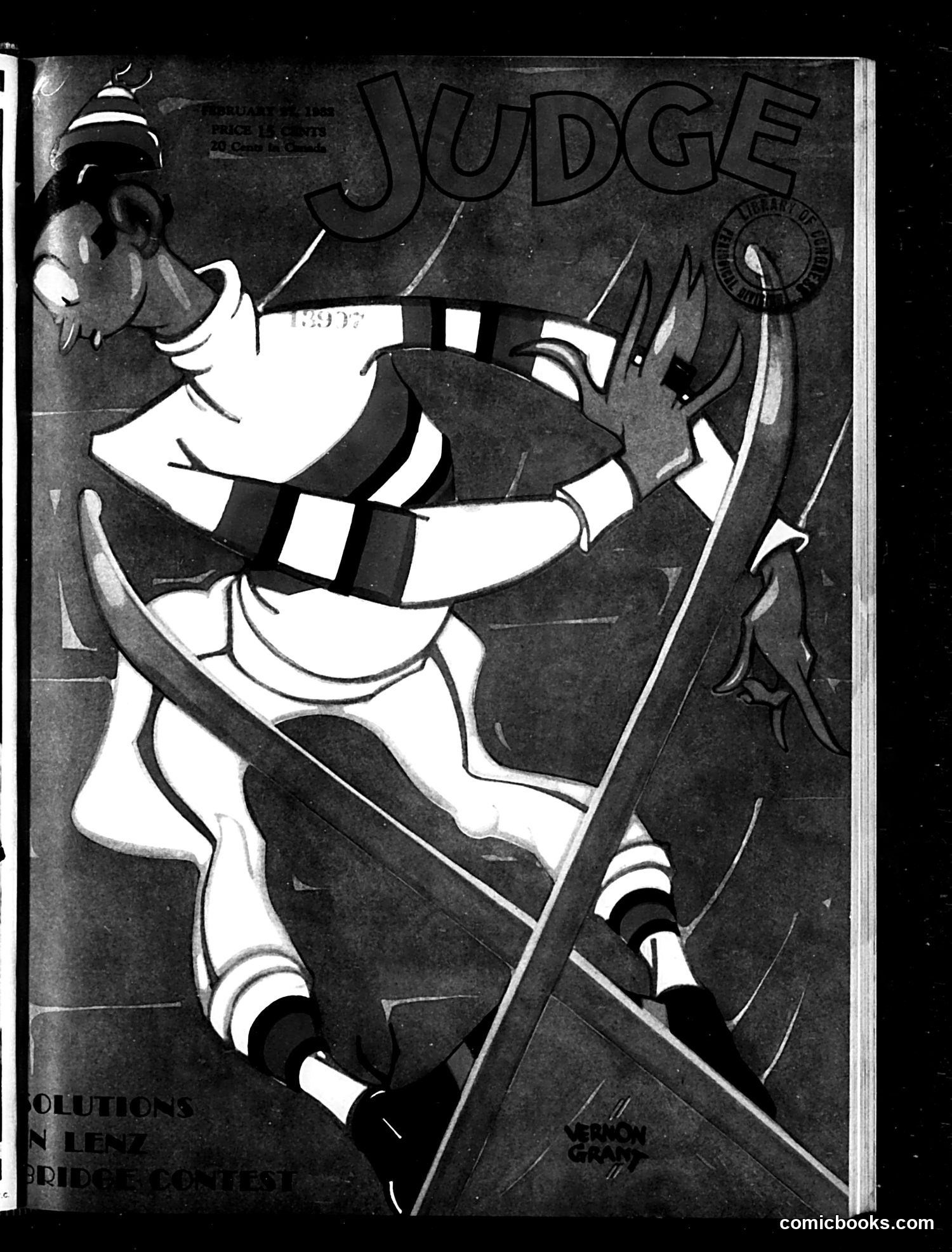
# Judge Magazine Page Analysis This appears to be a cover or feature page from *Judge* magazine depicting an anthropomorphic dog character dressed as a judge or judicial official, complete with robes and what appears to be judicial regalia. The figure holds a gavel and sits in an authoritative pose. The visible text fragments reference "solutions," "lenz," and "bridge contest," though full context is unclear from the partial OCR. The styling and composition suggest this is satirical commentary on judicial matters, possibly mocking legal proceedings or a specific court decision of the era. Without complete text or clearer date information, the specific political or social target remains uncertain, though the anthropomorphic characterization suggests commentary on authority figures or the legal establishment.
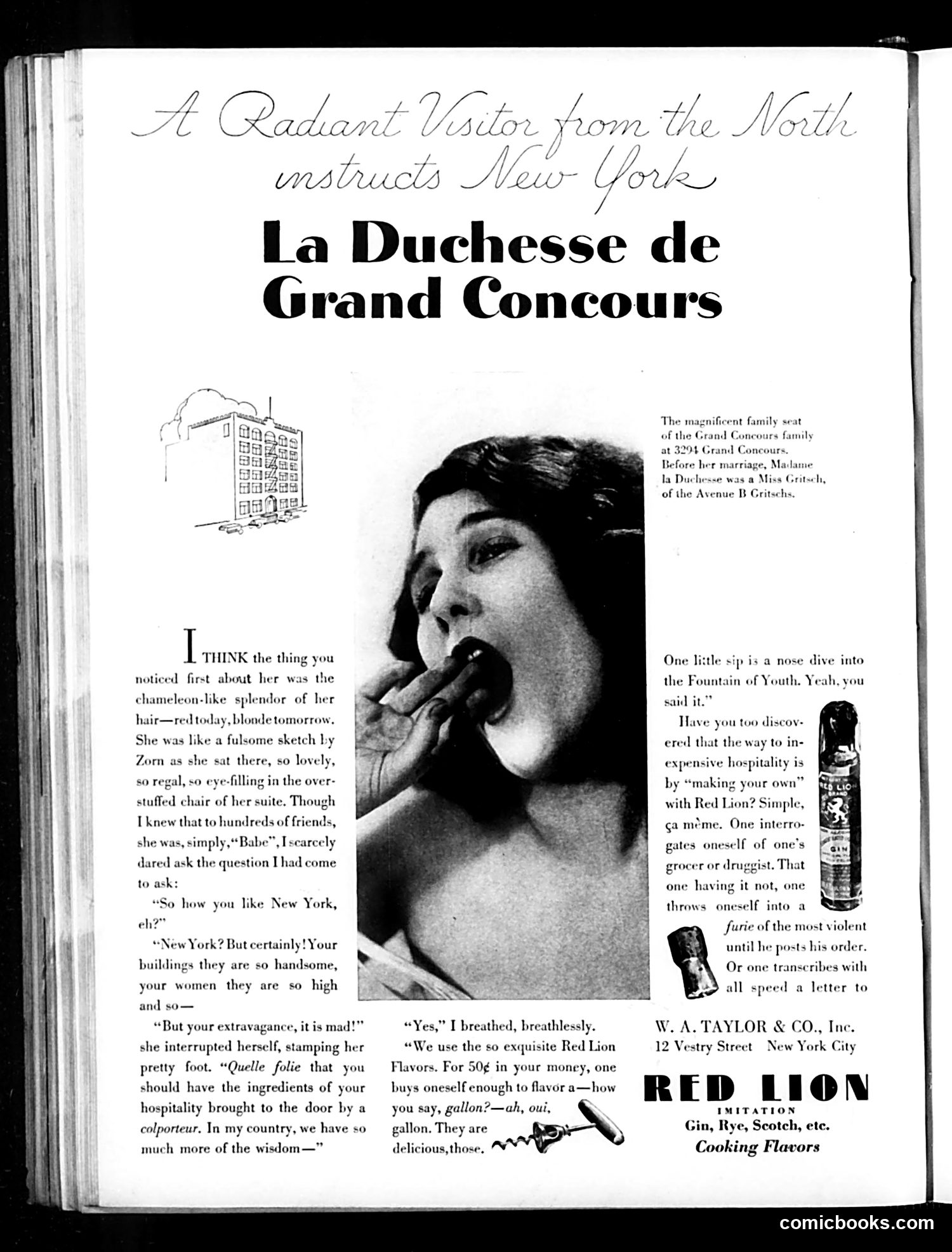
# Analysis This page is primarily **advertising disguised as editorial content**—a common Judge magazine format. The headline "La Duchesse de Grand Concours" introduces a wealthy French noblewoman visiting New York, photographed sipping from what appears to be a beverage. The satirical angle mocks upper-class European affectation and American social climbing. The Duchess criticizes New York's "extravagance" while embracing "hospitality," which the text reveals means consuming Red Lion flavoring extract—a cheap, mass-market product. The irony is that she discovers inexpensive American solutions superior to European sophistication. The small building illustration depicts the Grand Concours family residence at 3294 Grand Concourse in the Bronx. Ultimately, this is **product placement** leveraging xenophobic humor about French pretension to sell cooking flavors to American homemakers.
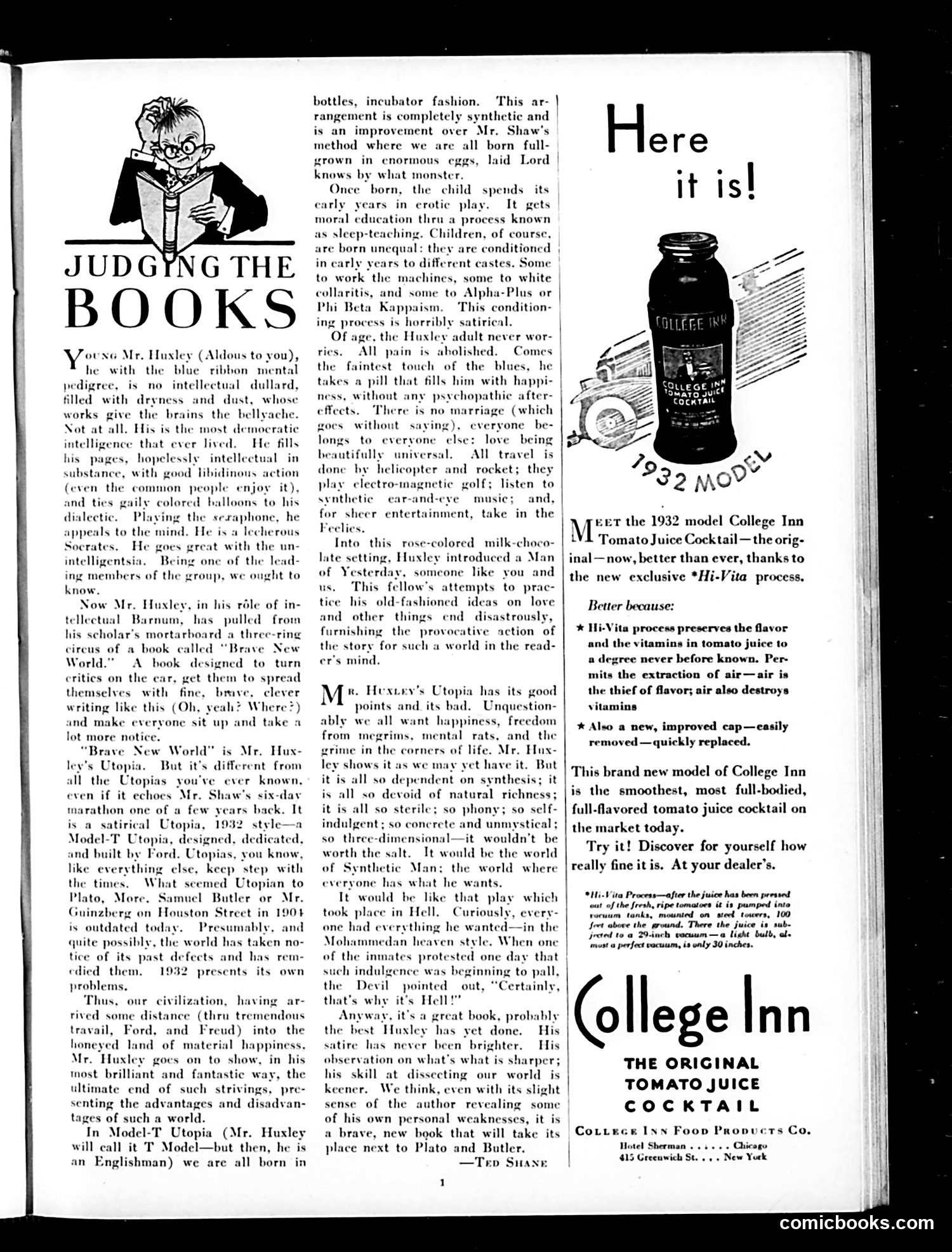
# Analysis of Judge Magazine Page This page combines book criticism with advertising. The left column, "Judging the Books," reviews Aldous Huxley's *Brave New World* and a 1932 Model-T Utopia. The critic (Ted Shane) mocks these dystopian works, praising Huxley's satire as superior because it exposes society's flaws without pretending to offer solutions. The cartoon shows a small figure labeled as representing Huxley-style critique—diminutive, intellectual, examining society through literature rather than action. The right side advertises College Inn Tomato Juice Cocktail using the "Hi-Vita process," claiming it preserves flavor and vitamins better than competitors. This juxtaposes satirical social commentary with commercial product marketing—typical of Judge's mixed editorial/advertising format from this era.

# Analysis This page is **primarily a General Electric advertisement**, not political satire. It promotes Mazda lamps by General Electric, manufactured in Nela Park, Cleveland, Ohio. The ad uses a relaxation theme: a woman reclines comfortably reading beneath a glowing Mazda lamp. The copy emphasizes that GE's research investments (a million dollars annually) have perfected these lamps for home use, improving visibility while reducing costs for consumers. The visual and textual message is straightforward product marketing: reliable lighting enables comfortable leisure activities. There is no political or social satire present—this is commercial advertising typical of Judge magazine's revenue model, where paid advertisements appeared alongside satirical content.
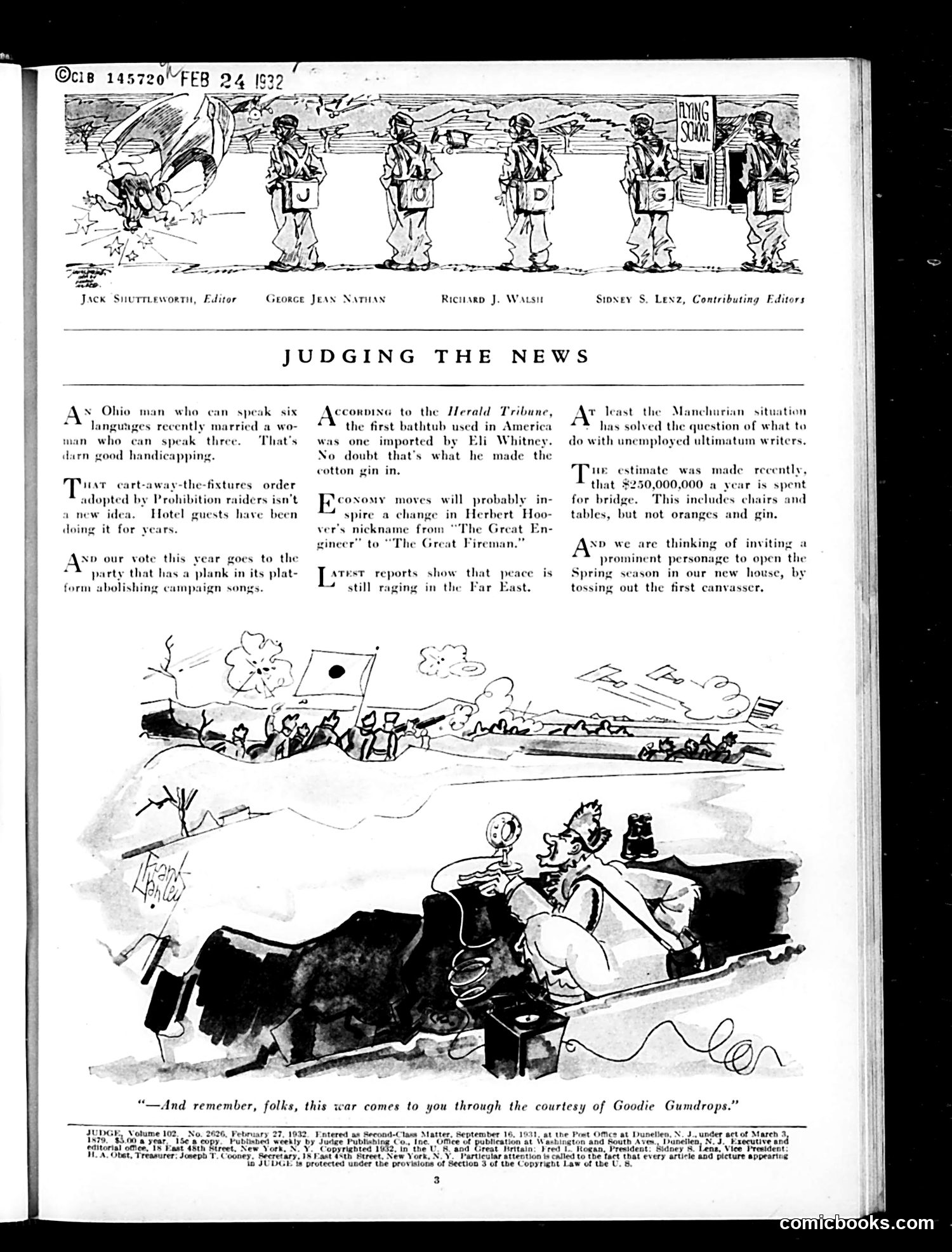
# "Judging the News" — February 24, 1932 This page features editorial commentary and cartoons satirizing current events. The bottom cartoon, captioned "And remember, folks, this war comes to you through the courtesy of Goodie Gumdrops," appears to mock media coverage of the ongoing conflict in the Far East (likely the Japanese invasion of Manchuria, 1931-32). The image shows what appears to be a radio broadcaster or commentator presenting warfare as entertainment, suggesting the satire criticizes how American media sensationalizes distant military conflicts for commercial purposes. The "Goodie Gumdrops" reference likely parodies actual sponsor names of radio programs, implying corporate interests profit from war coverage. The top cartoon shows five figures labeled with letters (likely representing newspaper editors or commentators), reinforcing the issue's focus on media criticism and editorial judgment.
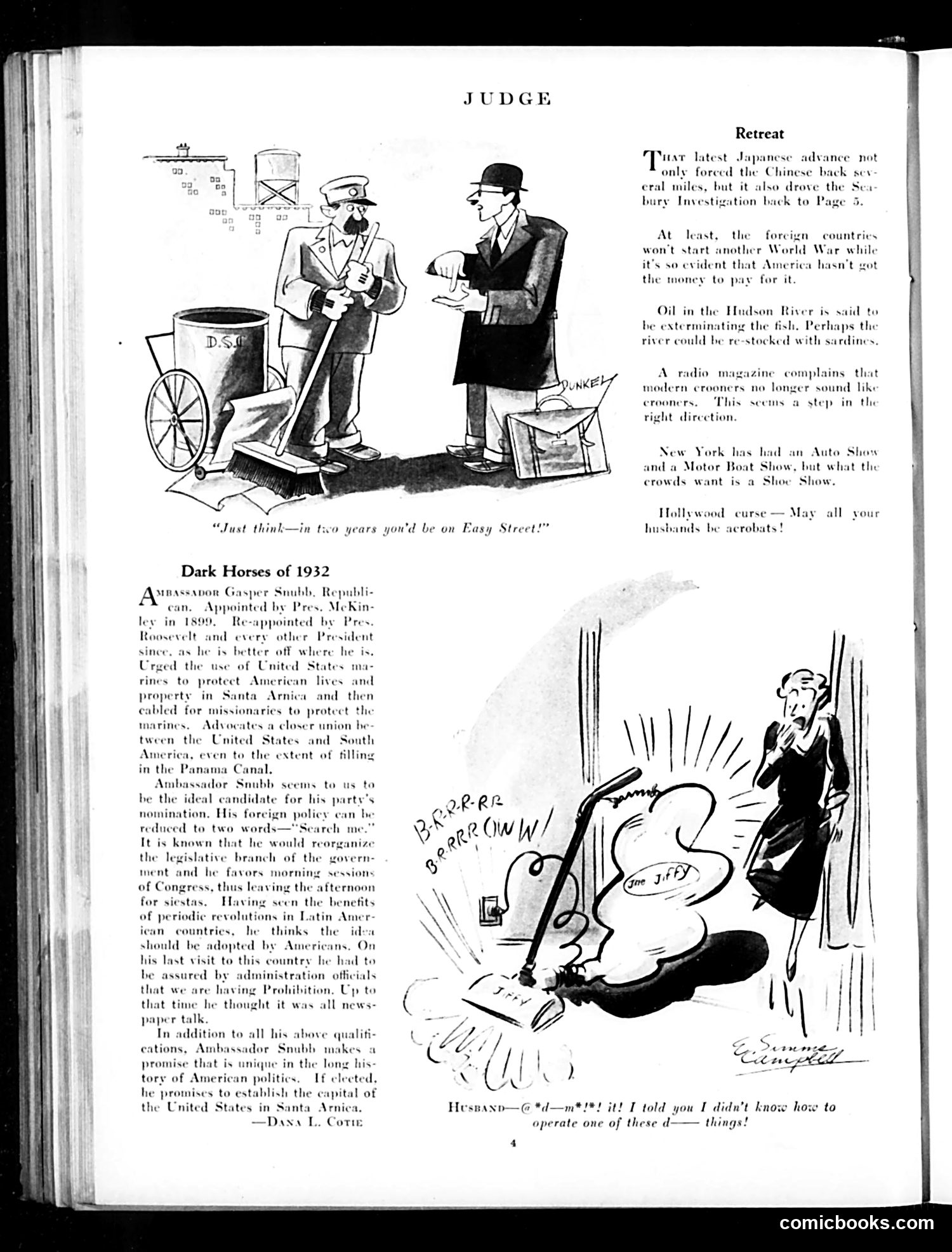
# Analysis of Judge Magazine Page The top cartoon depicts two figures discussing future poverty, with one standing on a large barrel labeled "D.S.D." (likely a financial or economic reference). The joke plays on economic anxiety during the Depression era—the character predicts homelessness "in two years" on "Easy Street." The lower cartoon shows a husband operating what appears to be a mechanical device or appliance, with his wife instructing him. The humor relies on gender stereotypes: the husband is incompetent with household technology, a common trope in period comedy. The "Dark Horses of 1932" article discusses Ambassador Gasper Snabb, a political figure. The satirical commentary questions his qualifications and foreign policy positions, suggesting skepticism about his nomination prospects. Overall, the page reflects Depression-era economic anxiety and traditional gender roles.
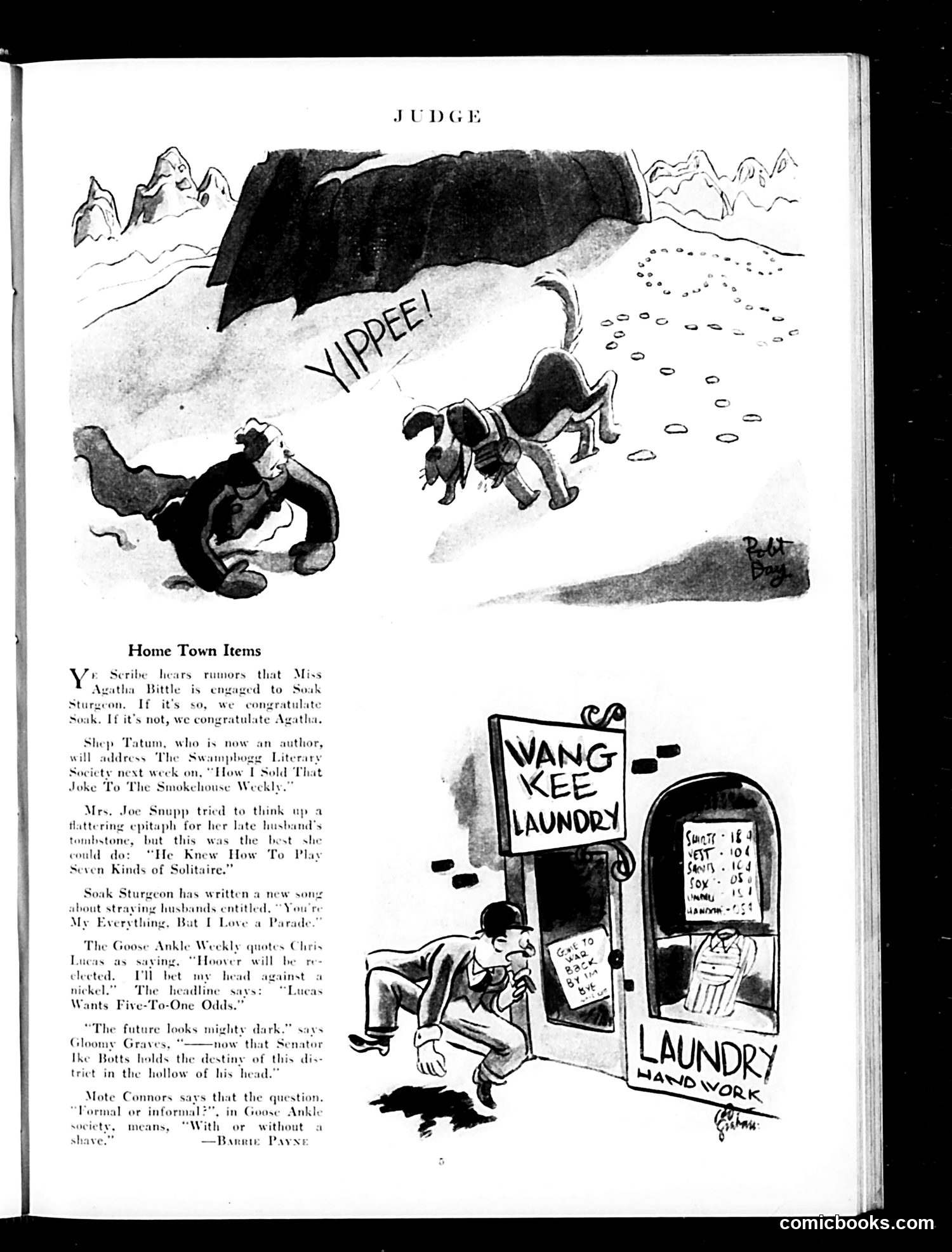
# Analysis of Judge Magazine Page **Top Cartoon ("Judge"):** Shows a figure in winter gear being chased by a large dark shape labeled "YIPPEE!" across snowy terrain. The meaning is unclear without additional context—it may reference a contemporary political figure or scandal, but the specific reference cannot be determined from the image alone. **Bottom Cartoon ("Wang-Kee Laundry"):** Depicts a man struggling with a laundry service counter. This appears to be ethnic satire, common in early 20th-century American humor, mocking Chinese laundry businesses through stereotypical naming and depiction. The humor relies on exaggerated characterization typical of the era's problematic comedic conventions. **"Home Town Items":** Brief gossip-column text about local figures and social observations, standard Judge magazine filler content.
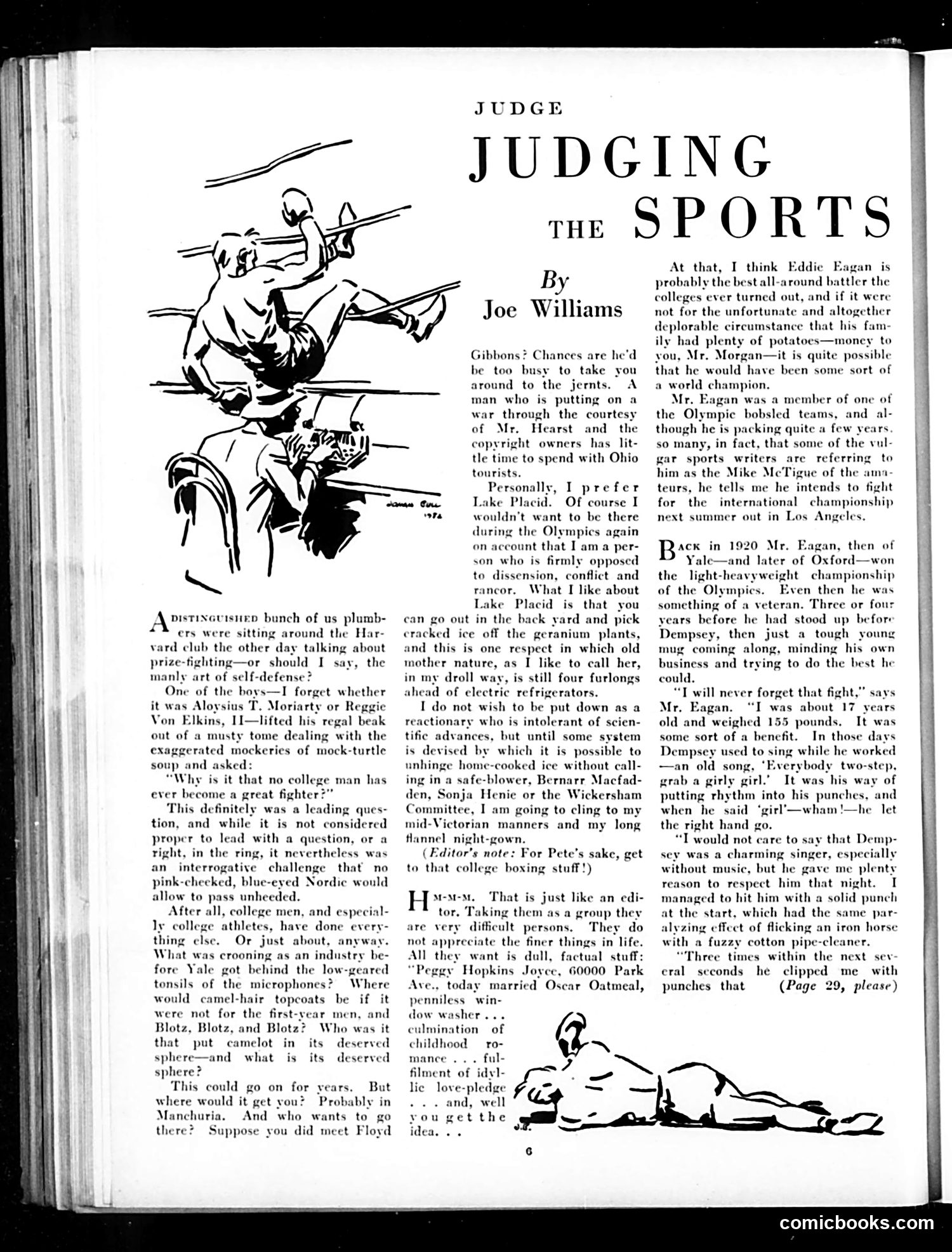
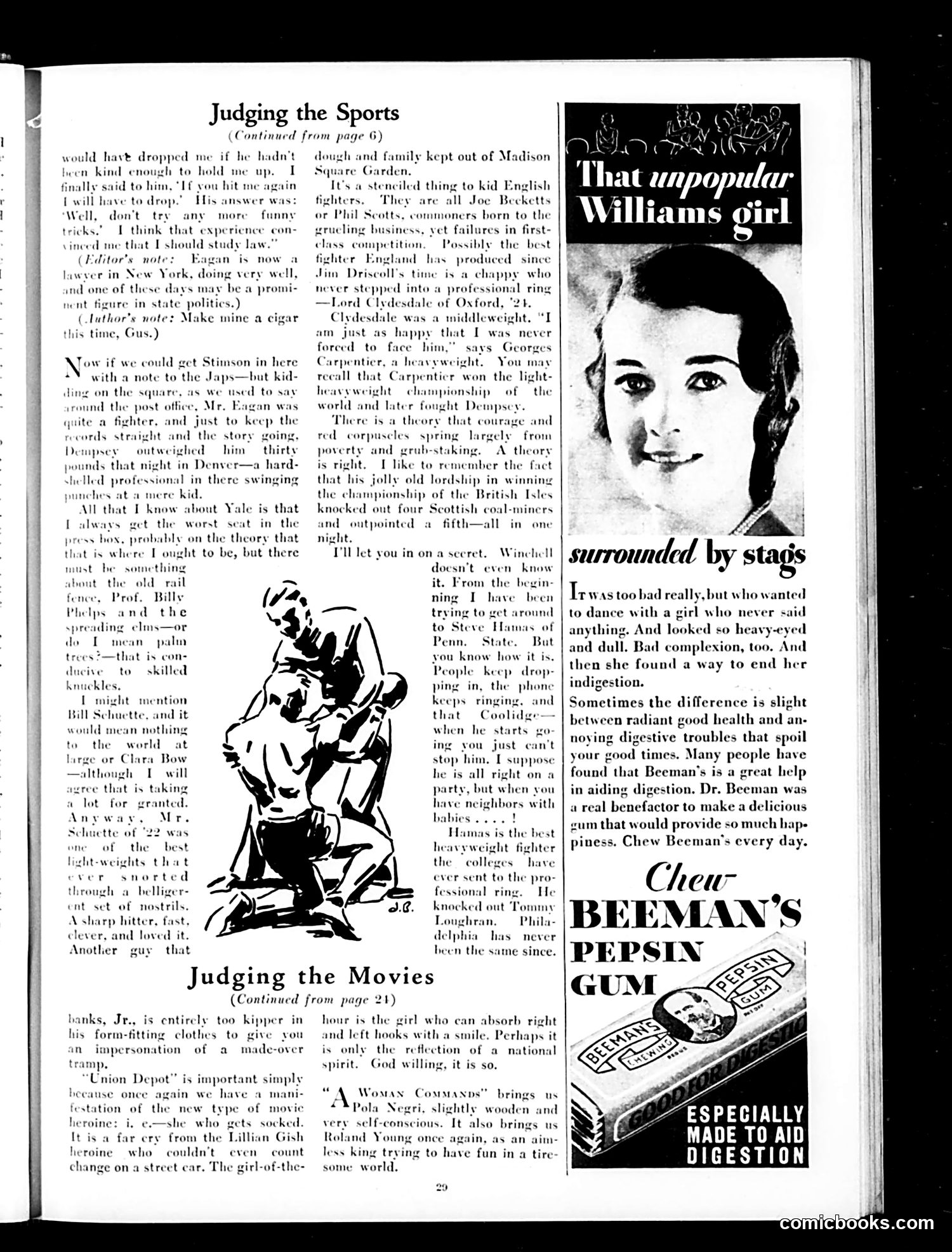
# "Judging the Sports" by Joe Williams This page combines editorial commentary on boxing and college athletics with satirical illustrations. The main article discusses Eddie Eagan, a boxer and Olympic athlete, and references his potential fight for an international championship. The text critiques college sports culture, mocking the notion that college athletes become "great fighters" and satirizing the "dull, factual stuff" college administrators want from athletes versus their actual talents. Williams names figures like Hopkins Joyce and Oscar Oatmeal (likely pseudonyms or misspellings), discussing boxing's role in youth development. The cartoons show boxing scenes—a fighter mid-punch and another knocked down—illustrating the physical nature of the sport being discussed. The piece appears skeptical of boxing's value while defending individual athletes like Eagan.
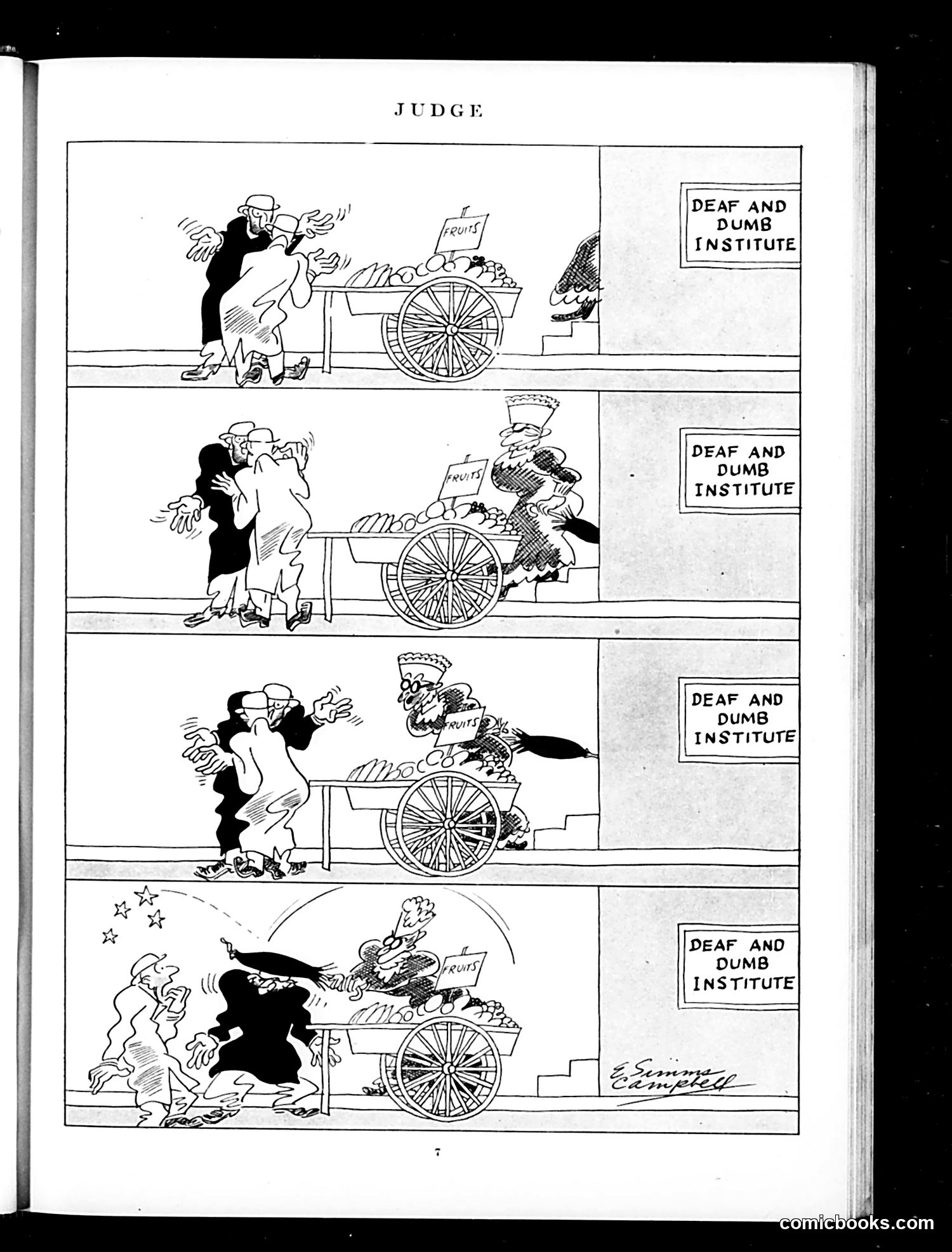
# Judge Magazine: "Judge" Cartoon Analysis This four-panel satirical cartoon depicts a judge being repeatedly knocked down by someone pushing a fruit cart labeled "DEAF AND DUMB INSTITUTE." The satire appears to target judicial corruption or incompetence—specifically, a judge who is being literally and figuratively overwhelmed by an institution (likely representing a charitable organization or government entity). Each panel escalates the violence, with the final panel showing the judge flying through the air with stars. The joke suggests the judge is either powerless against institutional interests or is being appropriately punished for favoring such an institution. The "deaf and dumb" label may imply the judge is blind to wrongdoing or acting foolishly in his rulings. Without identifying the specific judge or incident, this represents Judge magazine's typical critique of judicial or institutional abuse during the satirical era.
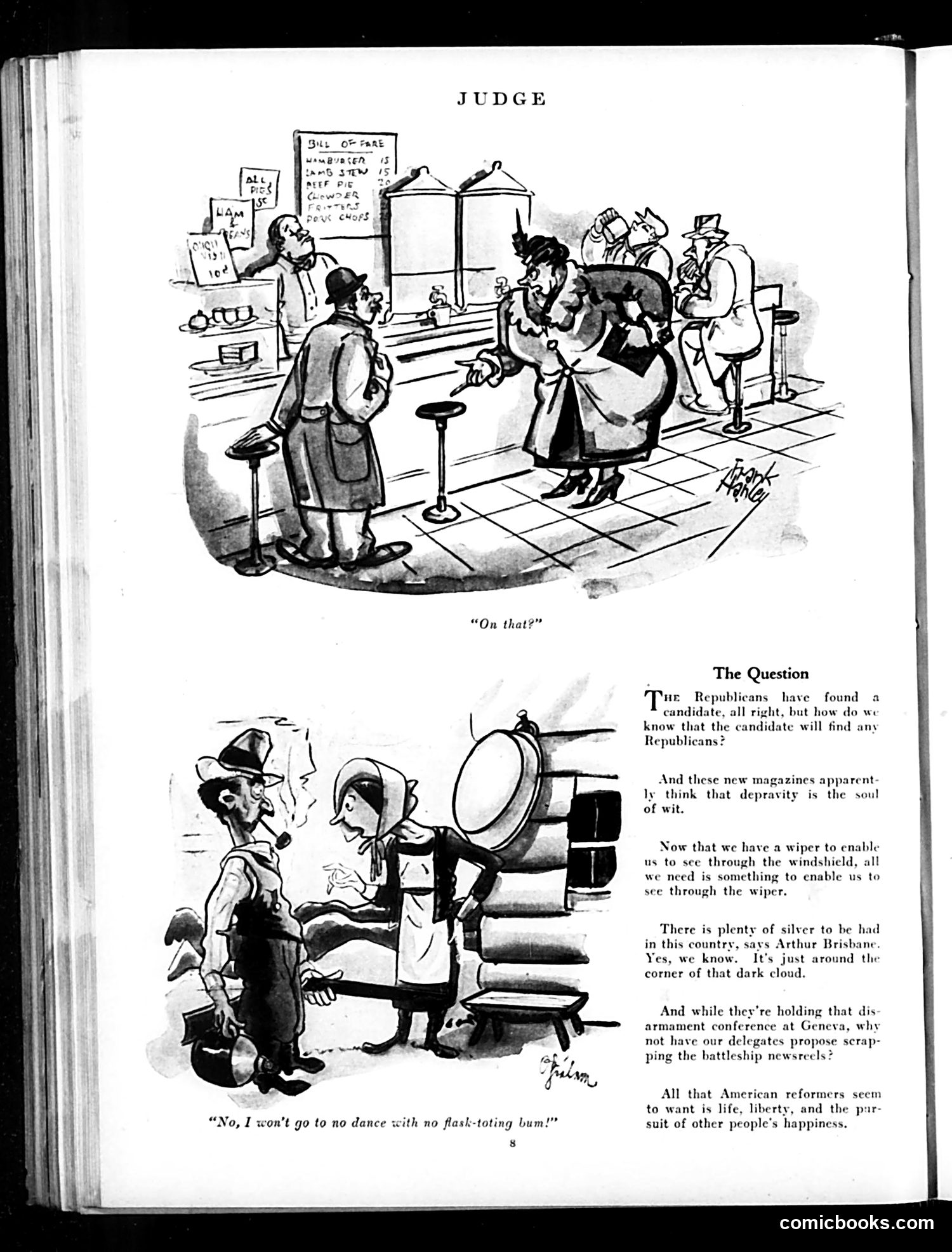
# Judge Magazine Page Analysis This page contains two editorial cartoons satirizing American political and social issues of the interwar period. The **top cartoon** ("On that?") depicts a courtroom scene where a judge appears skeptical or dismissive, likely mocking Republican Party leadership struggles—the accompanying text questions whether Republicans can find candidates who will actually support the party. The **bottom cartoon** ("No, I won't go to no dance with no flask-toting bum!") shows a couple discussing Prohibition-era drinking culture. The woman refuses to date a man who carries alcohol flasks, satirizing the contradictions of Prohibition enforcement and social hypocrisy. The **accompanying text** offers brief satirical commentary on contemporary issues: magazine depravity, automobile windshield wipers, economic hardship (silver shortage), disarmament conferences, battleship newsreels, and American reformers' focus on controlling others' behavior rather than solving systemic problems. The overall tone critiques both political incompetence and social pretension during the 1920s-early 1930s.
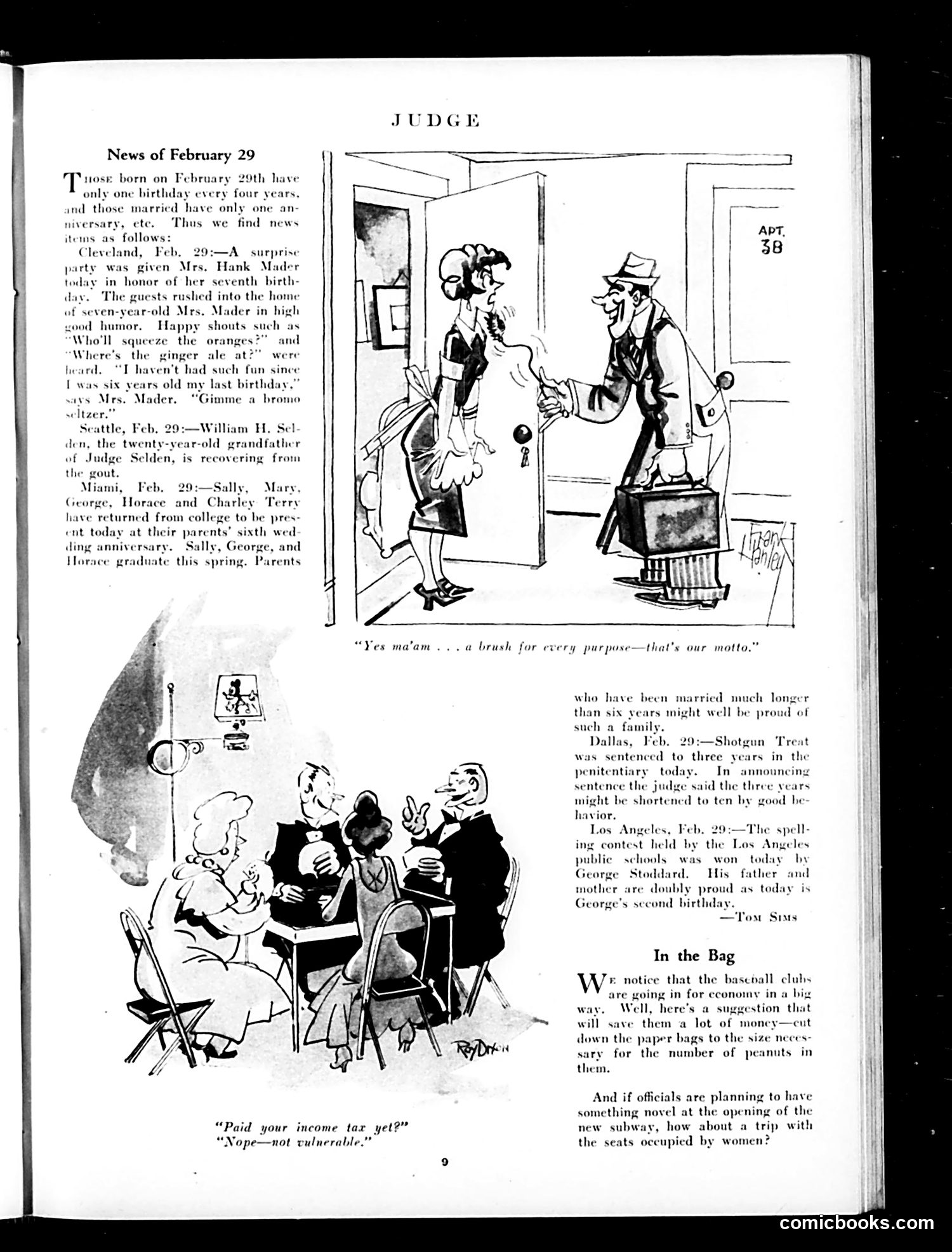
# Explanation for Modern Readers This page contains satirical news items and cartoons from Judge magazine, dated around February 29 (a leap-year date). **Top cartoon**: A salesman pitches brushes to a woman, claiming "a brush for every purpose." The satire mocks over-specialization and marketing excess—the absurd idea that consumers need dozens of specialized products. **Bottom cartoon**: Two men discuss income taxes. One says "Paid your income tax yet?" and the other responds "Nope—not vulnerable." This jokes about tax avoidance, likely referencing Depression-era anxieties about financial vulnerability and taxes. The "News of February 29" section humorously exploits leap-year births: people born on Feb. 29 only have birthdays every four years. Judge jokes about absurd consequences—a seven-year-old married woman, a 20-year-old grandfather—to satirize the peculiar arithmetic of leap-year births. The "In the Bag" section mocks baseball clubs' penny-pinching during economically difficult times, suggesting they reduce peanut bag sizes.
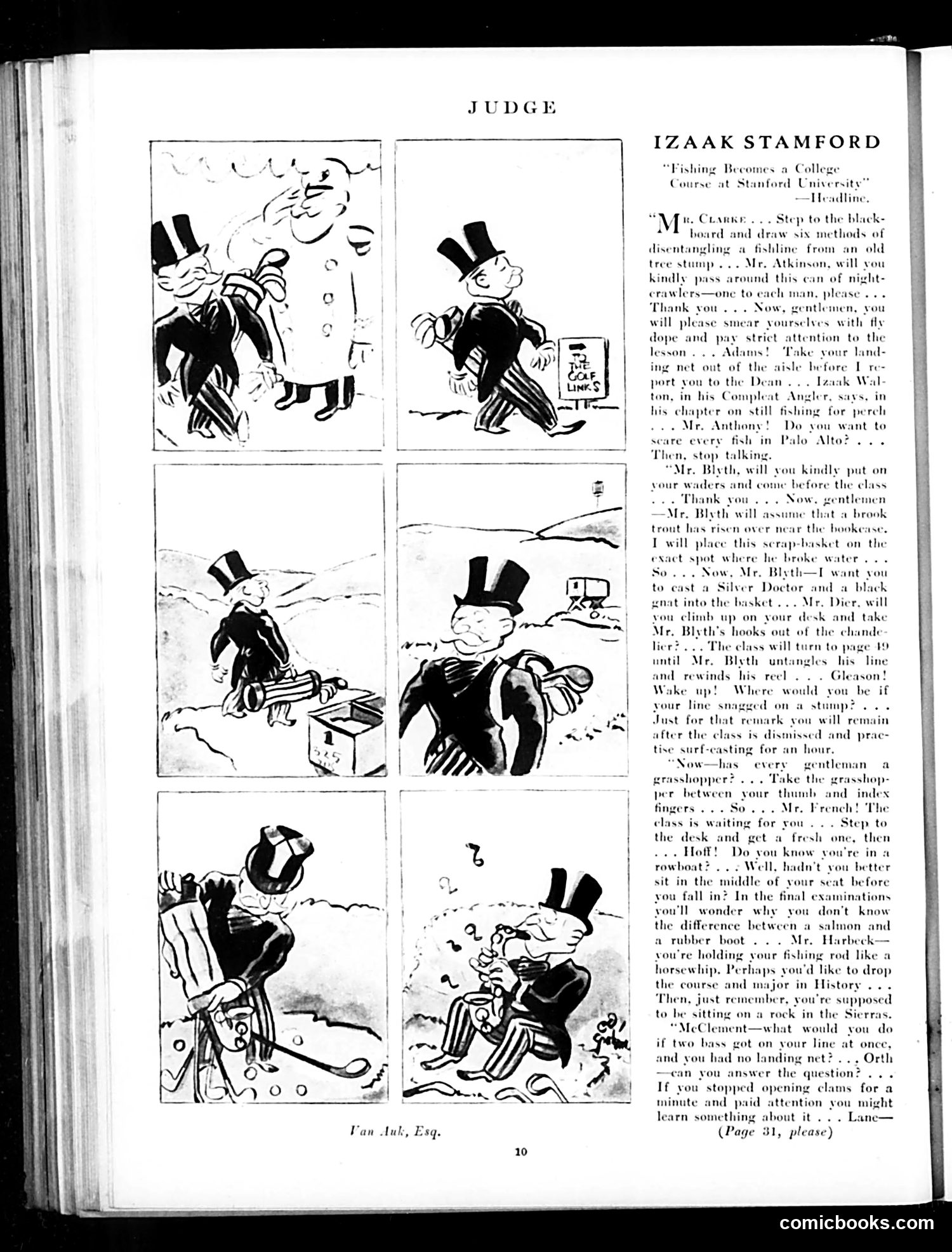
# Judge Magazine: "Izaak Stamford" Cartoon Explanation This satirical comic mocks Stanford University's decision to offer fishing as a college course. The cartoon depicts a classroom where an instructor teaches fishing fundamentals through absurd academic methods—students wear waders indoors, cast into wastebaskets, and study classical fishing texts like Izaak Walton's *Compleat Angler*. The humor targets the pretentiousness of colleges offering impractical courses under the guise of serious study. By treating fishing instruction with mock-formal pedagogy (pop quizzes, desk work, disciplinary remarks), the cartoonist satirizes educational institutions expanding their curricula into frivolous territory during what appears to be the early 20th century. The reference to "Izaak Stamford" puns on Izaak Walton (famous 17th-century fishing writer) and Stanford University. The satire suggests that making fishing "academic" strips it of its practical purpose—students learn theory in classrooms rather than actually fishing outdoors.