
Judge, 1932-02-27 · page 8 of 36
Judge — February 27, 1932 — page 8: what you’re looking at
What you’re looking at
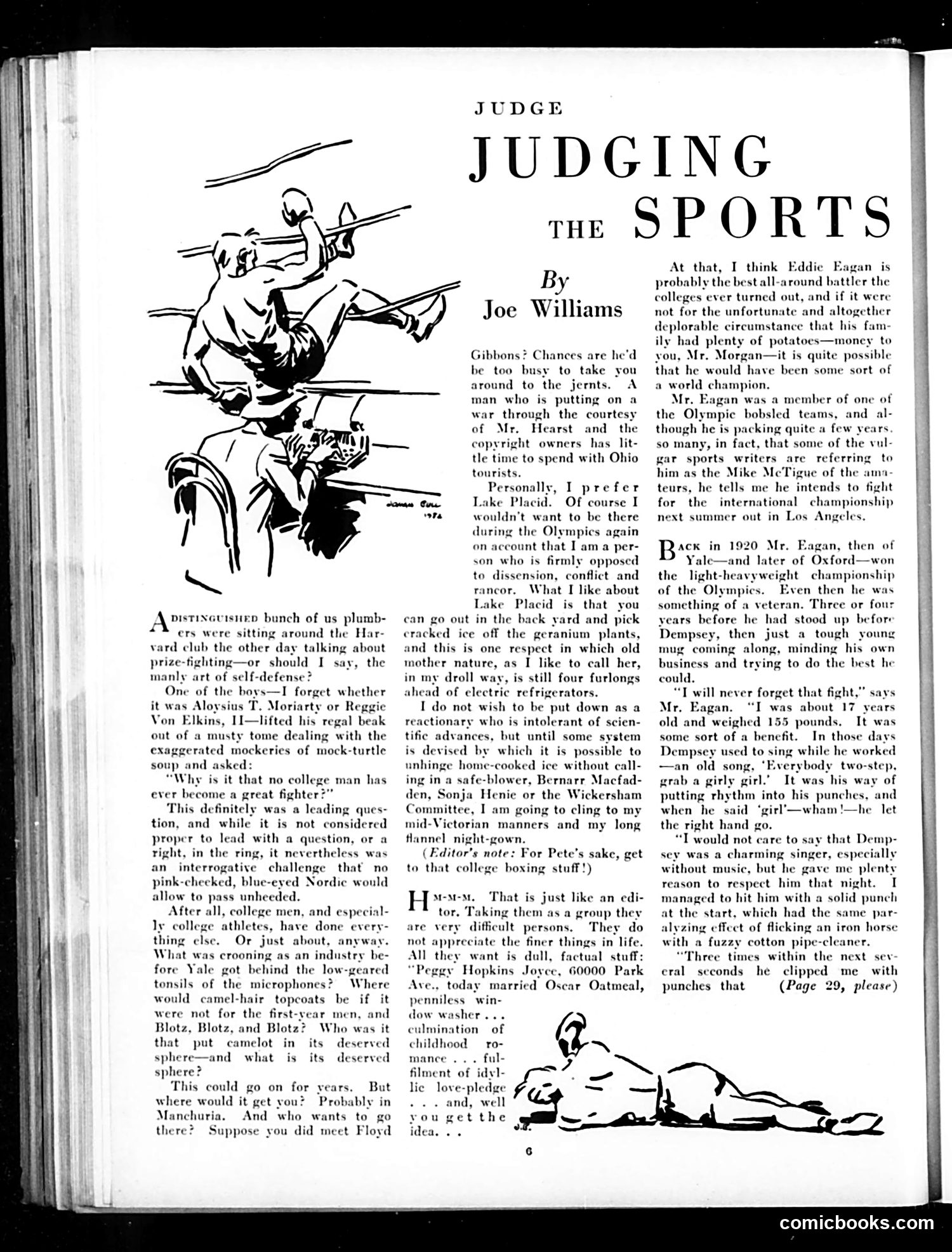
# "Judging the Sports" by Joe Williams This page combines editorial commentary on boxing and college athletics with satirical illustrations. The main article discusses Eddie Eagan, a boxer and Olympic athlete, and references his potential fight for an international championship. The text critiques college sports culture, mocking the notion that college athletes become "great fighters" and satirizing the "dull, factual stuff" college administrators want from athletes versus their actual talents. Williams names figures like Hopkins Joyce and Oscar Oatmeal (likely pseudonyms or misspellings), discussing boxing's role in youth development. The cartoons show boxing scenes—a fighter mid-punch and another knocked down—illustrating the physical nature of the sport being discussed. The piece appears skeptical of boxing's value while defending individual athletes like Eagan.
📄 Transcribed text from this page (OCR, searchable)
Machine-transcribed from the original scan — historical spelling and the odd misread are preserved.
" N A Ditixavisnien bunch of us plumb- + * ers were sitting around the Har- vard club the other day talking about prize-fighting—or should I say, the manly art of self-defense? One of the boys—I forget whether it was Aloysius T. Moriarty or Reggie Von Elkins, 11—lifted his regal beak out of a musty tome dealing with the exaggerated mockeries of mock-turtle soup and asked: “Why is it that no college man has ever become a great fighter?” This definitely was a leading ques- tion, and while it is not considered proper to lead with a question, or a right, in the ring, it nevertheless was an interrogative challen: that no jink- rd, blue d Nordic would ll, college men, and especial- athletes, have done every- Or just about, anyw crooning as an industry b fore Yale got behind the low-geared tonsils of the microphones? Where would camel-hair topcoats be if. it were not for the first-year men, and Blotz, Blotz, and Blotz? Who was it that put camelot in its sphere—and what is its sphere? This could go on for years. But where would it get vou? Probably in Manchuria. And who wants to go there? Suppose you did meet Floyd Ye deserved deserved JUDGE JUDG By Joe Williams Gibbons? Chances are he'd be too busy to take you around to the jernts. A man who is putting on a war through the courtesy of Mr. Hearst and the copyright owners has lit- tle time to spend with Ohio tourists. Personally, I prefer Lake Placid. Of course I wouldn't want to be there during the Olympics again on account that I am a per- son who is firmly opposed to dissension, conflict and rancor. What I like about Lake Placid is that you the back yard and pick cracked ice off the geranium plants, and this is one respect in which old mother nature, as I like to call her, in my droll w. is still four furlongs ahead of electric refrigerators. I do not wish to be put down as a nary who is intolerant of scien- dvances, but until some system -d by which possible to unhinge home-cooked ice without call- ing in a safe-blower, Bernarr Macfad- den, Sonja Henie or the Wickersham ee, Iam going to cling to my mid-Victorian manners and my long flannel night-gown. (Editor's note: For Pete's sake, get to that college boxing stuff!) can go out That is just like an edi- aking them as a group they are very difficult persons. They do not appreciate the finer things in life. All they want is dull, factual stuff: “Peggy Hopkins Joyce, 60000 Park Ave., today married Oscar Oatmeal, penniless win- dow washer... culmination of childhood — ro- mance... ful- ~ filment of idyl- 7 og SS ow oe lic love-pledge ++. and, well you getthe —_~ idea... ING At that, I think Eddie Eagan is probably the best all-around battler the colleges ever turned out, and if it were not for the unfortunate and altogether deplorable circumstance that his fam- ily had plenty of potatoes—moncy to you, Mr. Morgan—it is quite possible he would have been some sort of a world champion. Mr. n was a member of one of the Olympic bobsled teams, and al- though he is packing quite a few years so many, in fact, that some of the vul- gar sports writers are referring to him as the Mike McTigue of the ama teurs, he tells me he intends to fight for the international championship next summer out in Los Angeles. 1920 Mr. Eagan, then of and later of Oxford—won weight championship F Even then he w: something of a veteran. Three or four years before he had stood up before Dempsey, then just a tough young mug coming along, minding his own business and trying to do the best he could. “T will never forget that fight,” says Mr. Eagan. “I was about 17 old and weighed 155 pounds. It w: some sort of a bencfit. In those days Dempsey used to sing while he worked —an old song, ‘Everybody two-step, grab a girly girl.’ It was his way of putting rhythm into his punches, and when he said ‘ —wham!—he let the right hand go. “T would not care to say that Demp- sey was a charming singer, especially without music, but he gave me plenty reason to respect him that n managed to hit him with a solid punch at the start, which had the same par- zing effect of flicking an iron horse h a fuzzy cotton pipe-cleaner. rs “Three times within the next sev- eral seconds he punches that clipped me with (Page 29, please) comicbooks.com m SPORTS.