
Judge, 1932-02-27 · page 26 of 36
Judge — February 27, 1932 — page 26: what you’re looking at
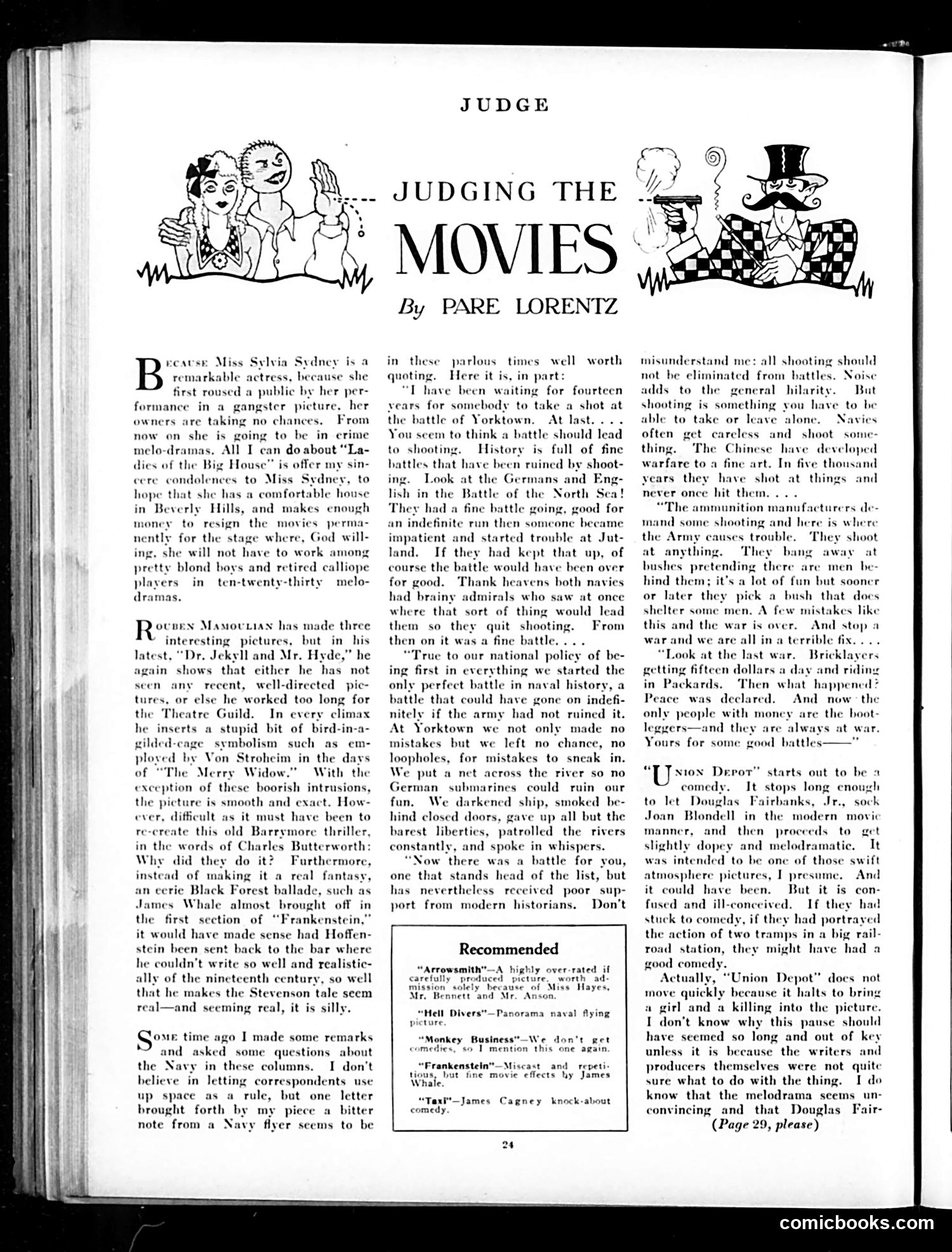
A restored page from Judge, 1932-02-27. Page through the whole issue in the reader above.
📄 Transcribed text from this page (OCR, searchable)
Machine-transcribed from the original scan — historical spelling and the odd misread are preserved.
ttre ee reavse: Miss Sylvia Sydney is a first roused a public by her per- formance in a gangster picture. her owners are taking no chances. From now on she is going to be in erime melo-dramas. can do about “La- dies of the B is offer my sin- condolences to Miss Sydney, to hope that she has a comfortable house in Beverly Hills, and ms money to resign the movies perma- nently for the stage where, God will- she will not have to work among tty blond boys and retired calliope s in- ten-twenty-thirty melo- dramas. cere Ro N Mamovtian has made three esting pictures, but in_ his Dr, Jekyll and Mr. Hyde,” he shows that her he has not recent, well-directed pic- tures, or else he worked too long for the Theatre Guild. In every climax he inserts a stupid bit of bird-in-a- gilded-cage symbolism such as plosed by Von Stroheim in the ¢ Merry Widow.” With the exception of these boorish intrusions, the picture is smooth and exact. How- difficult as it must have been to re-create this old Barrymore thriller, in the words of Charles Butterworth: Why did they do Furthermore, instead aking it a real fantasy, an ceri Forest ballade, such as James Whale almost brought off in the first section of “Frankenstein,” it would have made sense had Hoffen- in been sent k to the bar where he couldn't write so well and realistic- ally of the nineteenth centary, so well at he makes the Stevenson tale seem real—and seeming real, it is silly. Soe time ago I made some remarks ‘ nd asked some questions about the Navy in th I don't believe in letting correspondents use up space as a rule, but one letter brought forth by my piece a bitter note from a Navy flyer scems to be seen any em- ever, se columns. JUDGING THE MOVIES By PARE LORENTZ in these times well worth quoting. Here it is, in part: “T have been waiting for fourteen years for somebody to take a shot at the battle of Yorktown. At last... . You seem to think a battle should lead to shooting. History is full of fine battles that have been ruined by shoot- Look at the Germans and Eng- lish in the Battle of the North Sca! They had battle going, good for an indefinite run then somcone became impatient and started trouble at Jut- land. If they had kept that up, of course the battle would have been over for good. ik heavens both navies had brainy admirals who saw at once where tha would lead them so they quit shooting. From then on it was a fine battle... . “True to our national poli ing first in everything we ste only perfect battle in naval history, a battle that could have gone on indefi- nitely if the army had not ruined it. At Yorktown we not only made no mistakes but we left no chance, no loopholes, for mistakes to sneak in. We put a net across the river so no German submarines could ruin our fun. We darkened ship, smoked be- hind closed doors, gave up all but the barest liberties, patrolled the rivers constantly, and spoke in whispers. “Now there was a battle for you, one that stands head of the list, but has nevertheless received poor sup- port from modern historians. Don’t parlous Recommended “Arrowsmith"—A highly over-rated if My orth ad- solely because of Miss Hayes, Rennett and Mr. 4 “Hell Divers"—Panorama naval fying picture Monkey Busin "We don't get comedies, so mention this one again. “Frankenstein” —Miscast and repeti- tious, but fine movie effects hy James Whale. “Taxit—James Cagney knock-about comedy misunderstand me: not be elimir adds the shooting able all shooting should ted from battles. Noise neral hilarity. But is something you have to be to take or | Navies often get careless and some- thing. The Chinese warfare to a fine art. In five thousand years they have shot at things and never once hit them... . “The ammunition manufacturers de- mand some shooting and here is where the Army causes trouble. They shoot at anything. tb bang bushes pretending there are men be- bind them; it’s a lot of fun but sooner B a bush that docs - A few mistakes like war ix over. And ani a all in a terrible fix Bricklayers and riding Then what happened ? declared. And now the only people with money are the leguers—and th always Yours for some attle ‘'U nion Depot” starts out to be a comedy It stops long enough to let Douglas Fairbanks, Jr., sock Jo: Blondell in the modern manner, and then proceeds to get slightly dopey and melodramatic. was intended to be one of those swift atmosphere pictures, I presume. And it could have been. But it is con- fused and ill-conceived. If they had stuck to comedy, if they had portrayed tramps in a big rail- ion, they might have had a od come edy. “Union Depot” docs not move quickly because it halts to brin: a girl and a killing into the picture. I don’t know why this pause should have seemed so long and out of key unless it is because the writers and producers themselves were not quite sure what to do with the thing. I do know that the melodrama scems un- convincing and that Douglas Fair- (Page 29, please) lone. shoot have developed this and the nd we are “Look at the last war. ing fifteen dollars a day rds. hoot- at war. movic comicbooks.com