
Judge, 1932-02-27 · page 20 of 36
Judge — February 27, 1932 — page 20: what you’re looking at
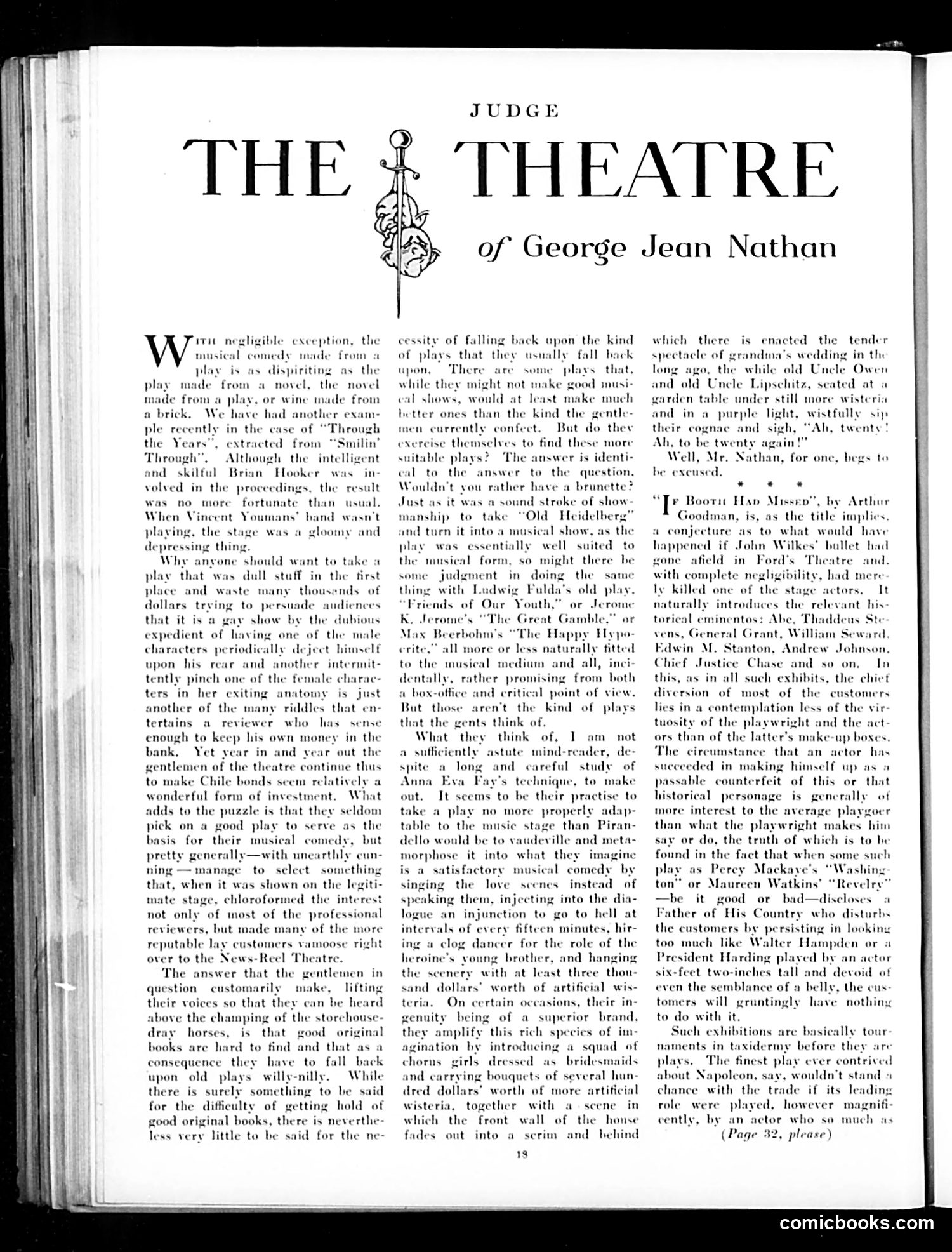
A restored page from Judge, 1932-02-27. Page through the whole issue in the reader above.
📄 Transcribed text from this page (OCR, searchable)
Machine-transcribed from the original scan — historical spelling and the odd misread are preserved.
gible nedy mn neg exception, the musical ¢ made from a play is ay diypiriting as the novel, the novel made from a play, or wine made from a brick, We had ple recently in the case of * the Years”, extracted from Through”, Although the intelligent ind skilful) Brian was in- volved in the proceedings, the result was no more fortunate than usual. When Vincent Youmans’ band wasn't playing, the depressing thi Why anyone should want to take a play that was dull stuff in the first ce and waste many thousends of dollars trying to persuade audiences that it is by the dubious expedient of having one of the characters periodically deject himself upon his rear and another intermit- tently pinch one of the female charac- ters in her exiting anatomy is just another of the riddles that en- tertains a reviewer who lias enough to keep his own money in the bank, Yet year in and year out the atlemen of the theatre continue thas to make Chile bonds seem relatively a wonderful form of investment. What adds to the puzzle is that they seldom pick on a good play to serve as the for their musical comedy, but pretty generally—with unearthly eun- ning — 0 to. select something that, when it was shown on the legiti- mate stage, chloroformed the interest not only of most of the | i reviewers, but made many of the more play made from a have another exam Hooker stage was a gloomy and a gay show nictle many basis reputable lay customers vamoose over to the News-Reel Theatre. The answer that the gentlemen in question make, lifting their voices so that they can be heard above the champing of the storchouse- dray horses, is that good books are hard to find and that as a consequence they have to fall back upon old plays. willy-nilly, While there is surely something to be said for the di hold of good orig . there is neverthe- less very little to be said for the ne- customarily original JUDGE THEATRE of George Jean Nathan cessity of falling back upon the kind of plays that they usually fall back upon. There are some plays. ths while they might not make dd inusi cal shows, at least make much better ones than the kind the gentle- men currently confect. But do thev exercise themselves to find these more suitable plays? The answer is identi- cal to the answer to the question, Wouldn't you rather have a brunette? Just as it was a sound stroke of show- take “Old Heidelber; ind turn it into a musical show, as the play essentially well) suited to the musical form, so might there be judgment in doing the same thing with Ludwig Fulda’s old play. Friends of Our Youth,” or Jerome kK. Jerome's “The Great Gamble.” or Max Beerbohi's “The Happy Hypo- crite.” all more or less naturally fitt to tl 1 medium and all, in dentally, rather promising from both a box-office and critical point of view. But those aren't the kind of plays that the gents think of. What they think of, I am not a sufficiently astute mind-reader, de- spite long study of Anna Eva Fay’s technique, to. make out. It seems to be their practise to take a play no more properly adap- table to the music than Piran- dello would be to vaudeville and me morphose it into what they imagine is a satisfactory musical comedy by singing the love scenes instead of speaking them, injecting into the dia- logue an injunction to go to hell at intervals of every fifteen minutes, hir- ing a clog dancer for the role of the heroine's young brother, and hanging the scenery with at least three thou- sand dollars’ worth of artificial wis- teria. On certain occasions, their in- genuity being of a brand. they amplify this rich species of im- agination by introducing a squad of chorus. bridesmaids ind carrying bouquets of several hun- dred dollars’ worth of more artificial together with a scene in front wall of the house into a serim and behind would manship to was some music stage supe girls dressed as wisteria, which the fades out 18 there is enacted the tender spectacle of grandma's wedding in th: long ago, the while old Uncle Owen and old Unele Lipschitz, seated at garden table under still more wisteris and in a purple light, wistfully sip their cognac and sigh, “Ah, twenty ! Ah, to be twenty again!” Well, Mr. Natl he excused. which an, for one, begs to * 2 @ ry Boorit Hav Mise”, by Goodman, is, 1 conjectu hapy i gone Arthur as the title implies. as to what would have John Wilkes’ bullet had afield in’ Ford's Theatre and. with complete negligibility, had mere ly killed one of the stage actors. It naturally introduces the relevant his torical eminentos: Abe, Thaddeus Ste ral Grant, William Seward anton, Andrew Johnson, Chase and so on, In all such exhibits, the chief diversion of most of the customers lies in a contemplation less of the vir tuosity of the playwright and the act- ors than of the The circumstance that an succeeded in ma vens, G Edwin M. Chief this, as in Justice actor has of this or that personage is generally of more est to the average } than what the playwright makes hin say or do, the trath of which is to be “Revelry” 1d—diseloses a Father of His Country who disturbs the customers by persisting in lookin too much like Walter Hampden or a President Harding played by an actor six-feet two-inches tall and devoid of even the semblance of a belly, tomers will gruntingly have to do with it. Such exhibitions are basically tour naments in taxidermy before they are plays. The finest play ever contrived about N apaleon,. say, wouldn't stand « if its leadin, however magnifi ‘aetor who so much ats 32, please) it good the eus nothings role were cently, by an (Page comicbooks.com