A complete issue · 36 pages · 1932
Judge — January 30, 1932
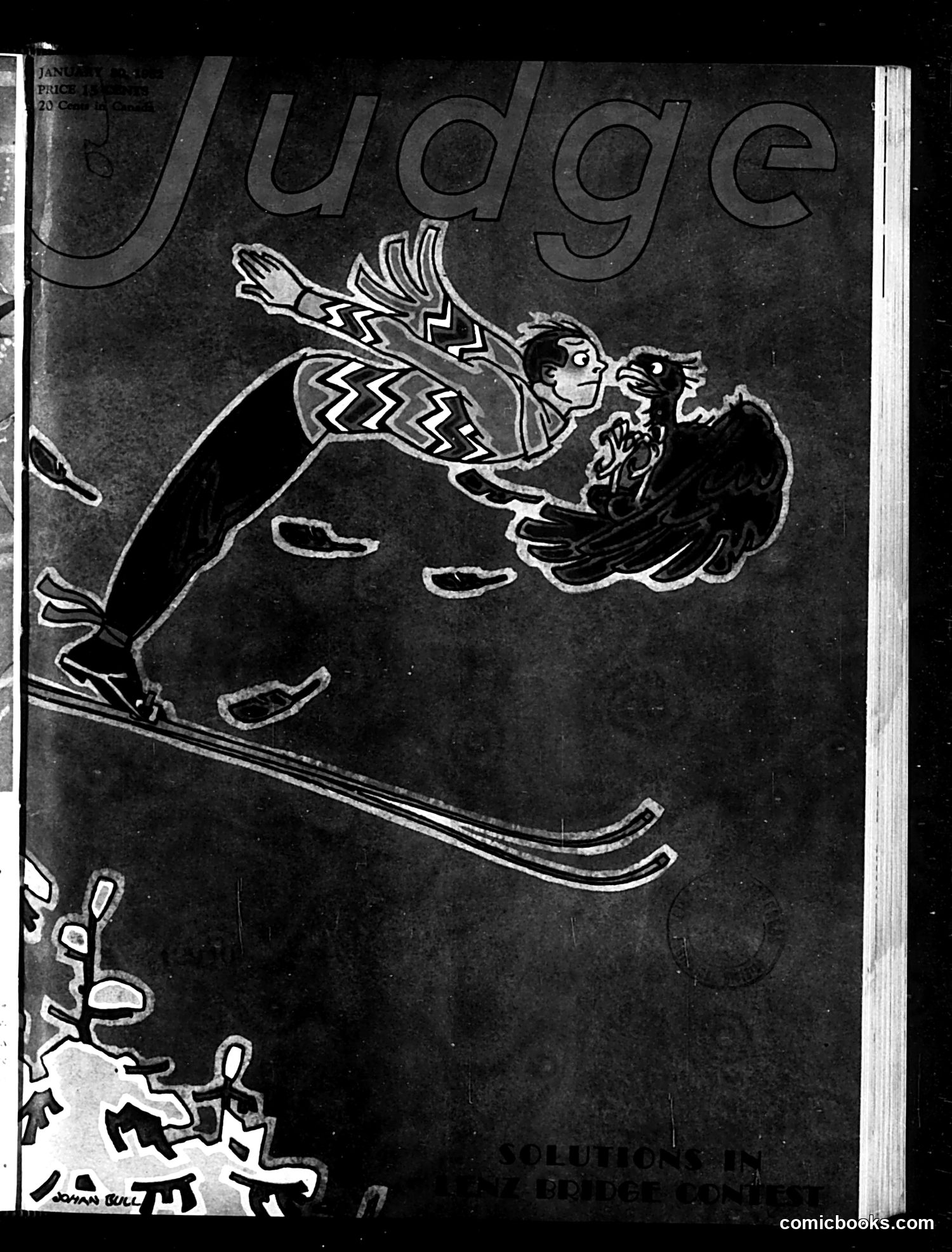
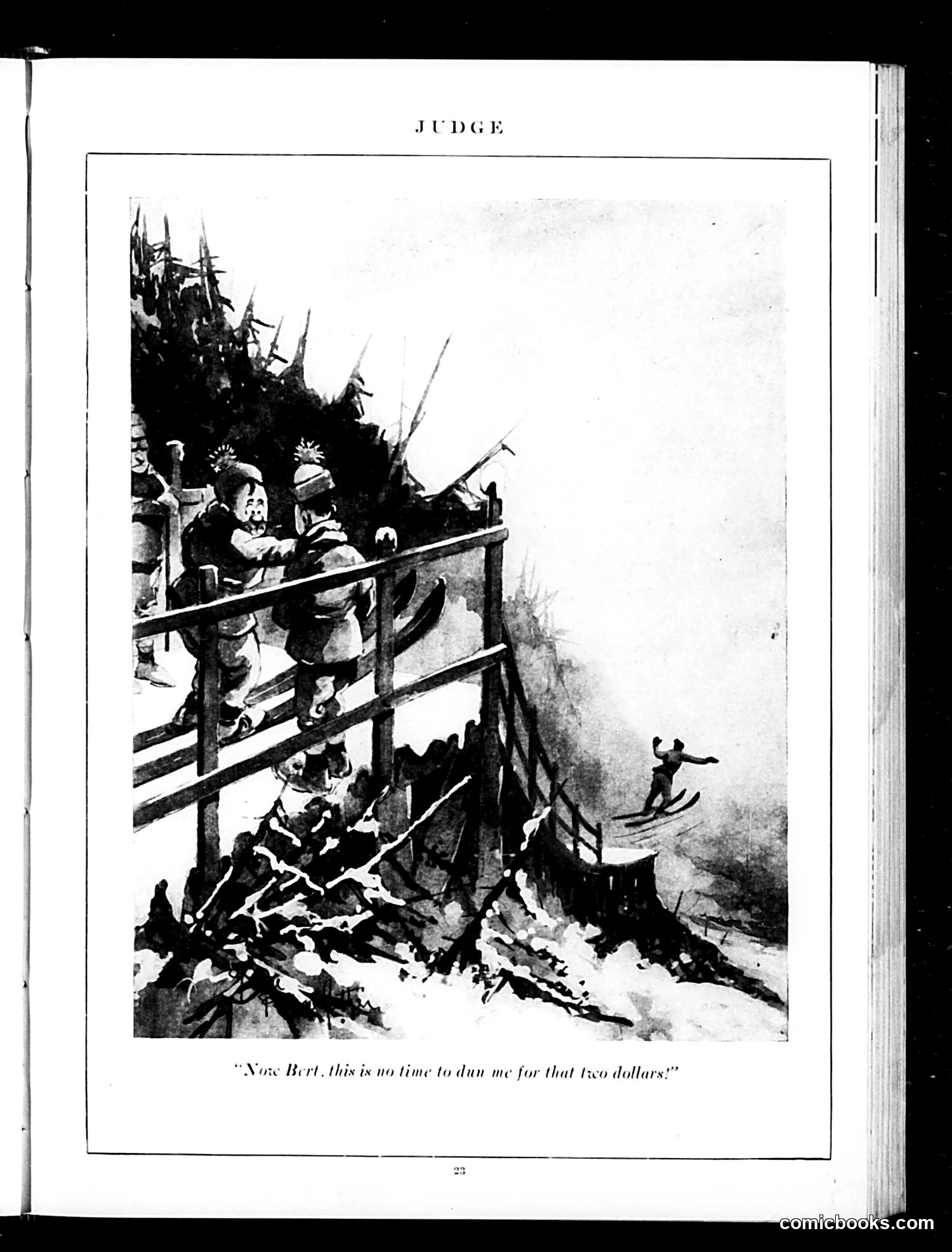
# Judge Magazine Cartoon Analysis This appears to be a cover from **Judge**, an American satirical magazine. The illustration shows a figure in winter clothing (with a patterned sweater or garment) sledding or skiing downward at a steep angle, appearing to be in an out-of-control or precarious situation. A smaller figure is also visible. The cartoon likely satirizes a political or social situation involving rapid decline or loss of control—a common metaphor in early 20th-century political cartooning. The dramatic downward trajectory suggests a cautionary commentary on some contemporary event or trend. However, without clearer text or date information visible in this image, I cannot definitively identify the specific political figures, event, or satirical point being made. The magazine's masthead reading "Judge" is visible at top.
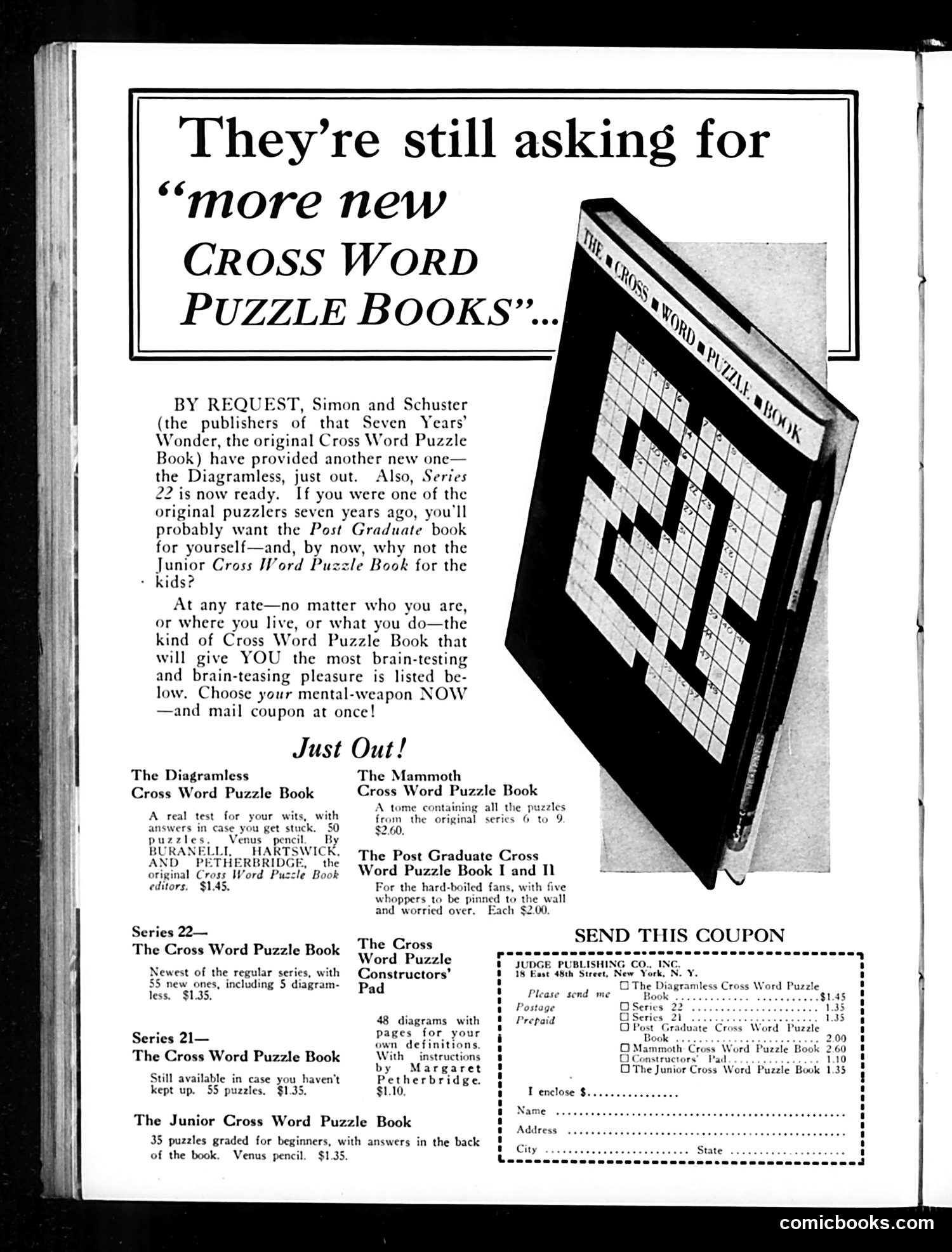
# Analysis This page is primarily **advertising**, not satire or political commentary. It promotes crossword puzzle books published by Simon and Schuster, marketed through Judge magazine. The headline "They're still asking for 'more new CROSS WORD PUZZLE BOOKS'" suggests crosswords were a popular fad at this time. The ad references multiple book series (numbered 21-22), specialized editions (for kids, advanced solvers), and previous bestsellers from "seven years ago." The accompanying image shows an isometric view of stacked puzzle books as a visual sales tool. A mail-in coupon appears below, listing various titles and prices ($1.35-$2.60). This reflects crosswords' status as a major commercial entertainment product, likely from the 1920s-30s based on the vintage typography and publishing context of Judge magazine.
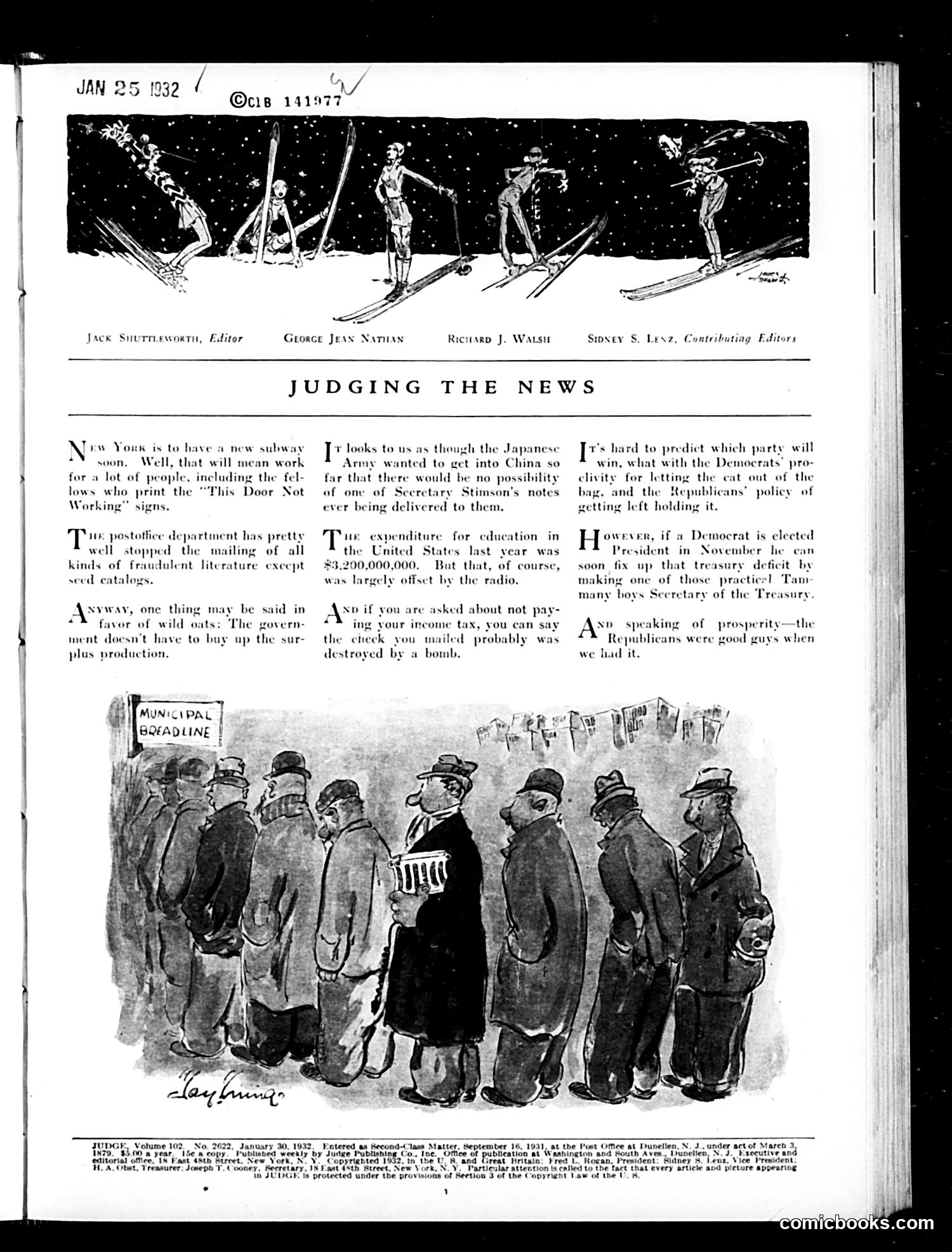
# "Judging the News" - January 25, 1932 This satirical column page features editorial commentary on current events during the Great Depression. **Main cartoon** (bottom): Shows men lined up at a "Municipal Breadline," with one figure prominently wearing what appears to be a sash or badge, suggesting he's a politician or official. The satire implies that even those in power face the same bread lines as ordinary citizens during economic crisis. **Text commentary** includes jabs at: New York's proposed subway system; fraudulent "This Door Not Working" signs; the Japanese Army's intentions regarding China; education spending ($3.29 billion); tax evasion via bomb destruction; and Democrats' management of the treasury deficit. The overall tone suggests frustration with government incompetence and hypocrisy during the Depression era.
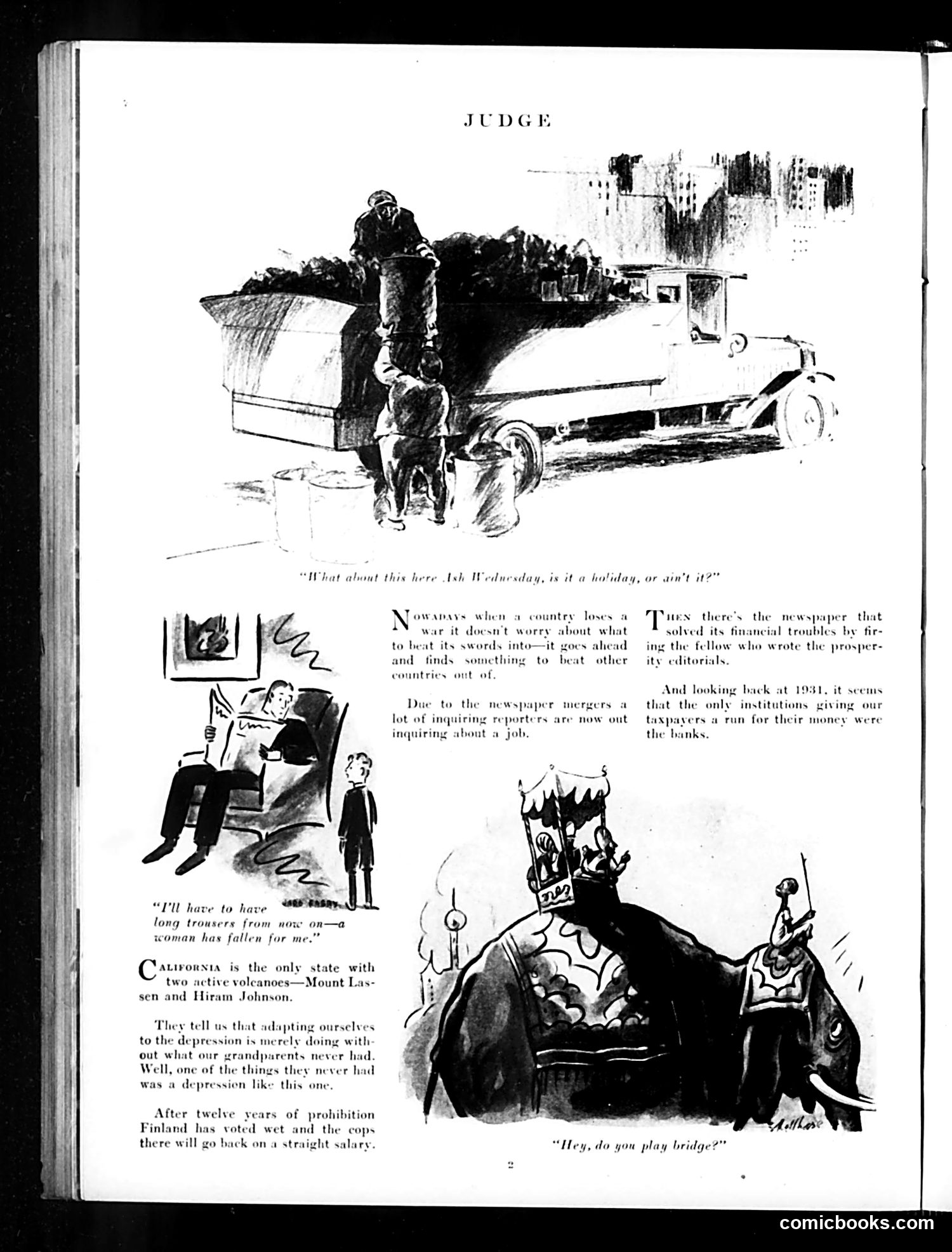
# Analysis This Judge magazine page uses satire to comment on Depression-era economic hardship and institutional failure. **Top cartoon**: A garbage collector questions whether Wednesday is a holiday, given economic collapse. The joke mocks how unemployment has made every day equally bleak. **Middle section**: References newspaper mergers reducing reporting jobs, and notes that by 1941, only banks were running well—while average citizens struggled. This critiques financial institutions' stability amid broader economic failure. **California reference**: Notes two active volcanoes exist there, sardonically suggesting natural disasters are comparatively mild to economic ones. **Bottom cartoon** ("Hey, do you play bridge?"): Depicts wealthy figures amid financial chaos (burning money/documents), likely satirizing how the elite remained insulated from Depression consequences while ordinary people suffered. The page's overall message: institutions failed ordinary Americans while some remained prosperous.
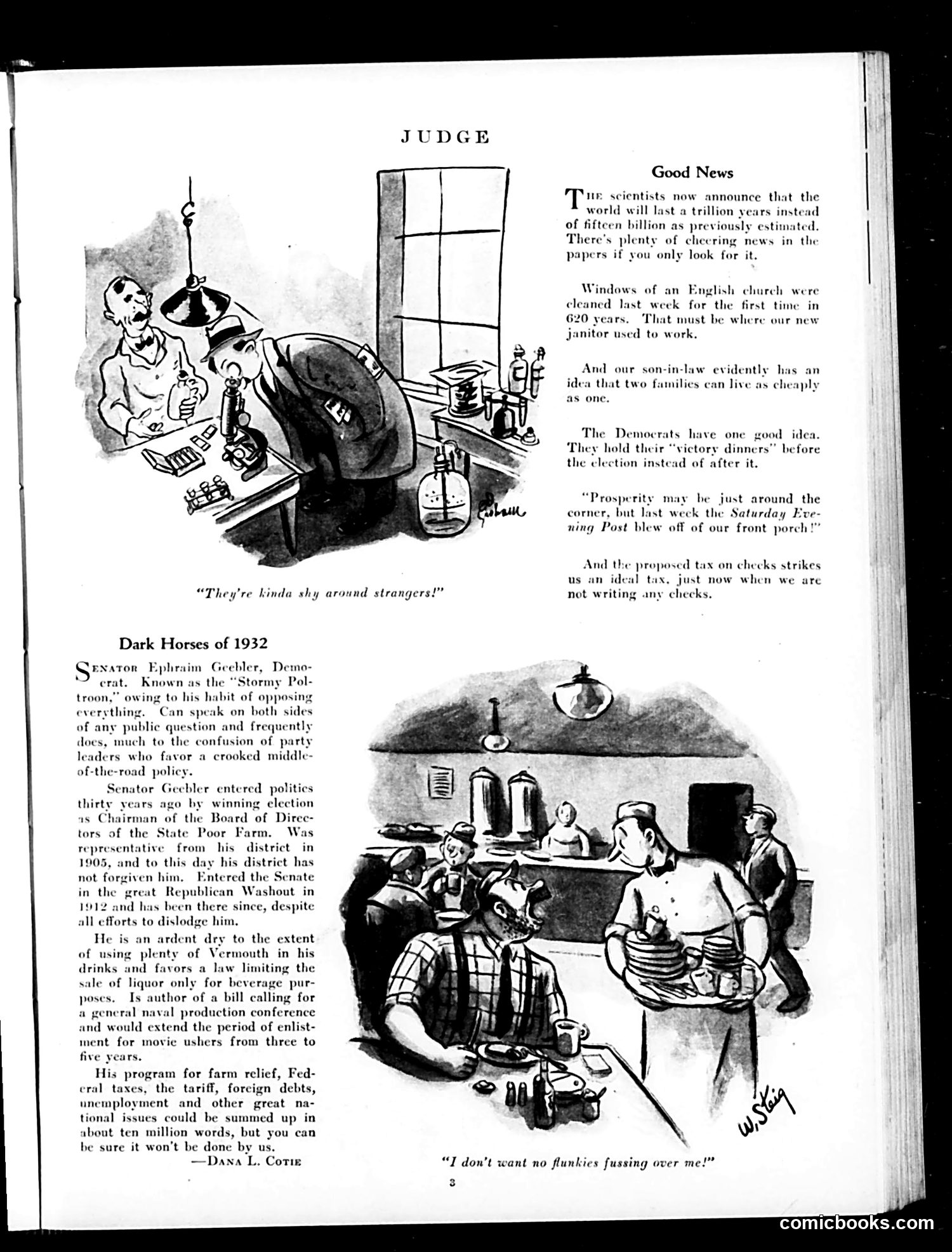
# Page Analysis: Judge Magazine **Top Cartoon ("Judge"):** Shows a judge sentencing someone while another figure holds a noose. The caption "They're kinda shy around strangers!" is unclear without additional context, but appears to satirize either judicial leniency or capital punishment practices of the era. **"Good News" Section:** Offers light satirical commentary on contemporary issues: world lifespan extending to a trillion years, church window cleaning after 620 years, families living cheaply together, Democrats holding "victory dinners" before elections, and a tax on check-writing. **"Dark Horses of 1932":** Profiles Senator Ephraim Gesbler, a Democrat known as the "Stormy Poltroon" for taking both sides of issues. The text criticizes his political record and opportunism while detailing his farm relief and various policy positions, written by Dana L. Cokie.
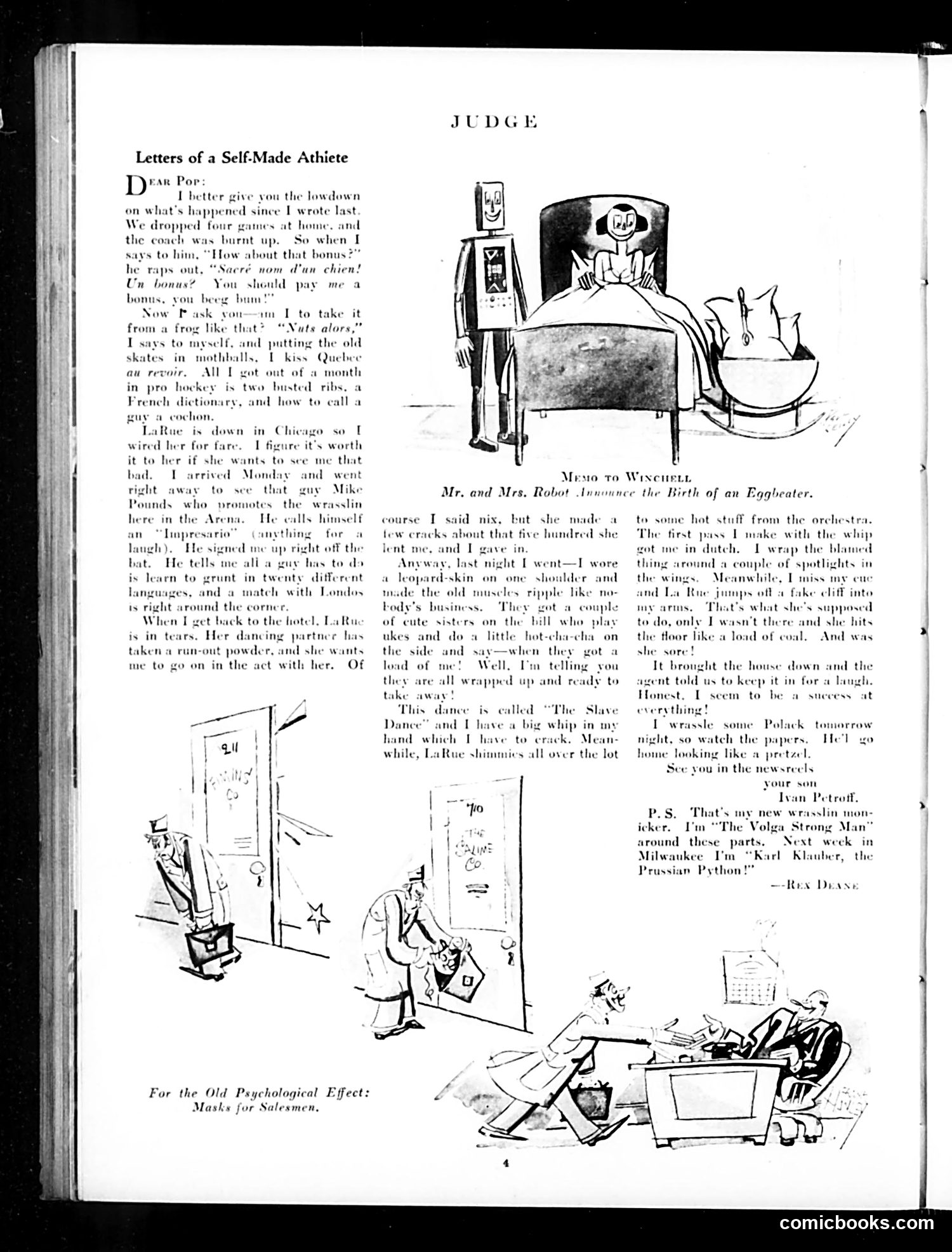
# Analysis of This Judge Page This page contains **"Letters of a Self-Made Athlete"** by Ivan Petroff, a humorous column about wrestling and theatrical performance. The main letter describes dropping four games at home, then negotiating a bonus with his coach. The writer describes wrestling moves using French terminology and theatrical language, comparing the sport to stagecraft—mentioning "the Slave Dance," spotlights, and fake moves to entertain audiences. The cartoons illustrate the theatrical absurdity: one shows a wrestling "match" resembling staged performance rather than genuine sport; another depicts salesmen using psychological masks. **The satire**: Professional wrestling is presented as theatrical entertainment rather than authentic athletic competition—a critique suggesting wrestlers and promoters prioritize spectacle and profit over genuine sport. This was a contemporary concern about wrestling's credibility.
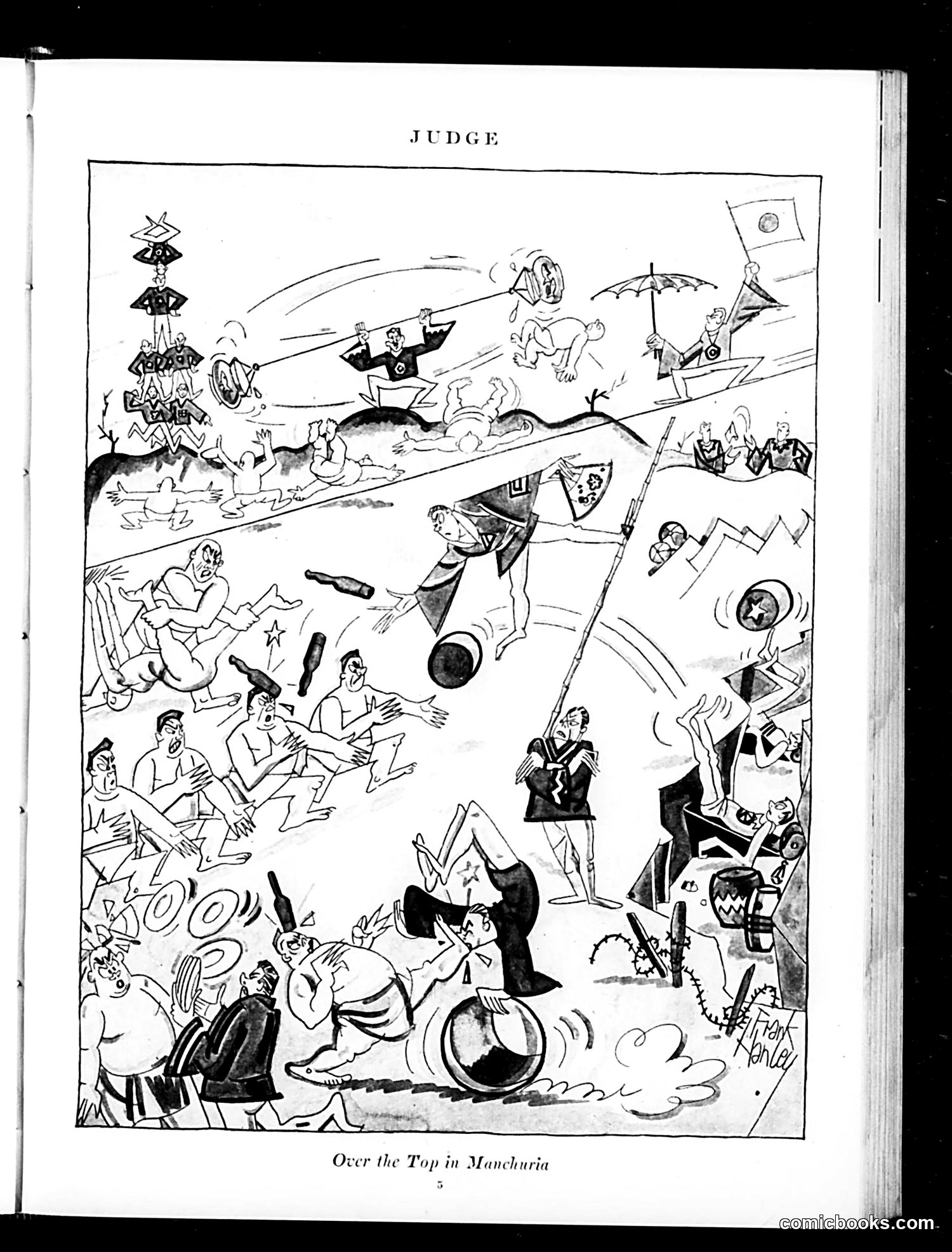
# "Over the Top in Manchuria" This Judge magazine cartoon satirizes the Russo-Japanese War (1904-1905) and the chaotic international response to it. The title references "going over the top"—military terminology for attacking across no-man's-land. The cartoon depicts a surreal beach scene where various national figures (likely representing different countries' diplomatic positions) engage in absurd, conflicting activities—some fighting, some observing with umbrellas, some in formal dress amid chaos. The "Manchuria" reference indicates the contested territory where Russia and Japan battled for control. The satire appears to mock how Western powers watched the conflict with detached curiosity while the actual combatants suffered, and how international diplomacy fumbled amid the warfare. The chaotic composition emphasizes the confused, contradictory nature of global responses to the distant Asian conflict.
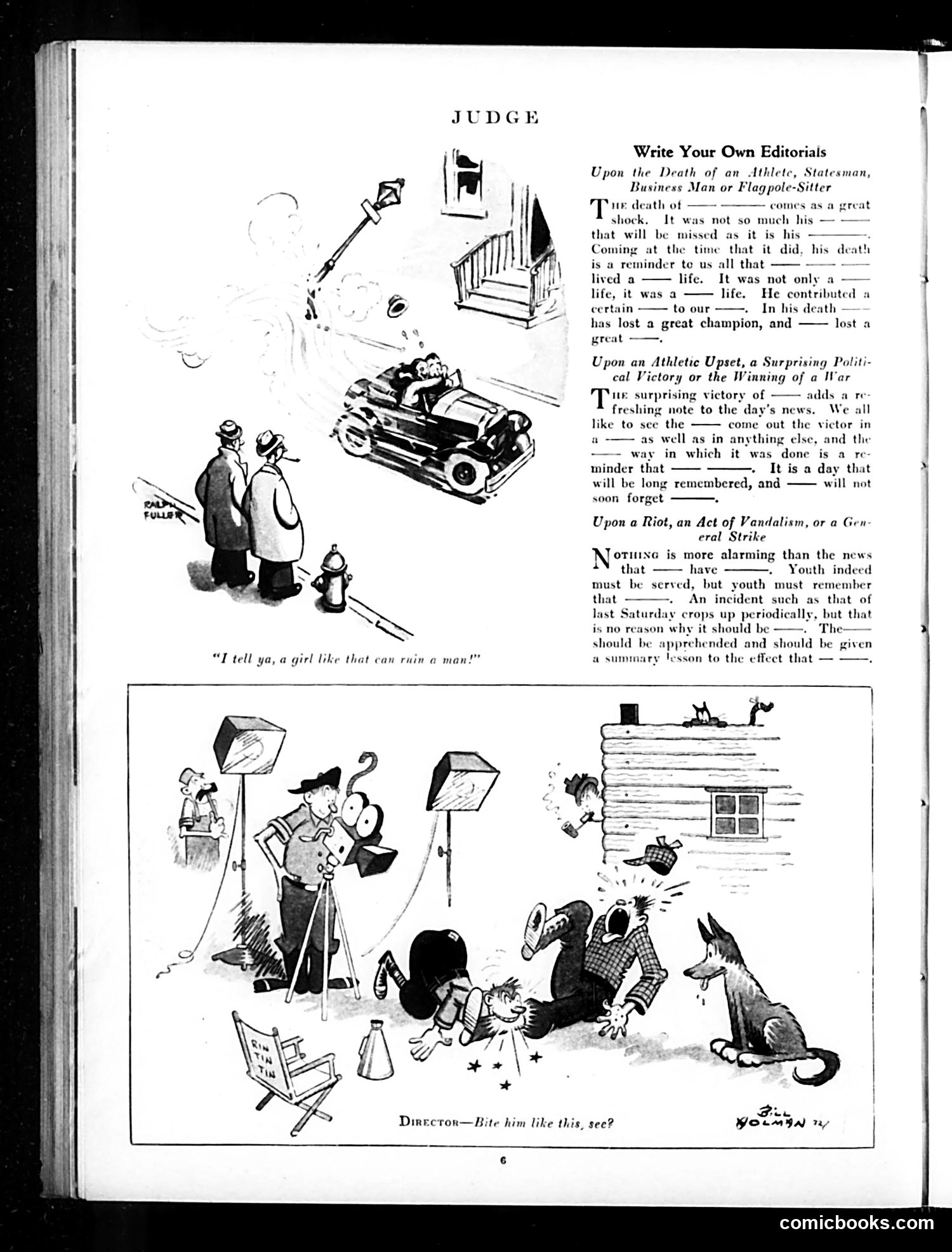
# Analysis of Judge Magazine Page This page features three editorial cartoon templates for readers to complete themselves—a participatory feature titled "Write Your Own Editorials." The top cartoon shows a hearse and two mourners discussing someone's death, with a caption about a prominent figure's passing. The middle cartoon depicts a chaotic scene with people fighting, labeled regarding "a Riot, an act of Vandalism, or a General Strike." The bottom cartoon shows a film director staging a scene with actors fighting while a fox watches—captioned "Director—Bite him like this, see?" The satirical point appears to be mocking how different publications might frame identical events (riots, strikes, fights) differently depending on their political perspective. By asking readers to fill in names and commentary, Judge invites them to consider how narratives can be manipulated through selective framing.
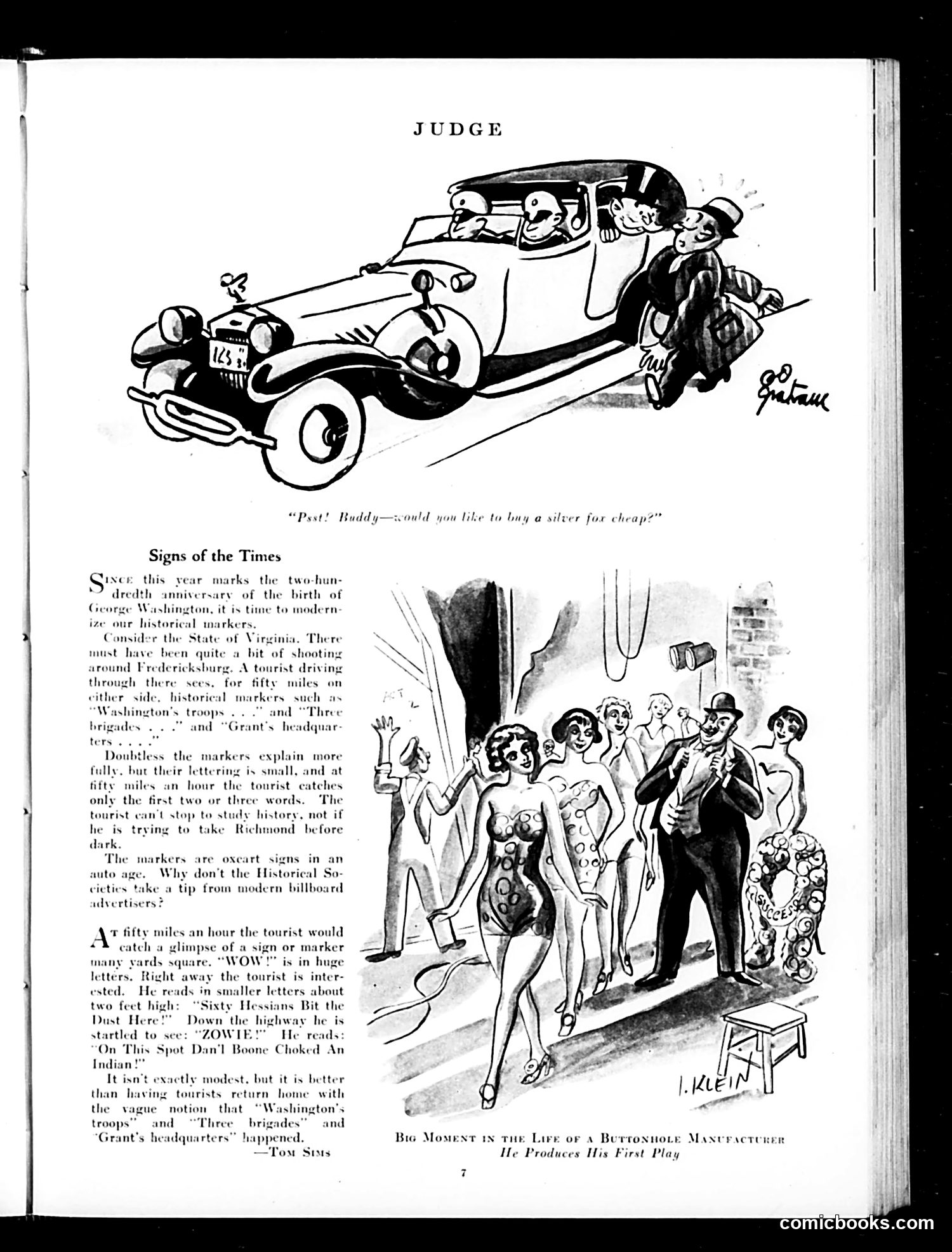
# Page Analysis: Judge Magazine **Top Cartoon**: A man in formal attire approaches a car with two occupants, offering to sell a "silver fox cheap." This is a con-artist pitch—"silver fox" was slang for an attractive older person, but also literal fur. The joke plays on the double meaning and the "Psst! Buddy" approach typical of street hustlers. **Main Article ("Signs of the Times")**: Satirizes Virginia's historical markers commemorating George Washington's bicentennial. The author argues these markers use small lettering unreadable from cars traveling 50+ mph. He mockingly suggests adopting modern billboard advertising tactics—using huge eye-catching words ("WOW!", "ZOWIE!") to grab tourist attention, with actual historical details in smaller text below. The satire critiques both outdated historical preservation methods and America's growing billboard advertising culture in what appears to be the 1930s. **Bottom Caption**: References a "buttonhole manufacturer's" first theatrical production, though context is unclear from this page alone.
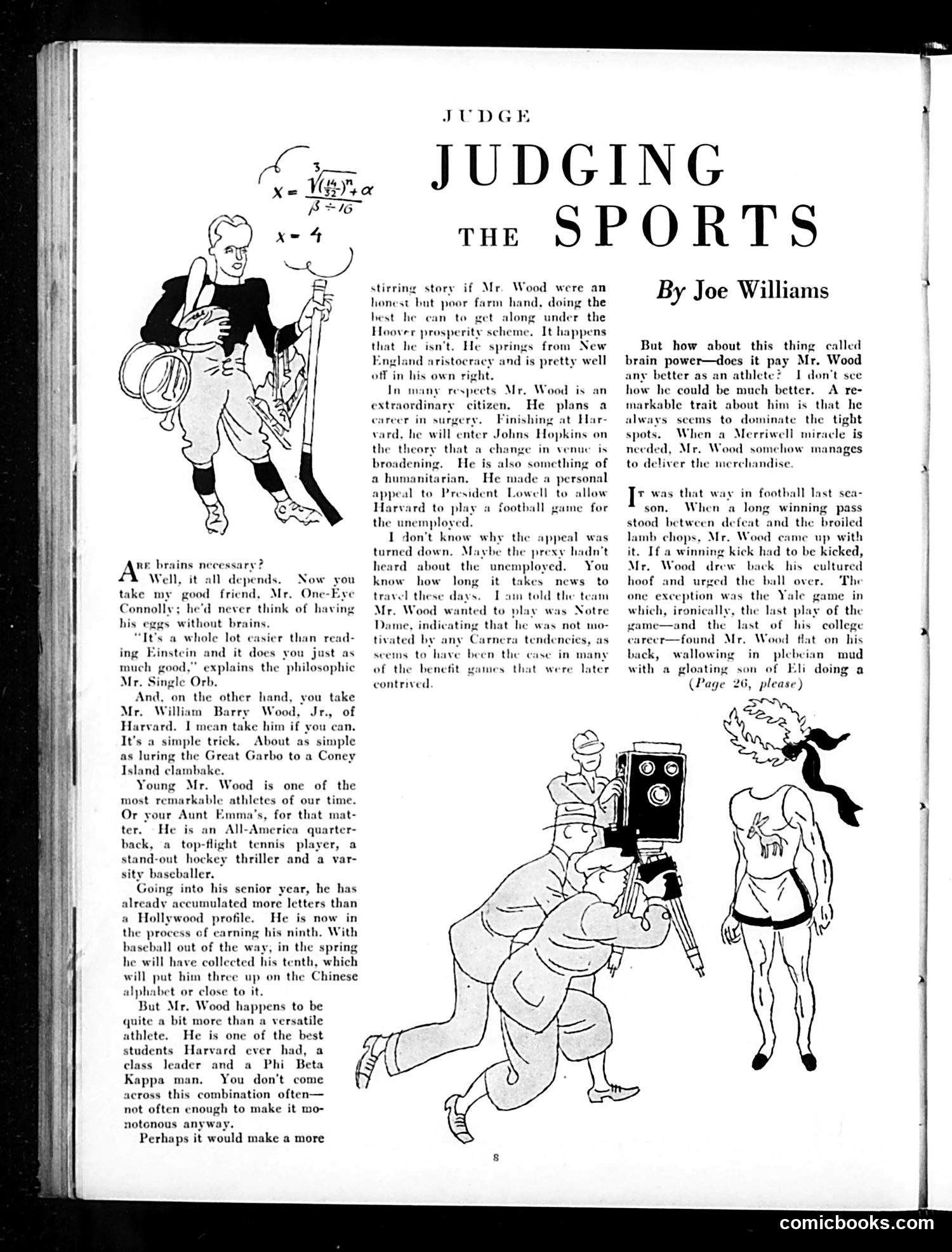
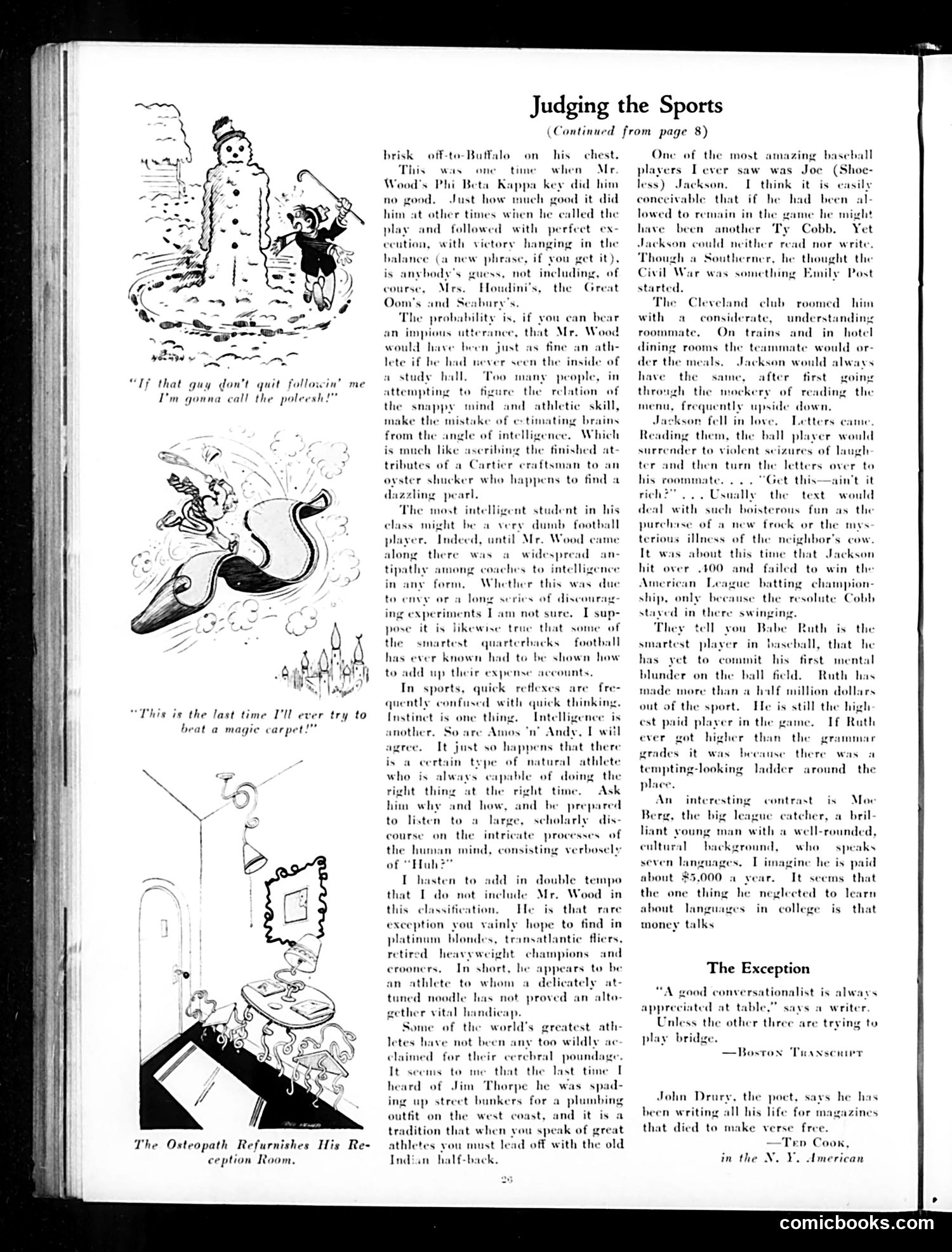
# Judging the Sports: William Barry Wood Jr. This article profiles William Barry Wood Jr., a Harvard student-athlete of exceptional accomplishment. The satire critiques the rarity of combining athletic excellence with genuine intellect and character. Wood is presented as an almost impossibly impressive figure: an All-American quarterback, top tennis player, hockey standout, varsity baseball player, and honor student (Phi Beta Kappa). The humor lies in the author's exaggerated amazement that such combinations exist at all—comparing his accumulated athletic letters to "the Chinese alphabet." The cartoon illustrations show photographers documenting Wood's athletic prowess, emphasizing how his achievements seem almost newsworthy or record-breaking. The piece gently mocks both the rarity of well-rounded excellence and the cultural obsession with athletic celebrities. The reference to "Hoover prosperity scheme" and mention of unemployed people suggests this article dates from the late 1920s-early 1930s, when such contrasts between privileged students and economic hardship carried particular weight.
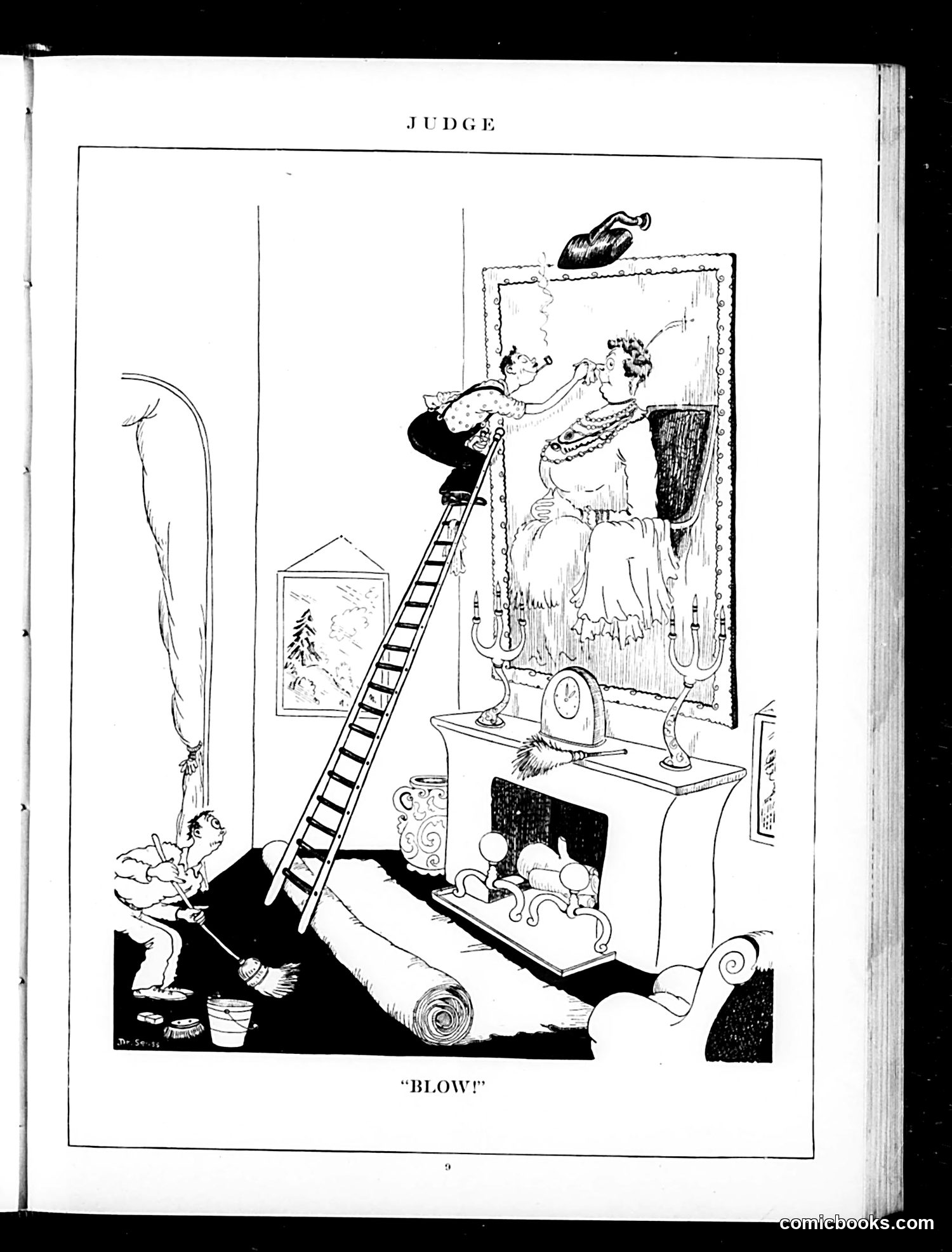
# "BLOW!" - Judge Magazine Cartoon This single-panel cartoon depicts a chaotic interior scene titled "BLOW!" A man on a ladder appears to be blowing air or smoke into an ornate picture frame containing a woman's portrait. Below, various figures and objects are scattered in disarray—including papers, vessels, and what appears to be someone being knocked back by the force. The composition suggests the act of "blowing" is causing widespread disruption and chaos in a refined domestic space. Without additional context or visible date/attribution, the specific political or social reference remains unclear. The cartoon likely satirizes either a particular public figure's actions or a general social phenomenon, but the exact target cannot be determined from the image alone. The humor appears to rely on visual chaos and the unexpected consequences of a simple action.
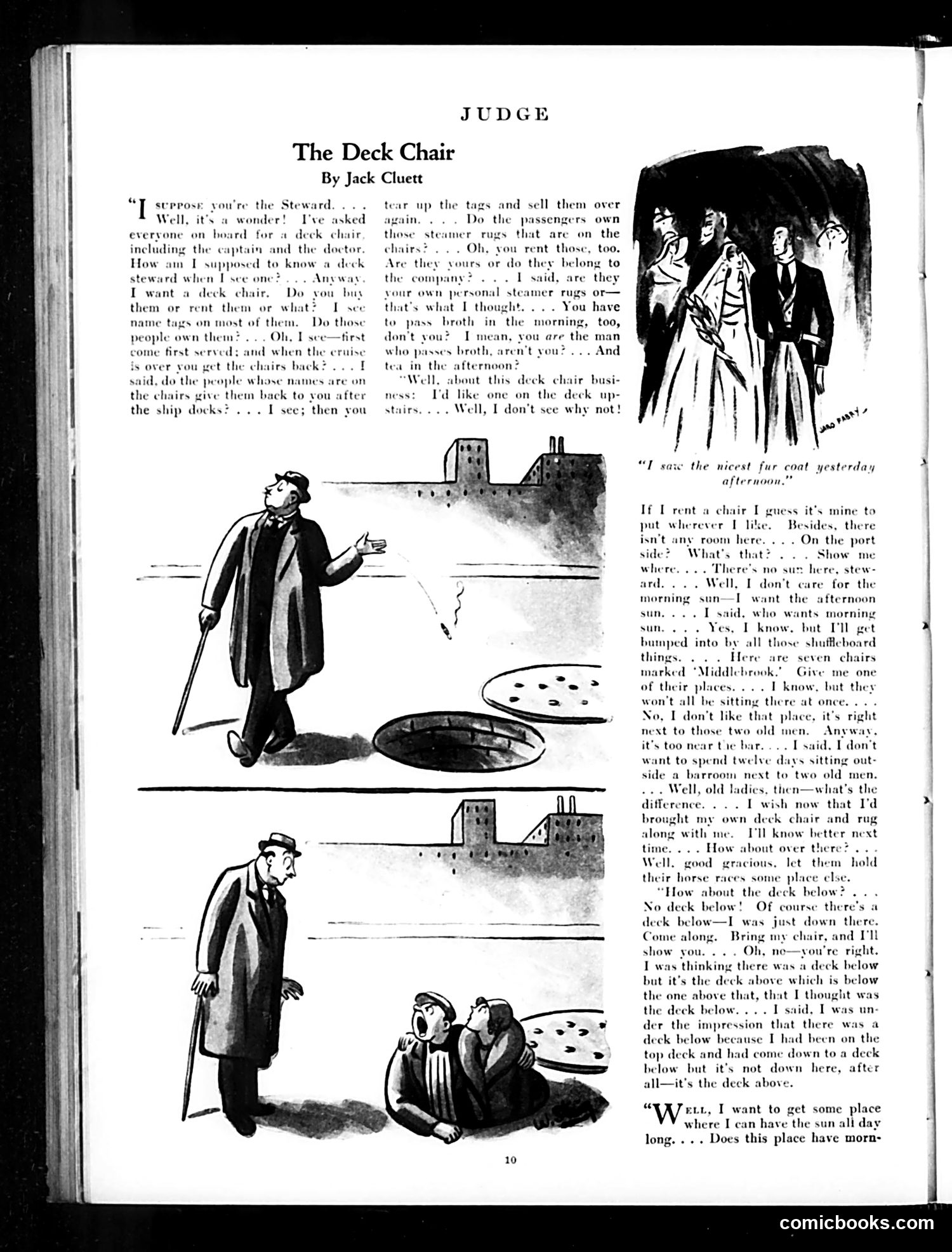
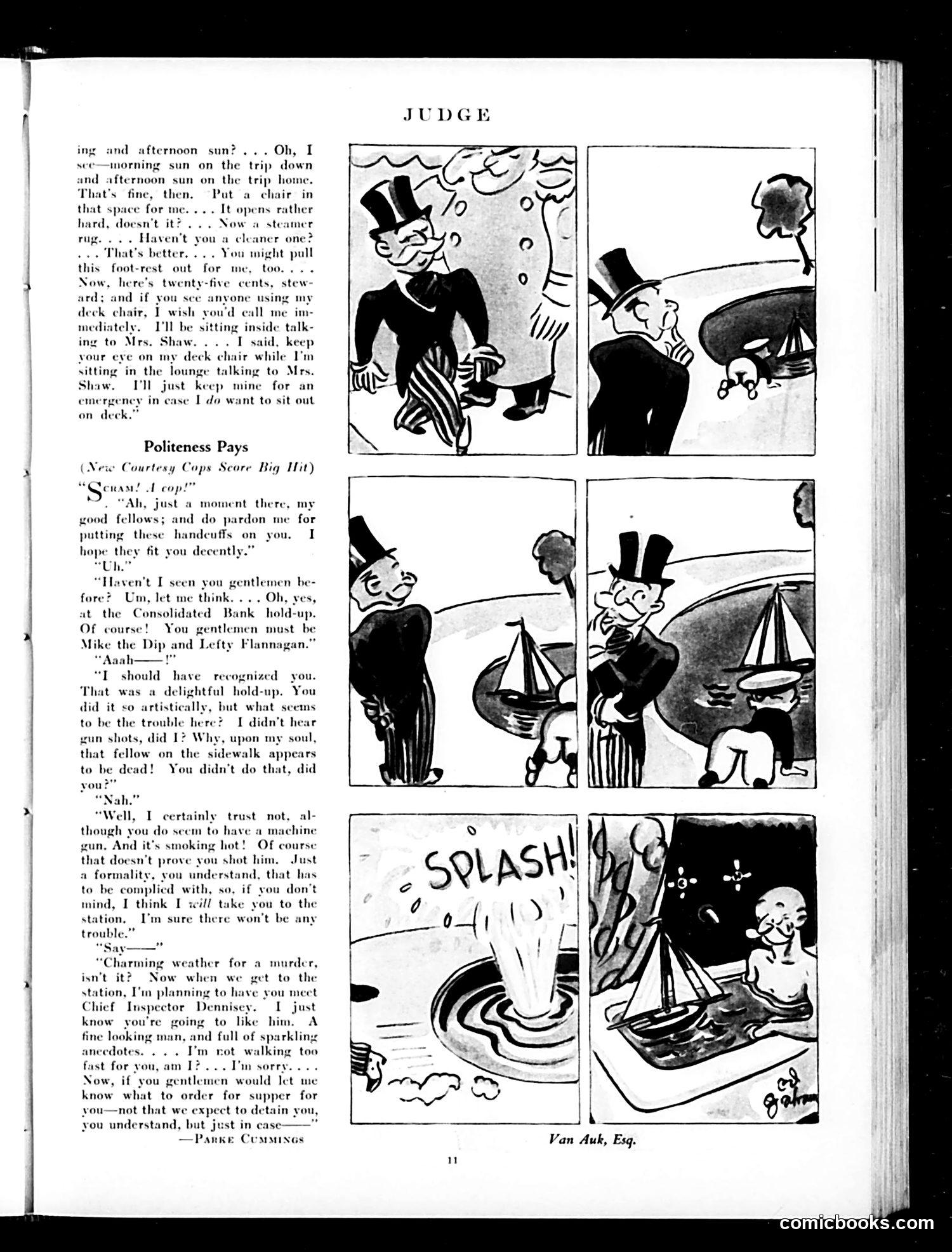
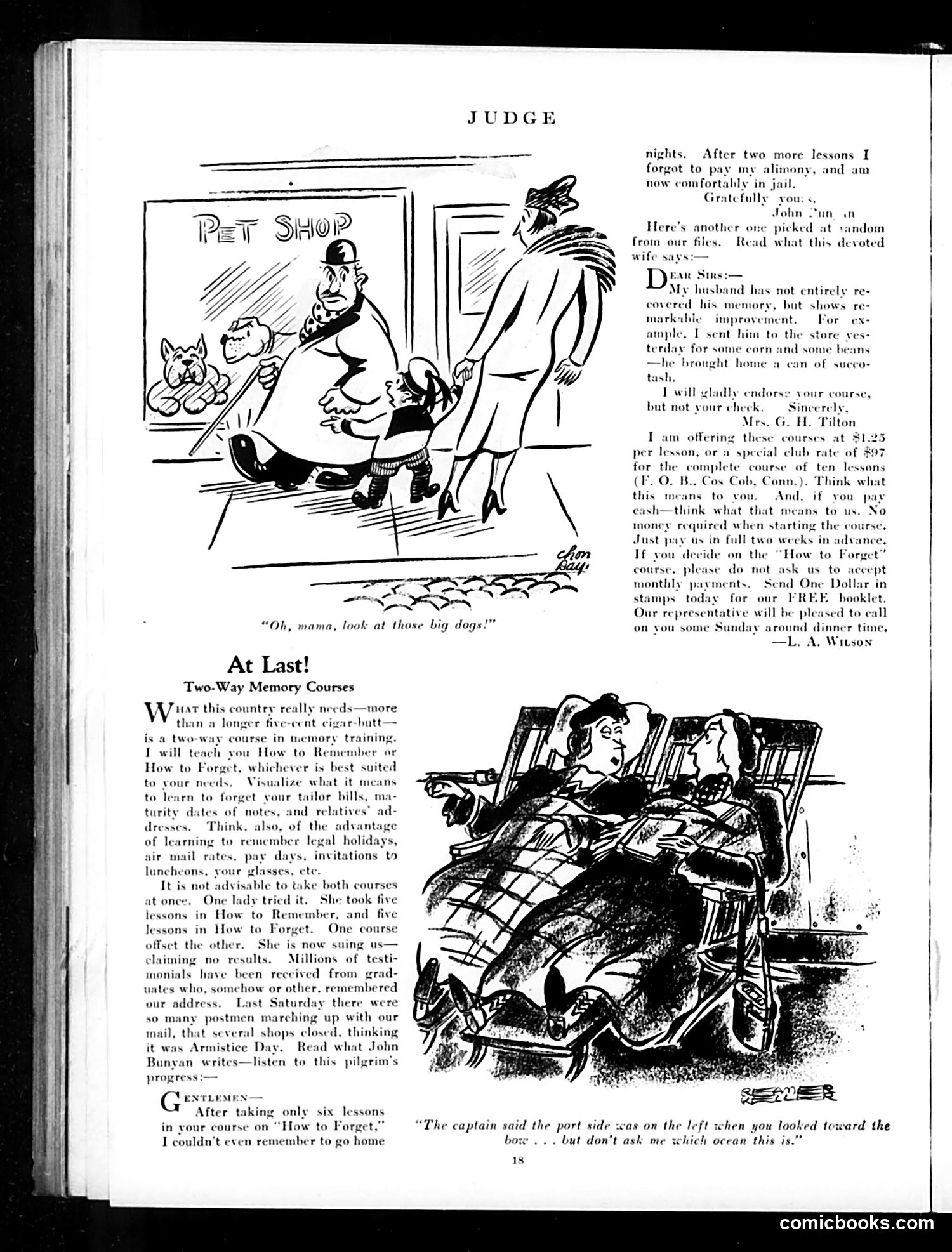
# "The Deck Chair" by Jack Cluett — Explanation This is a humorous story about a persistently demanding cruise ship passenger tormenting a steward. The passenger badgers him endlessly about obtaining a deck chair, asking nonsensical questions: Do passengers own the chairs? Can he place it anywhere? Who owns the steamer rugs? The satire targets the entitled, complaining leisure-class tourist of the early 20th century—someone obsessed with comfort and amenities while being fundamentally illogical and ungrateful. The passenger's circular complaints (confusion about "deck above" versus "deck below," wanting sun but avoiding crowds) reveal someone who cannot be satisfied regardless of accommodation. The illustrations show the steward's increasing exasperation as the passenger continues his absurd demands. The joke's point: some people will never stop complaining, no matter what service is provided. It's social commentary on cruise culture and passenger entitlement.