
Judge, 1932-01-30 · page 10 of 36
Judge — January 30, 1932 — page 10: what you’re looking at
What you’re looking at
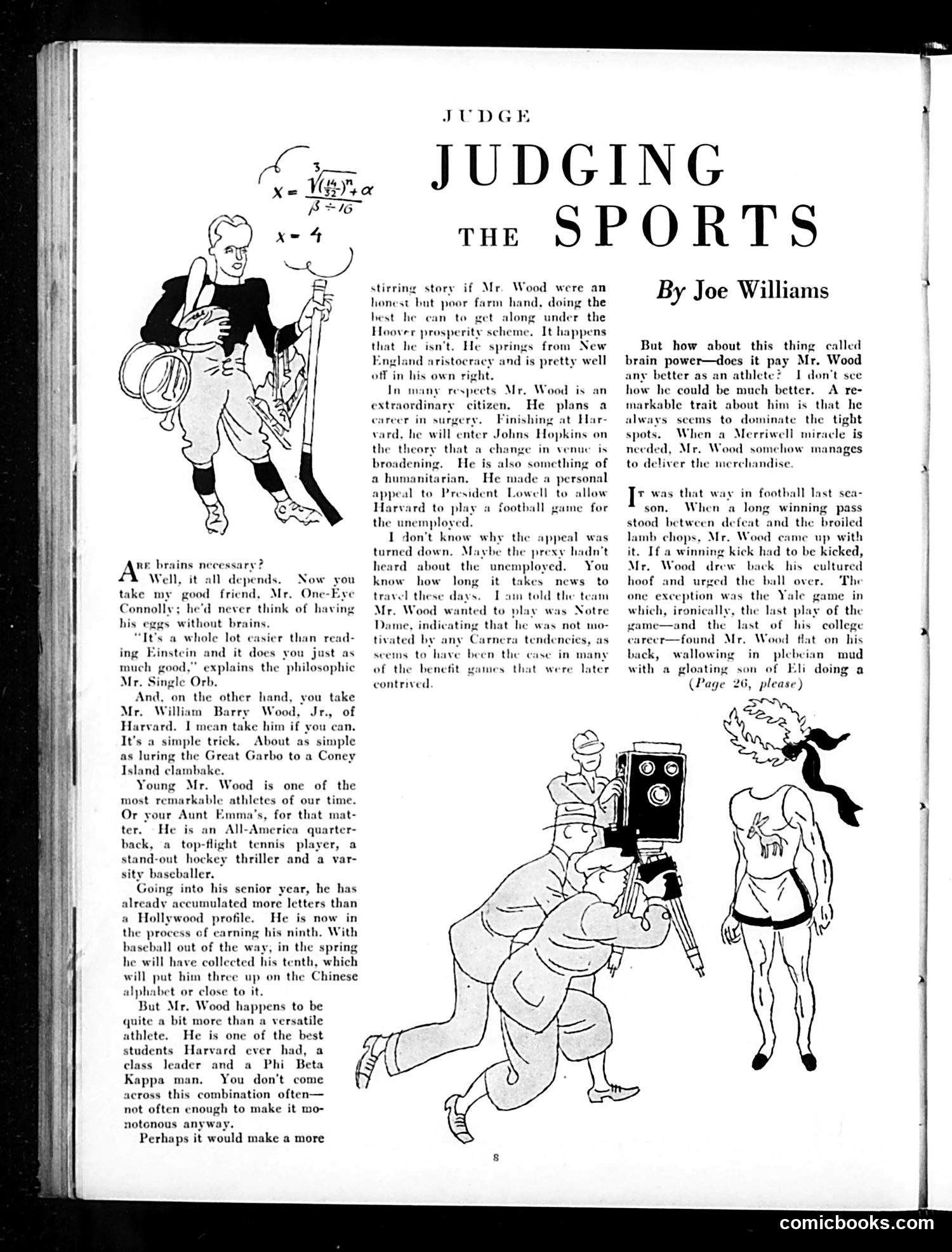
# Judging the Sports: William Barry Wood Jr. This article profiles William Barry Wood Jr., a Harvard student-athlete of exceptional accomplishment. The satire critiques the rarity of combining athletic excellence with genuine intellect and character. Wood is presented as an almost impossibly impressive figure: an All-American quarterback, top tennis player, hockey standout, varsity baseball player, and honor student (Phi Beta Kappa). The humor lies in the author's exaggerated amazement that such combinations exist at all—comparing his accumulated athletic letters to "the Chinese alphabet." The cartoon illustrations show photographers documenting Wood's athletic prowess, emphasizing how his achievements seem almost newsworthy or record-breaking. The piece gently mocks both the rarity of well-rounded excellence and the cultural obsession with athletic celebrities. The reference to "Hoover prosperity scheme" and mention of unemployed people suggests this article dates from the late 1920s-early 1930s, when such contrasts between privileged students and economic hardship carried particular weight.
📄 Transcribed text from this page (OCR, searchable)
Machine-transcribed from the original scan — historical spelling and the odd misread are preserved.
re brains necessary? Well, it all depends. Now you e my friend, Mr. One Connolly; he'd never think of hav his zs without bra “It’s a whole lot easier than re ing Einstein and it does you just as much good,” explains the philosophic Mr. Single Orb. And, on the other hand, you take Mr. William Barry Wood, Jr., of Harvard. I mean take him if you can, It's a simple trick. About as simple as luring the Great Garbo to a Coney Island clambake. Young Mr. Wood is one of the most remarkable athletes of our time. Or your Aunt Emma's, for that mat- He is an All-America quarter- ck, a top-flight tennis player, a stand-out hockey thriller and a var- sity baseballer. Going into his senior year, he has already accumulated more letters than a Hollywood profile. He is now in the process of earning his ninth. With baseball out of the way the spring he will have collected his tenth, which will put him three up on the Chinese alphabet or close to it. But Mr. Wood happens to be quite a bit more than a versatile athlete. He is one of the best students Harvard ever had, a class leader and a Phi Beta Kappa man. You don’t come across this combination often— not often enough to make it mo- notonous anyway. Perhaps it would make a more JUDGE JUDGING rue SPORTS stirring story if Mr. Wood were an honest but poor farm hand, doing the hest he can to get along under the Hoover prosperity scheme. It happens t he isn’t. He springs from New and aristocracy and is pretty well off in his own right. In many respects Mr. Wood is an extraordinary citizen. He plans a career in surgery. Finishing at Har- vard, he will enter Johns Hopkins on the theory that a change in venue is broadening. He is also something of a humanitarian. He made a personal appeal to President Lowell to allow Harvard to pla the unemployed. I don't know why the turned down. Maybe the p heard about the unemple know how long it takes news to travel these days. Iam told the team Mr. Wood wanted to play was Notre Dame, indicating that he was not mo- tivated by any € seems to have been the case in many football game for appeal was mera tendencies, as of the benefit games that were later contrived By Joe Williams But how about this thing called brain power—does it pay Mr. Wood . better as an athlete? I don’t see how he could be much better. A re- markable trait about him is that he always scems to dominate the tight spots. When a Merriwell miracle is necded, Mr. Wood somehow manages to deliver the merchandise. I" was that way in football last sea- son. When a long winning pass stood between defeat and the broiled lamb chops, Mr. Wood came up with it. If a winning kick had to be kicked, Mr. Wood drew back his cultured hoof and urged the ball over. ‘The one exception was the Yale game in w ironically, the last play of the yame—and the last of his’ college career—found Mr. Wood flat on his back, wallowing in’ plebeian mud with a gloating son of Eli doing a (Page 26, please) sN ry comicbooks.com