
Judge, 1932-01-30 · page 26 of 36
Judge — January 30, 1932 — page 26: what you’re looking at
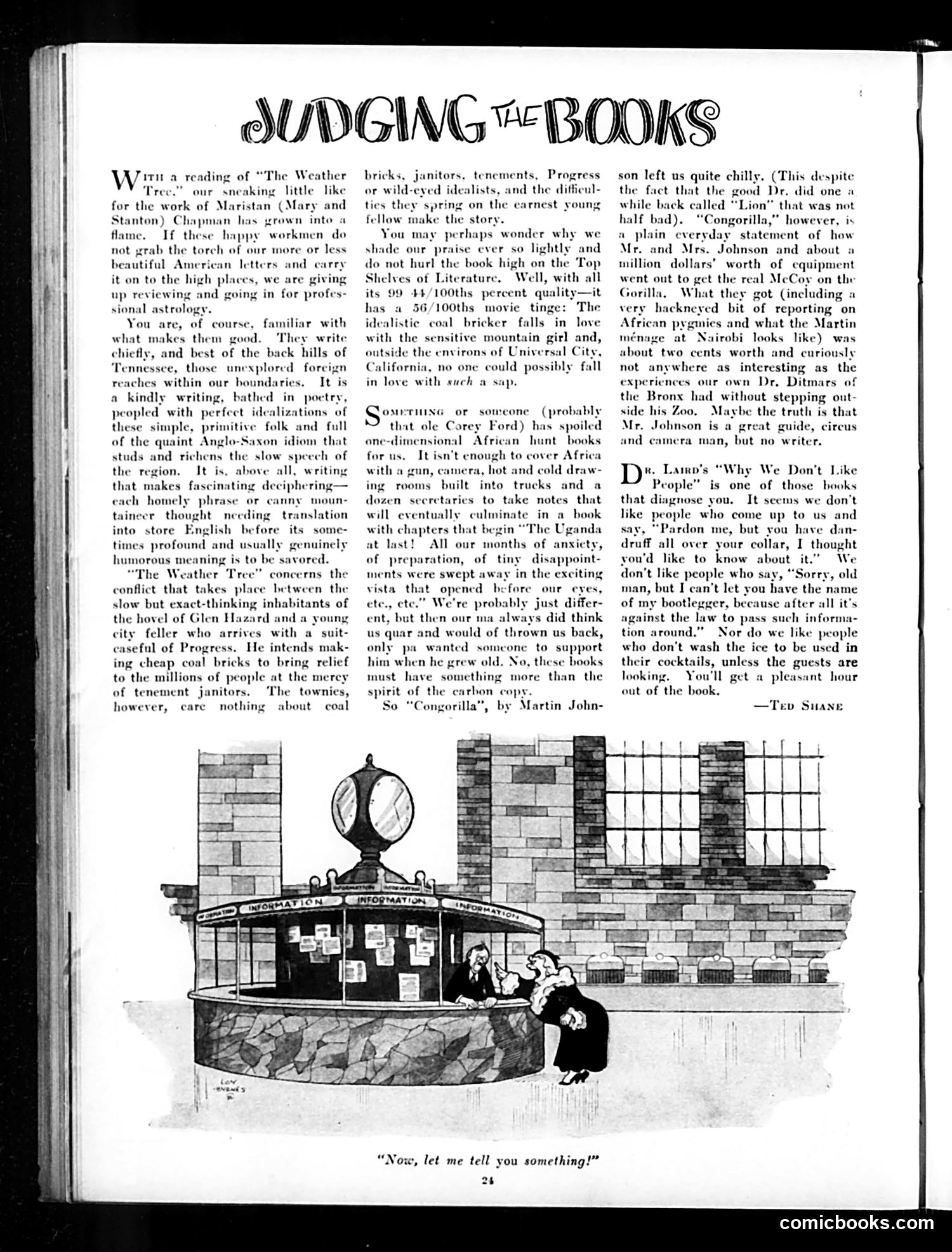
A restored page from Judge, 1932-01-30. Page through the whole issue in the reader above.
📄 Transcribed text from this page (OCR, searchable)
Machine-transcribed from the original scan — historical spelling and the odd misread are preserved.
Wwe a reading of “The Weather Tree.” our sneaking little like for the work of Maristan (Mary and Stanton) Chapman has grown into a flame. If these happy workmen do not grab the torch of our more or less beautiful American letters and it on to the high places, we are g up reviewing urry ring nd going in for profes- sional astrology. You are, of course, familiar with them good. They write d best of the back hills of those unexplored foreign reaches within our boundaries. It is a kindly writing, bathed in’ poetry, peopled with perfect idealizations of these simple, primitive folk and full of the quaint Anglo-Saxon idiom that studs and richens the slow speech of the r Hl, writing hering— ich homely phrase or canny moun- taineer the needing translation into inglish before its some- times profound and usually genuinely humorous meaning is to be savored. “The Weather Tree” concerns the conflict that takes pla tween the slow but exact-thinking inhabitants of the hovel of Glen Hazard and a young city feller who arrives with a’ suit- caseful of Progress. He intends mak- ing cheap coal bricks to bring relief to the millions of people at the mercy of tenement janitors. The townies, nothin about coal store however, care janitors, tenements, Progress ed idealists, and the diflieul- ties they spring on the carnest young fellow make the story. You may perhaps wonder why we shade our praise ever so lightly do not hurl the book high on the Top Shelves of Literature. Well, with all its 99 44/100ths percent quali has «a 56/100ths movie tin idealistic bricker falls in coal love with the sensitive mountain girl and, outside the environs of Universal City, California, no one could possibly fall in love with such a sap. Souetmsa or someone (probably that ole Corey Ford) has spoiled one-dimensional Afri hunt books for us. It isn't enough to cover Africa with a gun, camera, hot and cold draw- ing rooms built into trucks and a dozen secretaries to take notes that will eventually culminate in a book with chapters that begin “The Uganda at last! All our months of an of preparation, of tiny disappoint- ments were swept away in the exciting fore our eyes, We're probably just diifer- ent, but then our ma always did think us quar and would of thrown us back, only pa wanted someone to support him when he grew old. No, these books must have something more than the spirit of the carbon copy. So “Congorilla”, by Martin John- son left us quite chilly. (This despite the fact that the good Dr. did one a while back called “Lion” that was not half bad). “Congorilla,” however, is a plain everyday statement of how Mr. and Mrs. Johnson and about a million dollars’ worth of equipment went out to get the real MeCoy on the Goril What they got (including a very d bit of reporting on Afric and what the Martin ménage airobi looks like) was about two cents worth and curiously not anywhere as interesting as the experiences our own Dr. Ditmars of the Bronx had without stepping out- side his Zoo. Maybe the truth is that Mr. Johnson is a great guide, circus and camera man, but no writer. D": Lainp’s “Why We Don't Like People” is one of those books that diagnose you. It seems we don't like people who come up to us and say, “Pardon me, but you have dan- druff all over your collar, I thought you'd like to know about it.” We don’t like people who say, “Sorry, old man, but I can’t let you have the name of my bootlegger, because after all it's ainst the law to pass such informa- tion around.” Nor do we like people who don’t wash the ice to be used in their cocktails, unless the guests are looking, You'll get a pleasant hour out of the book, —Tepv Suane “Now, let me tell you something!” 26 comicbooks.com