
Judge, 1932-01-30 · page 34 of 36
Judge — January 30, 1932 — page 34: what you’re looking at
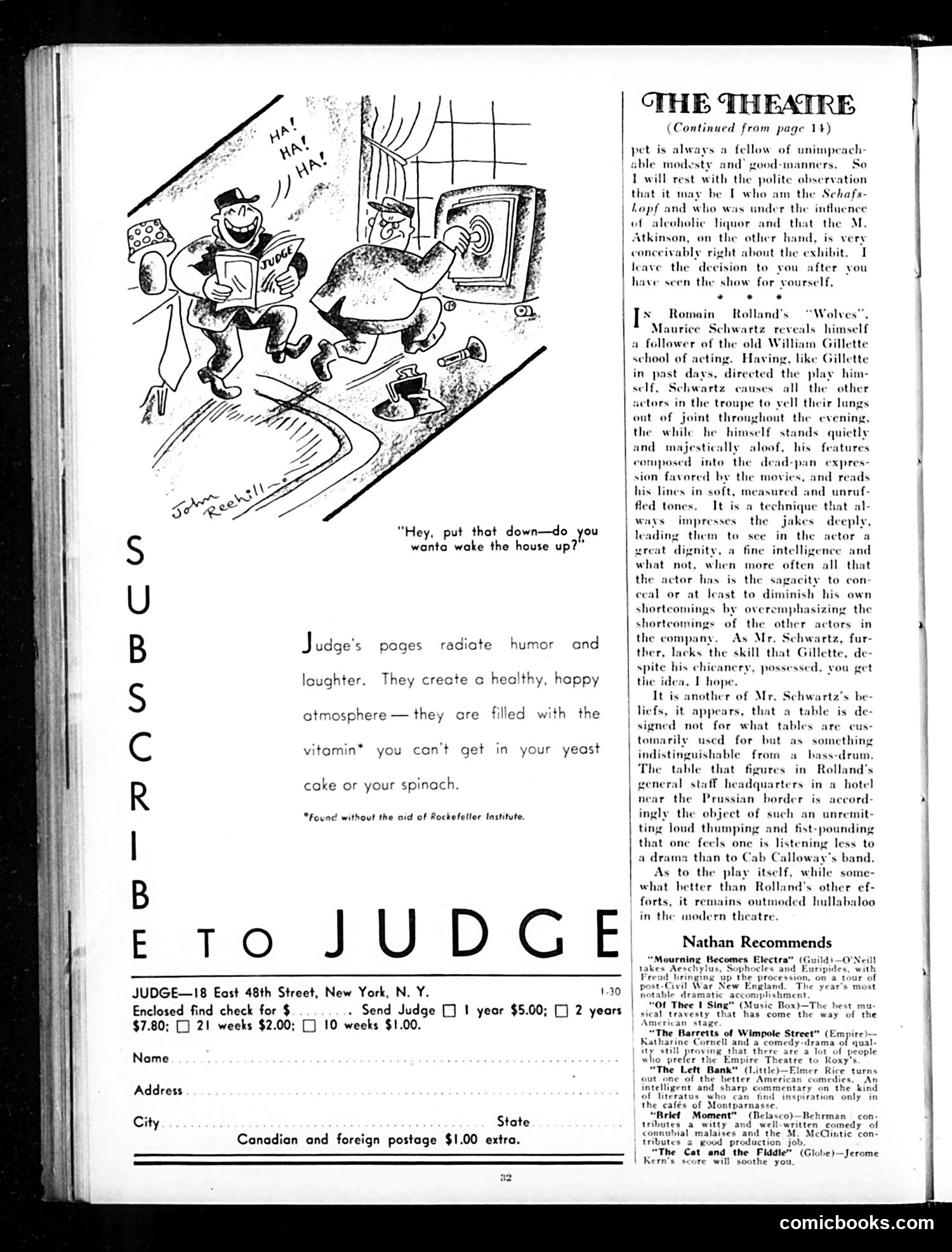
A restored page from Judge, 1932-01-30. Page through the whole issue in the reader above.
📄 Transcribed text from this page (OCR, searchable)
Machine-transcribed from the original scan — historical spelling and the odd misread are preserved.
E $7.80; Name Address City TO 21 weeks $2.00; “Hey, put thot down—do wanta wake the house up?" Judge's pages radiate humor ond loughter. They create a healthy, happy atmosphere — they ore filled with the vitamin® you can't get in your yeast cake or your spinach. “Found without the oid of Rockefeller Institute. JUDCE JUDGE—18 East 48th Street, New York, N. Y. 1.30 Enclosed find check for $ « Send Judge [] | year $5.00; [1] 2 years [1] 10 weeks $1.00. State Canadian and foreign postage $1.00 extra. CTHE THEATRE (Continued from page 14) pet is always a fellow of unimpeach able modesty and? good-manners. So 1 will rest with the polite observation that it may be I who am the Schafs- Lopf and who was under the influence of alcoholic liquor and that the M. Atkinson, on the other hand, is very conceivably right about the exhibit. I leave the decision to you after you have seen the show for yourself. “8 6 Romain Rolland’s “Wolves”. Maurice Schwartz reveals himself a follower of the old William lette school of acting. Having, like Gillette in past days, directed the play him- self, Schwartz causes all the other actors in the troupe to yell their lungs out of joint throughout the evening, the while he himself stands quietly and ma compose estically aloof. 1 into the dead-pan_ expres- sion favored by the movies, and reads his lines in soft, measured and unruf- fled tones. It is a technique that al- ways impresses the jakes deeply, leading them to see in the actor a ureat dignity, a fine intelligence and what not, when more often all that the actor has is the s. features city to con least to diminish his own s by overemphasizing the shortcomings of the other actors in the company. As Mr. Schwartz, fur- ther, lacks the skill that Gillette, de- spite his chicanery, possessed. you get the idea, I hope. It is another of Mr. Schwartz's be- liefs, it appears, that a table is de- signed not for what tables are cus- tomarily used for but as something indistinguishable from a ceal or 4 shorteom ss-drum, | The table that figures in Rolland’s general staff headquarters in a hotel near the Prussian border is aceord- ingly the object of such an unremit- loud thumping and fist-pounding t one feels ¢ is listening less to a drama than to Cab Calloway’s band. As to the play itself, while some- what better than Rolland’s other ef- forts, it remains outmoded hullabaloo in the modern theatre. Nathan Recommend: “Mourning Becomes Electra’ takes Aeschylus, Sophocles an Freud bringing up the processic 2 post-Civil War New England. The year's most able dramatic accomplishment ‘Of Thee 1 Sing” (Music Box)—The hest mu- | travesty that has come the way of the crican stage The Barretts of Wimpole Street” (Empire ‘ornell and a comedy-drama of ving er the Katharine ( > Ny. still py who pref ire Theatre to (Little)—El the better A and sharp ¢ of literatus who can fir the cafés of Montparnasse. “Briet_ Moment” (Belasco)—Behrman con es a witty well-written comedy of connubial malaises and the M. McClintic con- ction job. and the Fiddle” (Globe)—Jerome € will soothe you. Rice turns es. An he kind inspiration only in | Kern's sc ~ comicbooks.com