
Judge, 1932-01-30 · page 16 of 36
Judge — January 30, 1932 — page 16: what you’re looking at
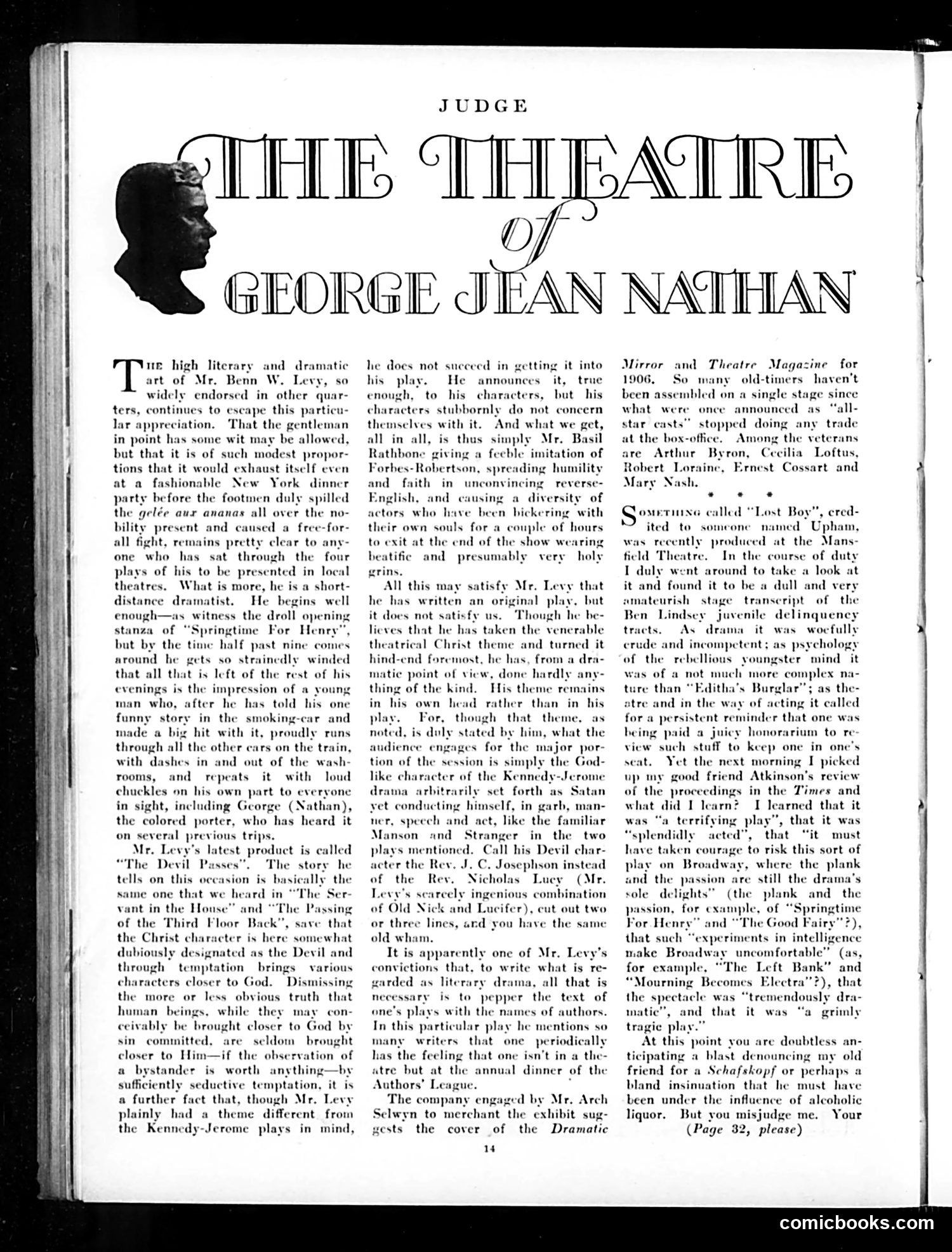
A restored page from Judge, 1932-01-30. Page through the whole issue in the reader above.
📄 Transcribed text from this page (OCR, searchable)
Machine-transcribed from the original scan — historical spelling and the odd misread are preserved.
a Soa arn mete JUDGE GEORGE J ne high literary and dramatic rt of Mr. Benn W. Levy, so widely endorsed in other q ters, continues to escape this particu- lar appreciation. That the gentleman in point has some wit may be allowed, but that it is of such modest propor- tions that it would exhaust itself even at a fashionable New York dinner party before the footmen duly spilled aur ananas all over the no- aused all fight, remains pretty ele ' one who has sat through the four plays of his to be presented in local theatres, What is more, he is a short- distance dramatist. He begins well enough—as witness the droll opening stanza of “Springtime For Henry” but by the time half past nine comes around he gets so strainedly winded that all that is left of the rest of his evenings is the impression of a you man who, after he has told his one funny story in the smoking-car and ade a biz hit with it, proudly runs through all the other cars on the train, with d 1 out of the wash- rooms, and repeats it with loud chuckles on his own part to everyone in sight, including George (Nathan), the colored porter, who has heard it on several previous trips. Mr. Levy's latest product is called “The Devil Passes’. The story he tells on this occasion is basically the same one that we heard in “The Ser vant in the House” and “The Passing of the Third Floor Back’, save that the Christ chars ar shes in ter is here somewhat dubiously designated as the Devil and through temptation brings various characters closer to God. Dismissing the more or less obvious truth that human beings, while they m ceivably be brought closer to sin committed, are seldom b closer to Him—if the obs stander is worth anything—by ently seductive temptation, it is a further fact that, though Mr. Levy plainly had a theme different from the Kennedy-Jerome plays in mind, he does not succeed in getting it into his play. He announces it, true enough, to his characters, but his characters stubbornly do not concern themselves with it. And what we get, all in all, is thus simpy Mr. Basil Rathbone giving a feeble ation of Forhes-Robertson, spreading humility nd faith in unconvincing reverse- iversity of actors who have been bickering with their own souls for a couple of hours to exit at the end of the show wearing beatific and presumably very holy grins. All this may satisfy Mr. Levy that he has written an original play, but it does not satisfy us. Though he be- lieves that he taken the venerable theatrical Christ theme and turned it hind-end foremost, he has, from a dra- matic point of view, done hardly any thing of the kind. His theme remains in his own head rather than in’ his Y For, though that theme, as noted, is duly stated by him, what the audience engages for the major por- inglish, and causing a tion of the session is simply the God- like el rr of the Kennedy-Jerome rily set forth as Satan yet conducting himself, in garb, man- ner, specch and act, like the familiar Manson and Stranger in the two plays mentioned. Call his Devil char- acter the Rev. J. C. Josephson instead of the Rev. Nicholas Luey (Mr. Levy's scarcely ingenious combination of Old Nick and Lucifer), cut out two or three lines, and you have the same old wham. It is apparently one of Mr. Le convictions that, to write what is re garded as literary drama, all that is necessary is to pepper the text of one’s plays with the names of authors. In this particular play he mentions so many writers that one periodically has the feeling that one isn’t in a the- atre but at th anual dinner of the Authors’ 1 . The company ¢ Selwyn to merch gests. the "s zed by Mr. Arch nt the exhibit sug- cover of the Dramatic 4 ACRES NACTHIAN Mirror and Theatre Magazine for 1906, So many old-timers haven't been assembled on a single stage since what were once announced as “all- star casts” stopped doing any trade at the box-office. Among the veterans are Arthur Byron, Cecilia Loftus, Robert Loraine, Ernest Cossart and Mary Nash. * 8 « Someta called “Lost I , ered- ited to someone named Upham, was recently produced at the Mans- field Theatre. In the course of duty I duly went around to take a look at it and found it to be a dull and ve amateurish stage transcript of th Ben Lindsey juvenile delinquency tracts. As drama it) was woefully crude and incompetent; of the rebellious you was of a not much more complex na- ture than “Editha’s Burglar’; as the- atre and in the w acting it called s psychology ter mind it for a persistent reminder that one was being paid a juicy honorarium to re view such stuff to keep one in one’s seat. Yet the next morning I picked up my good friend Atkinson's review of the proceedings in the Times and what did I les arned that it was “a tert y", that it was “splendidly acted”, that “it must have taken courage to risk this sort of ', where the plank still the drama’s > plank and the sole delights” passion, for ex: For Henry that such “experiments in intelligence make Broadway uncomfortable” (as, for example, “The Left Bank” and “Mourning Becomes Electra’”?), that the spectacle was “tremendously dra- it was “a grimly wie play.” At this point you are doubtless an- ting a blast denouncing my old friend for a Schafskopf or perhaps a Mand insinuation that he must have been under the influence of alcoholic liquor. But you misjudge me. Your (Page 32, please) comicbooks.com