A complete issue · 36 pages · 1931
Judge — November 28, 1931
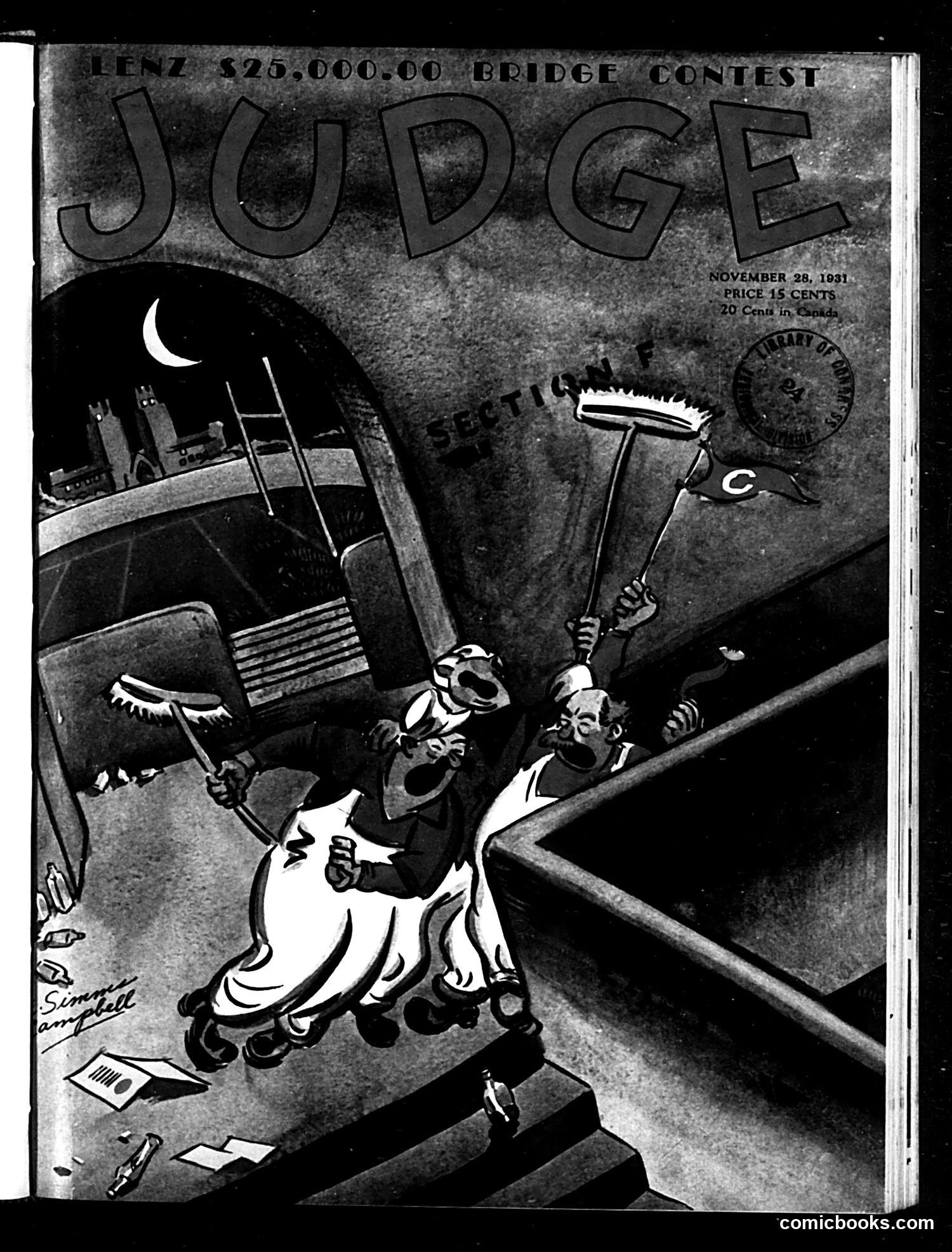
# Judge Magazine Cover Analysis This November 28, 1931 *Judge* cover depicts a bridge-building contest with exaggerated cartoon figures attempting to construct or repair a bridge structure. The imagery appears to be satirizing political or economic efforts during the Great Depression—a period when Americans were desperate for solutions to economic collapse. The "bridge" likely symbolizes economic recovery or financial restoration. The cartoonish workers struggling with their tools suggest satire about politicians' or leaders' incompetent attempts to fix the economy. The nighttime setting and precarious positioning emphasize the danger and difficulty of the situation. The Heinz $25,000 prize contest reference in the header suggests this ties to a contemporary commercial competition, possibly used as commentary on misplaced priorities during economic crisis.
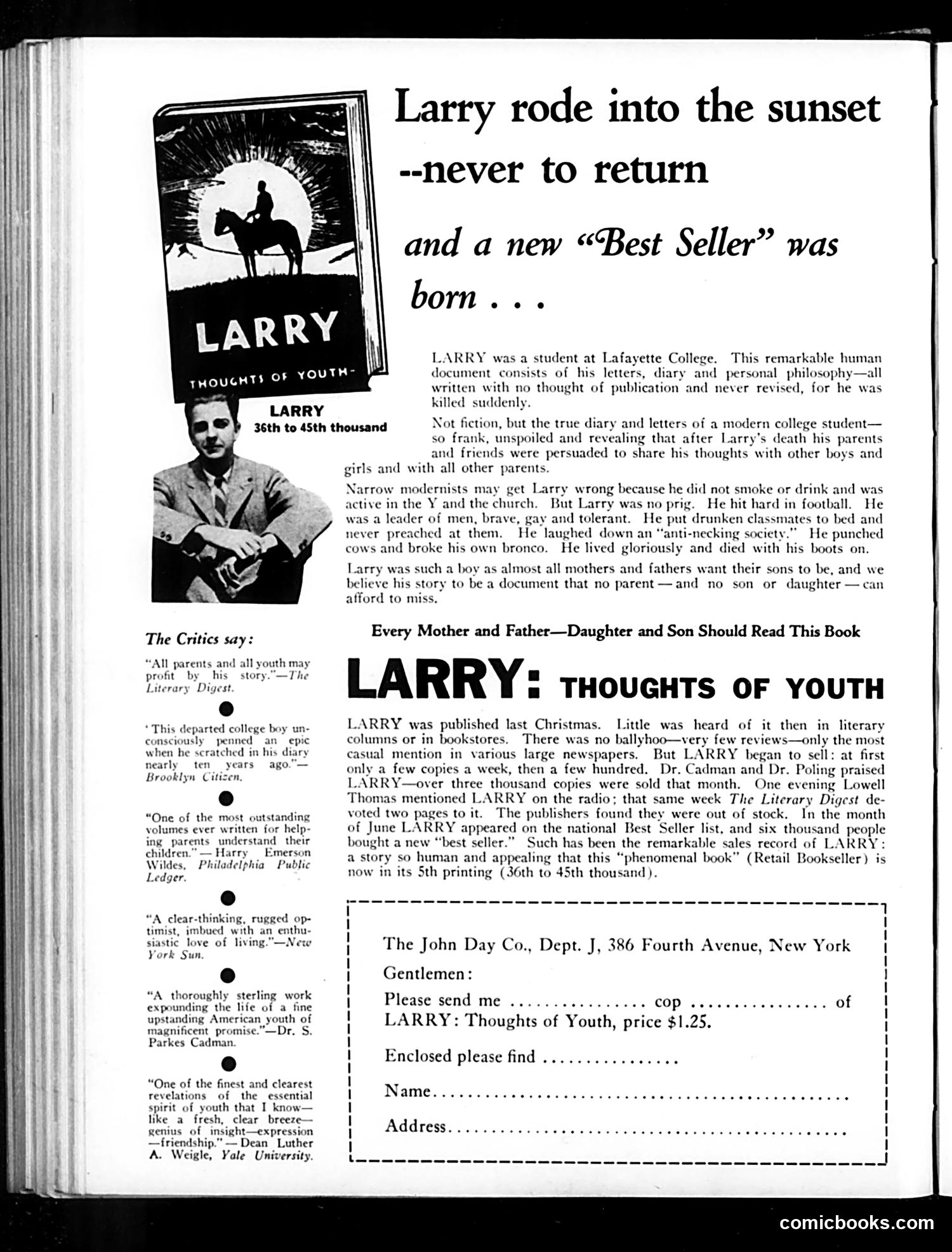
# Analysis of Judge Magazine Page This page is primarily **a book advertisement**, not political satire. It promotes *"Larry: Thoughts of Youth,"* a posthumous publication of letters and diary entries from Larry, a Lafayette College student who died suddenly. The marketing emphasizes Larry's everyman appeal: he was athletic, irreverent toward authority, drank and fought, yet morally earnest—a "boy as almost all mothers and fathers want their sons to be." Contemporary critics praised it as authentic youth commentary. The advertisement targets parents and families, positioning the book as essential reading that candidly reveals modern college student life. The dramatic "rode into the sunset—never to return" framing romanticizes the deceased author, marketing his tragic early death as adding poignancy to his genuine voice. This reflects early-20th-century publishing trends valorizing authentic youth narratives.
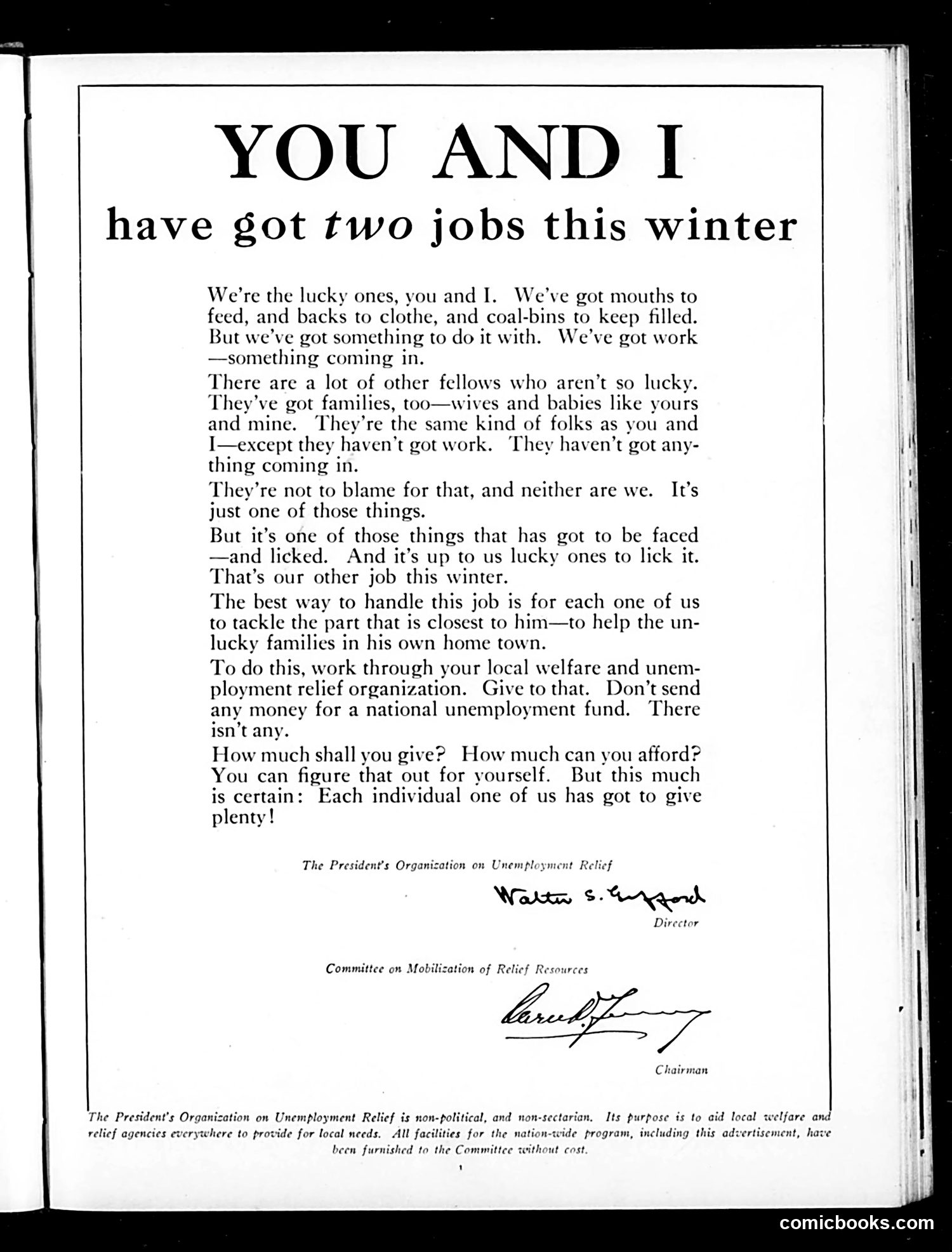
# Analysis This page contains a serious public service announcement, not satire. It's signed by Walter S. Gifford (Director of The President's Organization on Unemployment Relief) and appears to reference Depression-era relief efforts, likely early 1930s based on the language about winter hardship. The message appeals to employed citizens to help unemployed families through local welfare organizations rather than national funds. It emphasizes personal responsibility: those with jobs should donate "plenty" to aid their less fortunate neighbors. Rather than humor or satire, *Judge* magazine here uses its platform for civic advocacy—urging readers with employment to contribute locally to unemployment relief during economic crisis. The formal signatures and earnest tone reflect the gravity of Depression-era poverty.
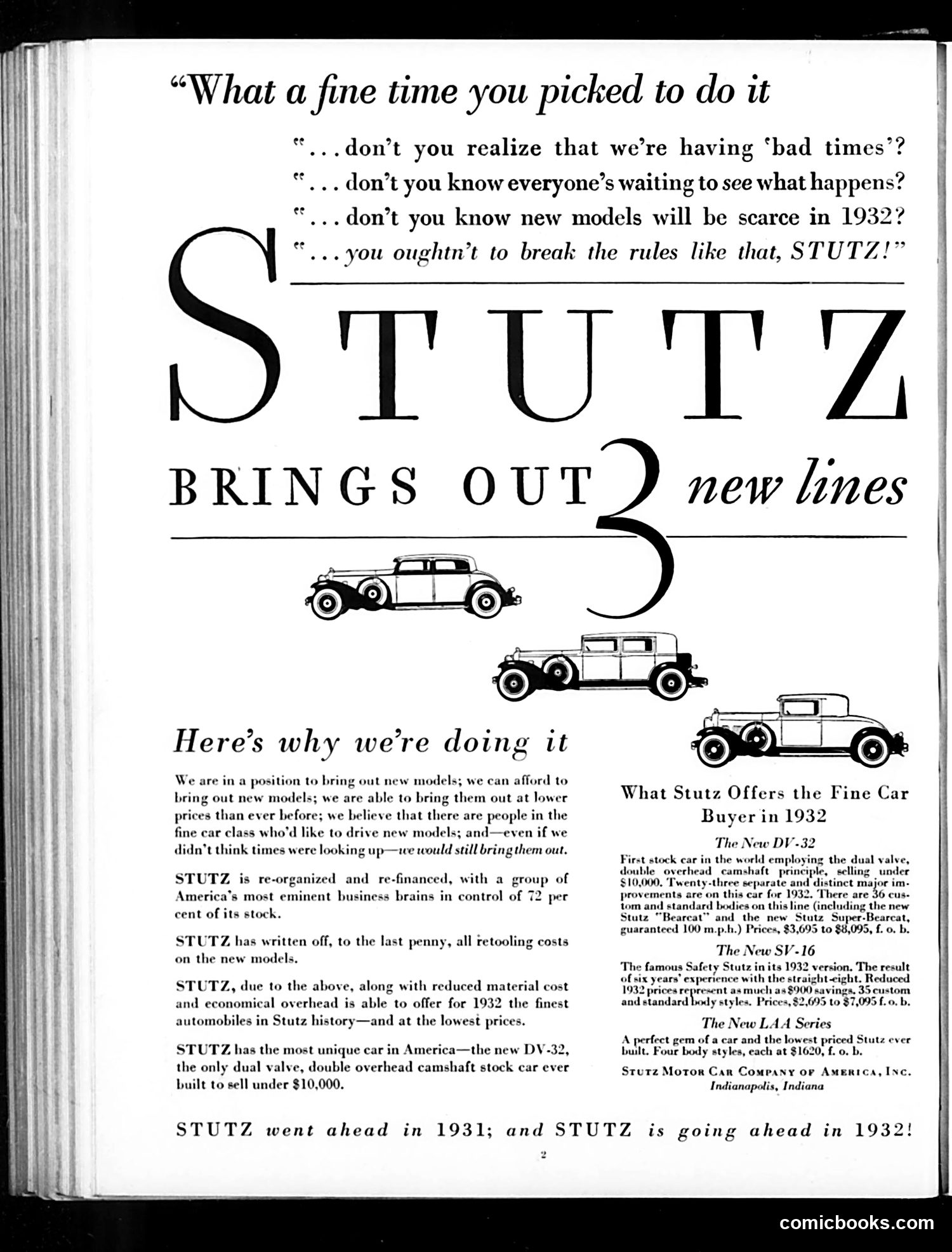
# Analysis This is primarily a **Stutz automobile advertisement**, not political satire. The page features dialogue criticizing Stutz's decision to launch three new car lines during the Great Depression (1932). The opening quote frames the announcement as poor timing—the public questions why the company would introduce new models when "we're having 'bad times'" and "new models will be scarce in 1932." The accusatory tone ("you ought to break the rules like that, STUTZ!") is sarcastic. However, the ad then pivots to justify the decision: Stutz claims reorganization and refinancing allowed them to afford new production while maintaining low prices. The advertisement emphasizes innovation (the dual-valve DV-32 model) and affordability as countercyclical strategies. Rather than satire, this represents **Depression-era marketing**: using apparent criticism as a rhetorical device to demonstrate confidence and business acumen during economic crisis.
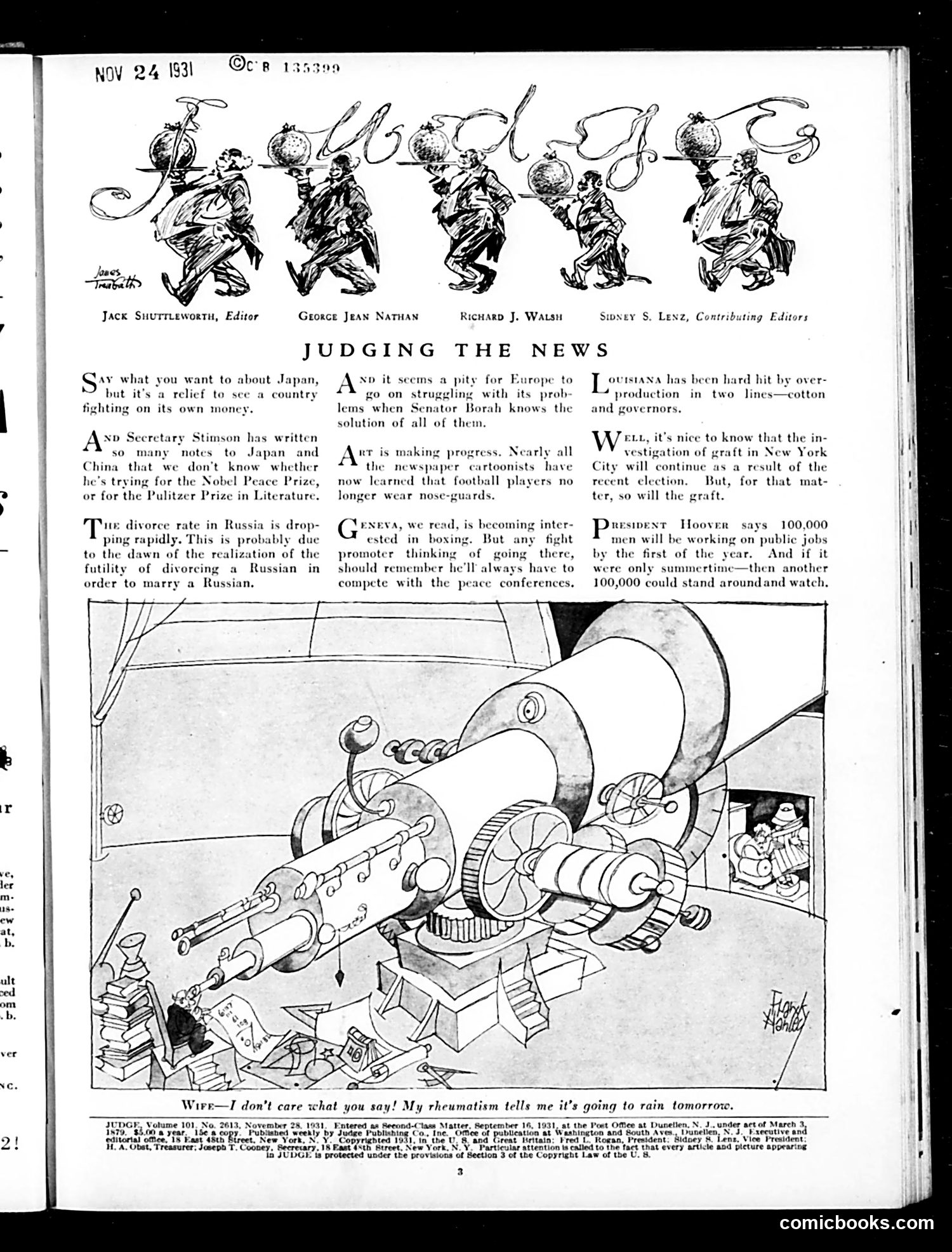
# Analysis of Judge Magazine Page, November 24, 1931 The page's main cartoon depicts an elaborate, absurdly complex mechanical contraption labeled "Wife—I don't care what you say! My rheumatism tells me it's going to rain tomorrow." **The Satire:** This illustrates a common domestic joke—a wife claiming she can predict weather through her physical ailments, despite her husband's skepticism. The ridiculously over-engineered machine represents his futile attempt to "scientifically" prove her wrong. The humor derives from the contrast between masculine rationality (represented by the complicated apparatus) and intuitive, body-based female knowledge that often proves correct anyway. The upper section features editorial commentary on contemporary issues: Japan's internal problems, European struggles, Russian divorce rates, boxing, newspaper cartoons, New York graft investigations, and public employment under President Hoover—typical satirical fodder for 1931's Great Depression era.
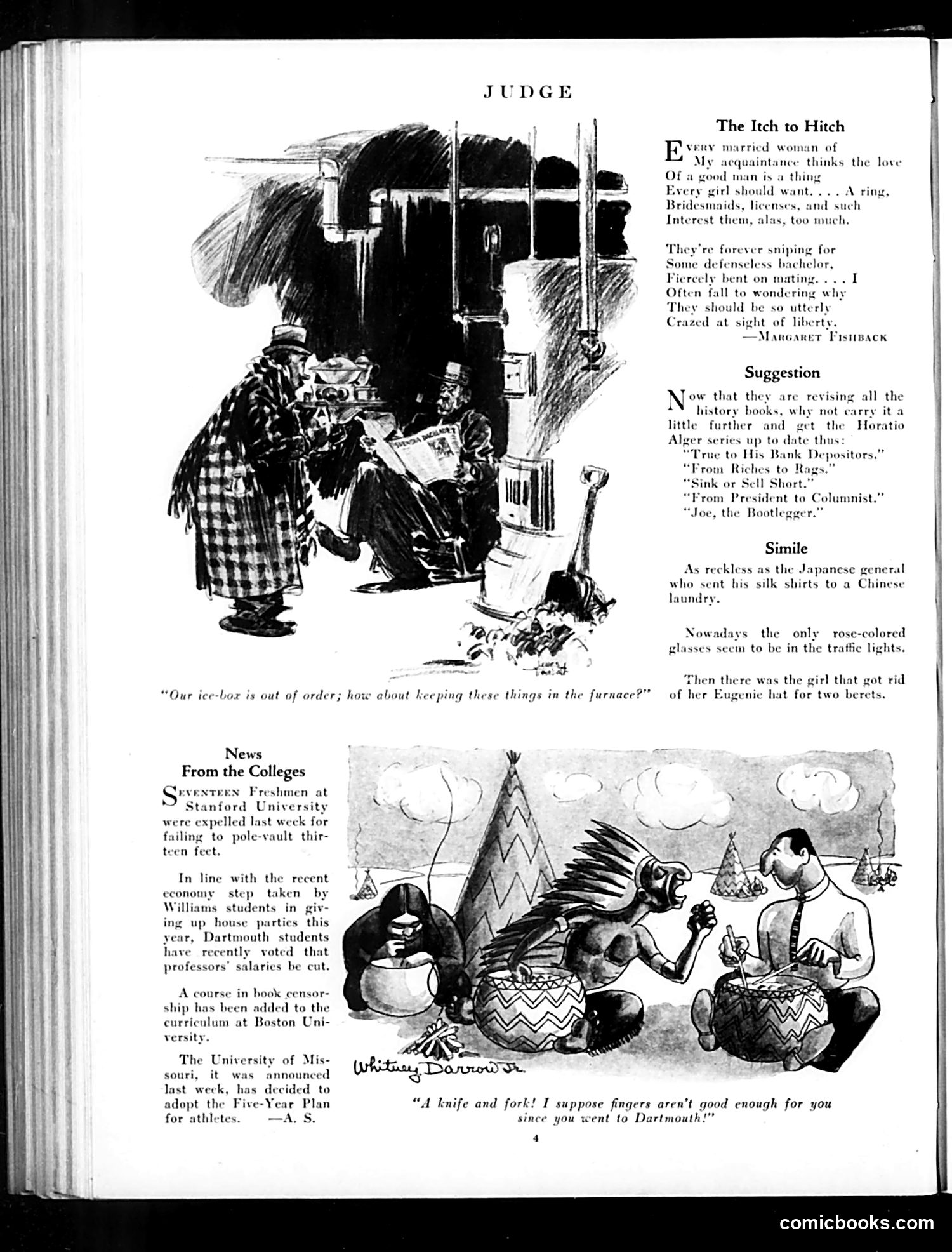
# Analysis of Judge Magazine Page The top cartoon depicts a janitor or building superintendent confronting a woman about furnace maintenance, with the caption "Our ice-box is out of order; how about keeping these things in the furnace?" This satirizes domestic complaints and the poor living conditions of working-class apartments—likely referencing inadequate heating and cooling systems in early 20th-century urban housing. The page includes three literary/social commentary pieces ("The Itch to Hitch," "Suggestion," "Simile") mocking marriage expectations, revisionist history books, and modern fashion trends. The bottom cartoon by Whitney Darrow shows Native Americans using utensils, captioned with a joke about "fingers" and Dartmouth, likely satirizing both Native American stereotypes and college life assumptions of the era. The "News from the Colleges" section reports actual campus incidents, including disciplinary actions at Stanford University.
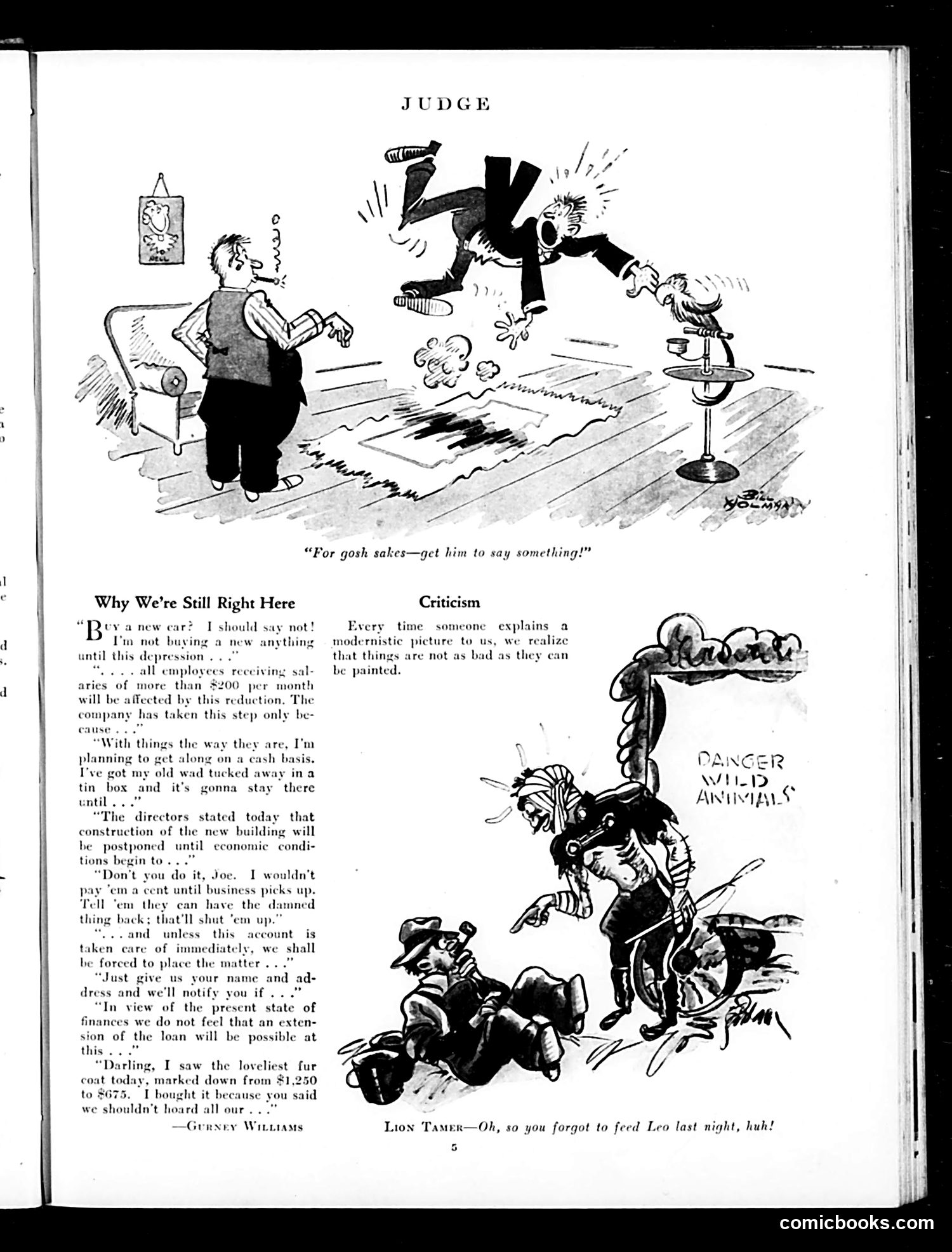
# Analysis of Judge Magazine Page **Top Cartoon ("Judge"):** A disheveled judge loses his composure and balance, literally kicked off his bench by an unseen force. The caption "For gosh sakes—get him to say something!" suggests judicial silence or evasion during a legal proceeding, likely satirizing a specific trial or court case where a judge refused to rule or speak on controversial matters. **"Why We're Still Right Here":** A monologue by "Gurney Williams" presenting Depression-era economic rationalizations—people justifying why they won't buy new cars or make purchases, citing the ongoing economic crisis. It's satirizing deflationary thinking and consumer hesitancy perpetuating economic stagnation. **"Criticism"/"Danger Wild Animals":** An unrelated cartoon-caption pair below, likely from different content.
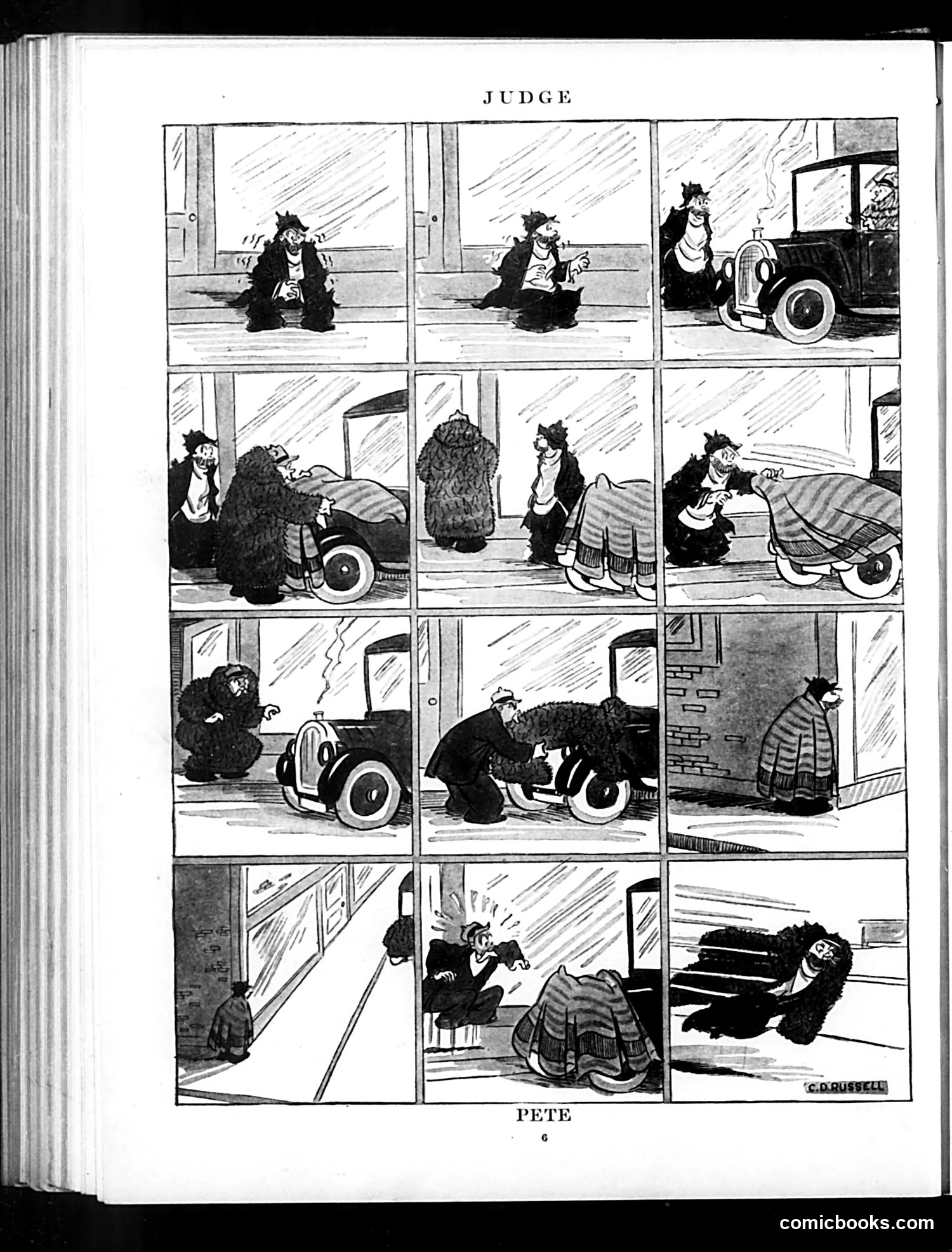
# Analysis of "Judge" Comic Strip Page This comic strip titled "Judge" (signed by C. D. Russell) depicts a slapstick narrative about a figure in formal dress dealing with a baby carriage. The sequence shows: the character sitting dejected in the rain, then attempting to manage an unwieldy carriage, struggling with its mechanics, and ultimately being knocked down or overwhelmed by it. The satire appears to mock domestic incompetence or the complications of childcare—specifically, a presumably upper-class man's inability to handle a baby carriage, a task typically assigned to women or servants. The humor derives from physical comedy and the contrast between the figure's formal attire and his undignified struggles with ordinary domestic objects. The exact political context remains unclear without additional page information.
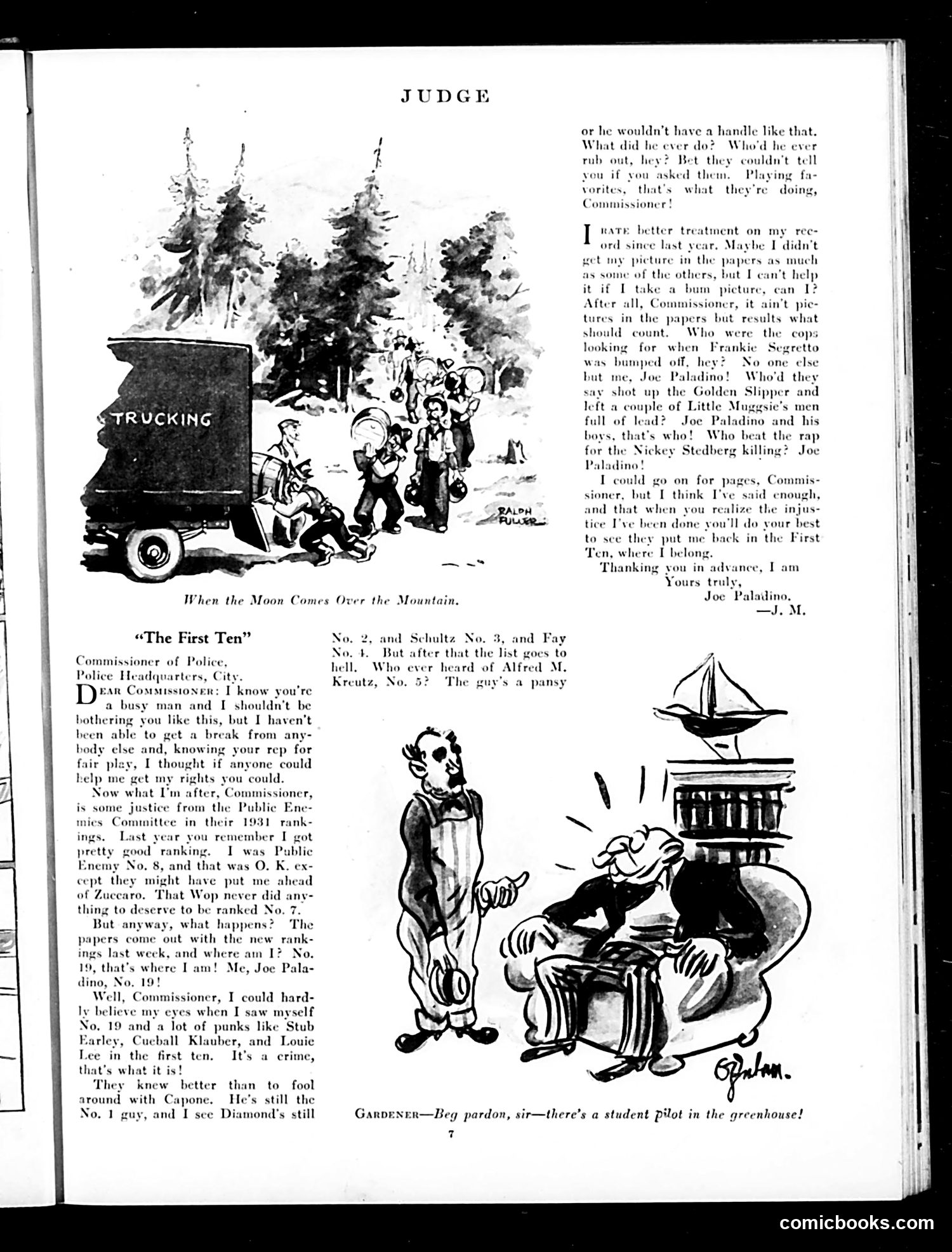
# Analysis for Modern Readers This page satirizes Chicago's criminal underworld during Prohibition, specifically the 1931 "Public Enemies" rankings—an actual FBI/press list of most-wanted gangsters. **The Main Cartoon:** Joe Paladino, a minor mobster, petitions Police Commissioner about his ranking dropping from #8 to #19. He complains he's been unfairly overlooked despite his "accomplishments"—murders, shootouts—while arguing rivals like Zuccaro didn't deserve higher rankings. He names actual gangsters: Capone (still #1) and Diamond. **The Satire:** Judge mocks both the criminals' vanity and the public's obsession with gangster rankings, treating violent felons like sports players. Paladino's indignant tone—demanding "justice" for being ranked too low—absurdly applies corporate fairness complaints to criminal status. **Historical Context:** This reflects 1930s media sensationalism around organized crime, when newspapers published actual "Most Wanted" lists, making gangsters into celebrities. The piece ridicules how seriously these criminals took their public rankings.
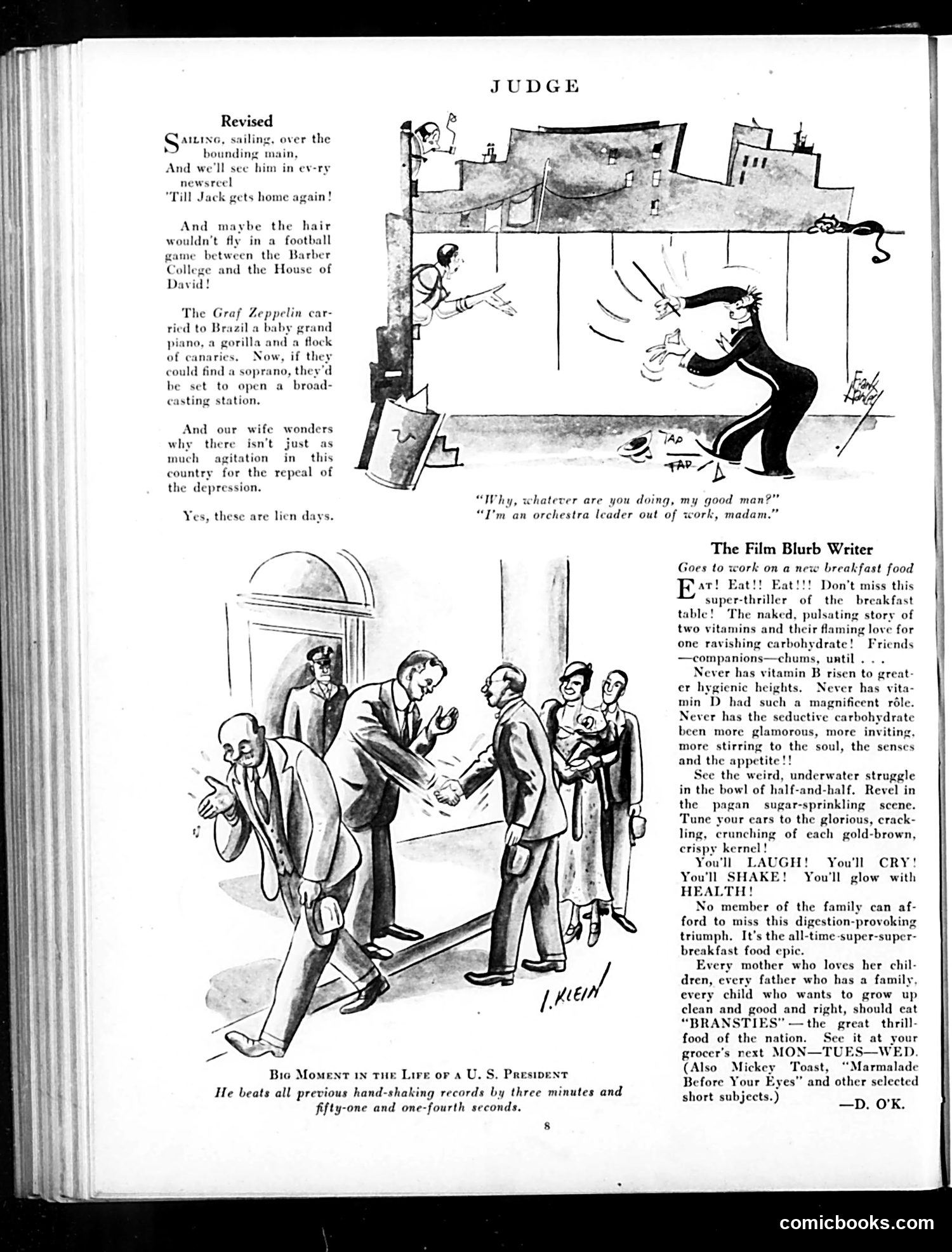
# Explanation of Judge Magazine Page This page contains three satirical pieces mocking Depression-era hardship and media excess: **Top cartoon**: An unemployed orchestra conductor tells a wealthy woman he's "out of work." The caption "Yes, these are lien days" puns on "lean days"—referencing Depression poverty and foreclosures. **"Big Moment" cartoon**: Mocks a U.S. President's hand-shaking record during a time when unemployment and desperation meant citizens sought any political contact for relief or employment. **"Film Blurb Writer" section**: Parodies overwrought advertising copywriting that applies melodramatic movie language ("naked, pulsating story," "You'll LAUGH! You'll CRY!") to breakfast cereal. It satirizes how advertisers manipulated Depression-anxious consumers by selling mundane products with exaggerated emotional appeals and pseudo-scientific health claims (vitamins B and D). The page's recurring theme: During economic collapse, Americans experience both genuine hardship and ridiculous commercial manipulation.
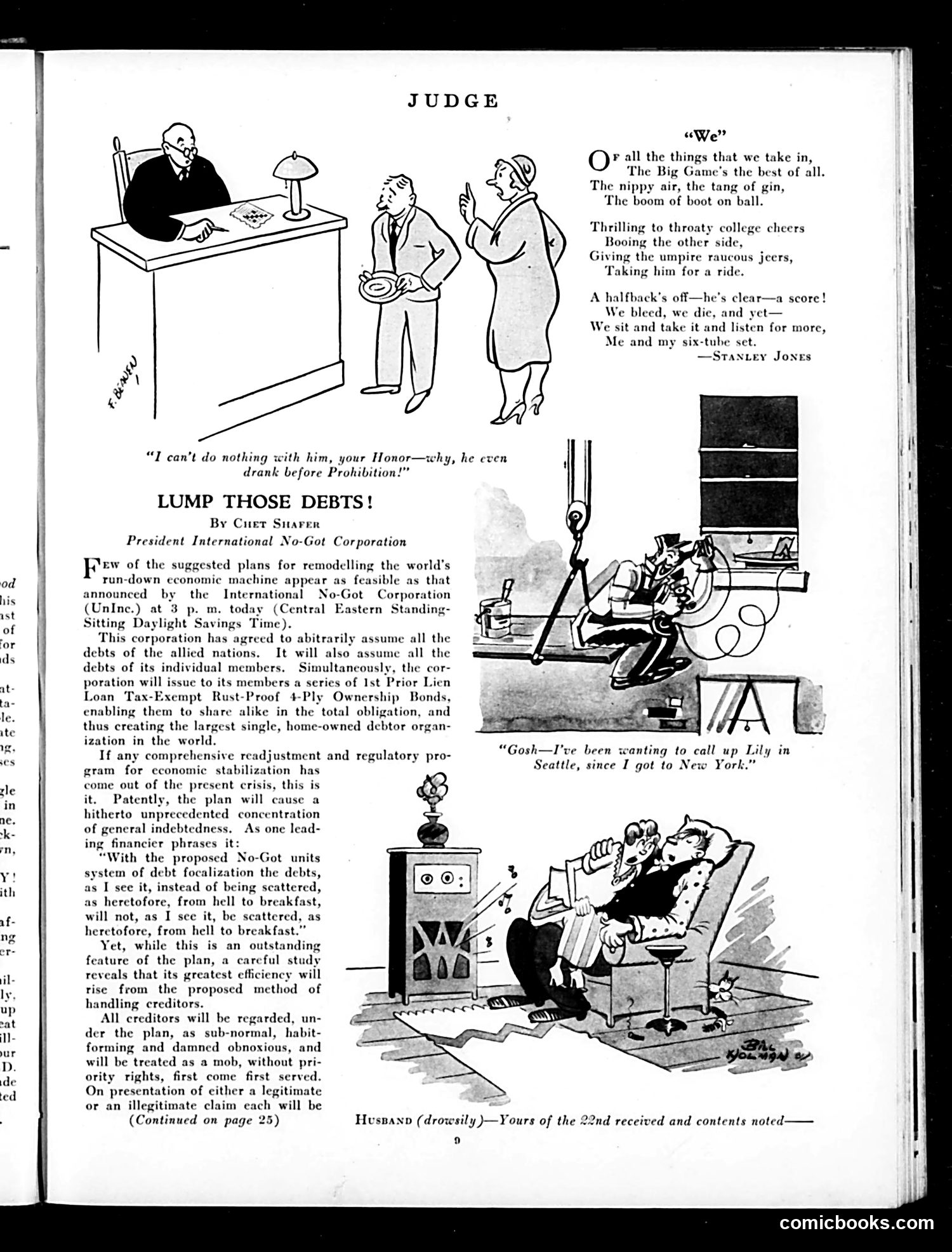
# Judge Magazine Satire Analysis This page satirizes post-WWI economic proposals through absurdist humor. **"Lump Those Debts"** mocks a real-world scheme (the "International No-Got Corporation") proposing to consolidate allied nations' war debts into a single entity. The satire emphasizes the plan's logical absurdity: rather than solving debt, it merely concentrates all obligations into one massive "home-owned debtor organization." The phrase "from hell to breakfast" humorously describes debt's scattered state. The cartoon showing a judge tells a joke about Prohibition (1920-1933): a defendant "even drank before Prohibition," implying this predates the law and is somehow worse than post-Prohibition drinking. **The "W" poem** celebrates baseball and gin-drinking—a knowing wink at Prohibition's unpopularity. **The bottom cartoon** depicts a husband receiving a telegram about a call to Seattle, humorously suggesting marital distance or infidelity during the telephone era. The overall tone reflects post-WWI economic anxiety and satirizes the era's futile debt-restructuring proposals while mocking Prohibition through casual alcohol references.
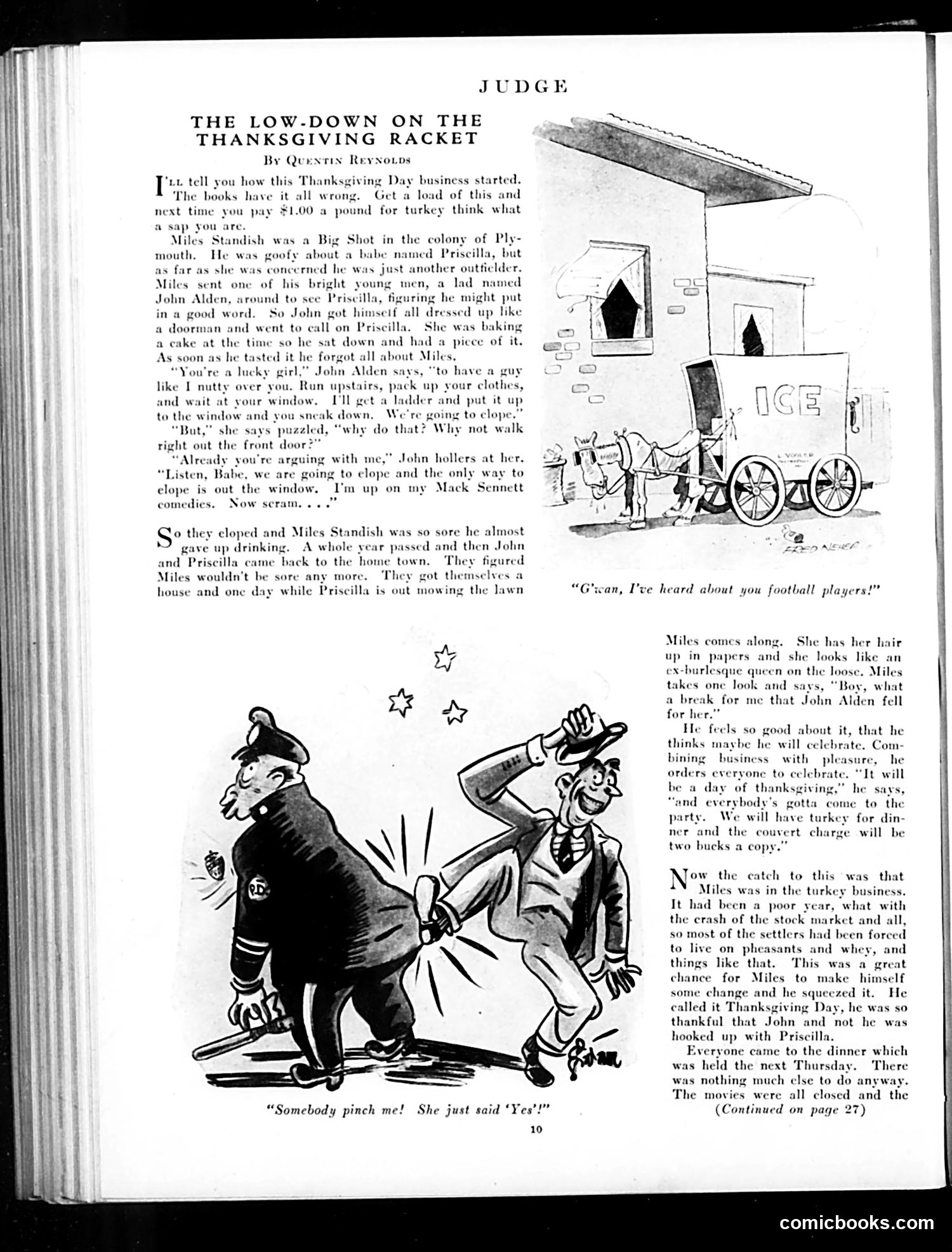
# "The Low-Down on the Thanksgiving Racket" This satirical piece by Quentin Reynolds rewrites the Pilgrims' origin story as a cynical commercial scheme. The article presents Miles Standish as a scheming businessman who uses the Thanksgiving holiday as a front to sell expensive turkey to settlers during hard economic times (referencing the stock market crash). The humor relies on deflating American historical reverence: the noble first Thanksgiving becomes a profit-driven "racket." References to "Mack Sennett comedies" (silent film slapstick) and the illustration showing a woman in hair curlers undercut romantic notions. The cartoon mocks both Pilgrims and modern consumers who overpay for turkey annually without questioning the origin story. This reflects 1920s-30s cynicism about commercialized holidays and American capitalism disguised as tradition—a common Judge magazine theme targeting both greedy businessmen and gullible consumers.