
Judge, 1931-11-28 · page 15 of 36
Judge — November 28, 1931 — page 15: what you’re looking at
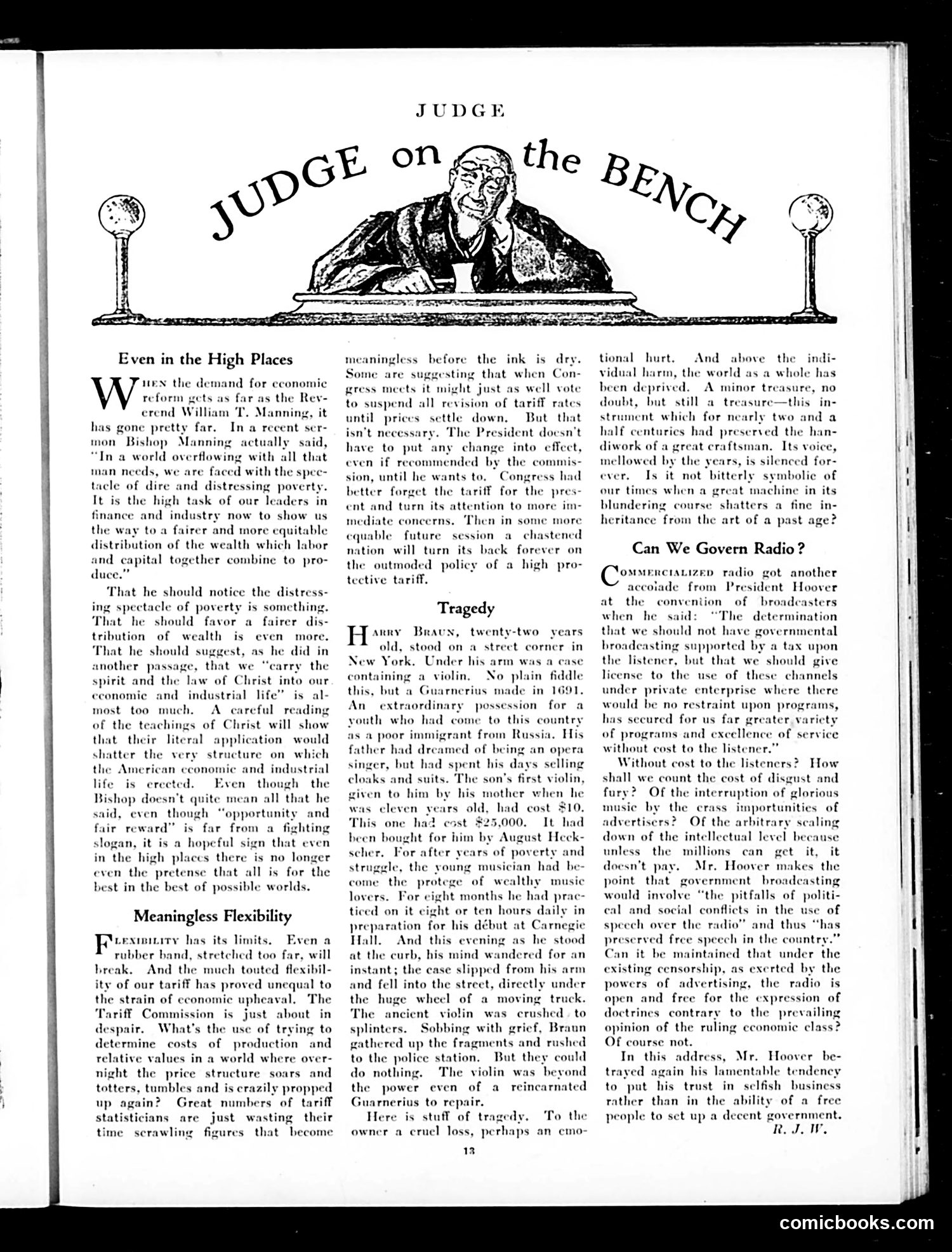
A restored page from Judge, 1931-11-28. Page through the whole issue in the reader above.
📄 Transcribed text from this page (OCR, searchable)
Machine-transcribed from the original scan — historical spelling and the odd misread are preserved.
Even in the High Places wen the demand for economic erend William Manning, it has gone pretty far. In a recent ser- mon Bishop Manning actually said, “In a world overflowing with all that man needs, we are faced with the spec tacle of dire and distressing poverty. It is the high task of our leaders in finance and industry now to show us the way toa fairer and more equitable distribution of the wealth which labor and capital together combine to pro- duce.” That he should notice the distress- ing spectacle of poverty is something. That he should favor a fairer dis- tribution of wealth is even more. ‘That he should suggest, as he did in another passage, that we “carry the spirit and the law of Christ into our economic and industrial life” is al- most too much. A careful reading of the teac! s of Christ will show that their literal application would shatter the very structure on which the American econon industrial Even though the Bishop doesn’t quite mean all that he said, even though “opportunity and fair reward” is far from a fighting slogan, it is a hopeful sign that even in the high places there is no longer even the pretense that all is for the best in the best of possible worlds. life is erected. Meaningless Flexibility Lextmitity has its limits. Even a rubber band, stretched too far, will break. And the much touted flexibil- ity of our tariff has proved unequal to the strain of cconomic upheaval. The Tariff Commission is just about in despair. What's the use of trying to determine costs of production and relative values in a world where over- night the price structure soars and totters, tumbles and is crazily propped up again? Great numbers of tariff statisticians are just wasting their time scrawling figures that become JUDGE meaningless before the ink is dry. Some are suggesting that when Con- gress meets it might just as well vote to suspend all revision of tariff rates until prices settle down, But that isn't necessary. The President doesn't have to put any change into effect, even if recommended by the commis- sion, until he wants to. Congress had better forget the iff for the pres- ent and turn its attention to more im- mediate concerns. Then in some more cquable future session a chastened nation will turn its back forever on the outmoded policy of a high pro- tective tariff. Tragedy Braun, twenty-two old, stood on a street corner in New York. Under his arm was a case years containing a violin, No plain fiddle this, but a Guarnerius made in 1691 An extraordinary possession for youth who had come to this country as a poor immigrant from Russia. His father had dreamed of being an opera er, but had spent his days selling ks and suits. The son's first violin, nto him by his mother when he was cleven years old, had cost $10. This one hs 9000. It had t for him by August Heck- 1 esst § been bo: the young protege of r cight months he come th lovers. preparation for his début at Carnegie Hall. And this evening as he stood at the curb, his mind wandered for an he case slipped from his arm to the street, directly under the huge wheel of a moving truck. The ancient violin was crushed. to splinters. Sobbing with grief, Braun gathered up the fragments and rushed to the police station. But they could do nothing. The violin was beyond the power even of a_ reincarnated Guarnerius to repair. Here is stuff of tragedy, To the owner a eruel loss, perhaps an emo- 12 nal hurt. f p the indi- vidual harm, the world as a whole has been deprived. A minor treasure, no doubt, but still a t ure—this in- strument which for nearly two and a half centuries had preserved the han- diwork of a great craftsman. Its voice, mellowed by the years, is silenced for- ever, Is it not bitterly symbolic of our times when a great machine in its blundering course shatters a fine heritance from the art of a past age? Can We Govern Radio ? Commenctauizen radio got another a le from President Hoover at the conventic of when he broadcasters determination that we should not have governmental broadcasting supported by a tax upon the listener, but that we should give license to the use of these channels under private enterprise where there would be no restraint upon programs, has secured for us fz of programs and ¢ without cost to the listener. Without cost to the listeners? How shall we count the cost of disgust and fury? Of the interruption of glorious music by the crass importunities of advertisers? Of the arbitrary scaling down of the intellectual level because unless the millions can get it, it doesn’t p Mr. Hoover makes the point t government broadcasting would involve “the pitfalls of politi- cal and social conflicts in the use of speech over the radio” and thus “has preserved free speech in the country.” Can it be maintained that under the existing censorship, as exerted by the of advertisi the radio is open and free for the expression of doctrines contrary to the prevailing opinion of the ruling cc Of course not. In this address, Mr. Hoover be- trayed again his lamentable tendene to put his trust in’ selfish business rather than in the ability of a free people to set up a decent government. RJ. W. said: riety of service powers omic class? comicbooks.com