
Judge, 1931-11-28 · page 18 of 36
Judge — November 28, 1931 — page 18: what you’re looking at
A restored page from Judge, 1931-11-28. Page through the whole issue in the reader above.
📄 Transcribed text from this page (OCR, searchable)
Machine-transcribed from the original scan — historical spelling and the odd misread are preserved.
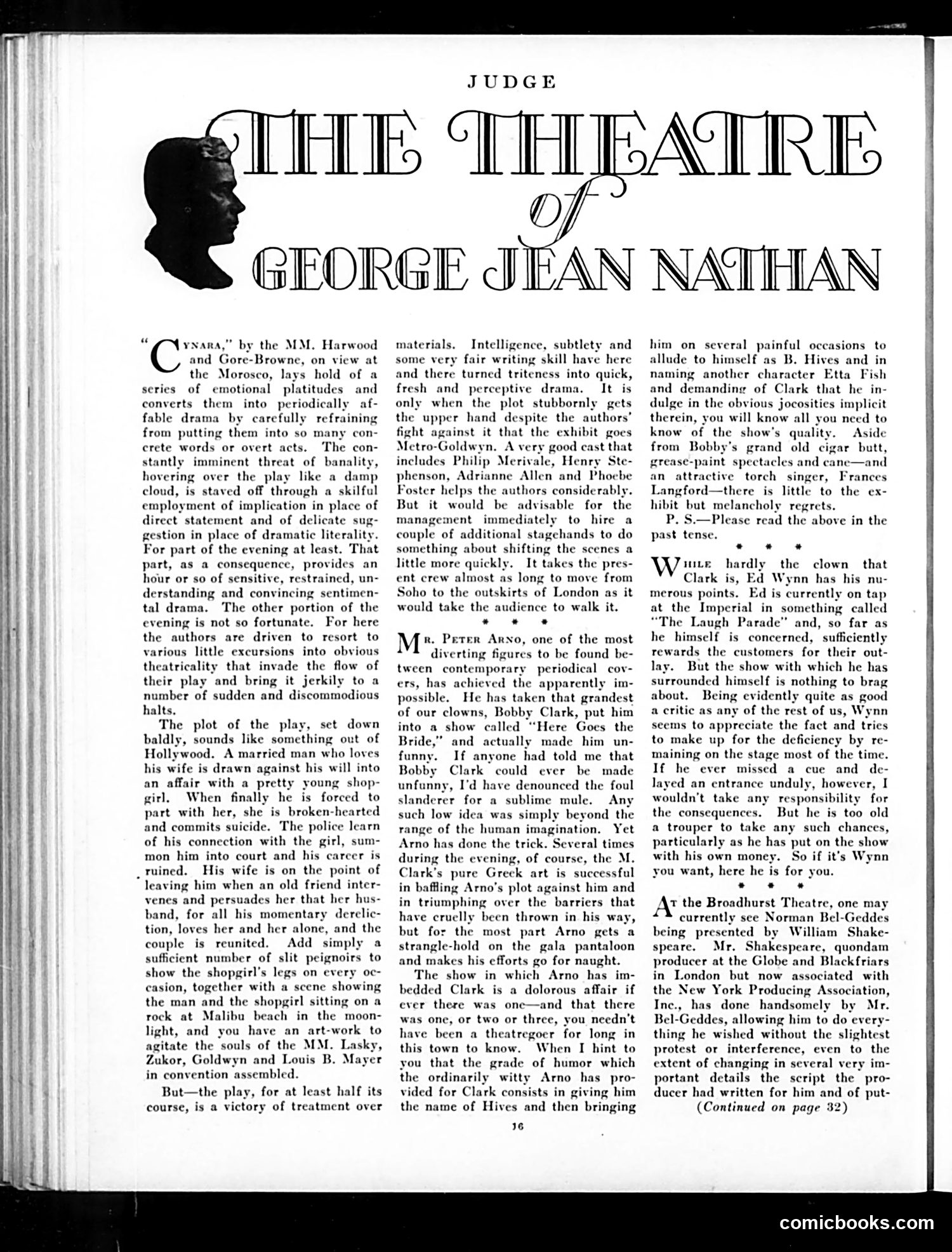
‘ay GEORGE J aa ynana,” by the MM. Harwood C and Gore-Browne, on view at the Morosco, lays hold of a series of emotional platitudes and converts them into periodically af- fable drama by carefully refraining from putting them into so many con- crete words or overt acts. The con- stantly imminent. thr of banality, hovering over the play like a damp cloud, is staved off through a skilful employment of implication in place of direct statement and of delicate sug- gestion in place of dramatic literality. For part of the evening at least. That part, as a consequence, provides an hour or so of sensitive, restrained, un- derstanding and convincing sentimen- tal drama. The other portion of the evening is not so fortunate. For here the authors are driven to resort to various little excursions into obvious theatricality that invade the flow of their play and bring it jerkily to a number of sudden and discommodious halts. The plot of the play, set down baldly, sounds like something out of Hollywood. A married man who loves his wife is drawn against his will into an affair with a pretty young shop- girl, When finally he is forced to part with her, she is broken-hearted and commits suicide. The police learn of his connection with the girl, sum- mon him into court and his carcer is _ruined. His wife is on the point of leaving him when an old friend inter- venes and persuades her that her hus- band, for all his momentary dereclic- tion, loves her and her alone, and the couple is reunited. Add simply a sufficient number of slit peignoirs to show the shopgirl’s legs on every oc- casion, together with a scene showing the man and the shopgirl sitting on a rock at Malibu beach in the moon- light, and you have an art-work to agitate the souls of the MM. Lasky, Zukor, Goldwyn and Louis B. Mayer in convention assembled. But—the play, for at least half its course, is a victory of treatment over materials. some v Intelligence, subtlety and y fair writing skill have here and there turned triteness into quick, fresh and perceptive drama. It is only when the plot stubbornly gets the upper hand despite the authors’ fight against it that the exhibit goes Metro-Goldwyn. A very good cast th includes Philip Merivale, Hen phenson, Adrianne Allen and Phoebe Foster helps the authors considerably. But it would be advisable for the management immediately to hire a couple of additional stagehands to do something about shifting the scenes a little more quickly. It takes the pres- ent crew almost as long to move from Soho to the outskirts of London as it would take the audience to walk it. * 8 # rn. Peter Arno, one of the most diverting figures to be found be- tween contemporary periodical cov- ers, has achieved the apparently im- possible. He has taken that grandest of our clowns, Bobby Clark, put him into a show called “Here Goes the Bride,” and actually made him un- funny. If anyone had told me that Bobby Clark could ever be made unfunny, I'd have denounced the foul slanderer for a sublime mule. Any such low idea was simply beyond the range of the human imagination. Yet Arno has done the trick. Several times during the evening, of course, the M. Clark's pure Greck art is successful in baffling Arno’s plot against him and in triumphing over the barriers that have cruelly been thrown in his way, but for the most part Arno gets a strangle-hold on the gala pantaloon and makes his efforts go for naught. The show in which Arno has im- bedded Clark is a dolorous affair if ever there was one—and that there was one, or two or three, you needn't have been a theatregoer for long in this town to know. When I hint to you that the grade of humor which the ordinarily witty Arno has pro- vided for Clark consists in giving him the name of Hives and then bringing 16 ACRE NACTHAN him on several painful occasions to allude to himself as B. Hives and in naming another character Etta Fish and demanding hat he in- dulge s implicit therein, you will know all you need to know of the show's quality. Aside from Bobby's grand old cigar butt, grease-paint spectacles and cane—and torch singer, I cre is little to the hibit but melancholy regrets. P. S.—Please read the above in the past tense. * # # V ite hardly the clown that Clark is, Ed Wynn has his nu- merous points. Ed is currently on tap at the Imperial in something called “The Laugh Parade” and, so far as he himself is concerned, sufficiently rewards the customers for their out- lay. But the show with which he has surrounded himself is nothing to brag about. Being evidently quite as good a critic as any of the rest of us, Wynn seems to appreciate the fact and tries to make up for the deficiency by re- maining on the stage most of the time. If he ever missed a cue and de- layed an entrance unduly, however, I wouldn't take any responsibility for the consequences. But he is too old a trouper to take any such chances, particularly as he has put on the show with his own money. So if it’s Wynn you want, here he is for you. . 8 & A the Broadhurst Theatre, one may currently see Norman Bel-Geddes being presented by William Shake- speare. Mr. Shakespeare, quondam producer at the Globe and Blackfriars in London but now associated with the New York Producing Association, Inc., done handsomely by Mr. Bel-Geddes, allowing him to do eve! thing he wished without the slightest protest or interference, even to the extent of changing in several ve: portant details the script the pro- ducer had written for him and of put- (Continued on page 32 ex- comicbooks.com