
Judge, 1931-11-28 · page 26 of 36
Judge — November 28, 1931 — page 26: what you’re looking at
A restored page from Judge, 1931-11-28. Page through the whole issue in the reader above.
📄 Transcribed text from this page (OCR, searchable)
Machine-transcribed from the original scan — historical spelling and the odd misread are preserved.
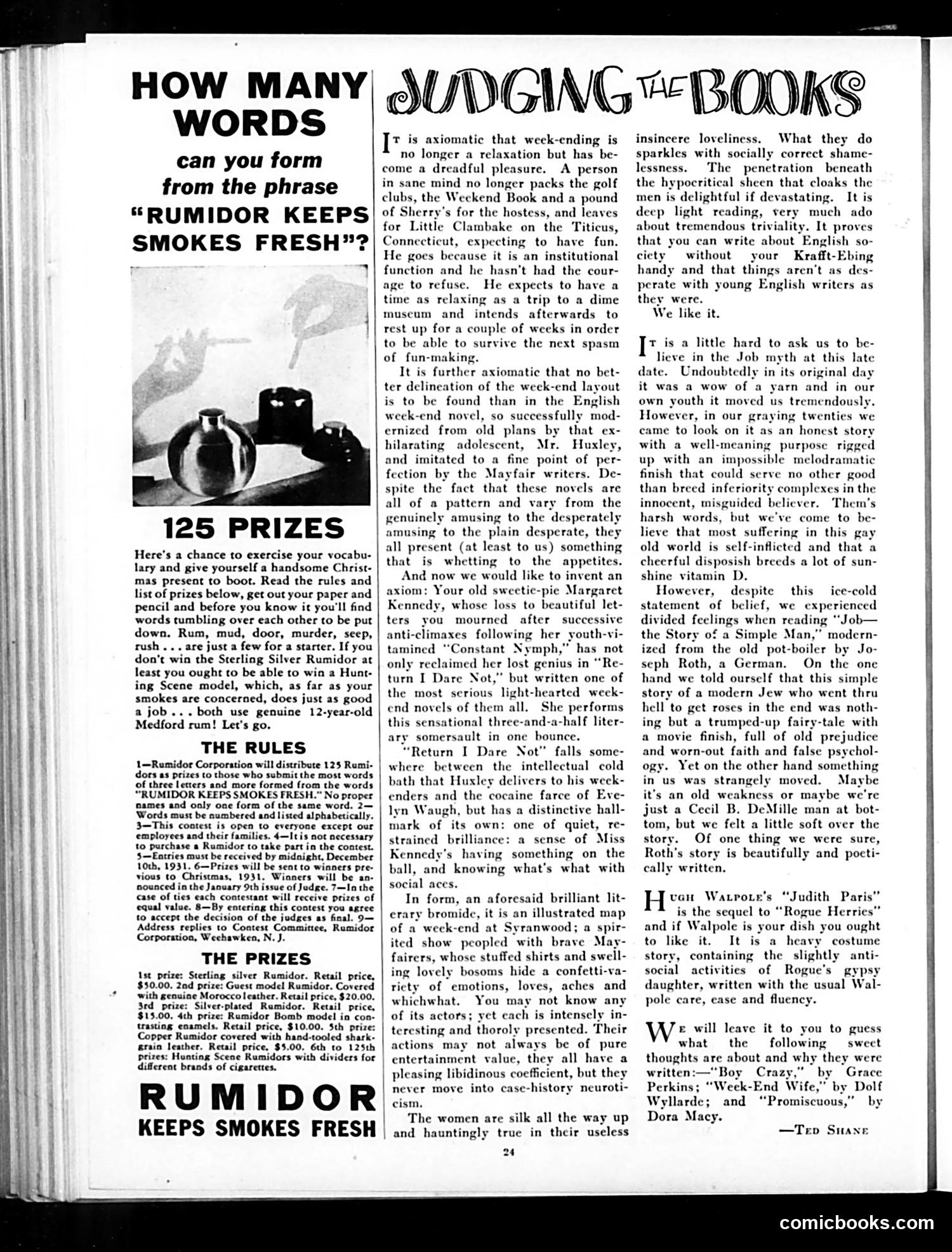
tm a ES TE ee OO HOW MANY WORDS can you form from the phrase “RUMIDOR KEEPS SMOKES FRESH"? - 125 PRIZES Here's a chance to exercise your vocabu- lary and give yourself a handsome Christ- mas present to boot. Read the rules and list of prizes below, get out your paper and pencil and before you know it you'll find words tumbling over each other to be put down. Rum, mud, door, murder, seep, rush ... are just a few for a starter. If you don't win the Sterling Silver Rumidor at least you ought to be able to win a Hunt- ing Scene model, which, as far as your smokes are concerned, does just as good a job... both use genuine 12-year-old Medford rum! Let's go. THE RULES 1—Rumidor Corporation will di: dors as prizes to those who submit the most words of three letters and more formed from the words “RUMIDOR KEEPS SMOKES FRESH.” No proper names and only one form of the same word. 2— ‘Words must be numbered and listed alphabetically. 3—This contest is open to everyone except our ind their families. 4—Itis not necessary to purchase a Rumidor to take part in the contest. ‘ed by midnight, December 10th, 1931. 6—Prizes will be sent to winners pre- vious to Christmas, 1931. Winners will be an- nounced in the January 91! of Judge. 7—In the case of ties contestant will receive prizes of equal value. 8—By entering this contest you agree to accept the decision of the judges as final. 9— Address replies to Contest Committee, Rumidot Corporation, Weehawken, N. J. THE PRIZES 1st prize: Sterling silver Rumidor. Retail price, $50.00. 2nd prize: Guest model Rumidor. Covered ith genuine Morocco leather. Retail price, $20.00. 3rd prize: Silver-plated Rumidor. Retail price, $15.00, 4th prize: Rumidor Bomb model in con- trasting enamels. Retail price, $10.00. Sth prize: Copper Rumidor covered with hand-tooled shark- grain leather. Retail price, $5.00. 6th to 125th prizes: Hunting Scene Rumidors with dividers for different brands of cigarettes. RUMIDOR KEEPS SMOKES FRESH ‘ibute 125 Rumi- | I" is axiomatic that week-ending is no longer a relaxation but has be- come a dreadful pleasure. A person in sane mind no longer packs the golf the Weckend Book and a pound of Sherry's for the hostess, and leaves for Little Clambake on the Titicus, Connecticut, expecting to have fun. He goes because it is an institutional function and he hasn't had the cour- age to refuse. He expects to have a time as relaxing as a trip to a dime museum and intends afterwards to rest up for a couple of weeks in order to be able to survive the next spasm of fun-making. It is further axiomatic that no bet- ter delineation of the week-end layout is to be found than in the English week-end novel, so successfully mod- ernized from old plans by that ex- hilarating adolescent, Mr. Huxley, and imitated to a fine point of per- fection by the Mayfair writers. De- spite the fact that these novels are all of a pattern and vary from the genuinely amusing to the desperately amusing to the plain desperate, the all present (at least to us) something that is whetting to the appetites. And now we would like to axiom: Your old sweetie-pie Margaret Kennedy, whose loss to beautiful let- ters you mourned after successive anti-climaxes following her youth-vi- tamined “Constant Nymph,” has not only reclaimed her lost genius in “Re- turn I Dare Not,” but written one of | the most serious light-hearted week- end novels of them all. She performs this sensational three-and-a-half liter- ary somersault in one bounce. “Return I Dare Not” falls some- where between the intellectual cold bath that Huxley delivers to his week- enders and the cocaine farce of Eve- lyn Waugh, but has a distinctive hall- mark of its own: one of quiet, re- strained brilliance: a sense of Miss Kennedy's having something on the ball, and knowing what's what with social aces. In form, an aforesaid brilliant lit- erary bromide, it is an illustrated map of a week-end at Syranwood; a spir- ited show peopled with brave May- fairers, whose stuffed shirts and swell- ing lovely bosoms hide a confetti-va- riety of emotions, loves, aches and whichwhat. You may not know any of its actors; yet cach is intensely in- teresting and thoroly presented. Their actions may not always be of pure entertainment value, they all have a pleasing libidinous coefficient, but they never move into case-history neuroti- cism, The women are silk all the way up | and hauntingly true in their useless oe] | SUDGING™ BOOKS insincere loveliness. What they do sparkles with soc ally correct shame- lessness. The penetration beneath the hypocritical sheen that cloaks the men is delightful if devastating. It is deep light reading, very much ado about tremendous triviality. It proves that you can write about English so- ciety without your Krafft-Ebing handy and that things aren't as des- perate with young English writers as they were. We like it. t is a little hard to ask us to be- lieve in the Job myth at this late date. Undoubtedly in ‘its original day it was a wow of a yarn and in our own youth it moved us tremendously. However, in our graying twenties we came to look on it as an honest story with a well-meaning purpose rigged up with an impossible melodramatic finish that could serve no other good than breed inferiority complexes in the innocent, misguided believer. Them’s harsh words, but we come to be- lieve that most suffering in this old world is self-inflicted and that a cheerful disposish breeds a lot of sun- shine vitamin D. However, despite this ice-cold statement of belief, we experienced divided feelings when reading ““Job— the Story of a Simple Man,” modern- ized from the old pot-boiler by Jo- seph Roth, a German. On the one hand we told ourself that this simple story of a modern Jew who went thru hell to get roses in the end was noth- ing but a trumped-up fairy-tale with a movie finish, full of old prejudice and worn-out faith and false psychol- ogy. Yet on the other hand something in us was strangely moved. Maybe it's an old weakness or maybe we're just a Cecil B. DeMille man at bot- tom, but we felt a little soft over the story. Of one thing we were sure, Roth's story is beautifully and pocti- cally written, Hee Watrote’s “Judith Paris” is the sequel to “Rogue Herries” and if Walpole is your dish you ought to like it. It is a hea costume story, containing the slightly an social activities of Rogue's gypsy daughter, written with the usual Wal- pole care, ease and fluency. W: will leave it to you to guess what the following — sweet thoughts are about and why they were written:—"Boy Cra by Grace Perkins; “Week-End Wife,” by Dolf Wyllarde; and “Promiscuous,” by Dora Macy. —Tep Suane comicbooks.com