A complete issue · 36 pages · 1931
Judge — May 30, 1931
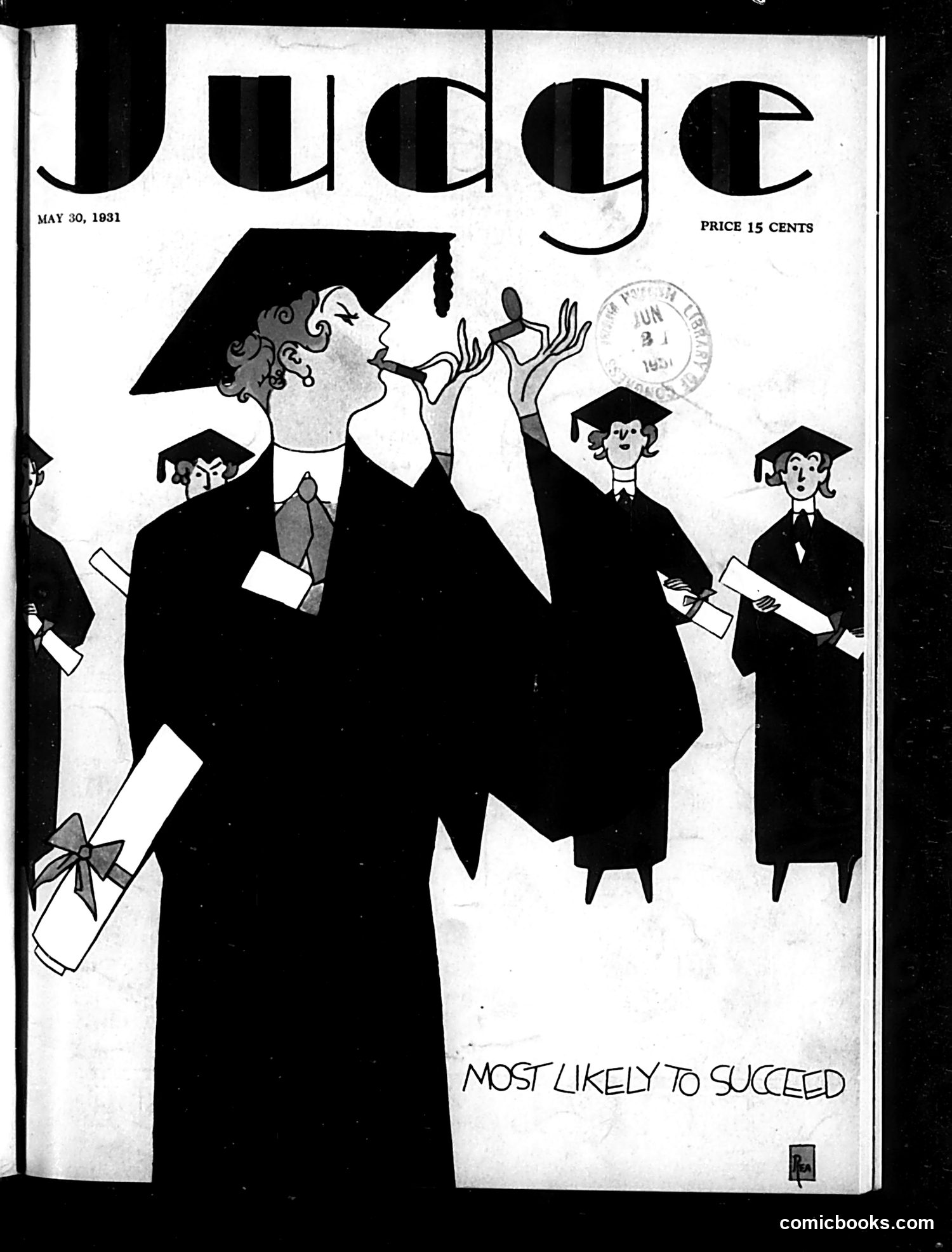
# Judge Magazine Cover Analysis (May 30, 1931) This cover satirizes academic success and social advancement through education. The central figure is a large woman in academic robes, depicted with exaggerated features in the caricature style typical of 1931. She appears to be a personification of "Education" or "Success," surrounded by smaller graduates in caps and gowns holding diplomas. The caption "Most Likely to Succeed" references the "class prophecy" tradition where schools predict which graduates will achieve the most. The satire likely comments on the gap between academic promise and real-world outcomes—particularly pointed given this was published during the Great Depression (1931), when many educated graduates faced unemployment despite their credentials. The joke suggests that educational achievement alone doesn't guarantee success in harsh economic times.
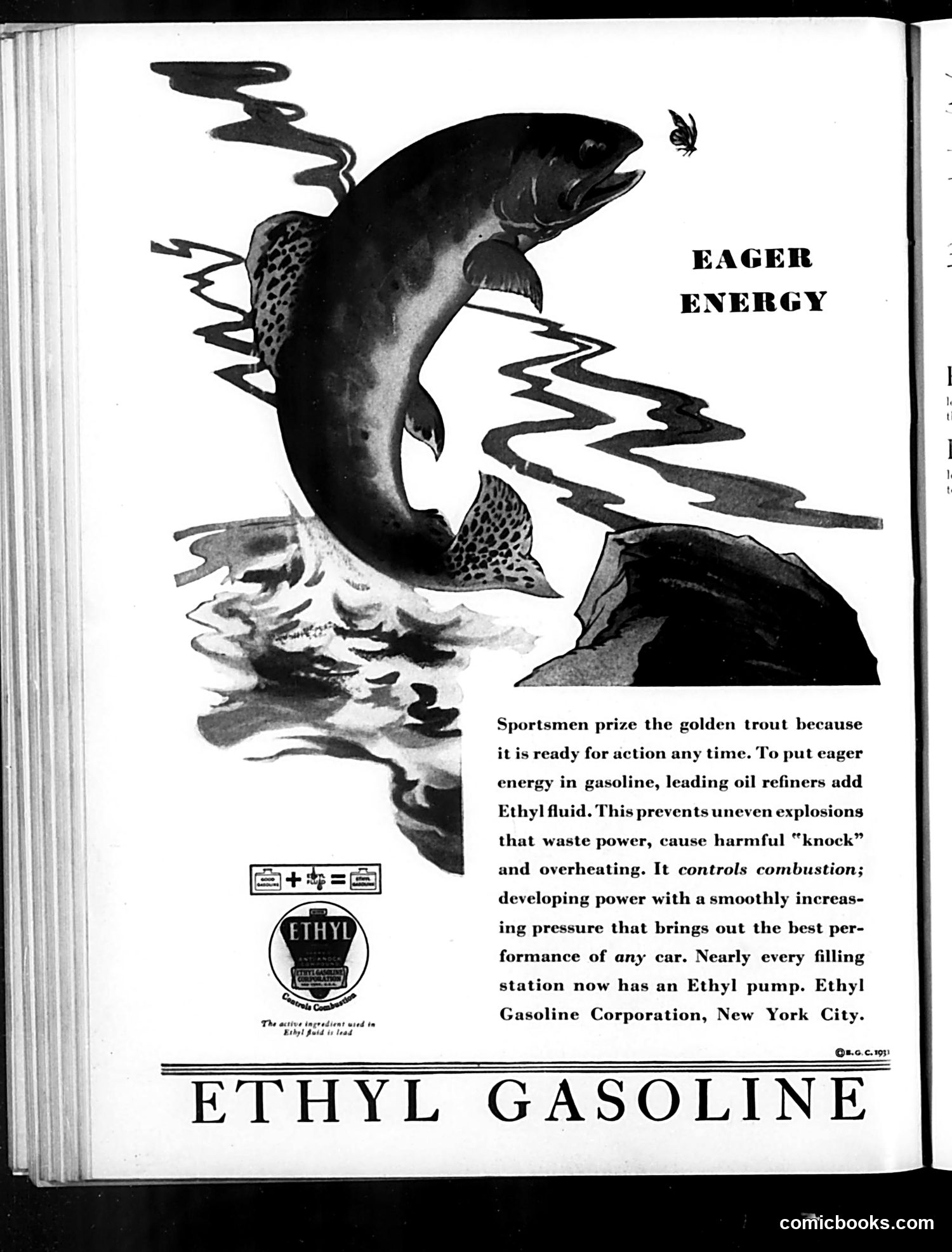
# Analysis This is primarily a **product advertisement**, not political satire. The "Eager Energy" headline uses a golden trout (a sportfish prized for its vigor) as a metaphor for gasoline performance. The ad promotes **Ethyl Gasoline**, a fuel additive product from Ethyl Gasoline Corporation (New York City). The text explains that Ethyl fluid—added by refiners to gasoline—prevents engine knock and uneven combustion, enabling smoother power delivery and better car performance. The jumping trout symbolizes readiness and explosive energy, paralleling what the product promises: controlled, eager power. The lightning bolts reinforce this energy metaphor. This appears to be from the 1920s-1930s era when Ethyl was actively marketed as a performance enhancement. The ad is straightforward commercial messaging rather than satire.
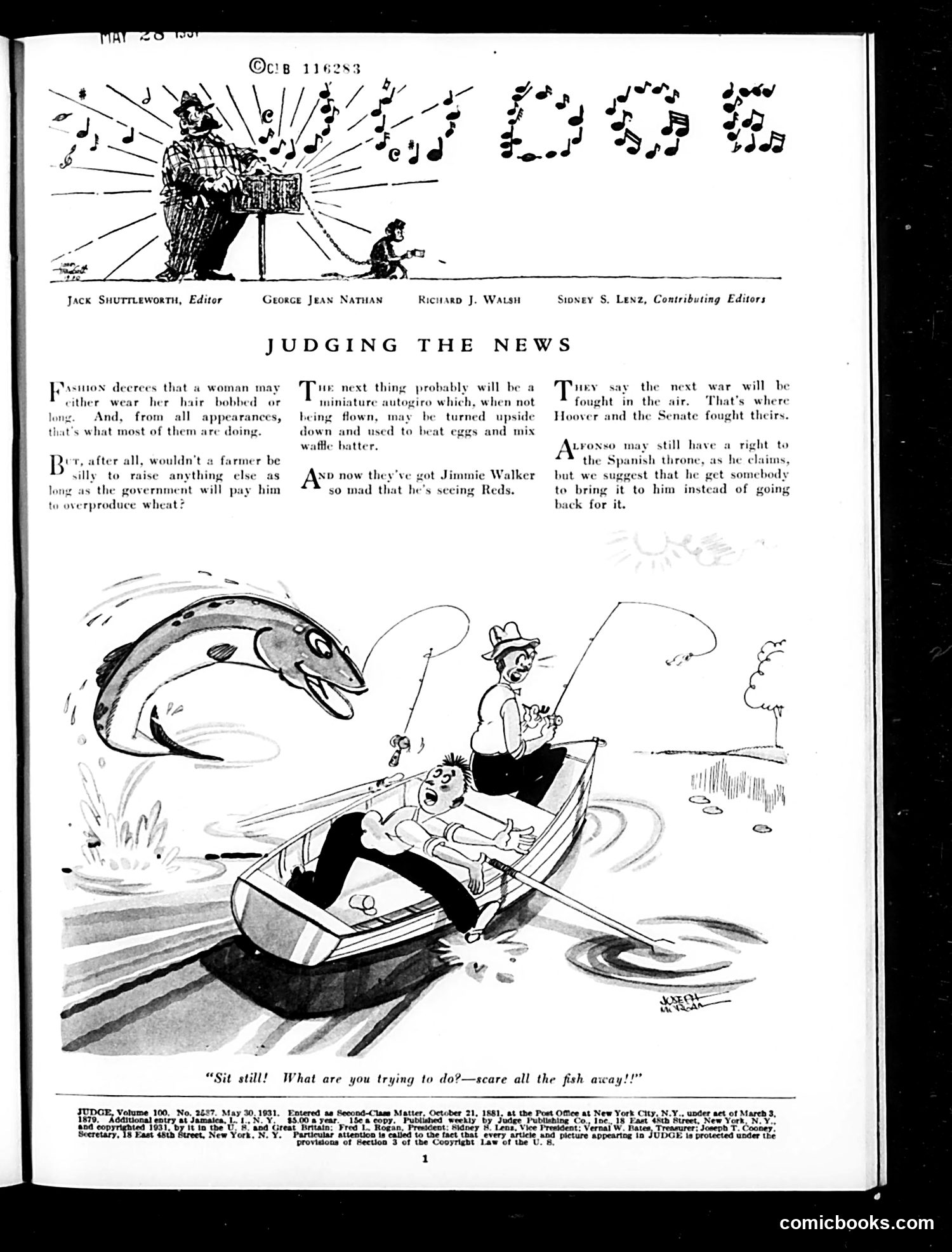
# Analysis of Judge Magazine Page (May 28, 1921) The main cartoon depicts two fishermen in a boat with a large fish jumping nearby. The caption reads: "Sit still! What are you trying to do?—scare all the fish away!" **The satire:** This appears to be a visual joke about restraint and composure during leisure activities. One fisherman is presumably moving around excitedly while the other urges calm. **Upper text sections** offer brief satirical commentary on contemporary topics: fashion decrees about women's hairstyles, a reference to "Jimmie Walker" (likely New York politician Jimmy Walker), predictions about future wars occurring "in the air," and discussion of Spain's throne. The cartoon's humor relies on relatable fishing-trip dynamics rather than specific political reference. The page functions as a general-interest satirical magazine mixing social observation with light humor.
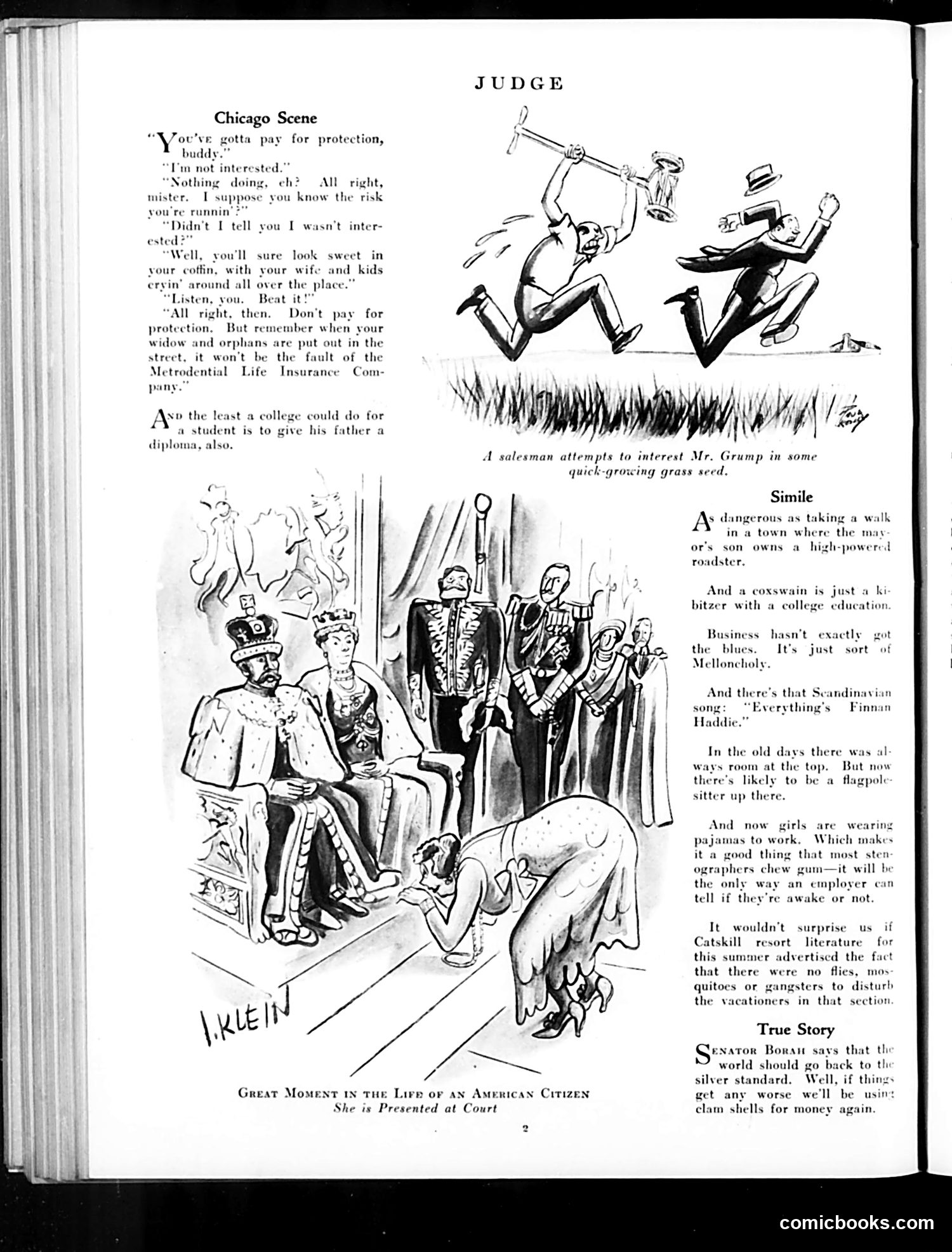
# Analysis of Judge Magazine Page **Top Cartoon ("Chicago Scene"):** A dialogue satirizes protection rackets. A salesman pressures a reluctant businessman ("Mr. Gramp") to buy insurance, threatening that without it, his widow and orphans will suffer publicly. The joke mocks both organized crime extortion and aggressive insurance sales tactics by conflating them—presenting legitimate insurance as indistinguishable from mob protection schemes. **Bottom Cartoon:** Depicts a woman presented at court before a royal figure, likely satirizing American social pretension or the practice of wealthy Americans seeking European aristocratic validation through formal court presentation. **Right Column ("Similes"):** Brief social commentary comparing contemporary annoyances (high-powered roosters, coxswains, business conditions, Scandinavian songs, workplace pajamas) to establish themes of modern life's absurdities.
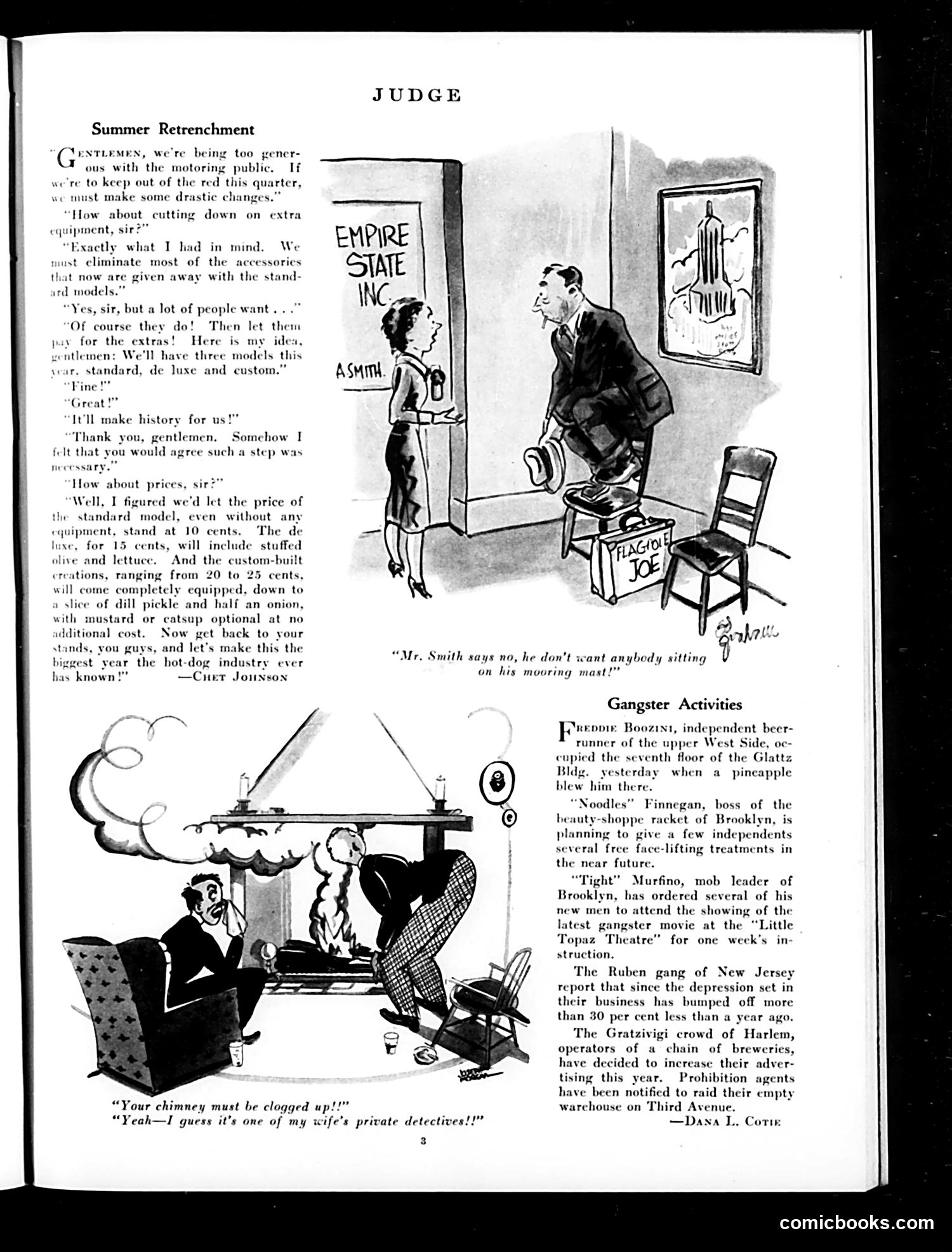
# Analysis of Judge Magazine Page **Top Cartoon ("Summer Retrenchment"):** A car manufacturer (likely Henry Ford or similar) discusses cutting costs during an economic downturn. The joke: to keep profits up while reducing prices, he'll eliminate accessories and standardize models into three tiers—"standard, de luxe and custom"—with minimal price differences. The satire mocks corporate cost-cutting disguised as consumer choice. **Bottom Cartoon:** A man discovers his chimney is clogged, but his wife suggests it's actually "one of my private detectives"—a Depression-era joke about surveillance and marital suspicion, popular in 1930s humor. **"Gangster Activities" Section:** Brief satirical news items about Brooklyn organized crime figures and their activities. The references are to actual gangster operations during Prohibition and its aftermath.
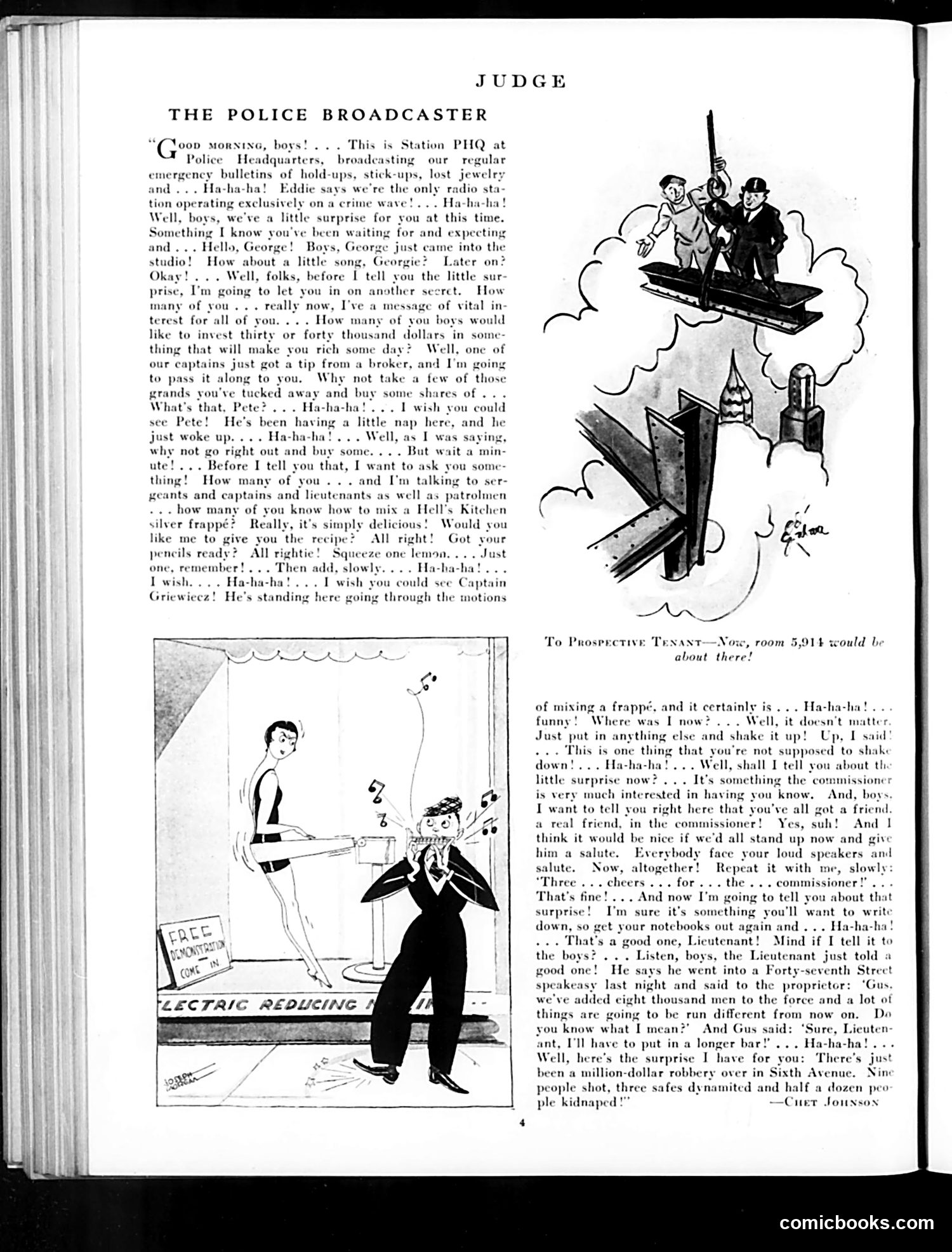
# "The Police Broadcaster" - Judge Magazine Satire This page satirizes early radio broadcasting and police communications. The main cartoon depicts a police radio broadcaster engaged in an absurdly rambling, jokey broadcast about crime prevention—complete with recipe instructions for a "Hell's Kitchen" drink and casual banter about stock tips and robberies. The joke targets the novelty of police radio stations (apparently a new phenomenon when this was published) and suggests their broadcasts are unprofessional, mixing actual police work with entertainment and self-promotion. The inset cartoon shows "electric reducing" services, likely satirizing another contemporary business fad. The satire implies these new institutional radio broadcasts—meant to serve the public—have become vehicles for frivolous content and self-interested promotion rather than serious public service.
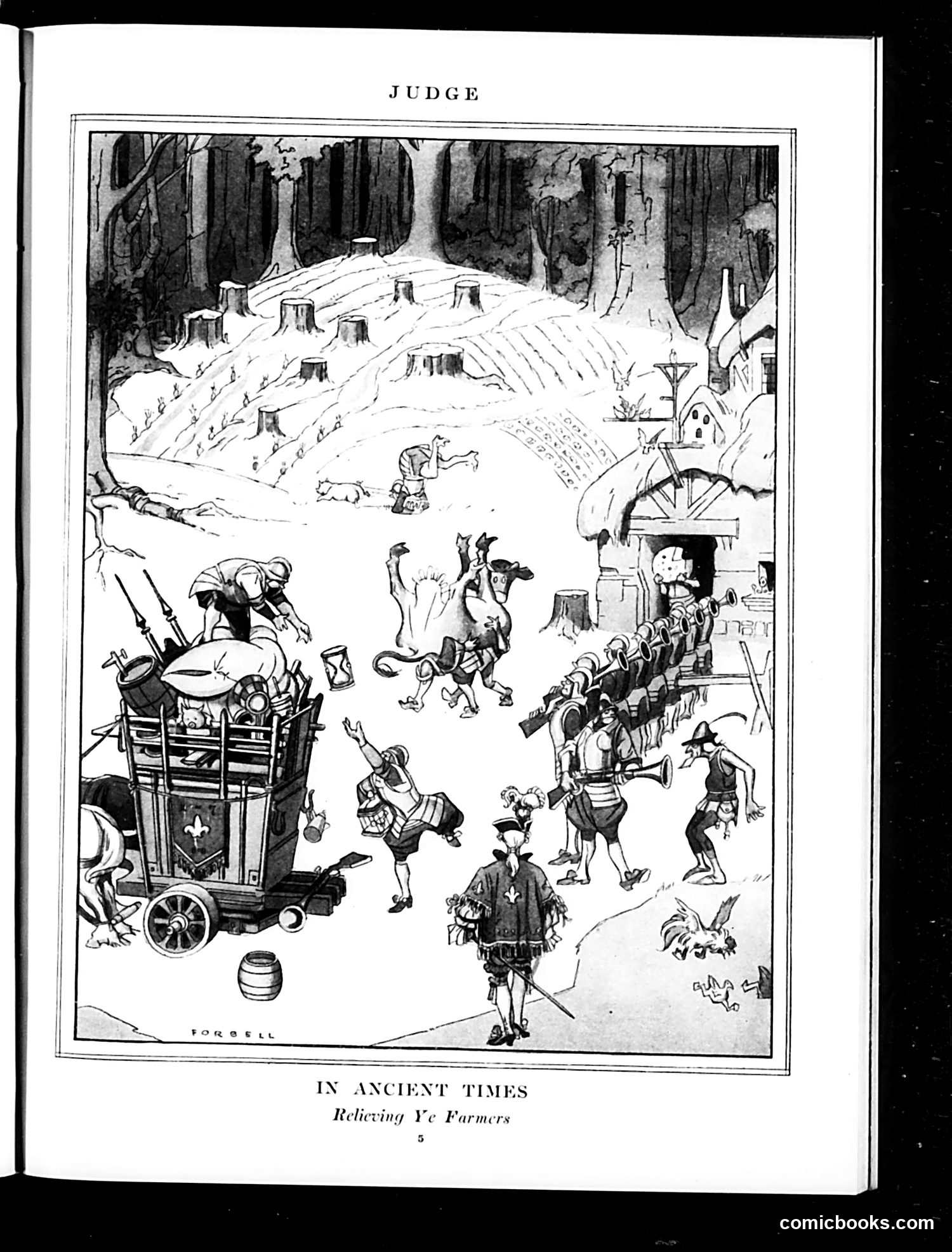
# "In Ancient Times: Relieving Ye Farmers" This Judge cartoon satirizes the burden placed on farmers through taxation or legal fees. The central figure in ornate dress (appearing to be a judge or nobleman) presides over a chaotic scene where common farmers are being "relieved" of their possessions—literally having goods loaded onto carts. The visual pun is sardonic: "relieving" farmers ostensibly means helping them, but the image shows authorities actually stripping them of property. The winter setting and desolate landscape emphasize their hardship. The title's archaic language ("Ye") suggests this oppressive practice is timeless, implying contemporary American farmers face similar exploitation despite modern progress. The cartoon critiques the legal or political system's treatment of agricultural workers as perpetual victims of institutional greed.
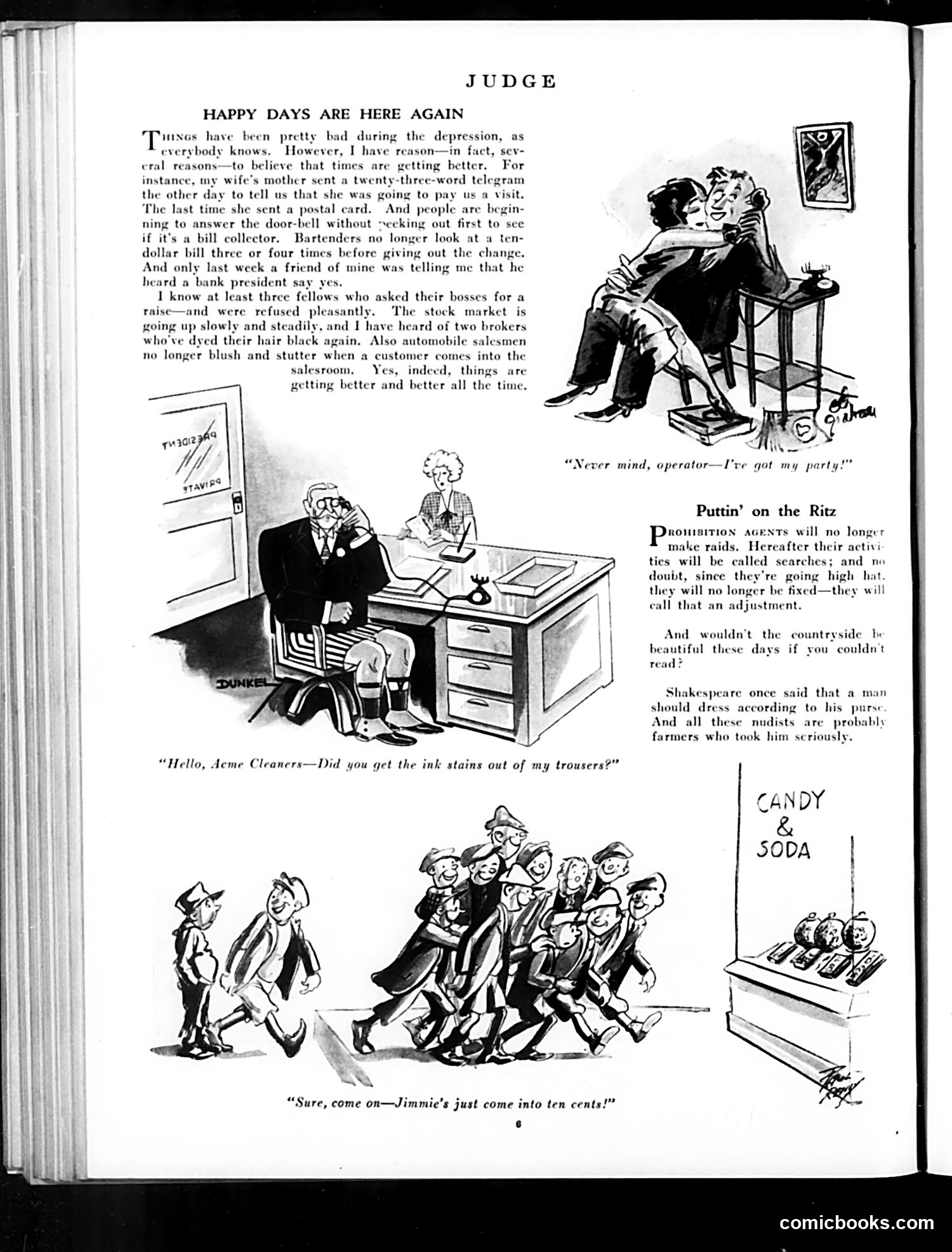
# Analysis of Judge Magazine Page This satirical page celebrates improving economic conditions through three cartoons: **Top cartoon**: A man reassures his barber that times are improving—he can now afford a haircut without first checking if it's a "full collector" (cheap). The satire mocks previous economic hardship. **Middle cartoon**: An office worker asks a cleaning service about removing ink stains, illustrating returning confidence in business activity. **Bottom cartoons**: One depicts children rushing to a candy/soda shop; another shows a man at an office asking about ink stain removal. Both suggest economic recovery—people spending money again on small luxuries and conducting normal business. The overall message: "Happy Days Are Here Again"—a reference to economic recovery, likely the post-Prohibition era or early Depression recovery. The satire celebrates ordinary consumption and business normalcy as signs of national improvement.
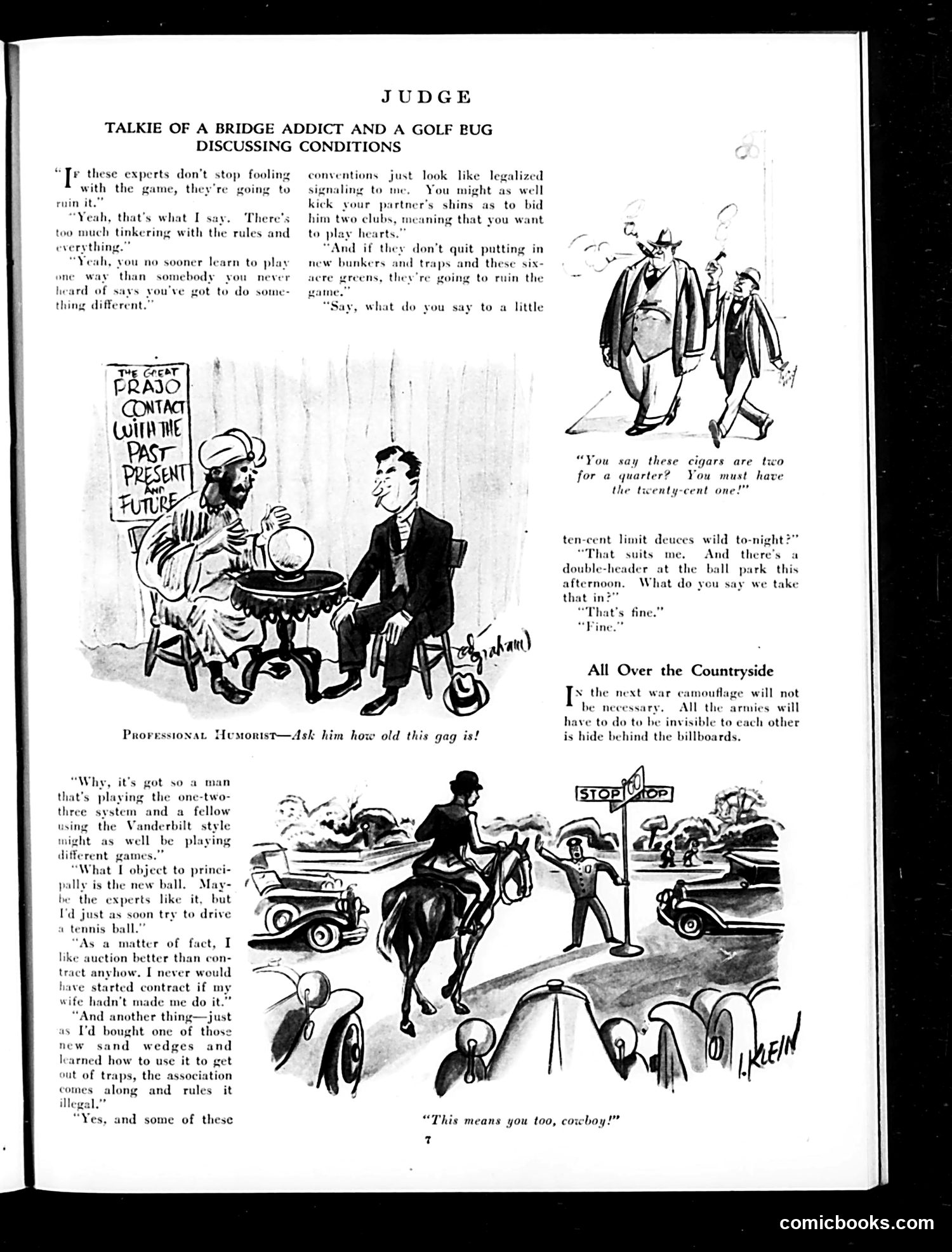
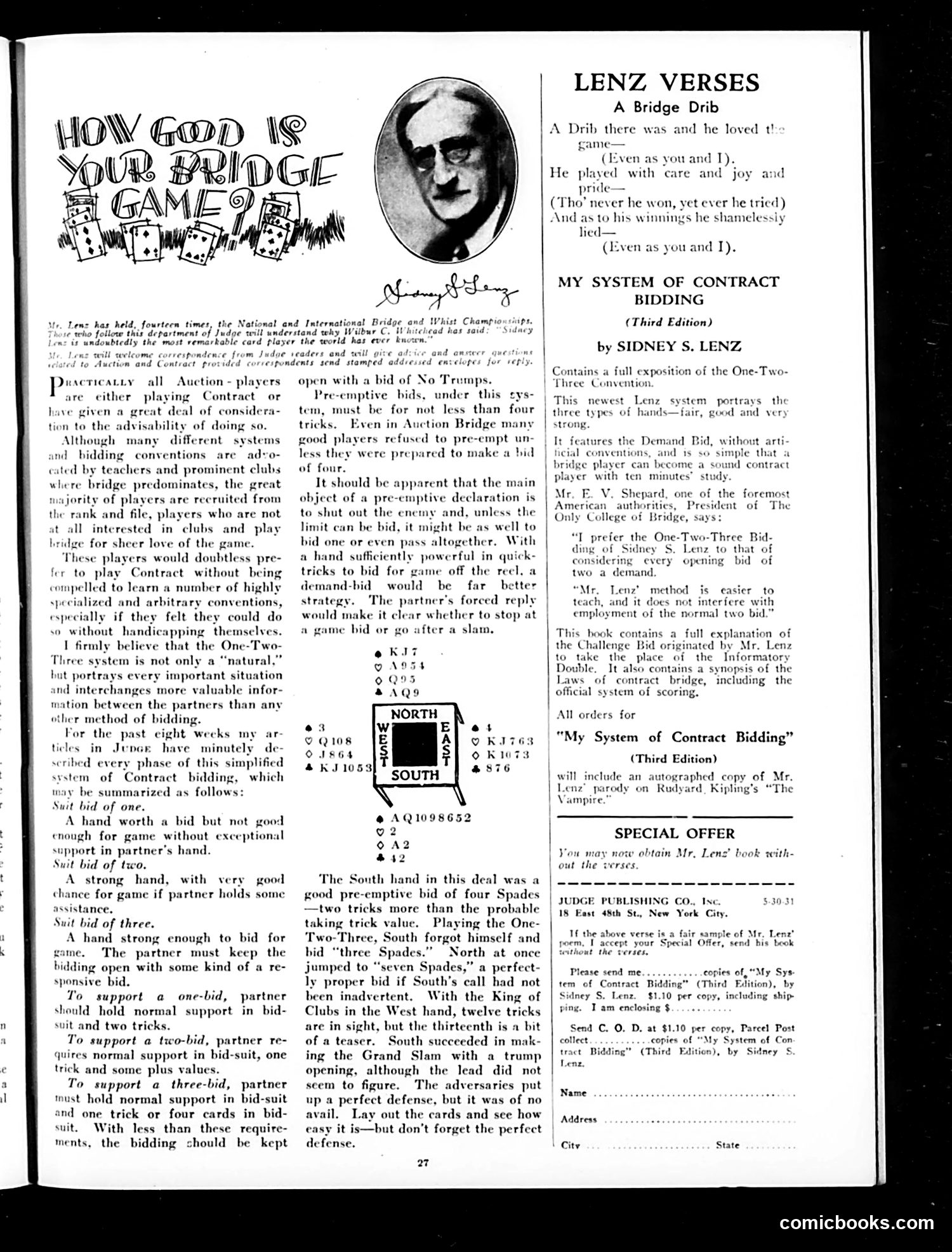
# Analysis This page from *Judge* satirizes complaints about rule changes in bridge (a card game) and golf. Two men discuss how experts constantly modify these games' regulations, making them impossible to master. The satire's point: both bridge and golf enthusiasts are obsessed with minutiae and resistant to change. The bridge player gripes about new bidding conventions that resemble "legalized signaling"; the golfer objects to new equipment (sand wedges) being banned and course modifications (bunkers, greens). The humor lies in the men's hypocritical rigidity—they simultaneously claim to prefer "the old way" while admitting they never would have learned these complex games in the first place without expert guidance. The bottom cartoon about wartime camouflage jokes that armies could hide behind roadside billboards, satirizing American commercial clutter. The exact publication date is unclear, but the "next war" reference suggests pre-WWII era (1930s-40s).
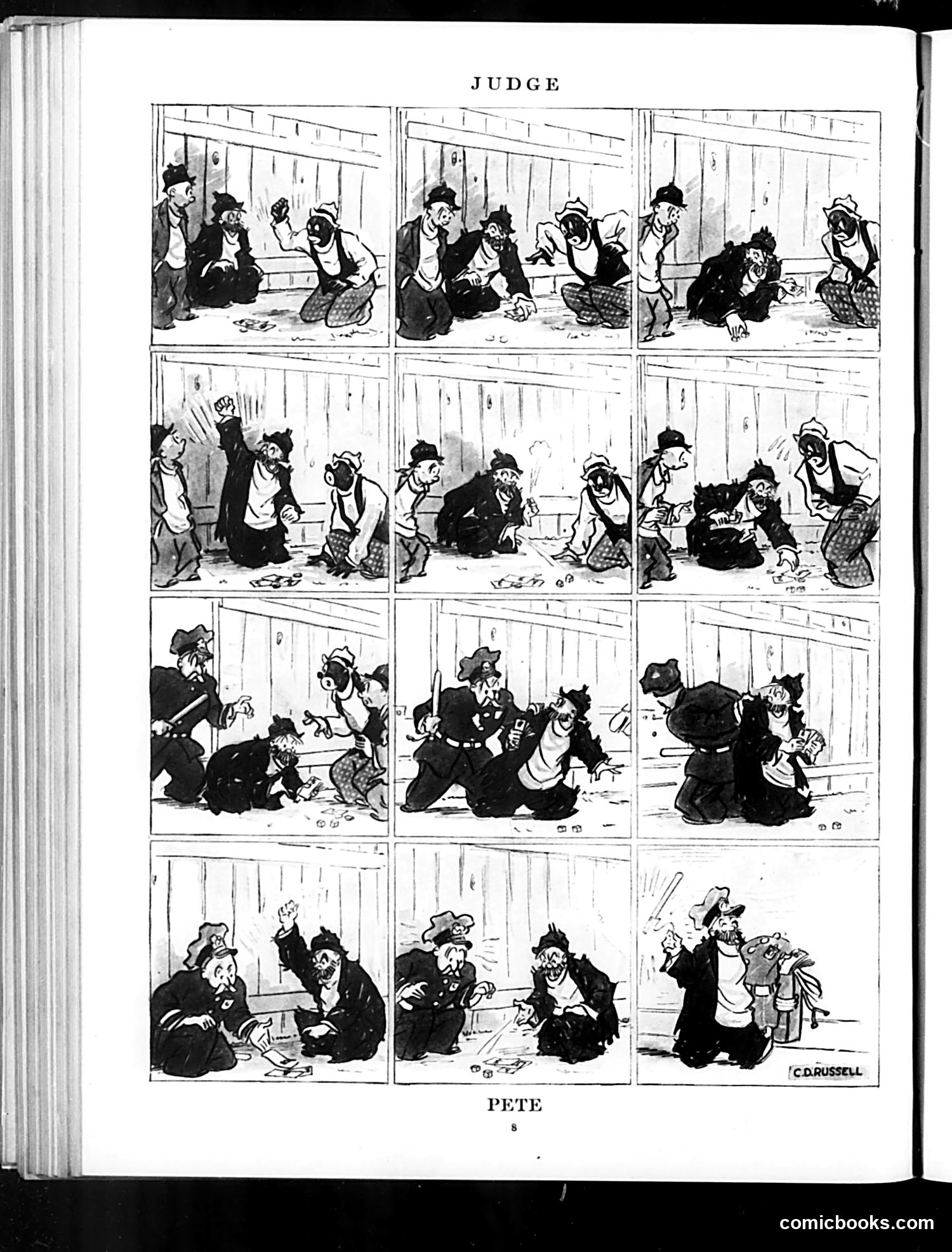
# "Judge" Comic: "Judge" and "Pete" This page contains two sequential comic strips by C.D. Russell (signed lower right). The top strip, "Judge," depicts what appears to be street urchins or poor children playing a game—likely marbles or dice—on a city sidewalk. The narrative progresses from their game through confrontation with authority figures (possibly police or officials in hats), escalating into physical altercation and chaos. The bottom strip, "Pete," shows similar street children in comparable scenarios of poverty and conflict with authority. Both strips appear to satirize urban street life and the treatment of poor children by the authorities, reflecting early 20th-century concerns about juvenile delinquency, poverty, and law enforcement practices. The exaggerated caricatures and slapstick violence typical of Judge magazine's humor style suggest commentary on social class conflicts.
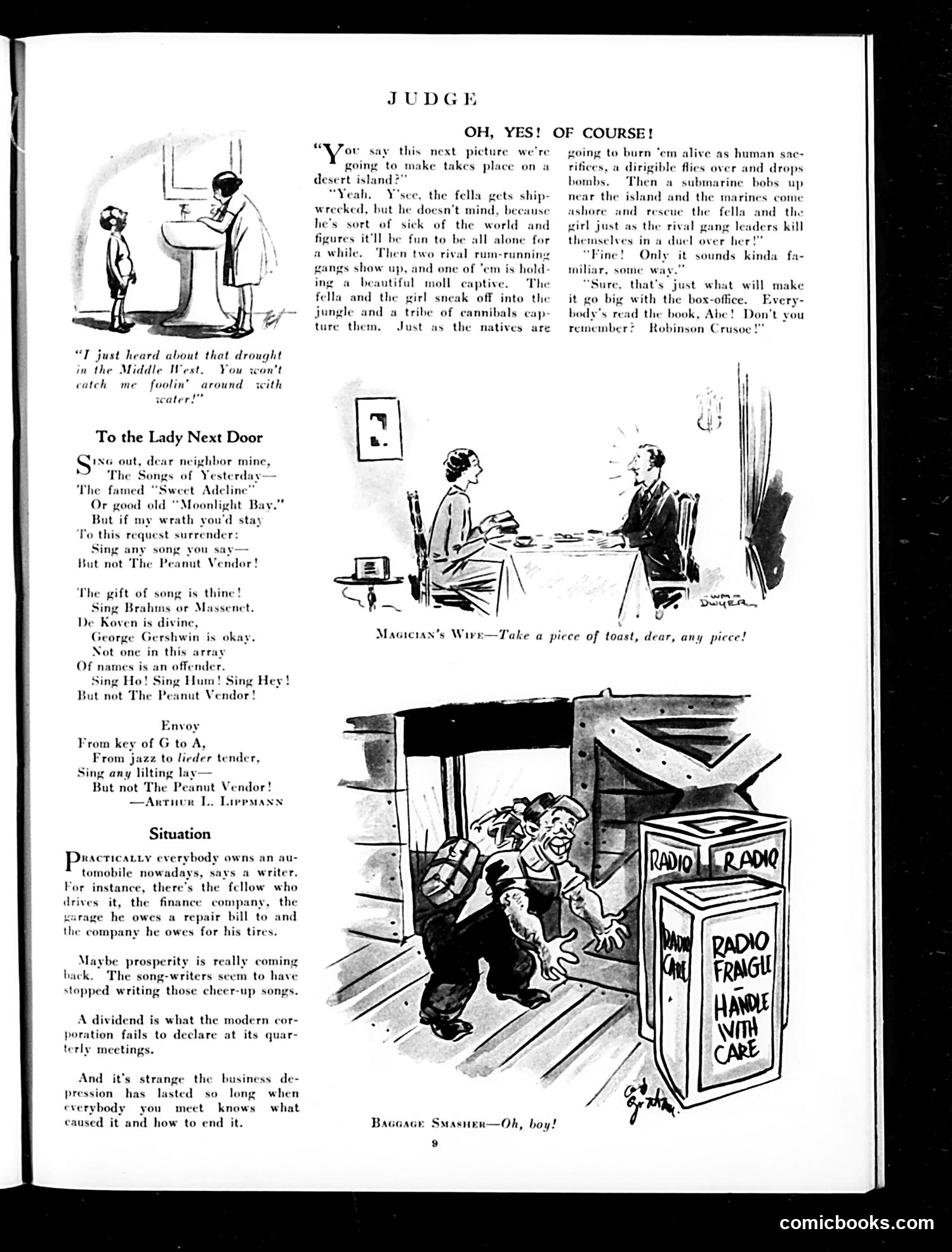
# Judge Magazine Page Analysis This page satirizes 1920s-30s American culture across multiple sketches: **"The Peanut Vendor" poem** mocks the era's obsession with a popular song of that title, so overplayed that neighbors beg each other to sing literally anything else—Brahms, Gershwin, old standards—just not that one more time. **"Magician's Wife"** shows a dining couple where the wife offers toast; the caption's joke is unclear from the image alone. **"Baggage Smasher"** depicts workers destroying radio equipment labeled "Handle with Care," sardonically captioning the destruction as inevitable carelessness. **"Situation" column** contains brief economic commentary: quips about automobile ownership (multiple parties "own" one car), Depression-era pessimism, and ironic observation that everyone claims to know what caused the economic crisis but nothing changes. **Bottom dialogue** parodies Hollywood's adaptation of *Robinson Crusoe*, with producers assured audiences will accept an absurdly plot-heavy desert island story because "everybody's read the book." The page reflects Jazz Age cynicism about consumer culture, economic instability, and mass entertainment.
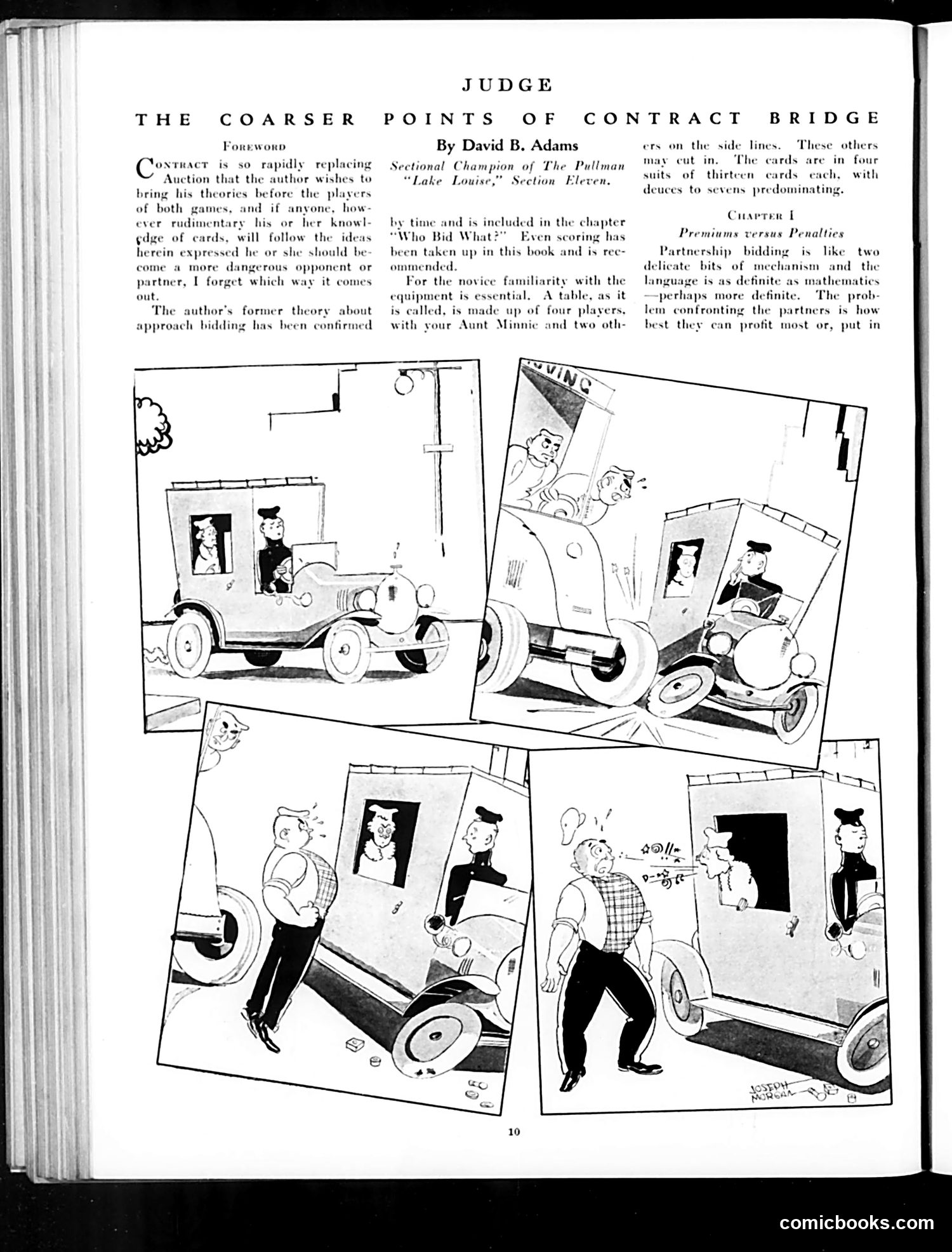
# Content Analysis This page introduces a bridge instruction manual by David B. Adams, a national champion. The cartoon strips illustrate **contract bridge gameplay and etiquette** — likely showing common scenarios at the bridge table. The comic panels depict people arriving at and departing from bridge games in cars, with figures entering/exiting through windows and doors. This appears to satirize the **social ubiquity of bridge** in early-to-mid 20th century American leisure culture — the game was so popular and time-consuming that people were practically living in their cars shuttling between games. The title "The Coarser Points of Contract Bridge" suggests the text addresses **basic fundamentals** for novice players. The foreword emphasizes that understanding bidding strategy and scoring rules helps players become "more dangerous opponents or partners." Without additional context, the specific cartoon jokes are unclear, but they likely mock bridge's social dominance or players' obsessive behavior around the game during this era.