
Judge, 1931-05-30 · page 20 of 36
Judge — May 30, 1931 — page 20: what you’re looking at
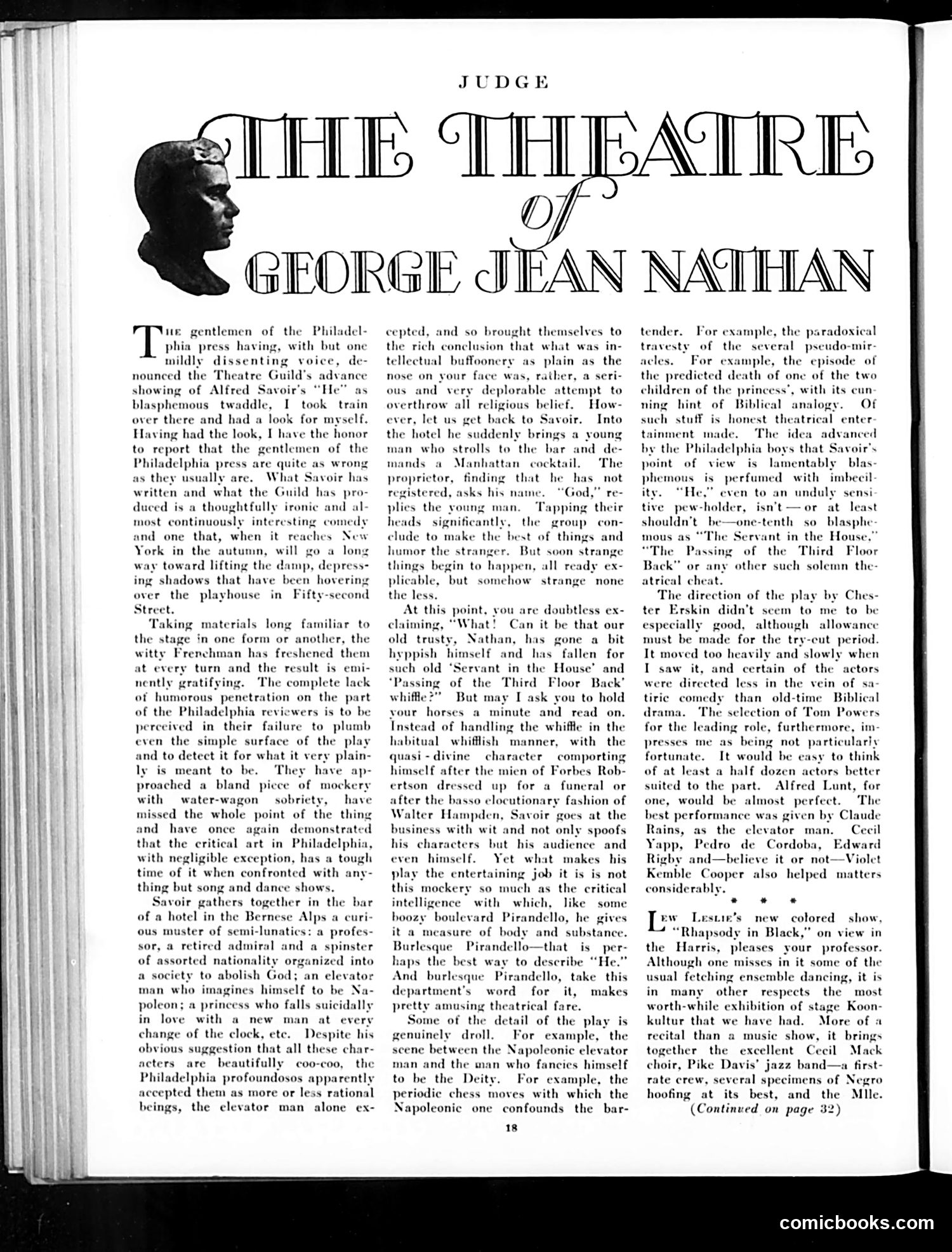
A restored page from Judge, 1931-05-30. Page through the whole issue in the reader above.
📄 Transcribed text from this page (OCR, searchable)
Machine-transcribed from the original scan — historical spelling and the odd misread are preserved.
ie gentlemen of the Philadel- phia press having, with but one mildly dissenting voice, nounced the Theatre Guild's adva showing of Alfred oir's “H blasphemous twaddle, I took train over there and had a look for myself. Having had the look, I have the honor to report that the gentlemen of the Philadelphia press are quite as wrong as they usually are. What Savoir has written and what the Guild has pro- duced is a thoughtfully ironic and al most continuously interesting comedy and one that, when it reaches N York in the autumn, will a long way toward lifting the damp, depress- ing shadows that e been hovering over the playhouse in Fifty-second Street. materials long familiar to the stage in one form or another, the witty Frenehr freshened them at every turn and the result is emi- nently gratifying. The complete of humorous penetration on the part of the Philadelphia reviewers is to be perceived in their failure to plumb even the simple surface of the p! and to detect it for what it very plain ly is meant to be. The ap- proached a bland piece of mockery with water-wagon sobriety, have missed the whole point of the thir and have onc in demonstrated that the critical art in Philadelphi with negligible exception, has a tough time of it when confronted with any- thing but song and dance shows. Savoir gathers together in the bar of a hotel in the Bernese Alps a curi- ous muster of semi-lunatics: a profes- sor, a retired admiral and a spinster of assorted nationality or; a society to abolish man who in poleon; a princess who falls suicidally in love with a new man at every change of the clock, ete. Despite his obvious suggestion that all these char- acters are beautifully coo-coo, the Philadelphia profoundosos apparently accepted them as more or less rational beings, the elevator man alone ex- JUDGE lie GEORGE ‘ay cepted, and so brought themselves to the rich conclusion that what was in- tellectual buffoonery as plain as the nose on your face was, rather, a seri- ous and very deplorable attempt. to overthrow all re pus belief. How- ever, let us get back to Sav Into the hotel he suddenly brings a young man who strolls to the bar and de- mands a Manhattan cocktail. The proprietor, finding that he has not stered, asks his name. “God,” re- plies the young man. Tapping their heads significantly, the group con- clude to make the best of things and humor the stranger. But soon strange things begin to happen, all r dy ex- but somehow strange none At this point, you are doubtless ex- ming, “What! Can it be that our old trusty than, has gone a bit hyppish himself and has fallen for such old ‘Servant in the House’ and ‘Passing of the Third Floor Back’ whiffe?” But may I ask you to hold your horses a minute and read on. Instead of handling the whiffe in the habitual whifflish manner, with the quasi-divine character comporting himself after the mien of Forbes Rob- ertson dressed up for a funeral or after the basso elocutionary fashion of voir goes at the bus nd not only spoofs his characters but his audience and even himself. Yet what makes his the entertaining job it is is not this mockery so much as the critical intelligence with which, like some boozy boulevard Pirandello, he it a measure of body and substance. Burlesque Pirandello—that is pe haps the best way to describe “H And burlesque Pirandello, take this department's. word for it, makes prett theatrical fare. Some of the detail of the p! nuinely droll. For example ne between the Napoleonic elevator man and the man who fancies himself to be the Deity. For example, the periodic chess moves with which the Napoleonic one confounds the bar- 18 ss with wit ACR Es NACIHIAN tender. For example, the paradoxical travesty of the several pscudo-mir acles. | For example, the episode. of the predicted death of one of the two dren of the princess’, with its cun ning hint of Biblical such stuff is honest the tainment mad The id hy the Philadelphia boys that Savo' point of view is lamentably blas phemous is perfumed with imbecil ity. “He,” even to an unduly sensi tive pew-holder, isn't —or at least shouldn't be—one-tenth so blasphe mous as “The Servant in the House.” “The Passing of the Third Floor or any other such solemn the- I cheat. direction of the play by Ches- skin didn’t seem to me to be Hy good, although allowan: must be made for the try-cut period. It moved and slowly when I saw it, « ain of the tors were directed less in the vein of sa- tiric comedy than old-time Biblical The selection of Tom Powers i furthermore, im- ng not particularl presses me a iy fortunate. It would be easy to think of at least a half dozen actors better suited to the part. Alfred Lunt, for one, would be almost perfect. The vas given by Claude as the elevator man. Cecil Pedro de Cordoba, Edward y and—believe it or not—Violet Kemble Cooper also helped matters considerably. * *# «# LT” Lestie’s new colored show, “Rhapsody in Black,” on view in the Harris, pleases your professor. Although one misses it some of the usual fetching ensemble dancing, it is in many other respects the most worth-while exhibition of stage Koon- kultur that we have had. More of a recital than a music show, it brings together the excellent Cecil Mack choir, Pike Davis’ j band—a first- rate crew, several specimens of Negro hoofing at its best, and the Mlle. (Continued on page 32) comicbooks.com