A complete issue · 36 pages · 1930
Judge — December 13, 1930
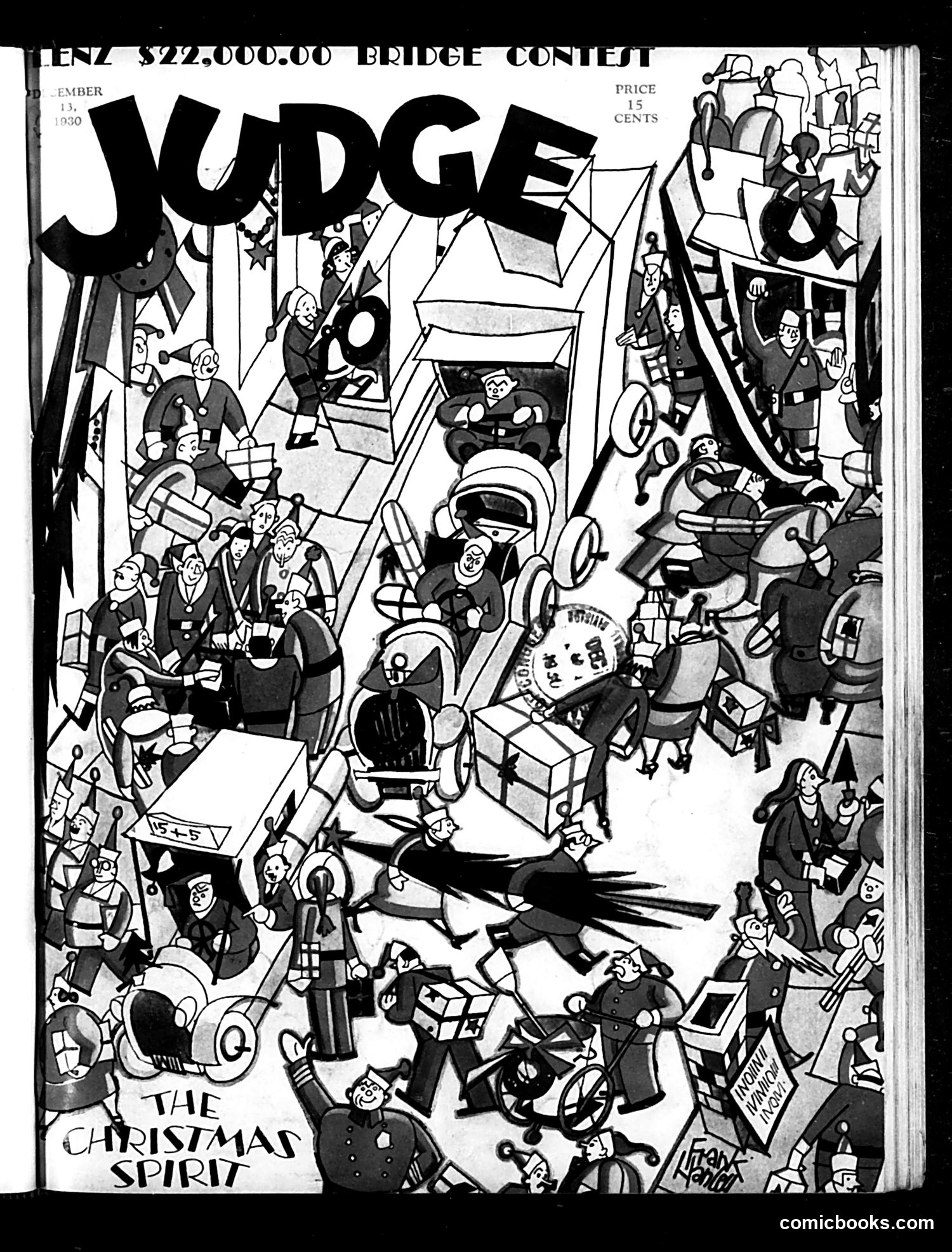
# Analysis of Judge Magazine Cover (December 1930) This is a satirical Christmas-themed cover depicting a chaotic toy store or gift-buying scene. The central figure appears to be Santa Claus surrounded by frenzied shoppers, mechanical toys, and commercial activity—likely satirizing the consumer frenzy of holiday shopping during the Great Depression era. The title "THE CHRISTMAS SPIRIT" suggests ironic commentary on materialism overshadowing the holiday's spiritual meaning. The crowded, mechanical composition emphasizes commercialism's dominance. The cartoon critiques how American consumer culture and gift-buying have become the dominant expression of Christmas, even amid economic hardship. The "$22,000.00 BRIDGE CONTEST" reference at the top indicates additional page content unrelated to the main cover illustration.
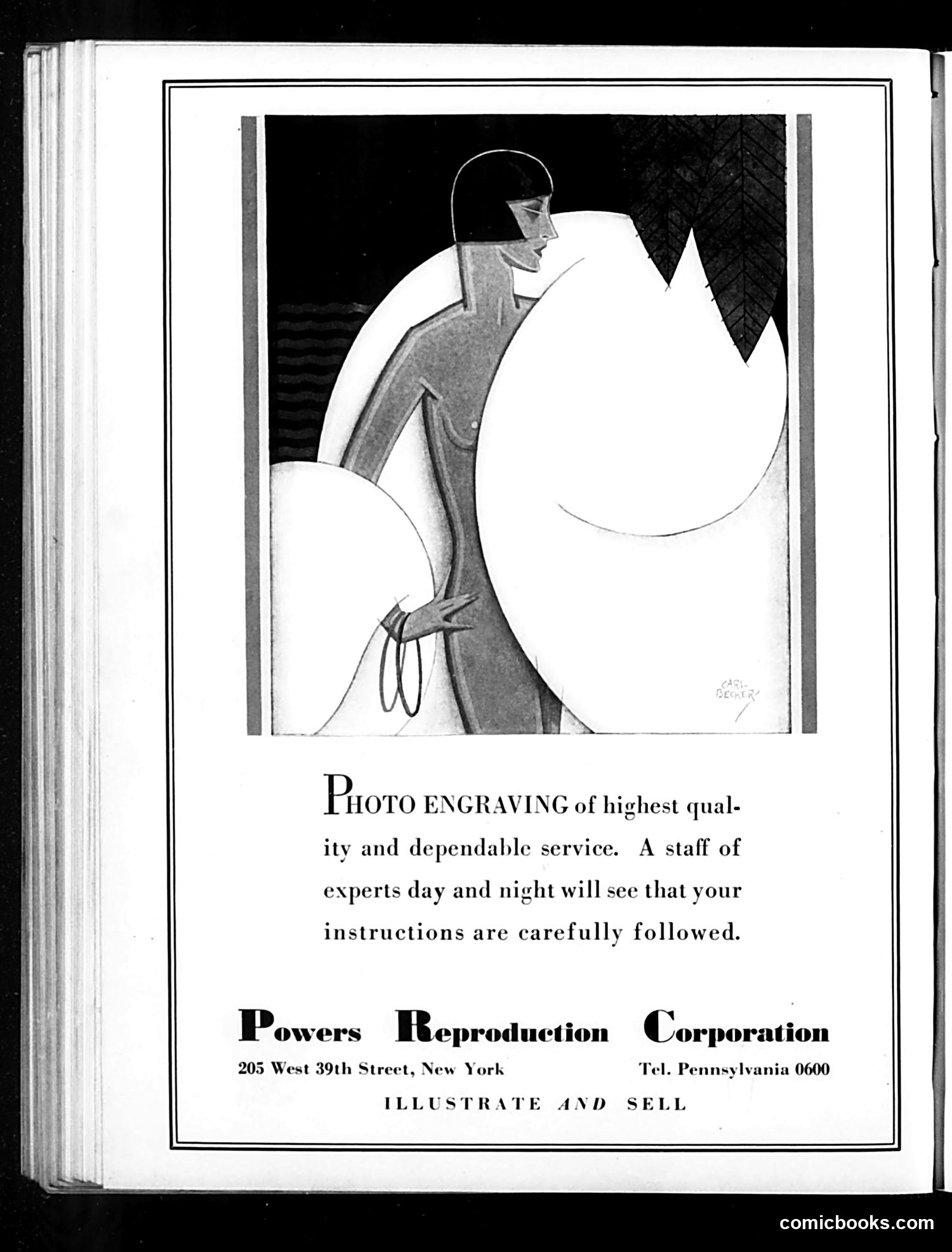
# Analysis This page is primarily **advertising**, not editorial content or satire. It features an Art Deco-style illustration of a stylized female figure in white garments against a dark background—typical 1920s-1930s modernist design aesthetics. The ad promotes **Powers Reproduction Corporation**, a photo engraving service located at 205 West 39th Street, New York. Photo engraving was a commercial printing technique essential for reproducing images in publications and advertisements. The text emphasizes quality workmanship and round-the-clock expert service ("day and night"). The tagline "ILLUSTRATE AND SELL" appeals to publishers and advertisers as business customers. This is not political or social satire, but rather a professional services advertisement targeting the publishing industry.
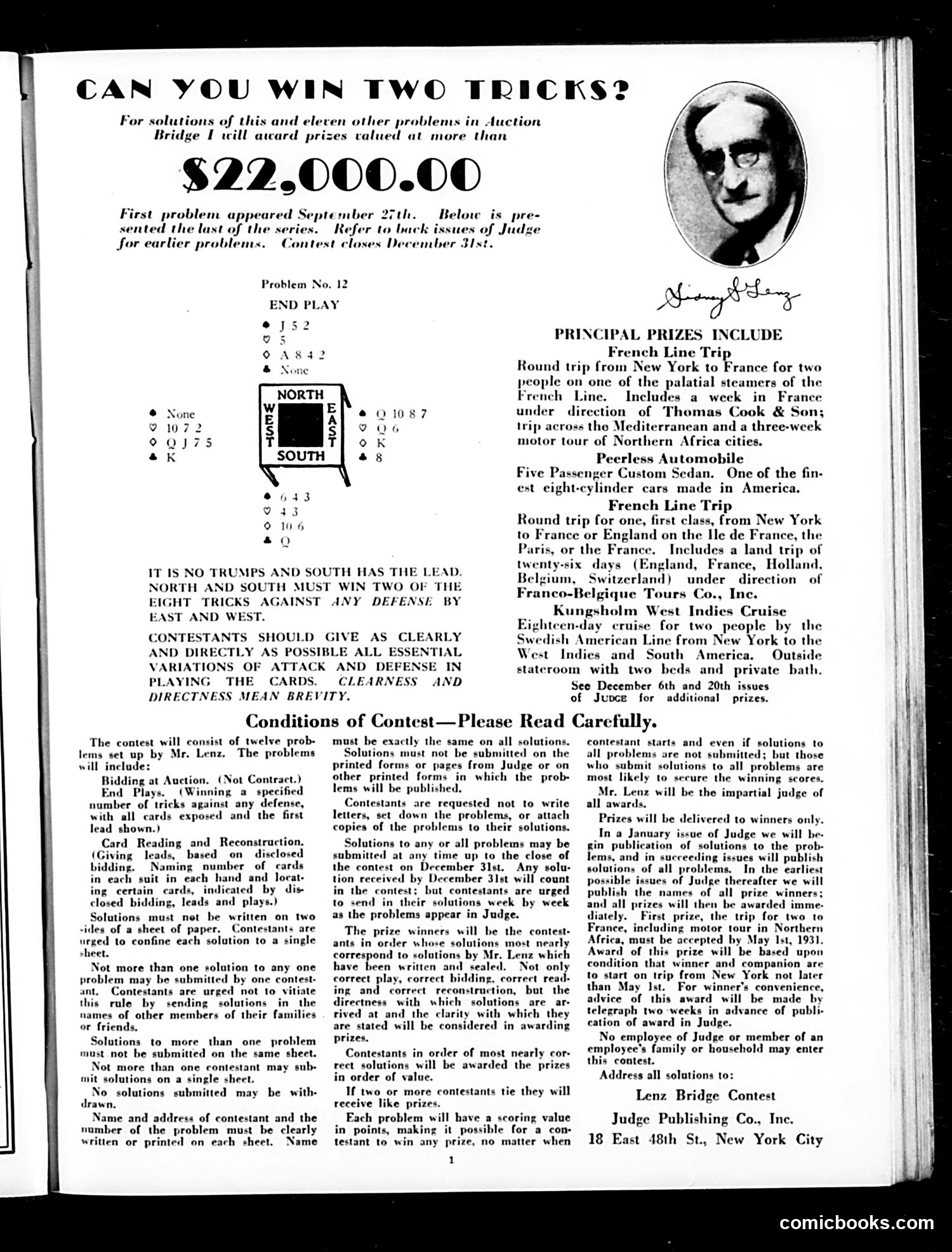
# Analysis This page is primarily a **contest advertisement**, not a political cartoon. Judge magazine is offering $22,000 in prizes (a substantial sum for the era) for solving twelve bridge problems—card game puzzles where players must deduce hidden cards based on bidding and play. The portrait shows **Mr. Lenz**, the contest judge and apparently a notable bridge expert. The problems involve analyzing trick plays and card distributions, requiring "clearness and directness" in explanations. Principal prizes include a French Line ocean voyage, a Peerless automobile, and a Caribbean cruise. The page emphasizes that solutions must be submitted by December 31st and published in Judge magazine. This reflects bridge's popularity as an intellectual leisure pursuit among affluent Americans in this period.
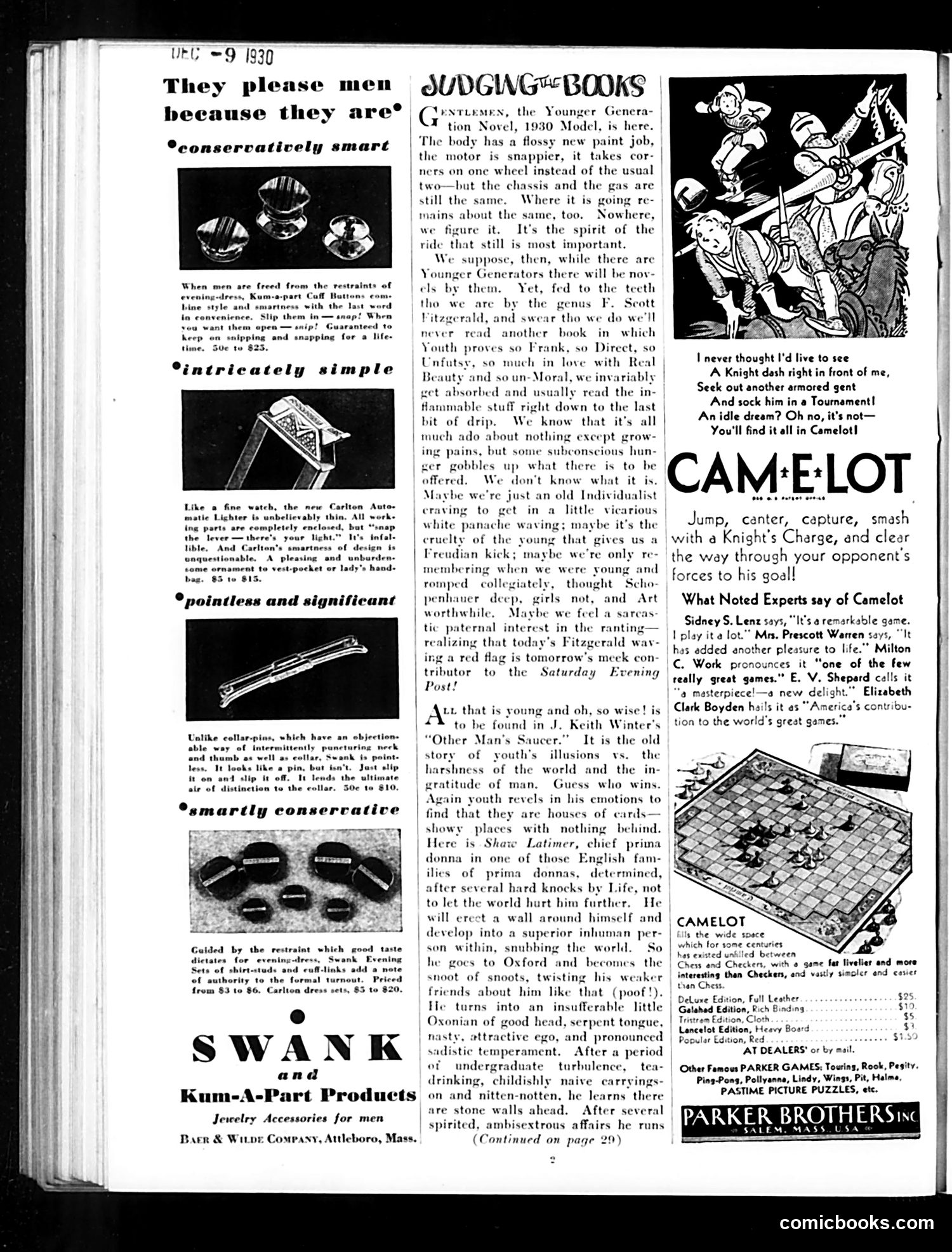
# Analysis This page is primarily **advertising and book reviews**, not political satire. The top left features ads for jewelry and accessories ("conservatively smart," "intricately simple," "pointless and significant"), emphasizing design sophistication for men. The center contains "**Judging the Books**"—a literary review section praising the 1930 Younger Generation novel by F. Scott Fitzgerald. The reviewer celebrates Fitzgerald's ability to capture youth's contradictions: romantic idealism versus worldly disillusionment, frivolity versus depth. **Camelot** (right side) is a board game advertisement featuring knights and tournaments, marketed to appeal to adventurous players. Bottom advertising includes **Swank** jewelry and **Parker Brothers** games. This reflects 1930 consumer culture: the magazine balanced satirical commentary with high-end product marketing for affluent readers interested in literature, games, and masculine accessories.
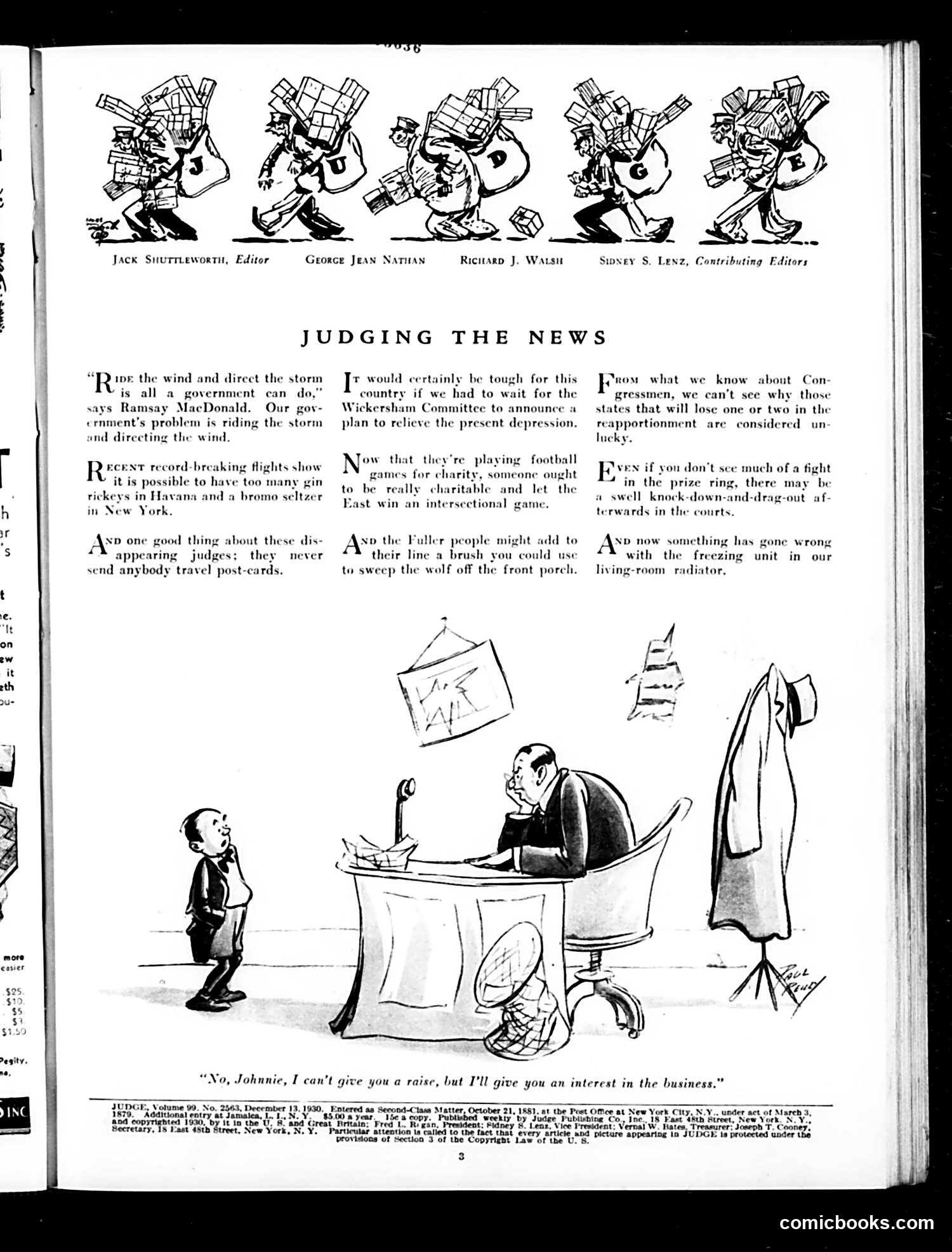
# "Judging the News" - December 13, 1930 This page satirizes Depression-era news stories through short commentary and a cartoon. The editorial quips mock government inaction ("all a government can do" is "ride the storm"), excess gin consumption in Harlem despite Prohibition, charity football games, and other current events. The main cartoon depicts a businessman at a desk telling a young boy: "No, Johnnie, I can't give you a raise, but I'll give you an interest in the business." This is bleak Depression humor—the businessman offers only false hope (a "share" in the business) instead of actual wage increases, reflecting how employers exploited workers during economic hardship by promising future gains instead of immediate pay.
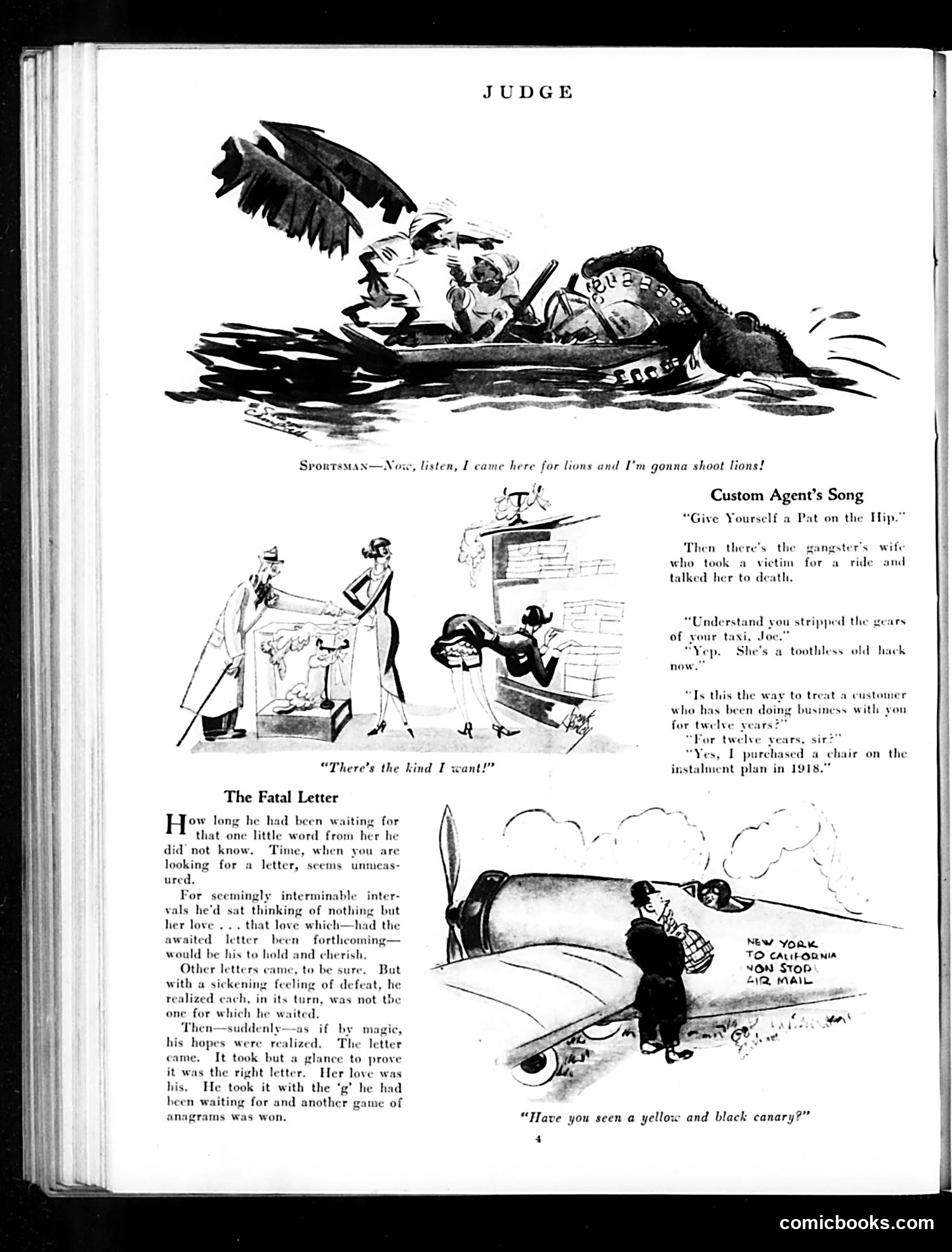
# Analysis of Judge Magazine Page **Top Cartoon ("Sportsman")**: A hunter in a sinking boat confronts an eagle, boasting he came to shoot lions—implying overconfidence meeting reality. This appears to be generic satire about poor planning or mismatched expectations. **Middle Section ("There's the kind I want!")**: Shows a domestic dispute, likely satirizing marital conflict or consumer behavior. **"Custom Agent's Song"**: Mocking text about a taxi driver mistreating a customer, suggesting satire of working-class service industry abuses or labor disputes. **"The Fatal Letter"**: A sentimental story about a man awaiting a love letter, with accompanying illustration of someone intercepting mail. This appears to be light romantic satire rather than political commentary. **Overall**: This page mixes generic humor, domestic comedy, and sentimental fiction rather than pointed political satire.
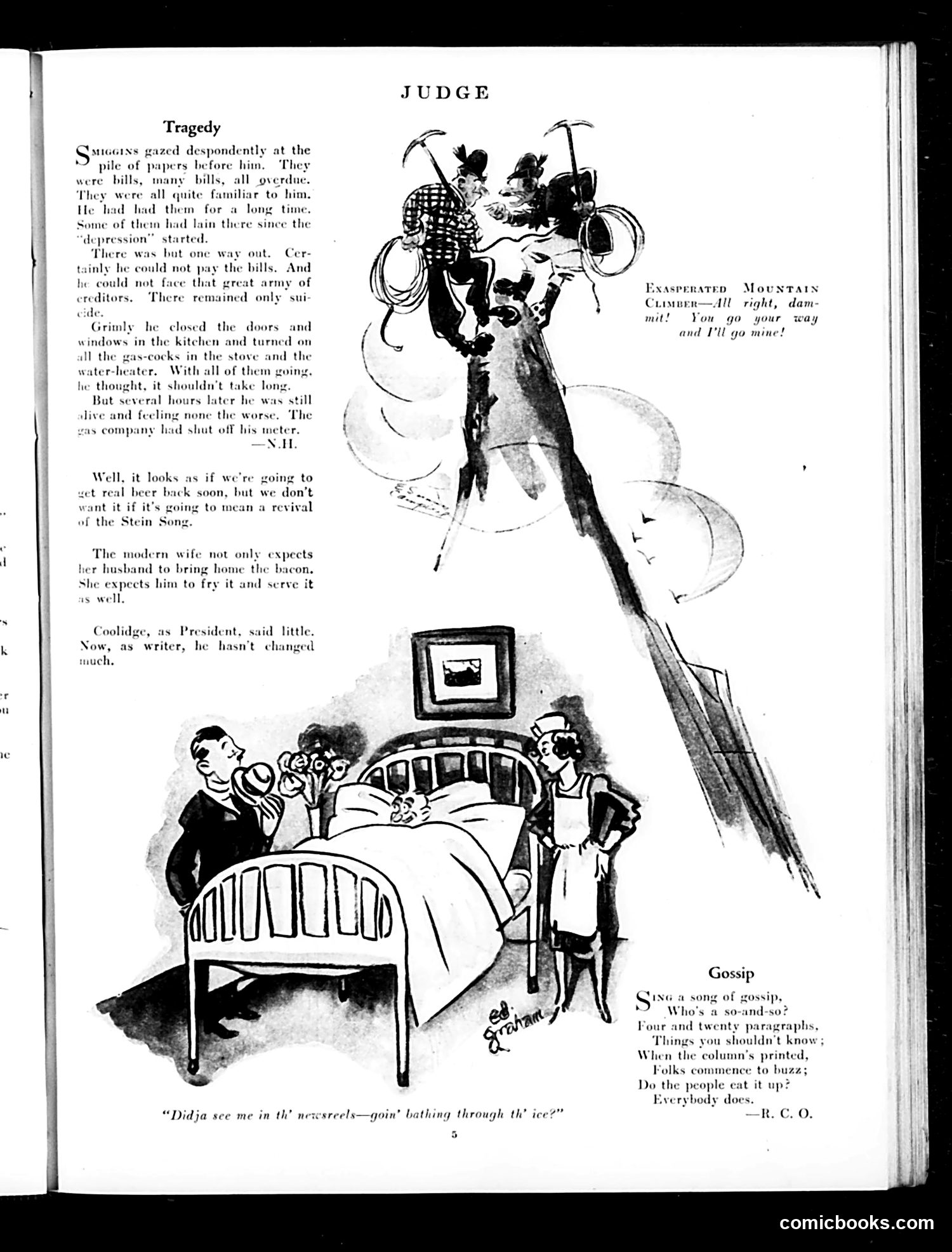
# Analysis of Judge Magazine Page This page contains three separate satirical pieces: **"Tragedy"** (left column): A commentary on economic hardship, depicting a man facing overdue bills during what appears to be the Depression era. The satire suggests his only solution is suicide—turning on gas appliances to asphyxiate himself. The dark humor critiques both his financial desperation and the impotence of institutions to help. **"Exasperated Mountain Climber"** (top right): A cartoon showing two cyclists on a mountain, with one exasperatedly telling the other to go their own way. The humor appears to involve romantic or relationship conflict during leisure activity. **"Gossip"** (bottom right): A poem-caption satirizing how gossip spreads through society—from newspapers to social circles, with people eagerly sharing scandalous information regardless of accuracy. The overall tone reflects early-20th-century social commentary on economic anxiety, modern dating, and information culture.
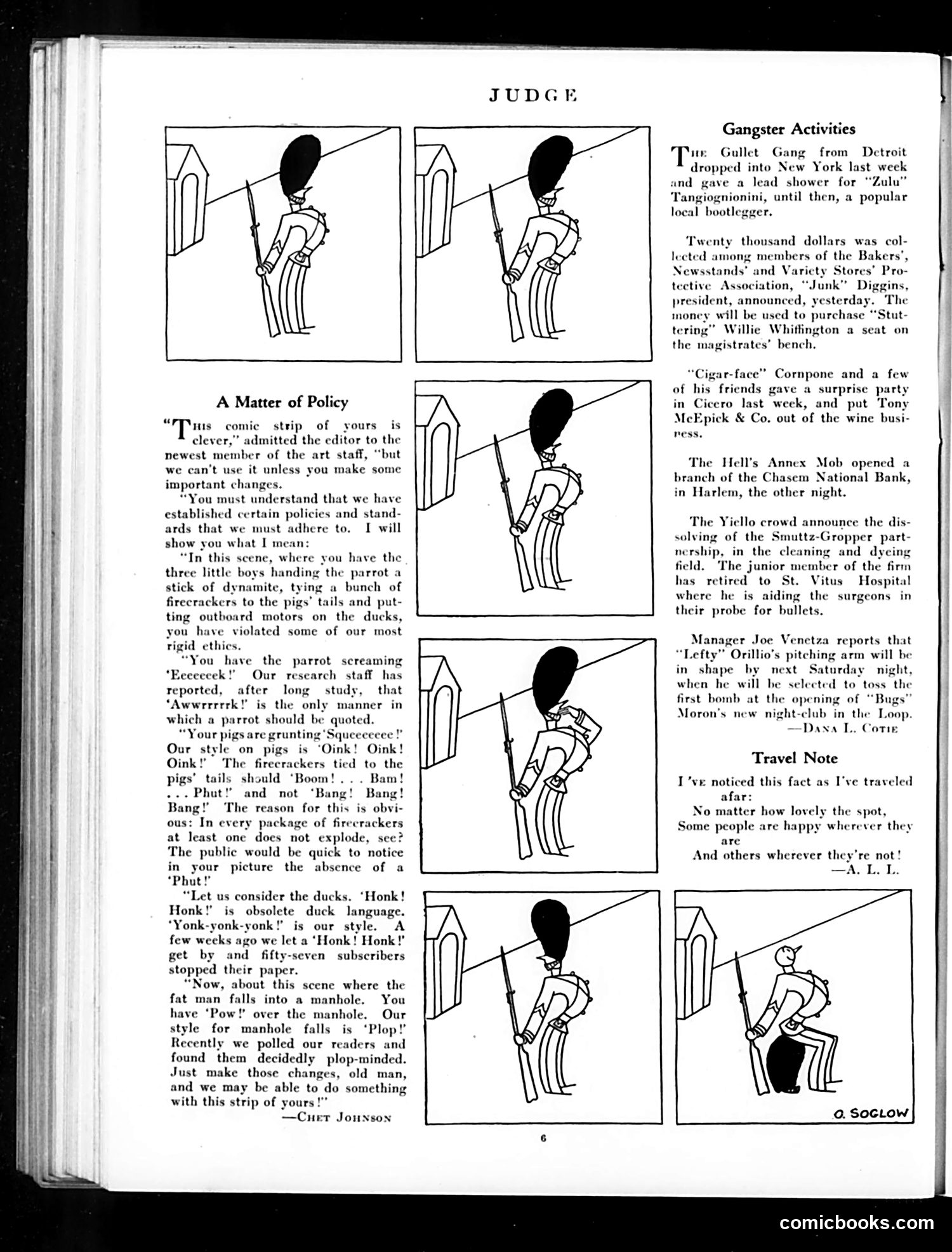
# "Judge" Page Analysis This page contains a comic strip titled "A Matter of Policy" by Chet Johnson (signed at bottom). The strip depicts a conversation between an editor and a new staff member about establishing editorial standards for a comic strip. The editor explains policies regarding character dialogue and sound effects—notably that parrots should say "Eeeeeeck!" rather than "Awwwrrr!", pigs should grunt "Squeeeece!" not "Oink! Oink!", and ducks should say "Honk! Honk!" (not "Yank-yank-yank!"). He emphasizes consistency and reader preferences, mentioning they polled readers who demanded changes. The humor satirizes editorial micromanagement and arbitrary creative restrictions. The comic strip's visual gags show characters falling through a manhole to illustrate these absurd stylistic rules. The right sidebar contains unrelated brief news items about gangster activities and other contemporary topics.
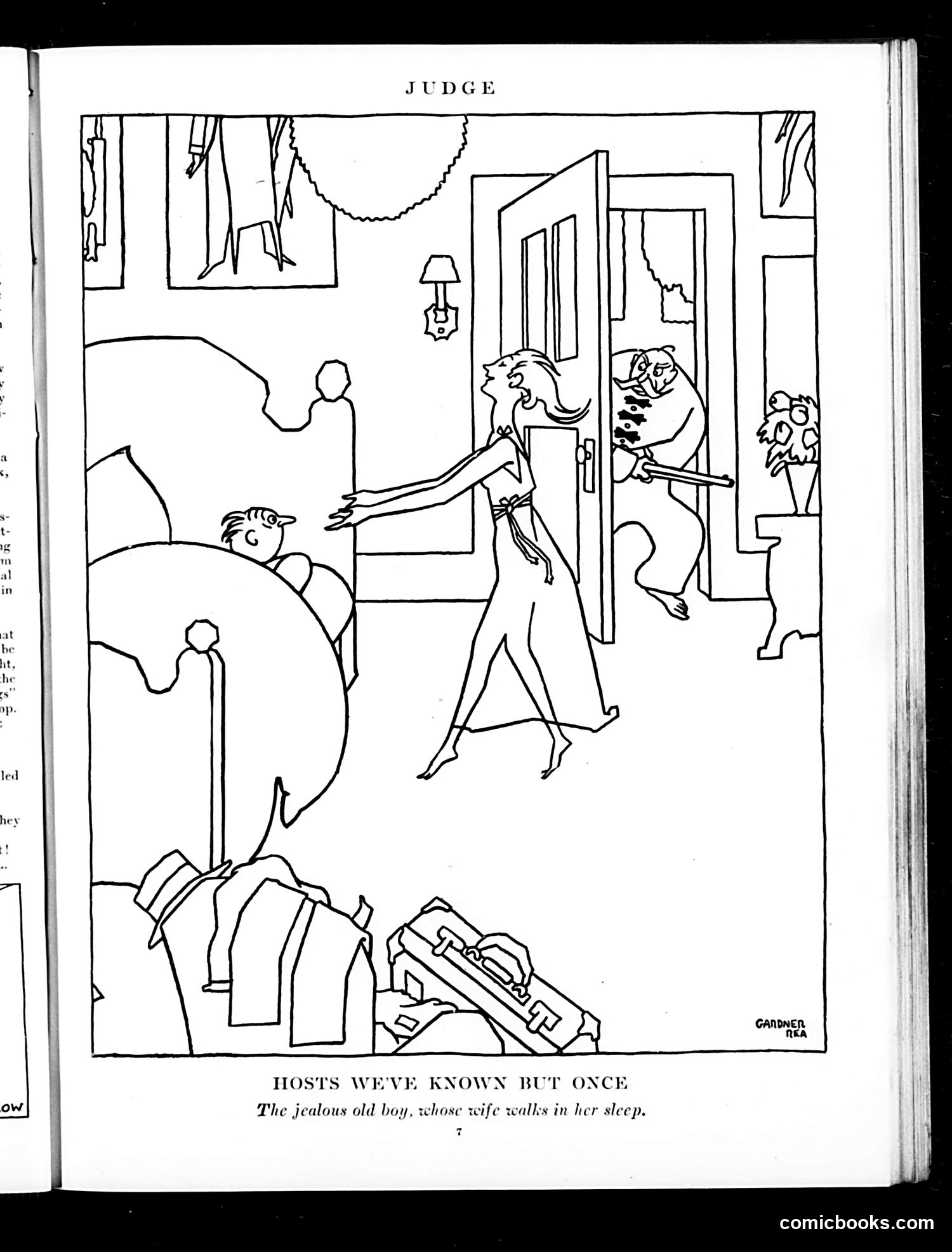
# "Judge" Cartoon Analysis This single-panel cartoon titled "Hosts We've Known But Once" depicts a domestic scene with the caption: "The jealous old boy, whose wife walks in her sleep." The humor plays on a common marital anxiety trope of the era: a husband suspiciously monitoring his sleepwalking wife's nighttime movements through their home. The illustration shows the wife in a nightgown moving through doorways while the husband watches from bed, with other household members visible in adjacent rooms. The satire targets masculine jealousy and paranoia—specifically, the anxious husband who interprets his wife's innocent sleepwalking as potential infidelity or improper behavior. It mocks both the husband's unfounded suspicions and the social context where wives' autonomy was subject to such scrutiny. The joke relies on period understanding of sleepwalking as a genuine concern and marriage dynamics of that era.
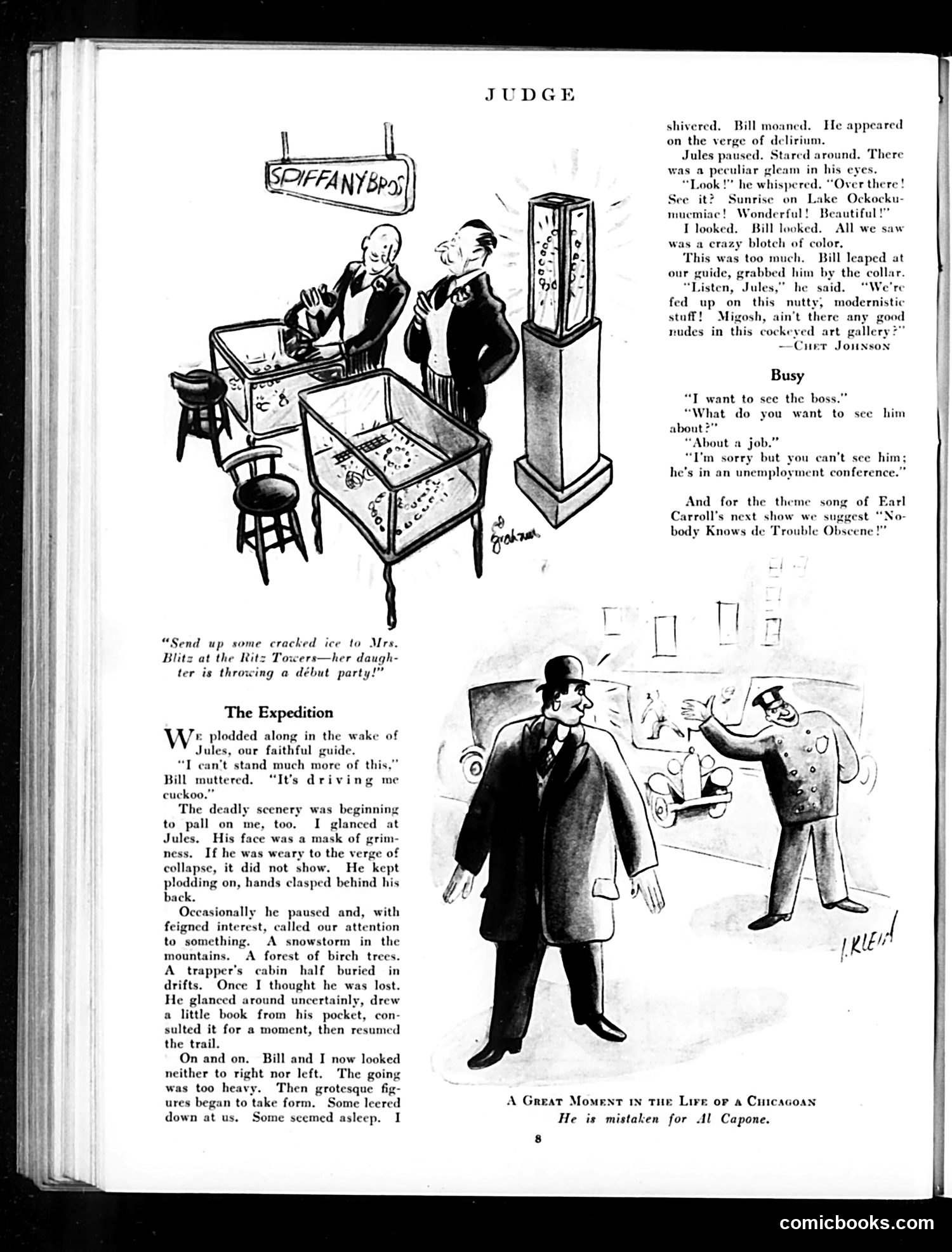
# Analysis of Judge Magazine Page This page contains multiple satirical pieces typical of 1920s-30s Judge magazine: **"The Expedition"** (main story): A narrative mocking modernist art appreciation. Jules, an affected guide, rhapsodizes over mundane landscapes ("Sunrise on Lake Ockocku-mucmiac") while the narrator and Bill see only "a crazy blotch of color." Bill's outburst—demanding "good nudes" instead of "nutty, modernistic stuff"—satirizes the pretentiousness of modern art enthusiasts versus common-sense viewpoints. **"Busy"** (top right): A joke about unemployment during what appears to be Depression-era economic crisis. The boss is unavailable because he's "in an unemployment conference"—darkly ironic given the visitor seeks a job. **"A Great Moment"** (bottom): Shows a man mistaken for Al Capone, the famous gangster. The humor derives from mistaken identity and the era's gangster obsession. The cartoons collectively mock modernism, unemployment anxiety, and 1920s-30s celebrity culture.
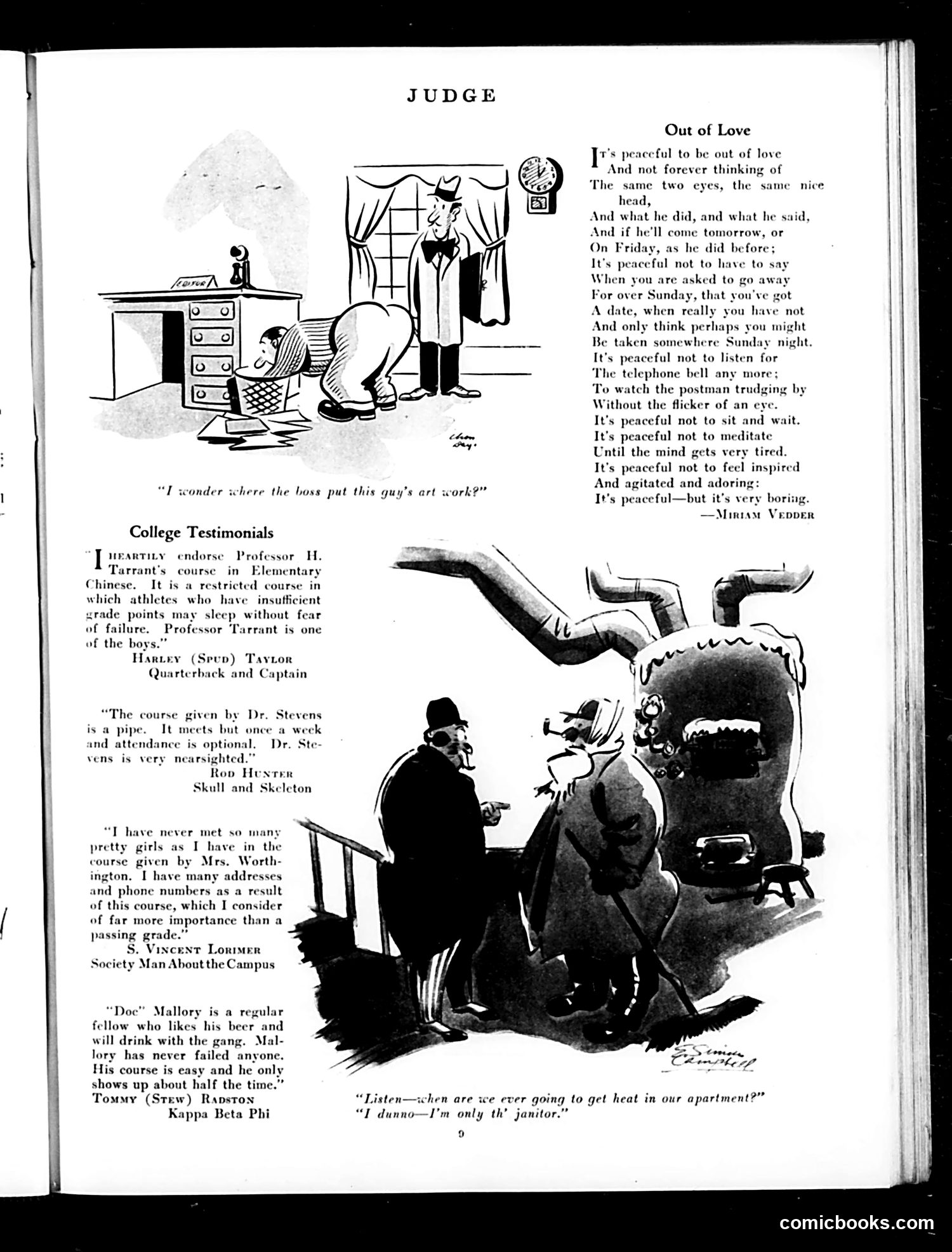
# Judge Magazine Page Analysis This page from *Judge* magazine contains satirical commentary on college life and romantic relationships. **"Out of Love"** is a poem by Miriam Vedder exploring the paradox of being romantically unattached—it offers peace from obsessive thinking and waiting, but proves "very boring." The sentiment captures early 20th-century romantic anxieties. **"College Testimonials"** mocks academic standards through fake student endorsements. Athletes praise courses for being easy (Professor Tarrant's for sleeping through, Dr. Stevens's for minimal attendance). One student values a professor's course primarily for meeting "pretty girls," while another praises "Doc" Mallory for never failing anyone and being lenient. These reveal satirical critiques of grade inflation, academic laxity, and students prioritizing social benefits over education. **The cartoons** show workplace and domestic absurdity—one depicts a messy artist's workspace; another shows a tenant complaining about lack of heat to an indifferent janitor, illustrating housing complaints and class indifference typical of the era.
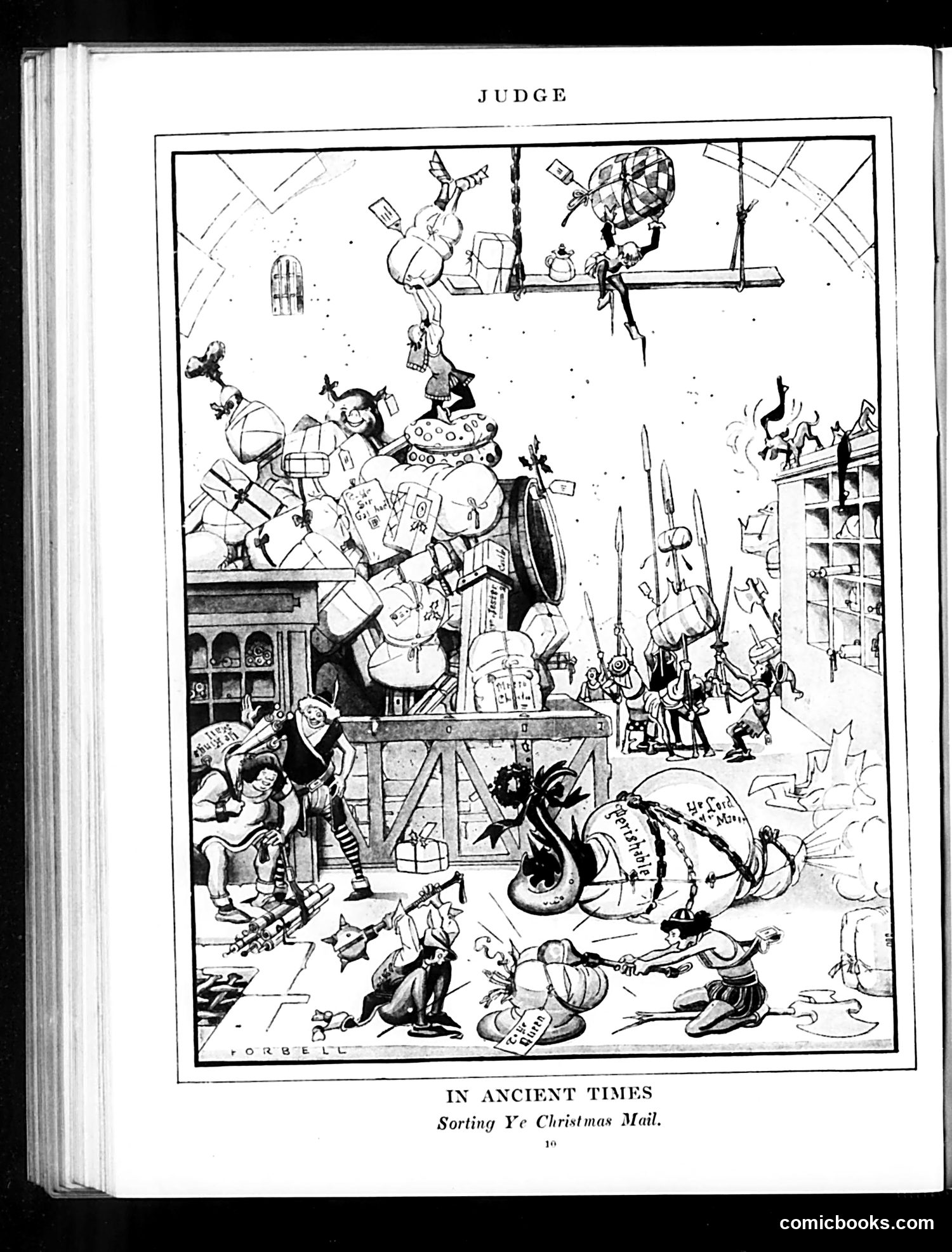
# Analysis This satirical cartoon depicts a chaotic medieval-style workshop scene titled "Sorting Ye Christmas Mail" in "Ancient Times." The image humorously imagines how Christmas mail sorting might have occurred in a fantastical past era. The scene shows numerous small figures engaged in frantic activity around oversized mail bags and packages. There's a central figure (possibly representing authority) elevated above the chaos, while workers below struggle with enormous bundles. Dragons, magical creatures, and impossible contraptions appear throughout, suggesting absurdity. The satire likely mocks the annual Christmas mail surge—a perennial logistical challenge. By depicting it in "ancient times" with fantastical elements, Judge magazine humorously exaggerates the overwhelming chaos postal workers faced during the holiday season, transforming a contemporary problem into comedic medieval fantasy.