
Judge, 1930-12-13 · page 18 of 36
Judge — December 13, 1930 — page 18: what you’re looking at
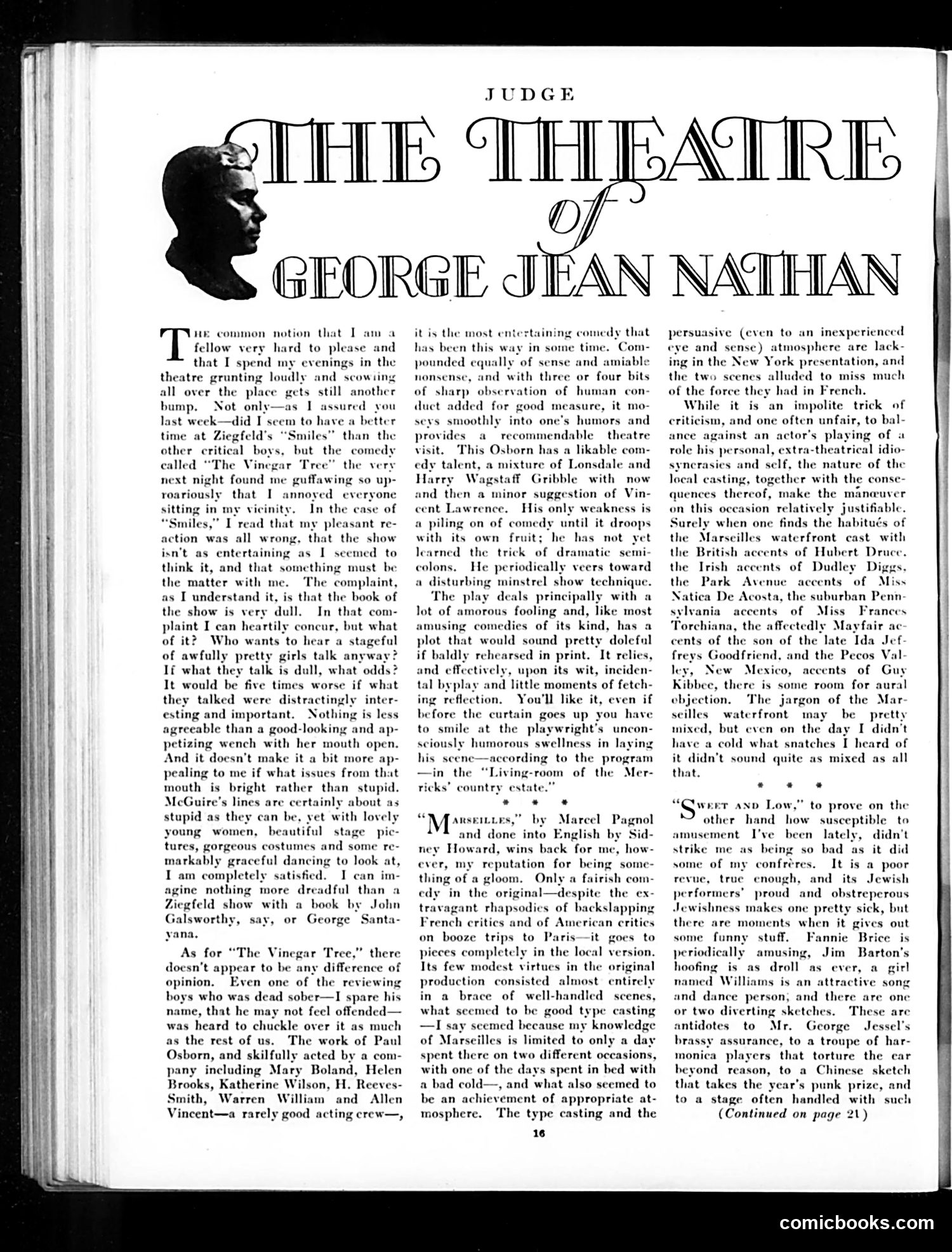
A restored page from Judge, 1930-12-13. Page through the whole issue in the reader above.
📄 Transcribed text from this page (OCR, searchable)
Machine-transcribed from the original scan — historical spelling and the odd misread are preserved.
HE common notion that Tam a | fellow very hard to please and that I spend my evenings in the theatre grunting loudly and_ sc 1 over the pl gets still another bump. Not only—as I assured you last week—did I se ea better time at Ziegfeld’s * than the other critical boys, but the comedy called “The Vinegar Tree” the very next night found me guffawing so up- roariously that I annoyed everyone sitting in my vicinity. In the case of les,” Tread that my pleasant re- ction was all wrong, that the show isn't as entertaining as I seemed to think it, and that something must be the matter with me. The complaint, as I understand it, is that the book of the show is very dull. In that com- plaint I can heartily concur, but what of it?) Who wants to hear a stageful of awfully pretty girls talk anyway? If what they talk is dull, what odds? It would be five times worse if what they talked were distractingly inter- esting and important. Nothing is less agreeable than a good-looking and « petizing wench with her mouth open. And it doesn’t make it a bit more ap- pealing to me if what issues from that mouth is bright rather than stupid. McGuire's lines are certainly about as stupid as they can be, yet with lovely young women, beautiful stage pic- tures, gorgeous costumes and some re- markably graceful dancing to look at, I am completely satisfied. I can im- wring, -gfeld show with a book by Galsworthy, say, or George yana, As for “The V doesn’t appear to be opinion. Even one of the re boys who was dead sober—I spare his name, that he may not feel offended— was heard to chuckle over it as much as the rest of us. The work of Paul Osborn, and skilfully acted by a com- pany including Mary Boland, Helen Brooks, Katherine Wilson, H. Reeves- Smith, Warren William and Allen Vincent—a rarely good acting crew—, JUDGE kb GEORGE J O it is the most entertaining comedy that this way in some time. Com- pounded equally of sense and amiable nonsense, and with three or four bits of sharp observation of human con duct added for good measure, it mo- seys smoothly into one’s humors and provides a recommendable thes visit. This Osborn has a likable com- edy talent, a mixture of Lonsdale and Harry Wagstaff Gribble with now and then a minor suggestion of Vin- cent Lawrence. His only w a piling on of comedy until with its own fruit; he learned the trick of dramatic semi- colons. He periodically veers toward a disturbing minstrel show technique. The play deals principally with a lot of amorous fooling and, like most amusing comedies of its kind, has a plot that would sound pretty dolefal if baldly rehearsed in print. It relies, and effectively, upon its wit, inciden- tal byplay and little moments of fetch- ing reflection. You'll like it, even if before the curtain goes up you have to smile at the playwright’s uncon- sciously humorous swellness in Iay his scene—according to the program —in the “Living-room of the Mer- ricks’ country estate.” * * « Mnsentess by Marcel Pagnol and done into English by Sid- » Howard, wins back for me, how- ever, my reputation for being some- thing of a gloom. Only a fairish com- edy in the original—despite the ex- travagant rhapsodics of backslapping French critics and of Aw n critics on booze trips to Paris—it goes to pieces completely in the local version. Its few modest virtues in the original production consisted almost entirely in a brace of well-handled scenes, what seemed to be good type casting —I say seemed because my knowledge of Marseilles is limited to only a day spent there on two different occasions, with one of the days spent in bed with a bad cold—, and what also seemed to be an achievement of appropriate at- mosphere. The type casting and the 16 has akness is tt droops not yet ACRE NATHAN persuasive (even to an inexperienced nd sense) atmosphere are lack- the New York presentation, and the two scenes alluded to miss much of the force they had in French. While it is impolite trick of criticism, and one often unfair, to bal- ance against an actor's pl role his personal, extra-theat syncrasies and self, the nature of the local casting, together with the conse- quences thereof, make the n n this occasion relatively justi ly when one finds the habitués of the Marseilles waterfront cast with the British nts of Hubert Druce. the Irish accents of Dudley Diggs. the Park Avenue ents of Miss . De Acosta, the suburban Penn a accents of Miss F iana, the affectedly Mayf. cents of the son of the late Ida | freys Goodfriend, and the Pecos Val “y, New Mexico, accents of Guy Kibbee, there is some room for aural ebjection. The jargon of the Mar seilles waterfront may be pretty ixed, but even on the day I didn't cold what snatches I heard of it didn’t sound quite as mixed as all that. avuver * *# «@ weet anv Low,” to prove on the other hand how susceptible to amusement I’ve been didn't s it did some of my It is a poor revue, true enough, and its Jewish performers’ proud and obstreperous Jewishness makes one pretty sick, but strike me as being se confréres. there are moments when it gives out some funny stuff. Fannie Brice is periodically amusing, Jim Barton's hoofing is as droll as ever, a girl named Williams is an attractive song nd dance person, and there are one or two diverting sketches. These are antidotes to Mr. George Jessel’s brassy assurance, to a troupe of har- monica players that torture the car beyond reason, to a Chinese sketch that takes the year's punk prize, and to a stage often handled with such (Continued on page 21) comicbooks.com