
Judge, 1930-12-13 · page 15 of 36
Judge — December 13, 1930 — page 15: what you’re looking at
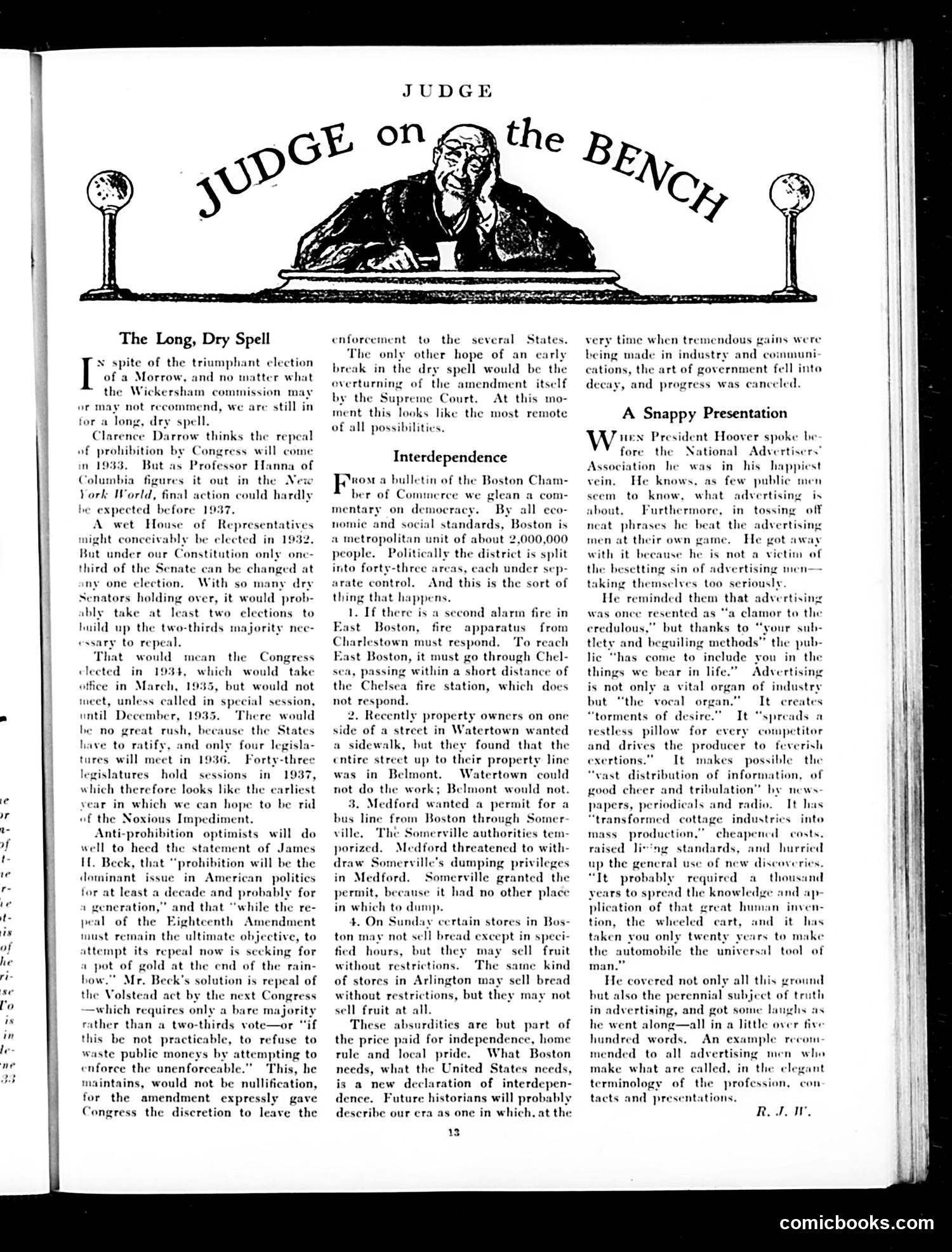
A restored page from Judge, 1930-12-13. Page through the whole issue in the reader above.
📄 Transcribed text from this page (OCR, searchable)
Machine-transcribed from the original scan — historical spelling and the odd misread are preserved.
JUDGE ] The Long, Dry Spell enforcement to the several States. very time when tremendous gains were | The only other hope of an early — being made in industry and communi spite of the triumphant election jreak in the dry spell would be the cations, the art of government fell into of a Morrow, and no matter what overturning of the amendment itself decay, and progress was canceled. j by the Supreme Court. At this mo- ment this looks like the most remote A Snappy Presentation 1 of all possibilities. the Wickersham comtission may not recommend, we are still in for a long, dry spell. Clarence Darrow thinks the rep, orm a Tuex President Hoover spoke be of prohibition by Congress will com fore the National Advertisers’ 1 1933. But as Professor Hanna of Interdependence Association he was in his happiest Columbia figures it out in the New F\woxta bulletin of the Boston Cham- vein. He knows, as few publie men York World, final action could hardly ber of Commerce we glean a com- seem to know, what advertising is he expected before 1937. mentary on democracy. By all eco- about. Furthermore, in tossing off t the advertisir ame. He got ase he is not a victim of he A wet House of Representatives nomic and social standards, Boston is neat phrases. he might conceivably be clected in 1932, a metropolitan unit of about 2,000,000 — men at their own But under our Constitution only one- people. Politically the district is split. with it bee: third of the Senate can be changed at » forty-three areas, each under sep- the besetting sin of advertising men ny one election. With so many dry control, And this is the sort of — taking themselves too seriously. Senators holding over, it would prob- thing that happens. He reminded them that advertising bly take at least two elections to - If there is a second alarm fire in was once resented as “a clamor to the huild up the two-thirds majority nec- E i Boston, fire apparatus from credulous,” but thanks to “your sub- essary to repeal. Cc cha irlestown must respond. To reach — tlety and beguiling methods” the pub- at would mean the Congress st Boston, it must go through Ch lic “has come to include you in the cleeted in) 1934, which would te sea, passing within a short distance of — things we bear in life.” Advertising ce in March, 1935, but would not the Chelsea fire station, which does is not only a vital organ of industry | | meet, unless called in special session, not respond. but “the vo It creates } 2 until December, 1 There would Recently property owners on one “torments of ¢ It “spreads a he no great rush use the States side of a street in Watertown wanted — restless pillow f0F every competitor | have to ratify, and only four legisla- a sidewalk, but they found that the and drives the producer to feverish tures will meet in 1936. Forty-three entire street up to their property line exertions.” It) makes possible the | legislatures hold sessions in 1937, was in Belmont. Watertown could “vast distribution of information, of | which therefore looks like the earliest not do the work; Belmont would not. good cheer and tribulation” by news i e sear in which we can hope to be rid 3. Medford wanted a permit for a papers, periodicals and radio. It has | is of the Noxious Impediment. tus ‘line from Boston through ansformed cottage industries inte { - Anti-prohibition optimists will do ville, Thi Somerville authorities tem- mass production,” cheapencid costs. af well to heed the statement of James porized. Medford threatened to with- ised living standards, and hurried t that “prohibition will be the draw Somerville’s dumping privileges up the gencral use of new discov le nt issue in Amer thousand n polities in Medford. Somerville granted the “It probably required at least a decade and probably for permit, because it had no other place rs to spread the knowledge and ap te 1 generation,” and that “while the re- in which to dump. plication of that great human inven- t- al of the Eighteenth Amendment +. On Sunday certain stores in Bos- tion, the wheeled cart, and it has | Ly must remain the ultimate objective, to | ton may not sell bread except in speci- taken you only twenty years to make of ittempt its repeal now is sccking for fied hours, but they may sell fruit the automobile the universal tool of he 1 pot of gold at the end of the rain- without restrictions. The same kind — man.” ri how.” Mr. Beck’s solution is repeal of of stores in Arlington may sell bread He covered not only all this ground s¢ the Volste: without restrictions, but they may not — but also the perennial subject of truth 'o —which requires only a bare majority — sell fruit at all. in advertising, and got some lat is rather than a two-thirds vote—or “if These absurdities are but part of — he went along—all in a little over five in this be not practicable, to refuse to the price paid for independence, home hundred words. An example recom le waste public moneys h rule and local pride. What Boston mended to all advertising men who ne | enforce the unenforces needs, what the United States needs, make what are called, in the elegant maintains, would not be nullification, is a new declaration of interdepen- terminology of the profession, con for the amendment expressly gave dence. Future historians will probably — tacts and presentations, Congress the discretion to leave the be our cra as one in which, at the 13 RIL, | comicbooks.com